In short
TechCrunch Disrupt 2026 will feature a Builders Stage session on AI defensibility, focusing on how startups can stay valuable when foundation model companies ship overlapping features. The discussion will bring together leaders from Airbyte, Webflow, and Radical Ventures in San Francisco this October.
- Foundation model updates are becoming a direct competitive threat to AI startups.
- Durable moats now center on proprietary data, embedded workflows, trust, and domain expertise.
- TechCrunch Disrupt 2026 will host a Builders Stage panel on AI defensibility in San Francisco.
- Investors are increasingly judging startups on whether they can survive the next model release.
- The strongest AI companies may be those that build around models, not just on top of them.
AI startups are being forced to confront an uncomfortable new reality: the biggest threat to their business may be the foundation model platform they build on, not a competing startup. That shift is now one of the defining strategic questions in the AI market, and it will take center stage at TechCrunch Disrupt 2026 in San Francisco this October.
The discussion matters because every major update from OpenAI, Anthropic, Google, and other model providers can turn a startup’s hard-won advantage into a native platform feature, reshaping product strategy, fundraising, valuations, and long-term company survival.
For years, startup competition was largely about speed, execution, and distribution. In today’s AI economy, founders must also anticipate whether the feature they are building could be absorbed into the next model release. That concern is helping redefine what defensibility means for artificial intelligence companies.
Why AI startup defensibility is changing so fast
The AI stack is moving at a pace that is difficult for startups to match. Foundation model companies are not only improving core model quality; they are also adding adjacent capabilities that can erase the gap between a standalone product and a platform feature.
That dynamic has raised a harder question for founders than the classic “build versus buy” debate: if the model provider can ship the same capability, how does a startup keep customers, pricing power, and investor confidence?
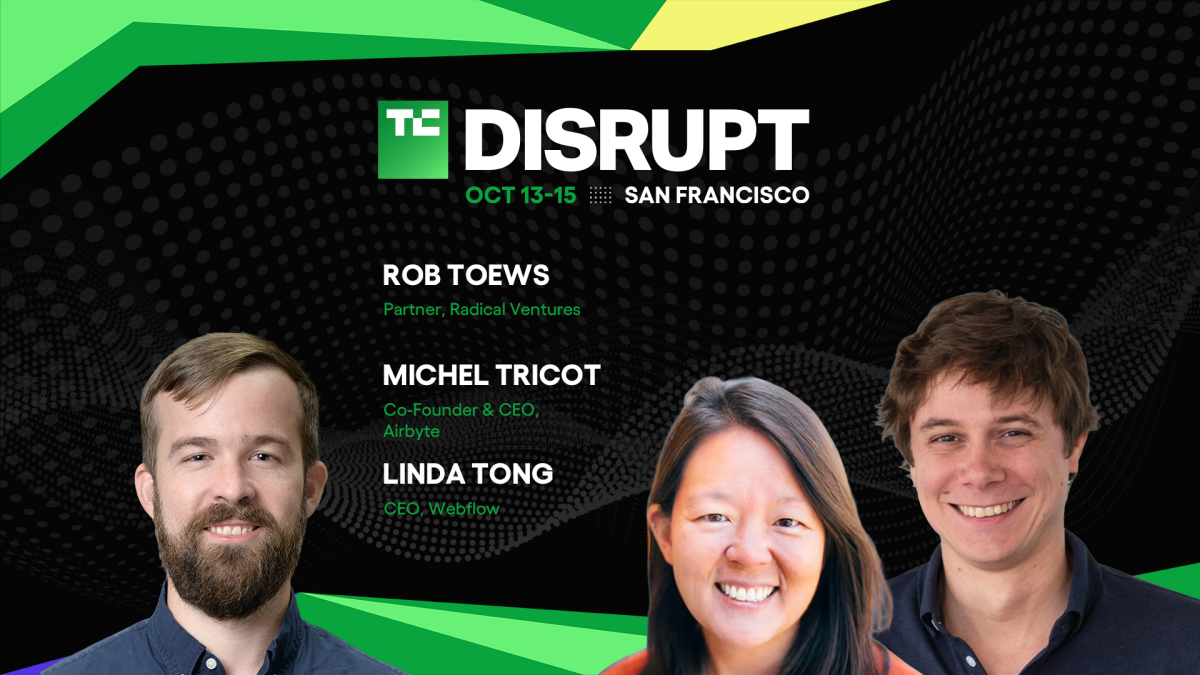
TechCrunch’s Builders Stage session titled “What Happens When OpenAI Ships Your Roadmap” is built around that question. The session will feature Airbyte CEO and co-founder Michel Tricot, Radical Ventures partner Rob Toews, and Webflow CEO Linda Tong at Disrupt 2026, which runs October 13–15 at Moscone West in San Francisco.
Disrupt is expected to draw more than 10,000 founders, investors, and operators for over 250 sessions focused on the forces changing how startups are built and scaled.
What happens when a platform turns your product into a feature?
What happens is that the startup must quickly prove it is more than a thin wrapper around someone else’s technology. If the core value proposition can be replicated inside a model interface, the startup risks becoming a short-lived add-on rather than a durable company.
That is why AI founders are now thinking less about isolated product features and more about durable moats. In practice, those moats often come from areas that large model makers cannot easily duplicate without significant time, customer trust, or industry specialization.
- Proprietary data that improves with usage
- Workflow integration that is difficult to replace
- Deep customer relationships built over time
- Industry expertise in regulated or technical markets
- Trust and compliance for enterprise buyers
That framework is increasingly central to how investors evaluate whether an AI startup can survive the next round of model upgrades.
How founders are rethinking AI defensibility
How founders are responding is by moving up the value chain. Instead of asking whether they can ship a clever demo, many are asking whether they can own a workflow, a dataset, or a business-critical system that remains valuable even after the next model release.
That change in thinking is not just philosophical. It affects product roadmaps, capital allocation, hiring, partnerships, and even whether a company should position itself as infrastructure, application software, or a domain-specific platform.
For investors, the calculus has also changed. A startup that once looked like an obvious breakout can look fragile if its main feature is too easy for a model provider to reproduce. Conversely, a company with embedded data, operational depth, and a loyal user base may be more valuable than its feature set suggests.
“The next generation of winners will not necessarily be defined by the smartest model,” the session’s framing suggests, but by the parts of the customer problem that the model itself cannot easily absorb.
Why data matters more than novelty
Why data matters is simple: model providers can move quickly on general capabilities, but they cannot easily recreate a startup’s proprietary operational data or the feedback loops generated by specific customers.
For companies in data infrastructure, enterprise software, healthcare, finance, manufacturing, and other workflow-heavy industries, that data can become the core of the moat. It improves products, strengthens switching costs, and makes the startup more valuable over time.
Why workflow ownership beats feature ownership
Why workflow ownership matters is that customers buy outcomes, not isolated functions. If a startup becomes part of a daily operational process, replacing it is more expensive than simply changing a setting in a model UI.
That is a major reason enterprise AI companies are pushing beyond novelty toward systems of record, systems of action, and specialized tools that sit inside business-critical processes.
Who is speaking at the Builders Stage session?
Who is speaking is as important as the topic itself. TechCrunch has assembled three voices with different vantage points on the AI market: a founder building infrastructure, an investor backing AI companies, and an operator leading a major software platform through a fast-changing market.
| Speaker | Role | Perspective on AI defensibility |
|---|---|---|
| Michel Tricot | CEO and co-founder, Airbyte | Builds data integration infrastructure and sees where durable value emerges beyond model capability |
| Rob Toews | Partner, Radical Ventures | Evaluates which startups have real moats and which risk becoming features |
| Linda Tong | CEO, Webflow | Leads a software company navigating product evolution and market pressure as AI changes expectations |
The session is designed to surface the practical questions founders are asking right now: What can be built that a model company is unlikely to ship tomorrow? Where does a startup’s leverage actually come from? And how should companies adapt when the market’s center of gravity keeps shifting?
Michel Tricot’s view from the infrastructure layer
Michel Tricot brings the perspective of someone building the plumbing beneath modern data and AI applications. Airbyte has grown into an open-source data integration platform used by more than 7,000 customers, including 18% of the Fortune 500, giving Tricot a direct view into enterprise demand and the value of deeply embedded systems.
In a market obsessed with model launches, infrastructure companies often have a clearer picture of what customers actually need to keep their businesses running. That includes data movement, reliability, governance, and the systems that connect AI products to real-world operations.
Linda Tong’s perspective from the SaaS front line
Linda Tong offers a view from the software application layer, where AI can both enhance and threaten existing products. As CEO of Webflow, she is leading a visual development platform through a period when customers expect smarter automation while still demanding ease of use, reliability, and differentiation.
Her background at Google, Cisco, and the NFL adds an operator’s understanding of scale, product transitions, and changing user expectations. That combination makes her perspective especially relevant to SaaS founders wondering how to evolve without being displaced by a platform update.
Rob Toews on what investors are really looking for
Rob Toews approaches the problem from the capital side. As a partner at Radical Ventures, he is in a position to assess AI startups across the market and identify which ones are building something defensible enough to matter several years from now.
For investors, the key question is no longer simply whether a startup can ride the AI wave. It is whether the company has built a durable position that can survive the next wave of model improvements, market consolidation, and platform expansion.
What makes an AI company durable in 2026?
What makes an AI company durable in 2026 is less about model access and more about strategic positioning. The best companies are likely to be those that create value around the model rather than depending entirely on it.
That can include owning a vertical market, controlling critical data flows, or delivering a workflow that customers rely on every day. It can also mean becoming difficult to rip out because the product is tied to internal processes, institutional knowledge, or compliance requirements.
Below is a simplified view of how startup value is shifting:
| Older AI startup advantage | Newer defensibility test | Why it matters |
|---|---|---|
| First-mover novelty | Embedded workflow value | Novelty fades; workflow dependence lasts |
| Model access | Proprietary data | Data can improve over time and resist copying |
| Feature speed | Customer trust | Trust is harder for large platforms to displace quickly |
| General-purpose use case | Domain expertise | Specialization can be more defensible than breadth |
That shift does not mean startups should avoid building on foundation models. It means they need to understand where their real control lies.
How investors are separating features from businesses
How investors are separating features from businesses comes down to whether the product can survive platform compression. If a startup’s core function can be copied by a model vendor, the company’s economic future may be limited unless it has additional layers of value.
Investors are therefore looking for stronger evidence of durability: customer retention, usage depth, enterprise penetration, differentiated data, and meaningful switching costs. In some cases, they are also paying more attention to whether the startup is becoming a platform itself rather than merely relying on one.
That has implications for fundraising. Founders must tell a story not just about growth, but about why their product remains relevant when foundation models improve. The pitch is increasingly about resilience, not just capability.
Why this debate matters beyond startups
Why this debate matters beyond startups is that it affects the direction of the entire AI economy. If model companies continue absorbing adjacent features, the market could consolidate around a smaller set of platforms and a much larger set of companies that must find their place above or around them.
That pressure is likely to reshape competition across enterprise software, data infrastructure, consumer AI, and vertical applications. It could also alter valuations by making investors more cautious about products that appear easy to reproduce.
In practical terms, that means founders have to be more disciplined about where they invest time and capital. Not every useful feature is worth building if the platform can release it in six months. The challenge is to identify the parts of the user problem that are most resistant to commoditization.
For many startups, the answer will involve moving closer to the customer, not the model. The deeper the relationship with the customer’s workflow, the harder it becomes for a platform to simply absorb the product.
What TechCrunch Disrupt 2026 is trying to surface
What TechCrunch Disrupt 2026 is trying to surface is a realistic playbook for founders building in a market where the ground shifts every few months. The Builders Stage session is not about whether AI will continue to improve; that is assumed. It is about what kind of companies can remain valuable as that improvement continues.
TechCrunch says the event will bring together thousands of attendees for panels, product conversations, and networking across the startup ecosystem. The session on AI defensibility sits squarely in the center of one of the industry’s most pressing strategic debates.
For founders, the lesson is blunt: shipping fast is no longer enough if the underlying platform can outship you. The companies that last will likely be those that build beyond the model, not just on top of it.
Key dates and details
For readers tracking the event, here are the most important details in one place.
| Item | Details |
|---|---|
| Event | TechCrunch Disrupt 2026 |
| Session | What Happens When OpenAI Ships Your Roadmap |
| Stage | Builders Stage |
| Dates | October 13–15, 2026 |
| Venue | Moscone West, San Francisco |
| Attendees | 10,000+ founders, investors, and operators |
| Sessions | 250+ across the event |
| Discount deadline | September 25, 2026 |
| Exhibit table deadline | September 18, 2026 |
TechCrunch is also encouraging attendees to register early for a discounted pass and noting that exhibit table booking is time-sensitive. The event has positioned itself as a major gathering point for startup decision-makers trying to understand where the market is heading next.
The bottom line for AI founders
The bottom line is that AI startups are no longer only competing with one another; they are competing with the companies that power the models underneath them. That makes defensibility one of the most important questions in the sector right now.
The startups most likely to endure will be those that can point to more than an impressive interface or a clever demo. They will need proprietary data, customer loyalty, embedded workflows, and a business reason to exist even after the next foundation-model update.
That is why the TechCrunch Disrupt 2026 session is timely. It captures the new reality of AI entrepreneurship: the toughest competitor may be the platform you rely on, and the most valuable startups may be the ones that learn how to build beyond it.
Editor’s note: This article is based on information about the TechCrunch Disrupt 2026 Builders Stage session and the broader strategic debate around AI defensibility.
Frequently asked questions
What is the main issue facing AI startups today?
The main issue is that foundation model companies can turn a startup’s core feature into a platform feature. That means founders must prove they are building something with lasting value, not just a temporary advantage that a model update can copy or absorb.
When and where is TechCrunch Disrupt 2026 taking place?
TechCrunch Disrupt 2026 is scheduled for October 13–15, 2026, at Moscone West in San Francisco. The event is expected to bring together more than 10,000 founders, investors, and operators for hundreds of sessions on the startup market.
Who is speaking in the AI defensibility session?
The session features Michel Tricot of Airbyte, Rob Toews of Radical Ventures, and Linda Tong of Webflow. Together, they represent the founder, investor, and operator perspectives on how AI companies can remain durable as the market evolves.
Why does AI defensibility matter for investors?
AI defensibility matters because investors want startups that can survive beyond the next model release. If a product can be easily copied by OpenAI, Anthropic, Google, or another platform, its long-term value and pricing power may be limited unless it has stronger moats.
How can an AI startup stay competitive against platform companies?
An AI startup can stay competitive by owning proprietary data, embedding itself in customer workflows, building domain expertise, and earning trust. Those advantages are harder for large platform companies to replicate quickly than a simple feature or interface.