In short
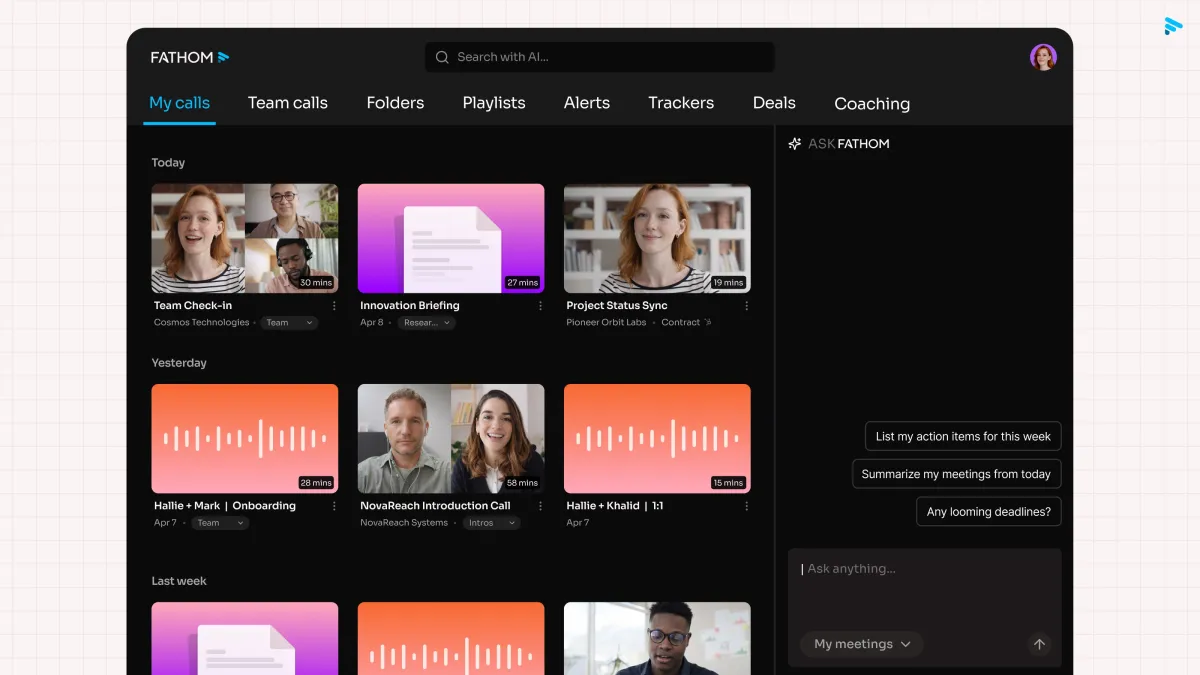
Superhuman has acquired Fathom, a Y Combinator-backed meeting notetaker, to deepen its AI productivity platform and build more agentic workflows. The deal gives Superhuman a proven product, a large user base, and a stronger route to turning meeting context into automated action.
- Superhuman acquired Fathom instead of building its own notetaker.
- Fathom brings more than 400,000 monthly active users and over 1 million recorded meetings.
- The move supports Superhuman’s push toward AI that can act on meeting context.
- Competition in the meeting intelligence market is intensifying.
- The deal underscores a broader shift from note capture to agentic workflow automation.
Superhuman has acquired Y Combinator-backed meeting notetaker Fathom as it pushes deeper into agentic productivity software, a move that could help the company turn meeting conversations into automated follow-up work. The deal matters because it gives Superhuman an established notetaking product, a large user base, and a better path to building AI that can act on meeting context in real time.
The acquisition, announced on September 14, 2026, reflects a wider shift in productivity software: companies are no longer trying only to help users write prompts and automate narrow tasks, but to build systems that can notice what is happening in a meeting and start work on their own. That ambition has made meeting intelligence a strategic battleground for startups and established platforms alike.
Why Superhuman wanted a notetaker instead of building one from scratch
Superhuman had already been experimenting with the category internally, but the company ultimately concluded that creating a polished notetaker was more difficult than it first appeared. Rather than spend more time rebuilding a mature product, it chose to acquire Fathom and fold it into a broader suite that already includes email, documents, calendar tools, a database product, and an AI agent builder.
According to CEO Shishir Mehrotra, the company’s internal tests made one thing clear: demand for the category is real, but the technical work behind it is more substantial than users may realize.
Mehrotra said Superhuman’s experiments increased confidence that people want meeting intelligence, but also showed how hard it is to do note capture, transcription, summarization, and related tasks well across the board.
That combination of user demand and engineering complexity appears to be what pushed Superhuman toward buying rather than building. In practice, an acquisition can shorten the distance between a promising idea and a product that can be deployed at scale.
What Fathom brings to Superhuman
Fathom enters the deal with an active product, a recognizable brand in AI meeting notes, and traction that many startups would envy. Founded in 2020, the company has raised more than $30 million, reached a valuation of $94 million in 2024, and grown to more than 400,000 monthly active users thanks in part to a free plan that has broadened adoption.
The company also says users have recorded more than 1 million meetings through its software. That usage gives Superhuman immediate access to a sizable stream of meeting data, product feedback, and workflow patterns that can help improve downstream AI features.
Fathom’s backers include Zoom Apps Fund, Telescope Partners, BoxOne Ventures, and Maven Ventures. Its cap table also includes several high-profile individual investors, among them Reddit chief executive Steve Huffman, former Twitch chief executive Emmett Shear, and Cruise co-founder Kyle Vogt.
How the deal fits Superhuman’s AI strategy
Superhuman’s broader goal is to make AI more proactive. Instead of waiting for a user to enter instructions, the company wants its software to interpret context, identify what needs to happen next, and initiate that work automatically.
Meetings are a natural source of that context. They contain action items, decisions, deadlines, follow-up commitments, and signals about priorities. A notetaker can capture all of that, but a more ambitious platform can use the information to trigger tasks across email, calendars, databases, and AI agents.
That is where Superhuman’s existing product line becomes important. With Fathom integrated, the company can imagine a workflow in which a meeting note automatically becomes a draft email, a calendar invite, a database update, or a task assigned to an AI agent.
In other words, the acquisition is not just about recording meetings. It is about making meetings the control point for a larger automation layer.
How big is the meeting notetaker market?
The meeting intelligence market has become crowded because it sits at the intersection of a clear user pain point and a strong AI use case. Businesses want better records of what was said in meetings, but the real commercial opportunity lies in converting those records into action.
That opportunity has attracted a wave of well-funded competitors, including Granola, Read AI, and newer entrant Wispr. Even companies that have already built strong user bases are under pressure to expand beyond basic transcription and summaries into more valuable workflow automation.
Below is a snapshot of the main players and dynamics shaping the category.
| Company | Known for | Recent signal | Strategic challenge |
|---|---|---|---|
| Fathom | AI meeting notes and recording | Acquired by Superhuman | Moving beyond standalone notetaking |
| Granola | Meeting notetaking | Raised millions for growth | Competing on product depth and distribution |
| Read AI | Meeting intelligence and summaries | Raised millions for expansion | Proving value beyond recap features |
| Wispr | New meeting-product entrant | Has attracted venture funding | Standing out in a crowded market |
What Superhuman gets from distribution
Distribution may be the most important part of the acquisition. Fathom’s chief executive, Richard White, said Superhuman’s scale gives the notetaker a chance to reach far more users than it could as an independent company.
White argued that Superhuman’s reach is huge and said distribution was central to the logic of the transaction. He added that a standalone Fathom would have had to recreate capabilities that already exist inside Superhuman’s broader platform.
That comment points to one of the most common reasons software companies acquire smaller products: the buyer already has the channels, customer relationships, and product architecture to make the acquired tool more useful faster than a standalone startup can.
Superhuman says it already serves roughly 40 million users. Plugging a notetaker into that ecosystem could dramatically expand the surface area for AI-assisted work, particularly if meeting data can flow directly into existing communications and planning tools.
How distribution can change the product economics
Distribution can be as valuable as product features because it lowers customer acquisition costs and increases the chances of cross-selling. If Fathom’s users can be introduced to Superhuman’s email, calendar, docs, and database products, the company can build a more integrated workflow business rather than rely on a single utility app.
That matters in a market where many tools look similar at the surface level. When features converge, scale, trust, and bundling often determine the winners.
What the acquisition says about agentic work
The deal is also a sign that “agentic” software is moving from concept to product design principle. In this model, the software does not simply assist the user; it reacts to signals, makes recommendations, and takes steps on the user’s behalf.
Meeting content is especially valuable for this shift because it is already a source of structured business intent. A project deadline mentioned in a call can become a reminder, a client request can become a draft response, and a decision can become a database entry. The notetaker is the bridge between human conversation and automated execution.
That is why productivity platforms are racing into the space. If they can own the meeting layer, they can potentially own the workflow that follows it.
How the workflow could work in practice
Superhuman’s vision suggests a pipeline in which the product first captures what happened in a meeting, then identifies action items, then routes those items into the right application. A customer question might turn into a follow-up email. A sales update might revise a record in a database. A team decision might generate a task for an AI agent.
That approach could make meetings less of an endpoint and more of a starting point for work automation. It also makes the notetaker a strategic asset rather than a standalone feature.
- Meeting content is captured and summarized.
- Action items are extracted in real time.
- Follow-up tasks are routed into email, calendar, or docs.
- AI agents can start work without manual prompting.
Why investors are paying attention
Meeting tools have become attractive to investors because they sit close to everyday business behavior and can often prove value quickly. Users immediately understand what they do, and companies can expand them into broader revenue-generating workflows.
At the same time, the category is difficult to defend on transcription alone. As a result, venture-backed players are under pressure to either deepen their products or find a larger platform to support growth. That market pressure likely made Fathom receptive to a deal with a company that can offer scale and adjacent functionality.
The broader signal is that AI productivity software is consolidating around platforms that can combine capture, action, and distribution. The standalone note app still has room to exist, but it may no longer be enough on its own.
Timeline of Fathom and the acquisition
The path to the deal spans several years of product development, fundraising, and category growth. This timeline highlights the main milestones mentioned in the announcement.
| Year | Event | Why it mattered |
|---|---|---|
| 2020 | Fathom is founded | Enters the meeting notetaking market early in the AI wave |
| 2024 | Company valued at $94 million | Shows investor belief in the category |
| 2026 | Superhuman tests internal notetaker | Signals strategic interest in the product area |
| September 14, 2026 | Superhuman acquires Fathom | Moves the startup into a broader agentic productivity platform |
What happens next?
The immediate next step is integration. Superhuman will need to connect Fathom’s meeting capture and summarization capabilities with its own products so that data can move cleanly across the platform. If that works, the combined company could offer a more complete workflow from meeting to action.
It is also likely that Superhuman will continue refining how its AI systems surface meeting context in real time. Mehrotra hinted that the company sees value in pulling relevant information out of conversations while they are happening, not only after the meeting ends.
That would place Superhuman in a stronger position to compete in a market where the most valuable products are likely to be the ones that do more than document work. The winners may be the platforms that can understand work as it happens, then help complete it.
Why this acquisition matters for the productivity software race
Superhuman’s purchase of Fathom is not just a startup M&A story. It is evidence that productivity software is evolving from passive assistance to active orchestration. The companies that can combine communication tools, scheduling, databases, and AI execution may become the next generation of workplace infrastructure.
Fathom brings user traction, meeting intelligence, and engineering expertise. Superhuman brings distribution, a broader product suite, and a clear ambition to make AI act on behalf of users. Together, the companies are betting that meetings will become the primary feedstock for agentic work.
If that bet pays off, the acquisition could prove to be an important early move in the race to build software that does not just record what happened, but starts what comes next.
Frequently asked questions
Why did Superhuman acquire Fathom?
Superhuman acquired Fathom to accelerate its move into AI-powered productivity and agentic workflows. Rather than spend more time building a notetaker internally, the company chose to buy a mature product with users, technology, and a head start in meeting intelligence.
How many users does Fathom have?
Fathom has more than 400,000 monthly active users, according to the company. It also says people have recorded more than 1 million meetings with the product, which gives Superhuman a meaningful base to build from after the acquisition.
What will Superhuman do with Fathom?
Superhuman is expected to integrate Fathom into its broader suite so meeting notes can feed into email, calendars, documents, databases, and AI agents. The long-term goal is to turn meeting context into real-time action and follow-up automation.
Who competes with Fathom in meeting notetaking?
Fathom competes with other AI meeting tools such as Granola, Read AI, and Wispr. The market is crowded, and many players are trying to move beyond transcription into more valuable workflow and automation features.
How much funding has Fathom raised?
Fathom has raised more than $30 million since it was founded in 2020. PitchBook data cited in the report values the company at $94 million in 2024, reflecting investor interest in meeting intelligence software.