Updated September 1, 2026 8:24 pm
In short
Amazon’s new Alexa shopping alerts can now nudge users about relevant launches and releases, and the company is hinting at a future where alerts may be suggested or created more automatically as part of a broader AI shopping toolkit.
- Update Me When sends personalized alerts tied to shopping-relevant events and launches.
- The feature extends Alexa from reactive answers to proactive purchase prompts.
- Amazon is bundling the tool with price tracking, deals, guides and other AI shopping features.
- The rollout suggests Amazon wants AI to anticipate consumer intent, not just respond to it.
Update — September 1, 2026 8:24 pm
Amazon also says Alexa shopping alerts could become more automatic over time. While people must set up Update Me When themselves for now, the company is already floating a future in which it may suggest alerts or generate them on shoppers’ behalf as they browse.
TechCrunch also notes that Amazon’s shopping AI now stretches beyond alerts and price tracking. Other tools include personalized deals, shopping guides, cart-building from past purchases, price-history tracking, AI summaries on product pages, handwritten list transcription, and item comparison features.
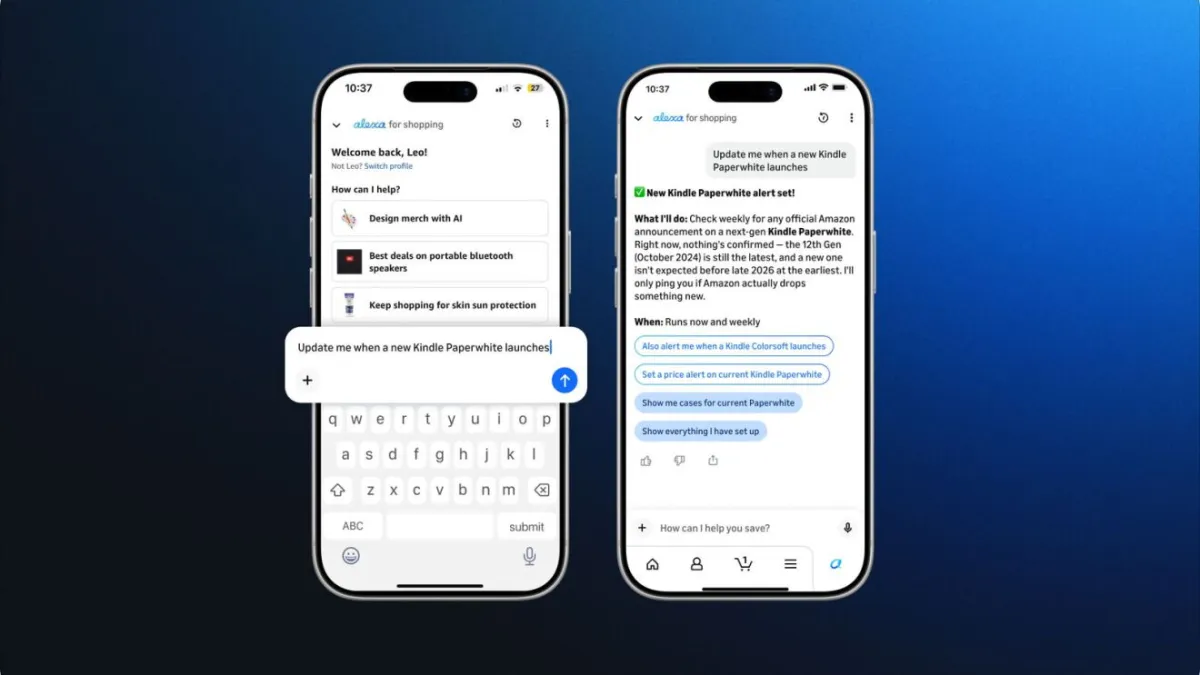
Amazon has added a new Alexa for Shopping feature called Update Me When that sends personalized alerts when something relevant happens that could prompt a purchase. The move, announced Tuesday, pushes Alexa further from a reactive helper into a proactive shopping assistant at a time when Amazon is increasingly using AI to anticipate what customers may want next.
The new tool matters because it expands Alexa’s role beyond answering questions or tracking prices. Instead of waiting for shoppers to ask about a product, Amazon now wants the assistant to surface timely prompts around launches, releases, tours, and other events that may trigger buying interest.
Amazon’s shopping AI has been evolving quickly, and this latest release gives a clearer view of where the company is heading: toward a more personalized, always-on retail layer that can track customer interests and surface purchase opportunities before users begin searching on their own.
What is Update Me When?
Update Me When is a notification feature inside Alexa for Shopping that lets users subscribe to alerts tied to topics, brands, and entertainment or product releases they care about. Amazon says the idea is to notify people when something new or relevant happens that could influence a buying decision.
Examples include a favorite brand unveiling a new product line, an artist announcing a concert tour, a new season of a TV show arriving, an author publishing a new book, or a tech company launching a fresh device.
The practical effect is simple: Alexa can now act like a shopping scout, watching for moments that might be worth attention even if the customer is not actively searching.
How does the feature work?
It works as a user-configured alert system. Consumers must set up the notifications themselves for now, rather than having Alexa infer every possible interest automatically.
Once enabled, the assistant can send updates when a subscribed topic changes in a way that may matter to the user. Amazon has not positioned it as a general news alert tool; it is specifically framed as a shopping-oriented feature.
That distinction is important. The goal is not simply to keep users informed, but to connect those updates to a possible purchase.
Why Amazon is pushing Alexa deeper into shopping
Amazon has spent years turning Alexa into a retail companion, and this rollout is the latest sign that the company sees AI as a way to increase both convenience and buying frequency. Historically, Alexa mostly responded after someone asked a direct question. The new approach is more predictive.
Rather than waiting for a shopper to say, “What’s new from this brand?” Amazon wants Alexa to infer that a new release, upcoming event, or seasonal update might be relevant enough to prompt action.
That shift matters because it moves Alexa from a retrieval tool into a discovery engine. For Amazon, discovery is valuable: the easier it is to surface a product or event at the right moment, the more likely a user is to engage — and potentially buy.
Amazon’s broader message is that AI should not just answer shopping questions, but help anticipate them, surfacing reminders and recommendations before a customer starts a search.
What this says about Amazon’s AI strategy
The feature underscores a broader change in Amazon’s AI playbook. The company is no longer using generative tools only to summarize listings or respond to queries. It is increasingly building systems that can monitor preference signals, infer relevance, and nudge users toward the next action.
That has implications well beyond Alexa. It suggests Amazon sees AI as a service layer that can unify search, recommendations, price monitoring, carts, and notifications into one shopping workflow.
In other words, Amazon is not just trying to make shopping faster. It is trying to make shopping more anticipatory.
Which Alexa shopping tools already exist?
Amazon already offers several AI-driven shopping functions inside Alexa and related product pages. The newest alert system builds on a stack of features that includes price tracking, automatic purchase triggers, personalized deals, and product comparison tools.
For customers, these features are designed to reduce friction. For Amazon, they also deepen engagement and create more reasons to return to the app or assistant.
| Alexa shopping feature | What it does | Why it matters |
|---|---|---|
| Update Me When | Sends alerts when a subscribed product, brand, show, book, tour, or launch becomes relevant | Prompts discovery before a shopper actively searches |
| Price tracking | Notifies users when an item hits a chosen price or discount level | Helps shoppers time purchases around deals |
| Auto-buy option | Can purchase an item automatically if it reaches a preset condition | Turns alerts into instant conversion |
| Personalized deals | Surfaces promotions tailored to the user | Improves relevance and conversion potential |
| AI shopping guides | Builds guides and suggests products from browsing and purchase history | Supports product discovery and comparison |
How does this change the shopping experience?
It changes shopping from reactive to proactive. Instead of relying only on manual searches or direct questions, Alexa can now push context-based reminders that align with user interests.
That may feel useful for consumers who follow specific brands, artists, authors, or tech companies. It could also save time by surfacing launches and releases at exactly the point when they matter most.
For example, a user following a particular phone maker could receive an alert when the company unveils a new device. A fan of a television series could be notified when the next season goes live. A reader could be told when a new title from a favorite author is available.
Why shoppers may like it
- It reduces the need to keep checking product or entertainment pages manually.
- It can help users act quickly on launches or limited-time opportunities.
- It centralizes updates inside one assistant already tied to shopping behavior.
- It may improve deal timing by pairing alerts with price or release changes.
Why it may also raise questions
The same system that makes shopping easier could also make Amazon’s influence feel more persistent. A feature that surfaces “relevant” events can be useful, but it can also blur the line between helpful reminders and commercial nudging.
Because the alerts are tied to shopping intent, Amazon may be able to shape when and how users are reminded about products or brands they care about. That makes the feature powerful, but also strategically important.
How does Update Me When fit into Amazon’s broader AI push?
It fits as one piece of Amazon’s attempt to make AI useful across the full shopping journey. The company is steadily adding AI capabilities that affect discovery, evaluation, purchase timing, and post-search support.
Amazon has already used AI to create product summaries and overviews on search results and item pages, build carts from past purchases, compare products, transcribe handwritten shopping lists, and help users track pricing history. Update Me When extends that logic into notifications.
That matters because notifications are high-value real estate. If Amazon can occupy the moment before a purchase decision is made, it can influence the entire conversion funnel.
From search assistance to intent prediction
The shift is subtle but significant. Earlier versions of Alexa shopping tools were mainly about answering known questions: Is this item in stock? Has the price dropped? What do these two products differ on?
Update Me When suggests a newer model: identify what the customer may care about, then prompt them at the right time. That is closer to intent prediction than simple assistance.
In practical terms, this is where AI shopping becomes most commercially valuable. The more Amazon can anticipate interest, the fewer steps there are between awareness and purchase.
What are the implications for brands and creators?
Brands, publishers, and entertainers could all benefit if Amazon’s alerts become widely adopted. A release, launch, or announcement may now find consumers through a new channel inside Alexa, not just through social media or email.
For companies launching products, this could become another avenue to reach existing fans. For artists, authors, and streaming platforms, it could offer a way to convert interest into immediate action when a new season, tour, or title drops.
There is also a competitive implication. If Amazon can become the place where consumers first hear about shopping-relevant updates, it gains more control over discovery than retailers that only respond to searches.
Potential use cases
- Fans subscribe to alerts for a favorite brand’s next release cycle.
- Shoppers monitor a product category and receive launch notifications.
- Entertainment followers get updates for album, book, show, or tour announcements.
- Deal-seekers pair alerts with price thresholds and auto-buy conditions.
What does this mean for Alexa itself?
It suggests Alexa is being repositioned as a shopping-first AI assistant with predictive capabilities. That is a notable evolution for a product that originally became famous as a voice assistant for simple tasks like timers, weather checks, and smart-home control.
Over time, Alexa has had to justify its place in Amazon’s ecosystem. Shopping has always been one of its strongest commercial roles, and AI gives Amazon a fresh way to make that role more compelling.
By adding tools like Update Me When, Amazon can make Alexa feel less like a passive assistant and more like an active retail advisor. That may be particularly important as consumers become more comfortable with AI systems that summarize, recommend, and even take actions on their behalf.
Amazon’s latest shopping tools show a clear attempt to make Alexa more useful before a customer starts looking, not just after they ask.
How new is this idea in retail AI?
The concept is not entirely new, but Amazon is applying it at consumer scale inside a mainstream shopping assistant. Retailers have long used recommendation engines, alerts, and loyalty-triggered messages to influence purchases. Amazon’s advantage is that it can combine those tactics inside a voice assistant linked to a massive commerce platform.
What distinguishes this launch is not the basic idea of notifying customers. It is the integration of that idea with Alexa, Amazon’s product catalog, shopping history, pricing tools, and AI-generated guidance.
That integration could make the feature more useful than a standalone app notification, because it sits inside an environment where users can search, compare, and buy with limited friction.
What happens next?
The most likely next step is broader automation and smarter suggestion prompts. Amazon is already hinting at a future where the assistant could do more than wait for people to configure alerts manually.
Today, shoppers must opt in and define what they want to track. In the future, Amazon may start recommending alerts based on browsing behavior, purchase history, or interest patterns. It could even generate alerts automatically if it believes a product launch or release aligns with a user profile.
If that happens, Alexa would move closer to a fully personalized commerce assistant — one that not only responds to what you ask, but also proposes what you may want before you know to ask.
Amazon’s AI shopping rollout at a glance
Here is a concise timeline of the shopping features discussed in Amazon’s latest update:
| Feature | Status | Primary function |
|---|---|---|
| Price alerts | Existing | Notify users when items hit target prices or discounts |
| Auto-buy on trigger | Existing | Automatically purchases items under preset conditions |
| Personalized deals | Existing | Recommends discounts tailored to shoppers |
| AI shopping guides | Existing | Creates helpful buying guides and comparisons |
| Update Me When | New | Alerts users to launches, releases, and other purchase-triggering events |
Why this launch matters beyond one Alexa feature
Because it offers a window into how Amazon thinks AI will drive commerce over the next few years. The company is betting that the future of shopping is not just faster search, but smarter anticipation.
If Amazon gets this right, shoppers may rely on Alexa not only for reminders about prices, but also for prompts about the very existence of things they might want to buy. That is a meaningful change in consumer behavior and a potentially powerful advantage for Amazon’s retail business.
As AI becomes more deeply embedded in commerce, features like Update Me When may seem small on the surface. But strategically, they are part of a much larger effort to turn assistants into decision-shaping tools.
For Amazon, the message is clear: the shopping assistant should not simply wait for the customer to arrive. It should help decide when the customer should care.
Frequently asked questions
What is Amazon’s Update Me When feature?
It is a new Alexa for Shopping alert tool that notifies users when something relevant happens, such as a product launch, book release, concert announcement, or new TV season, if that event could influence a purchase decision.
How does Alexa shopping price tracking work?
It lets shoppers set a target price or discount threshold for a product, then alerts them when the item reaches that condition. In some cases, Amazon says the assistant can even complete the purchase automatically if the user has enabled that option.
Why is Amazon adding more AI to Alexa shopping?
It is adding AI to make Alexa more predictive and commercially useful. Instead of only answering questions after a user asks, Amazon wants the assistant to surface timely prompts, improve discovery, and increase the chances of a purchase.
Do users have to turn on Update Me When themselves?
Yes. Amazon says shoppers currently need to configure the alerts directly. The company could later make the system more automated or suggest alerts based on browsing and shopping behavior, but that is not how it works at launch.