In short
Smallest.ai raised $13 million in Series A funding to build a voice AI system that responds in real time and sounds more human than current agents. The startup is betting that specialized speech models, not larger LLMs, will power the next generation of enterprise voice assistants.
- Smallest.ai closed a $13 million Series A led by Seligman Ventures.
- The startup is building a low-latency voice model for real-time conversations.
- Its system uses a small voice model for live interaction and a larger LLM for complex tasks.
- Current customers include RingCentral and Truecaller, with customer support startups also in its sights.
- The company is competing with ElevenLabs, Cartesia and other voice AI players.
Smallest.ai has raised $13 million in Series A funding to build a voice AI system designed to respond so quickly and naturally that callers cannot tell they are speaking to a machine. The startup says its approach could reshape enterprise voice agents by combining a fast, humanlike speech model with a larger AI model used only when deeper reasoning is needed.
The round, announced on July 31, 2026, was led by Seligman Ventures with participation from Sierra Ventures and 3one4 Capital. It lifts Smallest.ai’s total funding to more than $21 million and gives the late-2024 startup more runway as competition intensifies in the race to make voice interfaces feel truly conversational.
At the heart of the company’s pitch is a simple but difficult promise: reduce the awkward pause that often gives away an AI agent’s identity. While many large language models can answer accurately, they typically wait to process a full request before speaking. In live conversation, that delay can make an interaction feel robotic. Smallest.ai says it is trying to solve that by building a smaller, specialized model that listens, thinks and talks in parallel, closer to how people actually communicate.
Why Smallest.ai thinks voice AI needs a different architecture
Smallest.ai believes the future of voice agents will not come from simply making larger models faster. Instead, the company argues that real-time voice requires a separate system built specifically for speech, conversation flow and low latency.
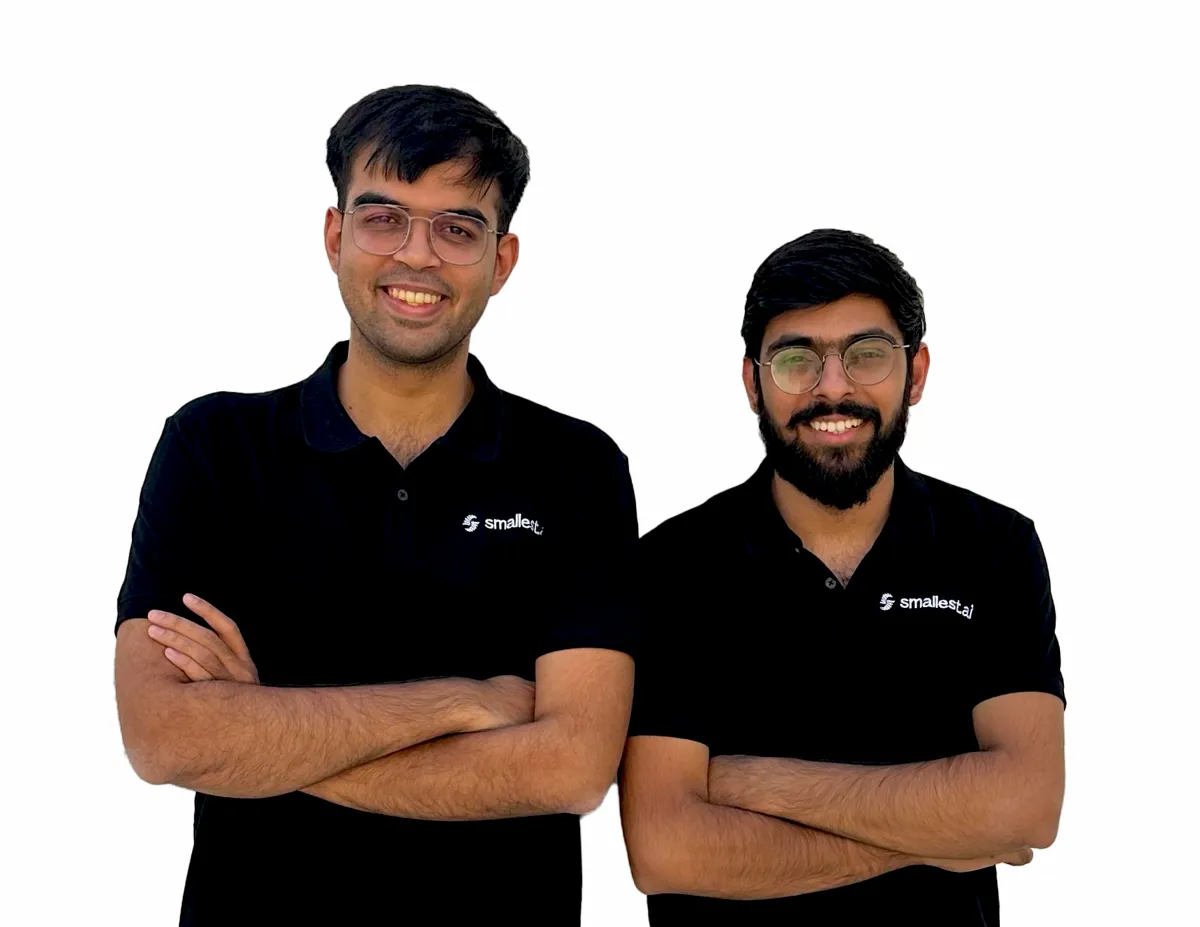
Founder and CEO Sudarshan Kamath says the company’s model is designed to behave more like a person in a live dialogue than a chatbot processing a text prompt. In a normal conversation, people often start planning their answer before the other person has finished speaking, and they may interrupt, pause, or adjust their response in real time. Smallest.ai wants its software to mirror that rhythm.
Kamath says the key design principle is conversational timing: a person speaking does not wait for an entire speech segment to finish before starting to think, and a useful voice agent should not behave that way either.
That distinction matters because voice customers care about more than accuracy. They want response speed, natural turn-taking, the ability to handle interruptions, and speech that sounds fluent across accents and environments. If a system is delayed by even a short pause, users often perceive it as artificial.
Kamath argues that text-based prompting works well for chat interfaces because users expect a pause between input and response. Voice is different. A phone call or live support conversation creates an expectation of immediate feedback, or at least the illusion of it. Smallest.ai is trying to build that illusion into the core of the product.
How does the company’s two-model approach work?
The company says its platform uses a small voice model as a real-time intelligence layer for routine, conversational tasks. When a customer asks something the small model cannot handle, the system can hand the issue off to a larger foundation model for deeper reasoning and research.
In practice, that means the voice agent can keep the conversation moving while still relying on a more powerful system behind the scenes when necessary. Smallest.ai likens the fallback process to a human support representative briefly placing a caller on hold to investigate a question before returning with an answer.
This hybrid setup reflects a broader view inside the startup that AI agents may evolve into two-part systems:
- a smaller, ultra-fast model for live interaction;
- an offline or background LLM used when more complex reasoning is required.
That model separation is central to Smallest.ai’s product strategy. The company is not trying to be a general-purpose chatbot platform. It is targeting the narrow but demanding problem of making spoken enterprise interactions feel immediate, natural and trustworthy.
What makes voice different from text?
Voice is different from text because human conversation depends on timing, not just content. People interrupt, overlap, pause for effect and react before an answer is fully formed. A text interface can tolerate a few seconds of silence. A phone call cannot.
That is why Smallest.ai is emphasizing latency as much as intelligence. The startup believes a voice agent that speaks smoothly and quickly will feel more human than a more capable model that hesitates before every answer.
What exactly is the startup building?
Smallest.ai is building voice infrastructure for enterprise customer conversations, with a focus on real-time spoken interactions rather than audio generation for media or entertainment.
The company says its system is tuned for voice-specific challenges such as:
- recognizing and responding to diverse accents;
- operating in noisy environments;
- supporting dozens of languages;
- maintaining low response delay during live calls.
Those details suggest the company is aiming at production use cases where reliability matters more than novelty. In customer support, sales, and service operations, a voice agent that sounds polished but struggles with noise, accent variation or timing is unlikely to win repeat business.
Smallest.ai’s broader message is that voice deserves its own technical stack. Rather than asking a giant language model to do everything, the startup is betting that specialized models will outperform generic systems for live speech.
Who is funding Smallest.ai?
The Series A round was led by Seligman Ventures, with Sierra Ventures and 3one4 Capital also joining the round. The new capital brings Smallest.ai’s total raised to more than $21 million since its founding in late 2024.
For a young startup still early in its commercial life, the funding is significant for two reasons. First, it provides resources to continue model development and enterprise deployment. Second, it signals that investors see meaningful market demand for real-time voice systems, even as the category becomes crowded.
Voice AI has become one of the more visible subsectors in artificial intelligence because it sits at the intersection of automation, customer experience and labor efficiency. Businesses see an opportunity to answer calls faster, reduce wait times and handle repetitive support questions without staffing every interaction with a human representative.
At the same time, the standard for success is unusually high. If a voice agent sounds stilted or too slow, customers immediately notice. That means the market rewards companies that can make the technology disappear into the background, leaving only a natural conversation.
Which customers is Smallest.ai targeting?
Smallest.ai says it already counts companies in the voice communications sector among its customers, including RingCentral and Truecaller. It is also pitching its technology to customer support companies, particularly newer AI-native platforms such as Sierra and Decagon.
The company’s logic is that support providers want to focus on the customer workflow, not the underlying speech model. Building high-quality voice infrastructure, Kamath suggests, can become a distraction for startups whose core value lies elsewhere.
Kamath has argued that support companies should not need to become experts in voice modeling just to offer a better customer experience, because the technical lift can pull them away from their main product focus.
That positioning could help Smallest.ai carve out a role as a specialist supplier rather than a direct application-layer competitor. Instead of selling finished customer support agents, it wants to become the voice engine behind them.
For enterprise buyers, that can be attractive if the technology is easy to integrate and robust enough to handle live traffic. For the startup, it creates a recurring infrastructure business anchored in usage rather than one-off software deployments.
How does Smallest.ai compare with rivals?
Smallest.ai is entering a market with several well-known players, including ElevenLabs and Cartesia, along with regional companies such as Sarvam that are focused on local language support.
The competitive split matters. Some voice AI firms are using their technology for dubbing, podcast production or synthetic media creation. Smallest.ai is taking a narrower path, concentrating on real-time, conversational enterprise agents.
That focus could help the company differentiate itself. By targeting live customer interactions, it is emphasizing latency, turn-taking and multilingual support rather than content creation. The use case is harder in some ways, but it is also more commercially important if it becomes the interface for customer service at scale.
At the same time, the market is becoming more crowded as well-funded AI customer support startups move deeper into voice. The question is no longer whether voice AI can work in principle, but which architecture is best suited to production environments and which vendor can deliver the most natural user experience.
Why not just build a voice model inside a support startup?
Smallest.ai’s answer is that support startups should stay focused on their core product. The company believes there is a difference between building a customer service platform and building the speech layer that powers it.
That division of labor could become increasingly important as AI agents mature. In the same way that companies do not build their own cloud infrastructure or payment rails from scratch, many may eventually rely on specialized voice providers rather than developing the stack in-house.
If that happens, Smallest.ai’s market opportunity could expand beyond support into any enterprise workflow that depends on live spoken interaction, from telecom and identity verification to scheduling and customer retention.
Why does the Turing test still matter here?
Because Smallest.ai is explicitly trying to make machine speech indistinguishable from human speech. Kamath says the company’s goal is not merely to make a voice agent useful, but to make it pass as a person in real-time conversation.
That ambition echoes one of AI’s oldest benchmarks: whether a human can tell they are talking to a machine. In practice, most commercial AI voice systems still fail that test quickly because they reveal themselves through lag, unnatural pacing or overly polished delivery.
Smallest.ai says it wants to eliminate those tells. The startup is not promising perfect general intelligence. It is promising a very specific kind of illusion: a conversation in which the caller is not immediately sure whether the other side is human or artificial.
That goal is ambitious, but it also reflects a practical business reality. In customer service, sounding natural can matter as much as answering correctly. A voice agent that feels human may reduce friction, improve engagement and lower the odds that a caller asks for a live representative.
What this funding round means for the voice AI market
The new financing underscores how quickly investors are moving to back the infrastructure layer of agentic AI. As chatbots evolve into systems that can call, answer, route and resolve issues by voice, the underlying models become strategic assets.
Smallest.ai’s pitch suggests that the market may split into two layers: companies that deliver the customer-facing experience, and companies that provide the low-latency speech intelligence underneath it. If that separation holds, the specialists could become valuable partners to larger platforms.
It also highlights a broader trend in AI development: smaller, task-specific models are gaining attention as alternatives to all-purpose systems. While large models remain essential for broad reasoning, specialized models may be better suited for tightly constrained jobs where speed, cost and consistency matter.
For enterprise buyers, the practical question is whether that specialization translates into better results. If a smaller voice model can produce faster, more humanlike conversations at lower cost, it could become a compelling part of the AI stack. If not, larger general-purpose systems may continue to dominate.
Key milestones in Smallest.ai’s growth
The company is still young, but its development has moved quickly. The following timeline shows the main steps disclosed in the announcement.
| Milestone | Details | Why it matters |
|---|---|---|
| Late 2024 | Smallest.ai is founded | Marks the start of the startup’s push into specialized voice AI |
| Before July 2026 | Earlier funding pushes total capital above $8 million | Built initial product development and early customer traction |
| July 31, 2026 | Announces $13 million Series A | Expands the company’s balance sheet and validates investor interest |
| Post-round | Total funding exceeds $21 million | Gives the startup more room to scale model development and sales |
What comes next for Smallest.ai?
The company will likely spend the new capital on product refinement, enterprise deployment and competition for talent in an increasingly crowded AI voice sector. It also faces the challenge of proving that specialized models can outperform broader platforms in live customer settings.
That proof will matter. Enterprise buyers rarely adopt infrastructure technology on vision alone. They want evidence that a system works in production, across accents, in noisy environments and under real call volume. They also want assurance that latency remains low even when the agent has to hand a question off to a larger model.
If Smallest.ai can demonstrate those capabilities, it may become a key infrastructure supplier in the next phase of AI agents. If it cannot, the company will have to defend its thesis against larger players with more resources and broader product suites.
For now, though, the startup has secured fresh backing for a clear bet: that the most important breakthrough in voice AI will not be how much a model knows, but how naturally it can keep up with a human conversation.
That is the problem Smallest.ai is trying to solve, and the $13 million Series A gives it a stronger shot at proving the case.
Frequently asked questions
What is Smallest.ai building?
Smallest.ai is building a real-time voice AI platform designed to make enterprise conversations sound and feel human. The company says its system uses a specialized small model for live speech and a larger model only when it needs deeper reasoning or research.
How much funding did Smallest.ai raise?
Smallest.ai raised $13 million in a Series A round. The financing was led by Seligman Ventures, with participation from Sierra Ventures and 3one4 Capital, bringing the startup’s total funding to more than $21 million.
Why is Smallest.ai focused on small models instead of larger LLMs?
Smallest.ai believes voice interactions require extremely low latency, which large language models often struggle to provide. The startup says smaller, specialized models can respond more naturally in live conversation, while larger models can be used in the background when needed.
Who are Smallest.ai’s customers?
Smallest.ai says it already works with companies in the voice communications space, including RingCentral and Truecaller. It is also targeting AI customer support firms such as Sierra and Decagon, which may prefer to buy voice infrastructure rather than build it themselves.
Who does Smallest.ai compete with?
Smallest.ai competes with voice AI companies such as ElevenLabs and Cartesia, as well as regional players like Sarvam. Its main distinction is a focus on real-time enterprise conversations rather than dubbing, podcasting or other audio-generation use cases.