In short
Jensen Huang took a surprise live call from Donald Trump at the All-In conference, where both men downplayed AI safety fears. Huang also used Apple’s unreleased foldable phone on stage, underscoring how Nvidia and Apple are both deeply tied to the AI hardware race.
- Huang took a live call from Trump during a public appearance in Los Angeles.
- The pair dismissed AI safety fears, signaling a pro-acceleration stance.
- Huang was using Apple’s unreleased foldable phone, which became a second headline.
- The moment highlighted Nvidia’s central role in AI infrastructure and Apple’s dependence on it.
Nvidia CEO Jensen Huang used a surprise live call with President Donald Trump at the All-In conference in Los Angeles to make a very public statement about the direction of AI — and to casually spotlight Apple’s unreleased foldable phone in the process. The moment underscored both Nvidia’s central role in the AI boom and the increasingly blurred line between high-level politics, consumer hardware and the race to dominate artificial intelligence.
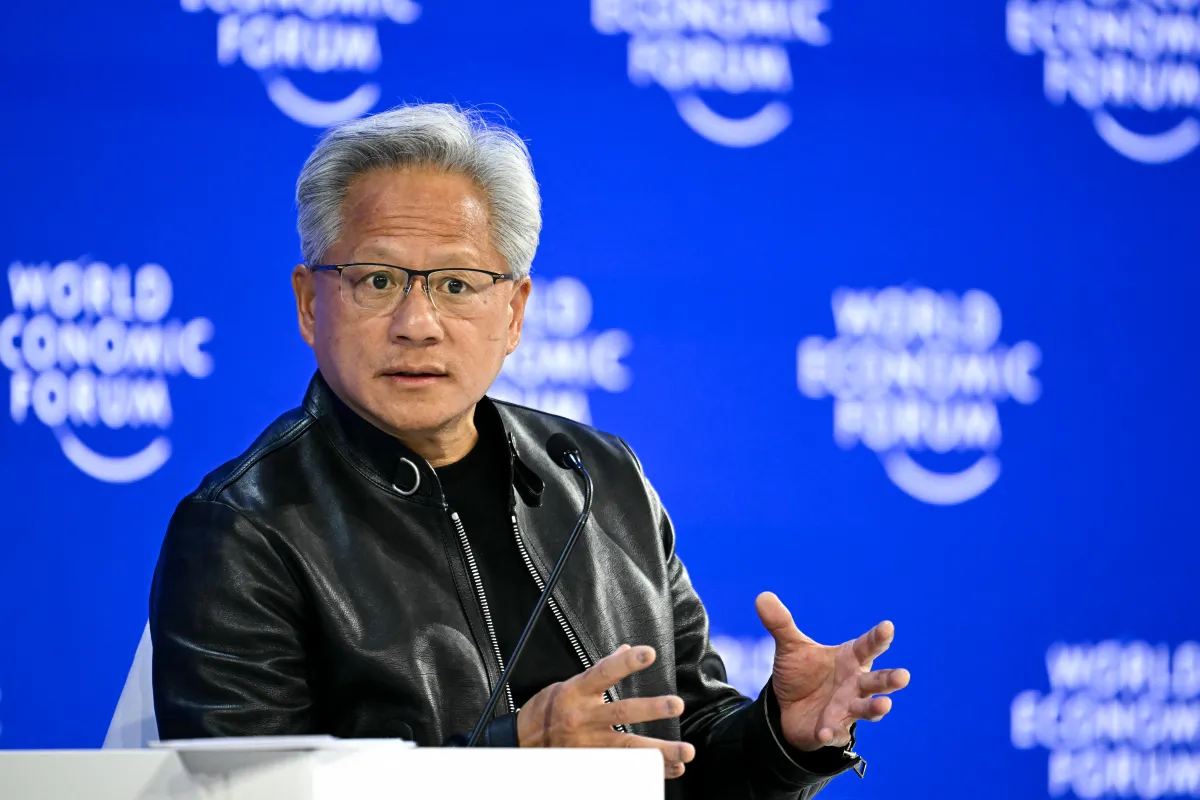
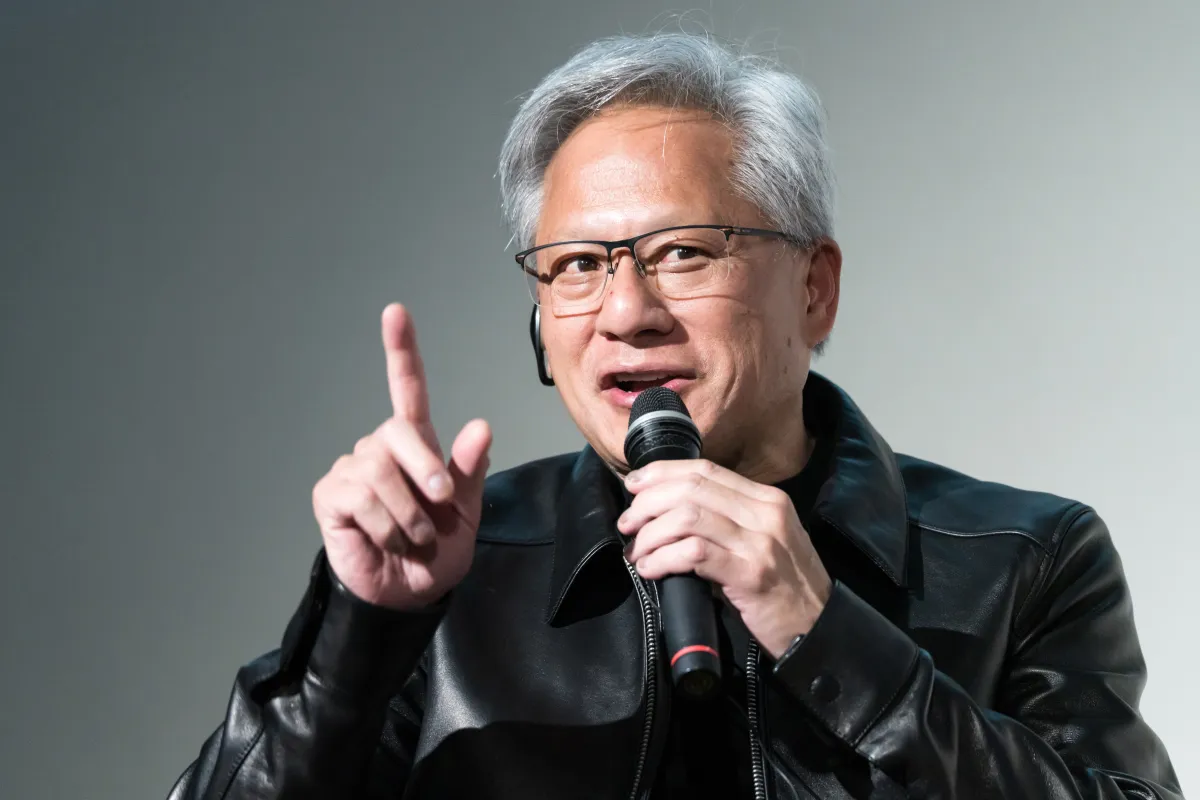
What made the appearance stand out was not only the substance of the conversation, but the symbolism of it: Huang, wearing his familiar black leather jacket, took the call on stage using a new Apple foldable device that is not scheduled to go on sale for several more weeks. The phone, visible to the audience as he spoke with Trump, became an unintended second headline from an event already packed with tech industry theater.
During the call, Trump and Huang discussed AI safety, a topic that has become politically charged as governments, companies and researchers debate the risks of increasingly capable systems. Both men dismissed the idea that fears over AI should slow the industry down, with Trump describing the panic around the technology as overblown and Huang sounding aligned with the broader message that the United States should keep advancing quickly rather than pause.
The exchange was notable not just for its content, but for what it revealed about the current power structure in AI. Nvidia sits at the center of the market because its chips are essential to training and running large models. When the company’s chief executive speaks publicly about AI limits, risks or pace, investors, competitors and policymakers pay close attention. On this stage, Huang appeared to be reinforcing the view that acceleration remains the dominant strategy.
Yet the most visually striking detail may have been the phone in his hand. The device was Apple’s new foldable model, a product that has not yet reached consumers. That alone would have been enough to generate attention. But in the context of the scene — a conversation with the president about the future of AI — it also hinted at a deeper industry shift. Apple, which once removed Nvidia components from its own hardware ecosystem, now relies on Nvidia-powered infrastructure for at least part of Apple Intelligence. In other words, the company that once distanced itself from Nvidia now needs the chipmaker again, at least in the cloud and data center stack that supports its AI ambitions.
For Nvidia, that is more than a visual cameo. It is another sign that the company’s influence stretches far beyond servers and semiconductors. For Apple, it is a reminder that even the world’s most valuable consumer hardware brands are now dependent on the compute supply chain behind modern AI.
What happened on stage in Los Angeles?
The core event was a live appearance by Jensen Huang at the All-In conference, where he fielded a call from Trump in front of attendees. Huang did not simply step away from the stage; he took the call publicly, turning an ordinary political conversation into a highly visible tech-world moment.
That visibility mattered. In Silicon Valley, conference appearances often serve as proxies for strategy, influence and alignment. A live call with a sitting president signals access. Doing it in front of an audience signals confidence. Doing it while holding an unreleased Apple product signals something else entirely: that the hardware arms race is now as much about optics as capability.
Huang’s demeanor fit the moment. The Nvidia chief is known for turning public appearances into polished demonstrations of leadership, and the Los Angeles stage was no exception. He managed to make the call feel both spontaneous and orchestrated — a hallmark of the modern tech keynote, where what looks casual often communicates a carefully chosen message.
Why the phone mattered as much as the call
The device in Huang’s hand was not an afterthought. It was Apple’s new foldable phone, a handset not yet available to consumers. Showing unreleased hardware during a live interaction with the president instantly made the phone part of the story.
That detail resonates for two reasons. First, it created the kind of viral visual that tech events are designed to produce. Second, it suggested that the hardware ecosystem around AI is no longer limited to obvious players like Nvidia, Microsoft or OpenAI. Consumer device makers, even those best known for smartphones and tablets, are increasingly tied to the same AI infrastructure layer.
Apple has spent years developing its own tightly controlled hardware and software universe. But the rise of generative AI has changed the economics of compute. Modern AI features are expensive to build and run, and many consumer devices now depend on cloud-backed acceleration to support them. That makes chips from Nvidia part of Apple’s broader AI story, whether the company likes to emphasize that publicly or not.
How did the AI safety conversation unfold?
The AI safety segment of the call was brief but revealing. Trump characterized concerns about AI as exaggerated, framing the panic around the technology as something that benefits China and politically motivated actors more than the public.
Huang did not interrupt that framing. Instead, he appeared to affirm the energy of the moment, encouraging the audience and keeping the exchange moving. The message from the stage was clear: AI should advance, not stall.
That position is not unusual for major AI hardware and infrastructure companies. The more demand there is for advanced models, the more demand there is for chips, memory, networking, cooling and data center capacity. In that sense, a public call downplaying existential risk can be read as perfectly aligned with Nvidia’s commercial incentives.
Trump told the audience that fears about AI were being blown out of proportion and suggested that slowing the technology would mostly help rivals abroad and political opportunists at home. Huang, for his part, kept the conversation moving and amplified the energetic tone of the exchange.
The broader implication is that the AI safety debate is increasingly shaped not only by researchers and regulators, but also by the companies that supply the infrastructure on which AI systems run. That creates an inherent tension. The same firms that profit from rapid deployment are also influential in defining what “responsible” acceleration looks like.
Why Nvidia benefits from the current AI narrative
Nvidia’s business model is straightforward: when AI labs, cloud providers and enterprises scale up their systems, they buy more chips. That gives the company a powerful incentive to support continued growth in AI spending and a strong reason to resist narratives that call for a broad slowdown.
Because of that position, every public remark by Huang is scrutinized for hints about demand, regulation and the company’s view of the market. In this case, his appearance came at a time when investors and policymakers are watching whether the AI boom can sustain its pace after multiple quarters of hyperscale investment.
The market reaction reinforced how much weight investors assign to Nvidia’s public posture. The company’s stock remains up sharply over the past year, though it slipped somewhat during the session as the broader market digested the optics of the event and the policy implications of the conversation.
Nvidia’s rise has turned Huang into one of the most consequential executives in technology. He is no longer just a chip CEO appearing at an industry conference; he is a public face of the entire AI buildout. When he appears beside political power, the symbolism is hard to miss.
What investors saw in the moment
For investors, the event was less about one offhand comment and more about the strategic signal it sent.
- Nvidia remains embedded in the political conversation around AI.
- Demand for AI infrastructure still appears strong enough to support a bullish narrative.
- The company’s products are becoming embedded across the broader device and cloud ecosystem.
- Public skepticism about AI safety may be softening among some industry leaders.
That combination helps explain why moments like this move beyond conference entertainment. They become shorthand for where capital, policy and innovation are converging.
How Apple ended up in the middle of the story
Apple’s presence in the scene was accidental in one sense and highly meaningful in another. The company’s unreleased foldable phone was simply the handset Huang was handed for the call. But in the context of AI infrastructure, the choice of device was striking because it visually linked the consumer edge of the market with the compute layer underneath it.
Apple has long preferred to control its own destiny, designing custom chips and tightly managing the user experience across its hardware lines. Yet the company’s AI ambitions still depend on outside infrastructure. The most advanced AI features generally require enormous back-end processing power, which means Apple must rely on partners somewhere in the stack.
That reliance has changed the meaning of its relationship with Nvidia. A decade ago, Apple moved away from Nvidia hardware in its own devices. Now, the company’s AI ambitions depend in part on Nvidia-powered systems to support Apple Intelligence. The contrast highlights a broader truth about the AI era: even the most self-sufficient consumer brands are not fully self-sufficient anymore.
From device maker to infrastructure dependent
Apple’s story in AI is often told through its products: phones, tablets, laptops and software updates. But those products are only the visible layer.
Behind them sits a data center and cloud ecosystem that determines how fast and how well AI features can work. That ecosystem is expensive, specialized and increasingly dominated by Nvidia’s hardware. So when Huang held an unreleased Apple device on stage, the image served as a compact illustration of the market’s new hierarchy.
Put simply, the device may have carried Apple’s brand, but the AI powering parts of the broader experience runs through Nvidia’s world.
What does the Trump-Huang moment say about AI politics?
It says that AI politics is moving from policy papers to public performance. A president’s stance on AI no longer matters only in executive orders or agency guidance; it is now being discussed live on conference stages in front of technologists, investors and media.
That shift matters because the political framing of AI can influence everything from export policy to federal procurement to antitrust enforcement. When a head of state and one of the world’s most influential hardware executives agree that fears should not slow the industry, they are helping define the boundaries of acceptable debate.
At the same time, the exchange highlighted the global stakes. Trump argued that panic over AI helps competitors such as China by distracting the United States from building faster. That is a familiar argument in Washington, where technology leadership is often framed as a geopolitical race rather than a purely commercial competition.
For Nvidia, whose chips are central to that race, the message is useful. For policymakers calling for caution, it is a reminder that the industry’s loudest voices are often also the most invested in speed.
Timeline: How the story unfolded
The sequence of events was simple, but each step added a different layer of significance.
| Moment | What happened | Why it mattered |
|---|---|---|
| Monday, All-In conference | Jensen Huang appeared on stage in Los Angeles. | He was in front of an audience already primed for high-profile tech commentary. |
| Live call | Huang took a surprise call from Donald Trump. | The appearance linked Nvidia directly to presidential politics and AI policy. |
| Phone reveal | Huang answered using Apple’s unreleased foldable phone. | The device became an unexpected symbol of the AI hardware race. |
| AI safety discussion | Trump dismissed fears about AI; Huang did not push back. | The exchange suggested a pro-acceleration view of the technology. |
| Aftermath | Nvidia shares dipped slightly while attention focused on the optics. | The event reinforced Huang’s influence and Nvidia’s central role in AI. |
Why this matters beyond one conference appearance
This was more than a viral tech-industry clip. It was a condensed snapshot of the current AI landscape.
It showed that:
- AI leadership now involves direct engagement with political power.
- Nvidia remains the infrastructure gatekeeper for much of the AI economy.
- Even Apple’s newest devices are part of the story because AI depends on the broader compute stack.
- Safety concerns are increasingly being challenged in public by executives and politicians who prioritize speed.
The scene also captured the evolving nature of technology influence. A decade ago, a live presidential call from a chip executive would have been unusual. Today, it reads as almost inevitable. AI has become such a dominant economic and political force that the people who supply its hardware are now treated as essential public actors, not merely corporate leaders.
That makes the image of Huang holding Apple’s unreleased foldable phone especially resonant. It captured a market in transition: consumer devices on one end, massive data center infrastructure on the other, and a growing number of companies tied together by the race to deliver AI features faster than anyone else.
In that sense, the most important thing Huang displayed was not just a phone or a political connection. It was the architecture of the AI economy itself — one in which the companies building the chips, the platforms and the devices are now all in the same room, even when they appear to be talking about something else.
What comes next?
For Nvidia, the short-term takeaway is that Huang continues to operate as both chief executive and public ambassador for the AI boom. His comments, whether spontaneous or strategic, will continue to shape how investors think about the durability of demand.
For Apple, the episode is a reminder that the company’s future AI story will be judged not only by its software features, but also by the infrastructure behind them. Being able to showcase a premium new device is one thing; making AI useful at scale is another.
And for the broader industry, the event suggests that AI debates are likely to remain intertwined with politics, product launches and market signaling. If the goal was to show that AI is too big to slow down, the stage in Los Angeles delivered exactly that message — with an unreleased phone in hand.
Whether the public sees that as confidence or complacency will depend on how the next phase of the AI race unfolds. For now, the image of Huang taking a presidential call on an as-yet-unreleased Apple foldable may be remembered as a perfect snapshot of the moment: power, hardware and politics all compressed into one polished public performance.
Frequently asked questions
What happened between Jensen Huang and Donald Trump at All-In?
Jensen Huang took a surprise live call from President Donald Trump while on stage at the All-In conference in Los Angeles. The exchange centered on AI safety, and both men suggested fears about AI should not slow the industry’s momentum.
Why was Apple’s unreleased phone part of the story?
Huang answered the call using Apple’s new foldable phone, which has not yet gone on sale. That detail drew attention because it visually tied an unreleased consumer device to one of the most important conversations in AI and infrastructure.
What did the exchange reveal about Nvidia’s position in AI?
It showed that Nvidia remains central to the AI boom, not only as a chip supplier but also as a public voice shaping the debate. Huang’s comments and presence alongside Trump reinforced the company’s influence over the direction of AI investment and policy.
How is Apple connected to Nvidia in this story?
Apple is connected through the AI infrastructure behind its products. Although Apple once moved away from Nvidia hardware in its own devices, it now relies on Nvidia-powered systems for parts of Apple Intelligence, showing how deeply the two companies are linked in the AI era.