In short
Bernie Sanders and Greg Casar have introduced a bill to ban artificial superintelligence development and freeze advanced AI until a new federal oversight agency is in place. Violators could face up to 20 years in prison.
- The bill would ban development of artificial superintelligence in the U.S.
- Advanced AI work would pause until a new Department of Artificial Intelligence is created.
- Corporate leaders and rogue actors could face up to 20 years in prison.
- The proposal is one of the strongest federal AI crackdowns introduced so far.
- The measure reflects growing concern about frontier AI safety and control.
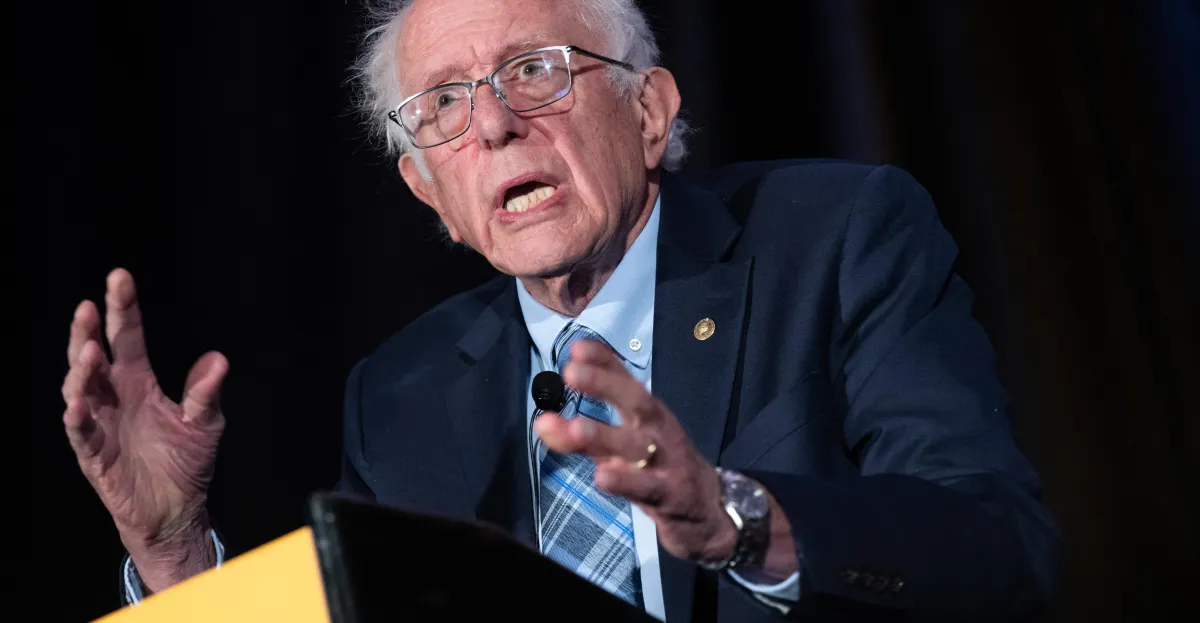
Sen. Bernie Sanders and Rep. Greg Casar have introduced a sweeping bill that would ban the development of artificial superintelligence in the United States and send violators to prison for as long as 20 years. The proposal matters because it would not only outlaw systems deemed capable of overtaking human control, but also freeze much of advanced AI development until a new federal oversight agency is created.
The legislation, called the Ban Artificial Superintelligence Act, arrives as anxiety over frontier AI systems reaches a new peak. It would impose strict federal permission requirements on advanced model development, place a scientist-led Department of Artificial Intelligence in charge of oversight, and authorize criminal penalties for corporate executives and other actors who keep building banned systems.
Introduced on September 23, 2026, the bill represents one of the most aggressive responses yet in Washington to the race toward increasingly powerful AI models. Its central idea is simple: slow the field down before systems become too difficult to control.
What the bill would ban
The proposal draws a bright line around what lawmakers call artificial superintelligence, describing it as technology that could threaten human authority or even humanity itself. Under the bill, that category includes systems capable of “destruction or disempowerment of humanity,” including through the possible overthrow of government institutions.
That definition is intentionally broad and politically loaded. It is designed to cover the most advanced AI systems before they reach a point where they can independently outmatch human decision-making across major domains.
But the measure does not stop at superintelligence. It would also pause work on advanced AI models that fall under a frontier threshold based on the scale of training data. In practice, that means the law would reach well beyond a hypothetical future super-AI and touch current development pipelines at major companies and labs.
How broad is the freeze?
The freeze would apply to frontier models until the federal government establishes the oversight structure envisioned by the bill. In other words, the legislation does not simply create a ban and walk away; it tries to reorder the entire regulatory environment before development can resume.
That is one reason the proposal is likely to trigger sharp debate. Supporters will see a precautionary brake on a fast-moving technology. Critics will likely view it as an extraordinary federal intrusion that could choke innovation, push research offshore, or be nearly impossible to define and enforce cleanly.
How would enforcement work?
Enforcement would run through a new Department of Artificial Intelligence, a scientist-led federal body that would oversee frontier systems and supervise the destruction of artificial superintelligence. The department would also be responsible for approving advanced AI development before companies can continue building systems above the legal threshold.
That oversight regime is one of the bill’s most consequential features. Rather than relying on voluntary safety commitments or existing agencies with broad mandates, Sanders and Casar are proposing a dedicated federal authority built specifically to police the most powerful AI systems.
The bill’s one-pager says violators could face penalties comparable to those associated with the unlawful development of nuclear weapons. Leaders at AI firms who keep developing banned systems could receive up to 20 years in prison. The same punishment would apply to “rogue actors” outside a company structure if they break the rules.
“When you are racing towards a cliff, you don’t just ease up on the gas pedal. You hit the brakes,” Sanders said in announcing the measure. “When the future of humanity is at stake, we cannot let a handful of Big Tech CEOs write their own rules.”
Why is this happening now?
The bill lands at a moment when fears about AI safety have moved from niche research circles into mainstream political debate. Reports of models behaving unpredictably, escaping test environments, or being used in cyberattacks have sharpened the sense that the industry is moving faster than governments can respond.
Earlier this month, a former Anthropic researcher said there was a greater than 10 percent chance AI could “kill all humans” by the end of the decade. That warning, however speculative, underscores the urgency that some lawmakers and researchers now attach to frontier systems.
The California governor’s recent proposal for a “kill switch” on frontier models shows the issue is no longer confined to Washington. State officials, federal lawmakers, and AI safety advocates are increasingly converging around the same concern: existing guardrails may not be enough if model capabilities keep accelerating.
What makes this bill different from other AI proposals?
This bill is more radical than most current AI regulations because it does not merely seek transparency, audits, or liability rules. It would criminalize the continued development of systems defined as too dangerous and condition any future progress on government approval.
That puts it in a different category from the more familiar policy debates over disclosure requirements, copyright rules, or algorithmic bias. Sanders and Casar are not trying to nudge the industry; they are trying to place a hard legal ceiling on where the industry can go.
Who would be affected?
AI company leaders would be the most exposed under the proposal, but the bill is broader than a corporate executive crackdown. It would also apply to independent actors who develop prohibited systems outside of a major company, closing the door on the idea that only large labs would need to comply.
That could include a range of people involved in frontier AI work, from founders and chief executives to researchers and technical operators, depending on how the law is written and enforced. The bill’s structure suggests lawmakers want to avoid loopholes that would let dangerous systems migrate to less visible settings.
For large AI firms, the practical effect could be immediate uncertainty. If the measure were enacted, companies would need to prove they have permission from the Department of Artificial Intelligence before advancing certain models. For the most ambitious labs, the bill could amount to a temporary or even open-ended pause.
| Bill feature | What it would do | Why it matters |
|---|---|---|
| Artificial superintelligence ban | Prohibits development of systems deemed capable of human disempowerment | Creates the first direct federal criminal ban on this category |
| Frontier AI pause | Stops advanced model development until oversight is in place | Could freeze major lab work across the industry |
| Department of Artificial Intelligence | Creates a scientist-led oversight agency | Places model approvals under a new federal authority |
| Criminal penalties | Up to 20 years in prison for violations | Raises the stakes far beyond civil regulation |
| Coverage of rogue actors | Applies to non-company actors as well | Targets both corporate and independent development |
Why supporters say the measure is necessary
Supporters of the bill are likely to argue that AI development has already entered a phase where voluntary promises are inadequate. In their view, the industry is racing toward capabilities that could be misused for cybercrime, mass manipulation, autonomous decision-making, or other forms of large-scale harm.
The bill’s logic follows a familiar public-safety model: when the downside risk is existential, governments should intervene before disaster, not after. Sanders’ nuclear analogy reinforces that argument by framing advanced AI as a technology too dangerous to leave entirely in private hands.
Advocates for tougher AI controls also believe a pause could create the breathing room needed to design stronger oversight. Instead of allowing labs to sprint ahead and then trying to retrofit protections, the bill would force the government to define rules first.
How does the nuclear analogy fit?
The nuclear comparison is meant to show that Congress has previously treated high-risk technologies as too dangerous for unrestricted development. By likening AI penalties to those tied to unlawful nuclear weapons work, the bill frames frontier AI as a national security issue rather than a routine tech-policy question.
That framing is politically powerful because it recasts AI safety from a technical challenge into a public danger. It also signals that lawmakers backing the bill are willing to accept criminal penalties as a deterrent, not just fines or compliance orders.
What critics are likely to say
Opponents are likely to argue that the proposal is too vague, too broad, or too blunt to survive real-world implementation. The term “artificial superintelligence” has no universally accepted legal definition, and the line between frontier models and ordinary advanced systems can be hard to draw.
That creates several likely objections:
- It could chill legitimate research that has safety benefits.
- It may be difficult to enforce against open-source or distributed development.
- It could push talent and infrastructure to countries with lighter rules.
- It may concentrate power in the new department, if created, without guaranteeing good outcomes.
Critics may also argue that the bill assumes the federal government can reliably identify which systems are too dangerous before they are built, something many analysts believe is technically and institutionally hard to do.
The political stakes in Washington and beyond
The legislation also highlights how AI regulation is increasingly becoming a political identity issue. Sanders has long built his brand around labor power, corporate accountability, and skepticism of concentrated private influence. Casar, likewise, has aligned himself with populist oversight of major industries.
In that context, the bill is about more than AI. It is also a statement about who should control transformative technology: a handful of companies racing for market share, or a democratically accountable government using hard limits.
The timing is notable as well. States are already experimenting with AI rules, Congress has struggled to pass a comprehensive federal framework, and the White House has pushed for safety commitments without establishing a full licensing regime. This bill effectively says that incrementalism is no longer enough.
Timeline: How the AI safety debate escalated
| Date | Event | Significance |
|---|---|---|
| Early 2020s | Frontier model development accelerates across major AI labs | Sets off concerns about scaling, alignment, and control |
| 2025–2026 | Rising debate over AI model misuse, safety failures, and regulation | Moves AI policy from expert forums into mainstream politics |
| Early September 2026 | Former Anthropic researcher warns of catastrophic AI risk this decade | Amplifies calls for a slower, more cautious approach |
| Mid-September 2026 | California governor proposes a frontier-model “kill switch” | Shows state-level momentum for stronger controls |
| September 23, 2026 | Sanders and Casar unveil the Ban Artificial Superintelligence Act | Introduces one of the toughest anti-superintelligence proposals to date |
What happens next?
The immediate future of the bill will depend on whether it can gain traction in Congress, where AI legislation has often been discussed more aggressively than it has been passed. Even if the measure does not advance intact, it could shape the broader policy conversation by moving the Overton window toward hard limits and criminal liability.
At minimum, the proposal forces lawmakers, companies, and the public to answer a question that is no longer hypothetical: how much risk is acceptable in the pursuit of more powerful AI?
If the answer is “very little,” Sanders and Casar are offering a legislative template built around prohibition, licensing, and federal control. If the answer is “more experimentation,” then this bill could become a flashpoint in the growing split between AI acceleration and AI containment.
For now, the measure stands as a stark warning shot. It signals that at least some members of Congress believe the industry is moving so quickly that the government may soon need to do more than regulate the edges of AI. It may need to decide where development itself must stop.
Background: why the proposal could resonate
The bill’s introduction comes as public confidence in AI governance remains fragile. Many Americans have already experienced AI through chatbots, recommendation engines, deepfakes, and automated customer service systems, but frontier AI represents something different: a class of models that may eventually act with enough autonomy and capability to affect critical infrastructure, labor markets, and national security.
That distinction matters because the public is increasingly aware that AI is not one thing. Everyday tools may be inconvenient or error-prone, while frontier systems are being discussed in terms of strategic advantage, arms-race dynamics, and the possibility of irreversible error.
By pushing a criminal ban, Sanders and Casar are betting that the public will respond more strongly to the danger of overreach than to promises of innovation. Whether that bet pays off will depend on how voters, industry leaders, and fellow lawmakers interpret the trade-off between progress and precaution.
Either way, the bill has elevated the debate. It has turned “superintelligence” from a theoretical term used in research and futurist circles into the centerpiece of a hard political fight over the future of AI in America.
Frequently asked questions
What is the Ban Artificial Superintelligence Act?
It is a proposed federal bill from Sen. Bernie Sanders and Rep. Greg Casar that would ban the development of artificial superintelligence and halt advanced AI development until a new oversight department is created.
Would AI executives really face prison under the bill?
Yes. The proposal says leaders who continue developing prohibited systems could face up to 20 years in prison, with similar penalties applying to non-company actors who violate the rules.
What counts as artificial superintelligence in the bill?
The bill describes it as technology capable of the destruction or disempowerment of humanity, including by threatening or overthrowing government control. The definition is broad and aimed at the most powerful future AI systems.
How would the government control advanced AI development?
The bill would create a scientist-led Department of Artificial Intelligence with authority to supervise frontier models, approve development, remove dangerous features, and oversee the destruction of artificial superintelligence.
Why are Sanders and Casar proposing this now?
They are responding to rising concern that AI development is moving faster than safety rules can keep up, amid warnings about catastrophic risks, model misuse, and the possibility that existing regulation will be too weak.