Updated August 28, 2026 3:54 pm
In short
Plaud is launching AI note-taking earbuds with an eSIM-equipped case, while the company says its business has scaled to a $100 million annual revenue run rate amid rising competition.
- Plaud One pairs AI note-taking earbuds with an eSIM-enabled case for remote agent use.
- The device records calls and in-person meetings, then pushes transcripts into tools like Gmail, Calendar, Notion and Slack.
- Pricing starts at $249, with limited free transcription and paid plans after that.
- Plaud is testing the form factor in limited quantities as competition in AI hardware intensifies.
- The company says future updates will add credit-based agentic features and more automation.
Update — August 28, 2026 3:53 pm
Plaud now says it has reached a $100 million annual revenue run rate, underscoring that the company’s note-taking hardware business has already found meaningful demand.
The company also says the competitive field is getting busier, pointing to Pocket, Anker, Comu, Viaim and Genspark as rivals building similar AI audio products.
Plaud’s CEO says the earbuds are meant to give users a way to reach AI from anywhere, even as the company concedes it will have to win over people who already use mainstream earbuds like AirPods or Pixel Buds.
Update — August 27, 2026 6:53 pm
Plaud now says its business has scaled to a $100 million annual revenue run rate, a sign the company’s note-taking hardware has already reached meaningful traction.
The updated source also says competition in the category is heating up fast, naming Pocket, Anker, Comu, Viaim and software maker Genspark among the rivals building similar products.
TechCrunch adds that Plaud sees the earbuds as a way to let people invoke AI from anywhere, while acknowledging it will still have to persuade users to switch from mainstream earbuds such as AirPods or Pixel Buds.
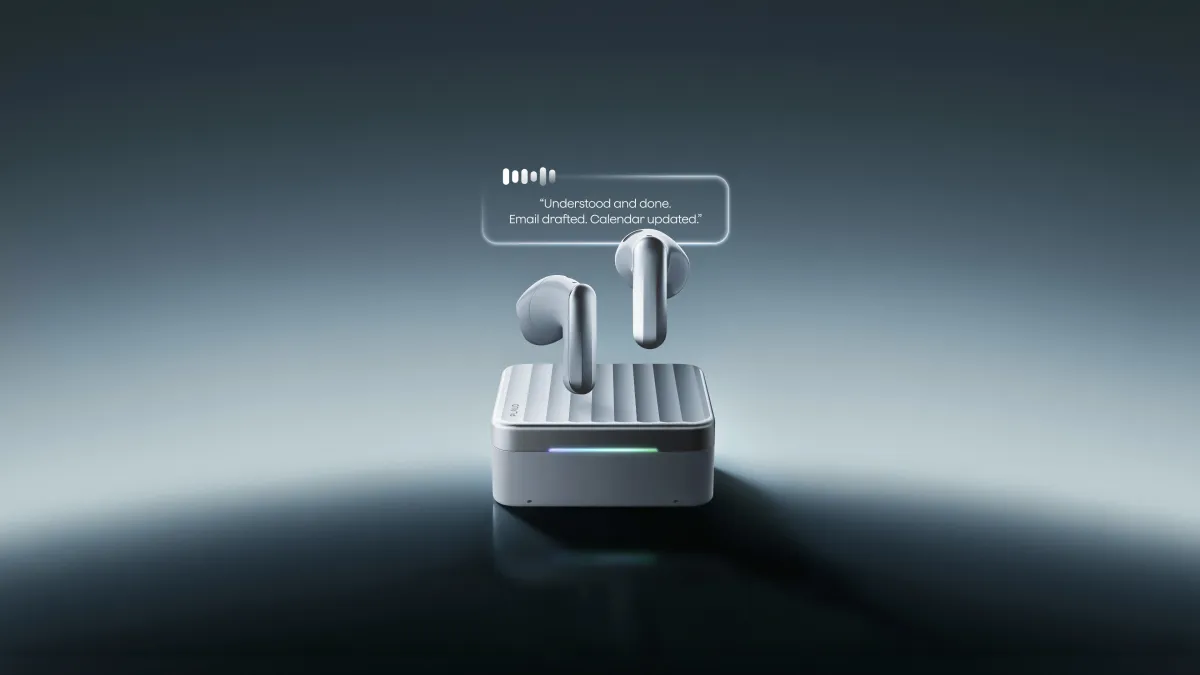
Plaud has unveiled Plaud One, a new pair of AI-focused earbuds with a companion case that includes an eSIM, letting users interact with its AI agents away from a phone or computer. The launch matters because it extends the company’s note-taking hardware into a more wearable format as competition intensifies across the AI audio device market.
The Shenzhen-based startup is trying to turn a familiar consumer product — wireless earbuds — into a hands-free capture tool for meetings, calls and follow-up work. Plaud says the device will ship in limited quantities, with preorders open now for $249 and deliveries expected in the fourth quarter of 2026.
What Plaud One is, and why it matters
Plaud One is the company’s latest attempt to combine audio recording, transcription and AI-driven workflow automation in a single product. The earbuds are designed to record phone calls, while the charging case can capture in-person conversations or note snippets during meetings.
The launch is significant because it shows how far the market for AI note-taking hardware has evolved. A few years ago, the category was mostly about microphones hidden in pendants, rings, pucks or wristbands. Now the fight is shifting toward formats people already recognize and use daily.
Plaud is already one of the best-known names in this space, claiming more than 2.5 million users across its hardware and software products. That scale gives it a stronger launch pad than many newer rivals, but it also raises expectations that each product needs to do more than merely record audio.
How the Plaud One works
The device is built around two layers of capture: the earbuds handle calls, while the case can pick up conversations in the room. Plaud says the case can clearly capture voices from up to five meters away, making it useful for meetings, interviews and casual brainstorming sessions.
The earbuds include 12mm drivers and active noise cancellation, which is meant to improve the listening experience as well as the recording quality. On a single charge, Plaud says the earbuds can record up to six hours of in-person meetings or three hours of calls, while the case and earbuds together can deliver as much as 25 hours of conversation recording.
What the eSIM case adds
The most unusual element is the case’s built-in eSIM. Plaud says that feature allows people to command AI agents remotely without relying on a connected phone or laptop. In other words, the hardware is intended to become an always-available interface for AI, not just a recording accessory.
That approach is aimed at a growing consumer expectation: users want AI to be reachable from anywhere, without opening an app or sitting at a desk. For Plaud, the eSIM is less about connectivity for its own sake and more about creating a persistent, wearable command point for agentic tasks.
What the AI agent can actually do
After audio is transcribed, Plaud says its AI agent can use the content of a conversation to trigger follow-up actions across common productivity tools. The company says it can connect with Gmail, Google Calendar, Notion and Slack, enabling workflows such as drafting emails, creating documents or preparing presentations based on meeting notes.
That promise overlaps with what software-first note-taking services already offer. Products such as Granola, Fathom and Read AI have already built businesses around recording calls, transcribing them and then helping users turn those transcripts into tasks or summaries.
Where Plaud is trying to differentiate itself is by bundling that software with purpose-built hardware and a new form factor. The company’s argument is that earbuds — because they are wearable, socially familiar and often already on the user’s body — are a more natural gateway to AI than a separate app or desk-bound recorder.
“For AI we need to have a wearable and an always-ready interface, one that people love to wear, is socially acceptable and private by design,” Plaud chief executive Nathan Xu said in a briefing.
Why Plaud is entering the earbud market now
Plaud’s move comes as hardware startups race to find the best physical shape for AI note-taking. The category has been crowded for months, and new products continue to arrive with microphones built into everything from jewelry-like wearables to pocket-sized gadgets.
The earbud format is not new to this market. Rivals including Viaim and Anker already have similar note-taking earbuds available, which means Plaud is entering a field where the hardware concept is familiar and the differentiation must come from software performance, design and distribution.
But Plaud appears to believe the format still has room to grow if paired with stronger AI features. The company’s pitch is not that earbuds themselves are revolutionary; rather, it is that an AI-native workflow can be made more useful when the recording device is also the conversational interface.
Why a limited launch signals caution
The company is treating Plaud One as a measured experiment rather than a full-scale category reset. It says the device will be available only in limited quantities, suggesting the startup wants to test customer demand before committing fully to earbuds as a major product line.
That caution makes sense in a market where many users already own capable wireless earbuds from Apple, Google, Samsung and other brands. If the same hardware can already record audio when paired with a note-taking app, Plaud must persuade buyers that its integrated experience is worth switching for.
Pricing, subscriptions and what buyers get
Plaud One starts at $249, with preorders open now and shipping expected in the fourth quarter of 2026. Buyers will receive 300 minutes of free transcription each month, after which they must move to a paid plan.
The company says subscriptions begin at $8.33 per month when billed annually. That pricing puts Plaud in the same general territory as many productivity and AI tools that rely on recurring revenue rather than one-time device margins alone.
There is also a future credit system in the pipeline. Plaud says a forthcoming update will add agentic capabilities that will be charged through a credit-based model, and Plaud One buyers will receive $200 in credits for those tasks.
How the business model is evolving
The structure suggests Plaud is aiming for a hybrid revenue mix: hardware sales up front, subscription income for transcription, and usage-based charges for advanced AI actions. That model can be attractive because it ties revenue to both device adoption and ongoing engagement.
It also gives the company room to expand the product’s value over time. A buyer may begin by using Plaud One as a recorder, then later move into document generation, calendar handling or email drafting as the AI agent becomes more capable.
| Feature | Plaud One | What it means |
|---|---|---|
| Price | $249 | Positions the device in the premium consumer hardware range |
| Free transcription | 300 minutes per month | Enough for light to moderate meeting use |
| Subscription starting price | $8.33/month billed annually | Signals a recurring software revenue model |
| Recording battery life | Up to 6 hours in-person, 3 hours calls | Supports meetings and call capture on one charge |
| Total conversation recording | Up to 25 hours with case | Extends usage across a full workday or more |
| Connectivity | eSIM in case | Enables remote interaction with AI agents |
How Plaud compares with the competition
In the broader market, Plaud is competing on two fronts at once: against dedicated hardware makers and against software-only meeting assistants. That makes the category unusually crowded, because users can choose either a physical product or an app-based service to solve similar problems.
Hardware competitors include Anker, Viaim, Comu and Pocket, while software players such as Granola, Fathom, Read AI and Genspark are building products that start with transcripts and then push users toward automation. The result is a market in which feature overlap is high, but product philosophy differs sharply.
Software tools often work best for people who sit in long remote meetings and want clean summaries, task extraction and document generation. Hardware tools may be more appealing to users who move between rooms, travel often or want a device that is always ready to capture audio without thinking about whether an app is open.
Why earbuds may still be a hard sell
Even with Plaud’s software stack, the company faces an obvious challenge: many buyers already own AirPods, Pixel Buds or Galaxy Buds. Those products are not purpose-built note-takers, but they are reliable, familiar and already deeply integrated into consumers’ daily routines.
Plaud’s answer is that it is not trying to beat those brands at general-purpose audio. Instead, it wants to create a meeting-recording system wrapped in a wearable that people are already comfortable wearing. Whether that is enough to shift purchasing behavior will depend on how seamlessly the software and agent features work in real-world use.
How big is Plaud already?
Plaud is no tiny experiment. The company said in June that it had reached an annual run-rate revenue of $100 million, a figure that indicates real traction in a relatively young product category.
That milestone matters because it suggests there is meaningful consumer demand for AI capture hardware, even if the category still lacks a clear dominant standard. Plaud’s scale may also help it gather data, refine its transcription quality and improve its future agent workflows faster than smaller entrants can.
Still, reaching $100 million in run-rate revenue does not guarantee durable leadership. In fast-moving AI hardware markets, user enthusiasm can shift quickly if rival products offer better battery life, cleaner transcripts, lower prices or deeper integrations with the tools people already use.
What happens next?
Plaud says richer agent capabilities will arrive in an update over the coming months, with tasks likely governed by credits. That means the current earbuds may serve as an early version of a broader platform rather than a final product in their own right.
For buyers, the near-term question is whether Plaud One offers enough convenience and software value to justify yet another wearable in an already crowded audio ecosystem. For Plaud, the bigger strategic question is whether earbuds can become the default interface for AI note-taking before the market settles on a different form factor.
If the company is right, the earbud case could become more than a charger: it could be the always-on entry point to a personal AI assistant that records, organizes and acts on conversations from almost anywhere.
If it is wrong, Plaud One may still help the startup learn what users want from AI wearables — and where the limits of this category begin.
Timeline of Plaud One and the AI note-taker market
The product arrives after a rapid buildup in the AI recording space. The table below places Plaud One in context with the broader commercial evolution of the category.
| Period | Development | Market significance |
|---|---|---|
| Early wave | AI note-taking devices appear in pendants, rings, pucks and wristbands | Shows first attempts to make recording wearable |
| Current phase | Hardware and software players converge on transcription plus workflow automation | Moves the category beyond summaries into action-taking |
| August 2026 | Plaud introduces Plaud One earbuds with eSIM case | Pushes the form factor toward mainstream consumer audio |
| Coming months | Agentic features and credit-based task system expected | Could expand the device into a fuller AI platform |
Bottom line for buyers and investors
Plaud One is less a standard pair of earbuds than a strategic bet on how people will interact with AI in the future. The company is arguing that the best interface for AI may not be a chat window at all, but a private wearable that can capture speech, transcribe it and trigger work across everyday apps.
Whether that vision wins out will depend on the quality of Plaud’s software, the usefulness of its agent features and the degree to which consumers are willing to buy specialized hardware for a task their current earbuds may already support in a simpler way.
For now, Plaud has made one of the clearest attempts yet to turn AI note-taking into a mainstream wearable product. The market will soon show whether that is the next step in the category — or just another experiment in an increasingly crowded race.
Frequently asked questions
What is Plaud One?
Plaud One is an AI-focused pair of earbuds from Plaud that can record calls, capture in-person conversations through its case and turn transcripts into actions through connected productivity tools. The company is positioning it as a wearable interface for AI note-taking and automation.
How does the eSIM case work?
The eSIM case lets users interact with Plaud’s AI agents remotely without relying on a phone or computer. Plaud says that makes the device more like an always-available AI interface than a simple audio recorder or charging accessory.
How much does Plaud One cost?
Plaud One costs $249 for preorder. Buyers get 300 free transcription minutes per month, after which paid plans begin at $8.33 per month when billed annually.
How is Plaud One different from regular earbuds?
Plaud One is designed specifically for recording, transcription and AI workflows, while regular earbuds mainly handle music and calls. Its case can capture meetings, and its software can draft emails, documents and presentations from the recorded content.
When will Plaud One ship?
Plaud says Plaud One will ship in the fourth quarter of 2026. The company is limiting initial quantities, which suggests it is using the release as a market test for AI-native earbuds.