In short
Donald Trump posted White House renovation photos that included an image apparently altered with AI. The post prompted scrutiny over authenticity, disclosure and the growing use of synthetic visuals in politics.
- Trump shared a before-and-after White House column photo that appears to have been AI-edited.
- Google’s SynthID Detector reportedly flagged the image as made or edited with OpenAI.
- Online users spotted mismatched steps, repeated reflections and other visual inconsistencies.
- Real painting work at the White House was documented in June, but the post’s presentation remains in question.
- The episode highlights how synthetic media is complicating trust in official political imagery.
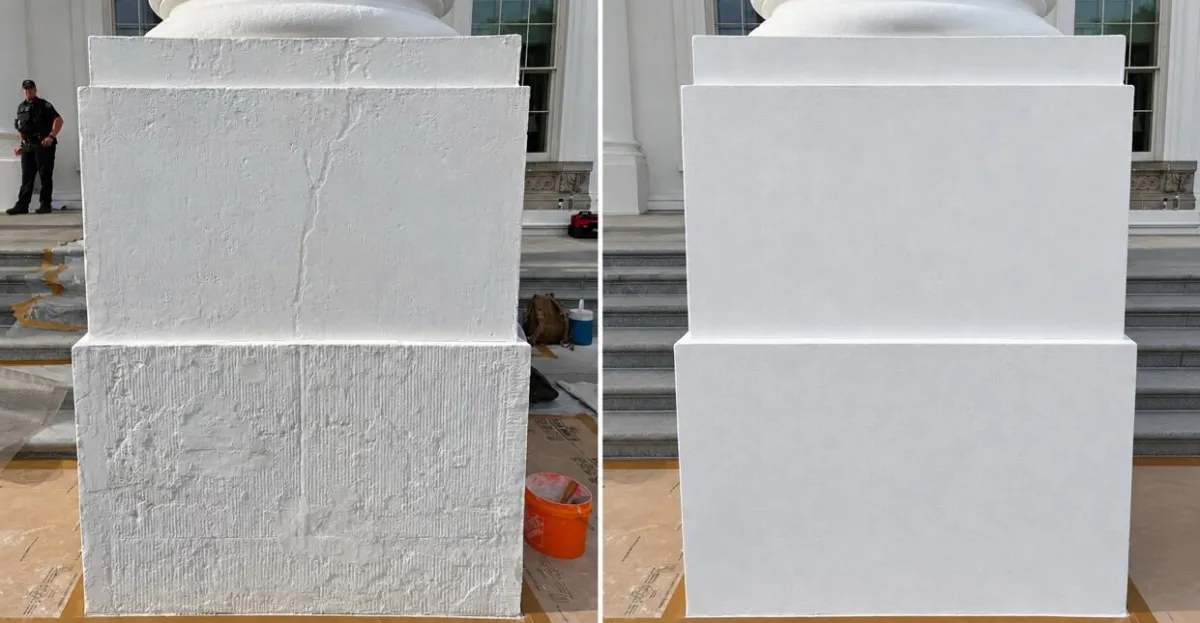
President Donald Trump posted a set of White House renovation photos on Truth Social this week, but one image in the sequence appears to have been altered with artificial intelligence. The misleading “before and after” picture of a freshly painted column matters because it shows how AI-generated or AI-edited visuals are increasingly slipping into political messaging, even when the subject is something as routine as building maintenance.
The image in question compares an older White House column with a supposedly restored version, but independent checks and visual inconsistencies suggest the “after” shot was modified. Google’s AI detection tools reportedly flagged the photo as being made or edited with OpenAI, while a close look at the image reveals several oddities that do not line up with an authentic side-by-side comparison.
The episode is another reminder that the White House, the president, and the broader political ecosystem are now operating in an information environment where synthetic media can be used casually, publicly, and sometimes without clear disclosure. That raises obvious questions about trust, documentation, and the growing difficulty of telling ordinary photography from computer-altered imagery.
What Trump posted and why it stood out
Trump’s post was meant to celebrate restoration work at the White House, showing off the condition of a column before renovation and its appearance after fresh paint. On the surface, it looked like a simple visual brag: a quick example of upkeep and beautification at the presidential residence.
But the image was quickly scrutinized online because the two sides of the comparison looked suspiciously similar in composition and detail. Instead of reading as a natural before-and-after photo taken at different times, it looked more like one image had been reworked to exaggerate the “after” effect.
That distinction matters. In politics, images are rarely neutral. A photo that suggests a restored landmark can be used to reinforce an image of competence, order, and stewardship. When the image is synthetic or partially synthetic, the message becomes more complicated: the story is no longer just about renovations, but also about how the administration chooses to visually present them.
Why the photo raised AI concerns
The reason the column image drew attention is that it contains several visual clues that point away from ordinary photography. The easiest-to-spot problem is the staircase arrangement. The number and placement of steps on both sides of the structure appear inconsistent, and they do not match the layout visible in the “before” image.
Other details are even stranger. The angle of the two photos appears nearly identical, including the reflections in the windows and the placement of protective cardboard near the base of the column. In a genuine before-and-after comparison, some overlap is possible, but here the resemblance is so close that it looks less like two separate photos and more like one image being repurposed.
The restored column itself also looks unusually smooth, another visual clue that tends to show up in AI-edited images. Overly polished surfaces, subtle geometry errors, and inconsistent architectural details are common signs that an image has been generated or heavily altered rather than simply photographed.
Visual comparisons shared by online users suggested the “after” image did not behave like an ordinary photograph, with mismatched steps, repeated reflections, and a too-perfect finish drawing the most attention.
How was the image checked?
The image was reportedly run through Google’s SynthID Detector, which is designed to identify media that has been created or edited with AI by looking for an invisible watermark associated with certain synthetic content. In this case, the detector reportedly identified the image as AI-generated or AI-edited.
That does not necessarily prove every part of the picture was manufactured from scratch. It does indicate, however, that the photo likely passed through an AI tool at some stage, whether for enhancement, cleanup, or more extensive manipulation. For readers, that distinction can be difficult to parse, which is exactly why synthetic media is becoming such a problem in public communication.
The verification concern is made more serious by the fact that the image was presented as a straightforward documentary comparison. If a photo is used to show a public works update, viewers reasonably expect a real-world record rather than a composited or AI-assisted visual.
How reliable are AI detectors?
AI detectors can be useful indicators, but they are not perfect proof on their own. They may miss synthetic content, misclassify edited material, or fail to explain exactly what was changed. Still, when detector results line up with visible inconsistencies, the case for manipulation becomes much stronger.
In this instance, the detector result was only one part of the picture. The rest came from the image itself: repeated angles, repeated reflections, and structural details that did not make logical sense between the two versions. Taken together, those clues make the photo difficult to treat as a clean, unaltered before-and-after document.
That uncertainty is important because the public often assumes that photographs shared by officials are factual evidence. As AI tools become easier to use, that assumption becomes less secure. What once required professional editing skills can now be done quickly and at scale, sometimes with only a few prompts or clicks.
Was the White House actually repainted?
Yes, there is evidence that real maintenance work took place. Photos from June showed people painting the front of the White House, which means the column in question may genuinely have received a fresh coat of paint. The issue is not whether some renovation happened; it is whether the posted comparison accurately represented it.
That distinction is crucial. A real repair or restoration can be documented honestly, but a synthetic or altered image can make the work look more dramatic, more uniform, or more pristine than reality. In this case, the apparent manipulation may have been aimed at polishing the visual narrative rather than inventing the renovation from scratch.
The White House did not immediately respond to requests for comment about the photo. That silence leaves open a basic question: whether the image was altered intentionally, whether AI was used for a benign correction, or whether the post simply reflected a careless approach to image selection and presentation.
How this fits Trump’s long relationship with AI images
Trump is not new to synthetic visuals. He has frequently shared AI-generated caricatures and other digitally manipulated images of himself, often in ways that blur the line between political branding and internet spectacle. His social media style has long embraced highly stylized content, and AI has become another tool in that mix.
The broader Trump ecosystem has also repeatedly crossed into questionable visual territory. The White House has previously shared racist AI memes and at least one image that appeared to edit a protester in a misleading way, making the person appear more distressed than in reality. Together, those examples show a communication environment in which digital manipulation is no longer an exception; it is increasingly part of the playbook.
That trend matters beyond one single post. When public offices circulate altered visuals, they lower the bar for what counts as acceptable political imagery. Over time, that can normalize a culture in which authenticity is optional and visual persuasion matters more than documentary accuracy.
Why this matters for politics and public trust
The White House is one of the most scrutinized buildings in the world, and photos of it carry symbolic weight. Images from the presidential residence are often treated as records of history, ceremony, and governance. If those images are altered without disclosure, the public loses a small but meaningful piece of trust.
That trust problem is not theoretical. Political actors already live in a world of edited clips, selective framing, and viral misinformation. AI only accelerates the process by making manipulation cheaper, faster, and more convincing. A polished fake can now travel as quickly as a real image, and in some cases faster.
This creates a new burden for journalists, platforms, and audiences. Media outlets have to verify what they can. Social platforms must decide whether to label synthetic content. And users have to become more skeptical of anything that looks too smooth, too perfect, or too conveniently designed to support a political message.
Why the White House example is especially important
The White House is not a random campaign account or anonymous social feed. When its images are altered, the effect is more serious because they come wrapped in institutional authority. People are more likely to treat them as factual, which makes disclosure and accuracy even more important.
That is why this incident resonates beyond the renovation itself. It is a case study in how official-looking communication can be quietly shaped by AI tools, whether for convenience, aesthetics, or persuasion. Once that becomes routine, it gets harder to know what kind of media the government expects the public to trust.
Key details at a glance
| Item | Details |
|---|---|
| Who posted it | President Donald Trump on Truth Social |
| What the post showed | A before-and-after image of a White House column renovation |
| Why it drew scrutiny | Visual inconsistencies suggested the “after” photo had been AI-edited |
| Detection result | Google’s SynthID Detector reportedly flagged the image as made or edited with OpenAI |
| White House response | No immediate comment |
| Context | Real painting work at the White House was documented in June |
Timeline of the photo controversy
| When | Event |
|---|---|
| June | Photos showed workers painting the front of the White House |
| October 15, 2026 | Trump posted the renovation images on Truth Social |
| Shortly after posting | Users online flagged the image for mismatched steps and repeated details |
| After scrutiny | The image was reportedly identified by Google’s SynthID Detector as AI-edited |
What the online reaction revealed
Public reaction focused less on the paint job itself and more on the credibility of the image. That response is telling. People are increasingly primed to inspect visuals for signs of manipulation, especially when they come from political figures known for aggressive media tactics.
The scrutiny also showed how quickly crowdsourced verification now happens online. Reddit users and other observers did what used to be the job of a newsroom photo desk: they compared structural details, looked for repeated features, and tested whether the image made sense in context. In some ways, the public has become more visually literate because AI has made deception easier to spot.
Still, that defensive posture is not a healthy long-term solution. A democracy should not have to rely on ad hoc internet detective work to determine whether an official post is authentic. Clear labeling and careful disclosure would do far more to preserve confidence.
What happens next?
The immediate question is whether the White House or Trump’s team will address how the image was produced. If the photo was lightly edited for cosmetic reasons, that should be disclosed. If AI played a role, audiences deserve to know that too. Silence only deepens suspicion.
Beyond this single incident, the larger issue is that AI-assisted visuals are becoming normal across politics, advertising, and public relations. That means the standards for official communication may need to change. A photo once signaled evidence; now it may signal only that someone wanted evidence to look a certain way.
For now, the White House column image is a small but revealing example of a much larger shift. AI is no longer confined to experimental demos or meme culture. It is now showing up in the visual language of power — sometimes in places as formal as the presidency itself.
If nothing else, the episode underscores a new rule for the internet age: when a political image looks too neat, too symmetrical, or too conveniently dramatic, it is worth asking whether the picture is documenting reality — or manufacturing it.
Background: why synthetic visuals are a growing political issue
AI-generated and AI-edited imagery has become a major concern because it compresses the old timeline of deception. In the past, convincing photo manipulation usually required expertise, time, and access to specialized software. Today, a synthetic image can be produced in seconds and distributed instantly to millions of users.
That speed changes the stakes in several ways:
- It makes misleading visuals easier to produce than fact-checked explanations.
- It can overwhelm corrections, especially when a fake image goes viral first.
- It creates uncertainty even around genuine photos, since audiences may distrust all images.
For political communicators, the temptation is obvious: AI can make official messaging look sharper, more flattering, and more controlled. But every time that happens without disclosure, the line between presentation and deception becomes harder to defend.
Why readers should care
Most people will not remember the exact column in question, but they should remember the broader lesson. Synthetic media is no longer a future problem; it is already part of everyday political communication. A renovation photo from the White House is a small example, but it captures the larger crisis of visual trust.
When public officials share images, they are not only posting content. They are making a claim about reality. If that claim is built on AI editing, audiences deserve to know — because the issue is not just what the image shows, but whether the image deserves to be believed.
Frequently asked questions
Was Trump’s White House renovation photo AI-generated?
Yes, the image appears to have been AI-edited or AI-generated. Google’s SynthID Detector reportedly flagged the posted photo as made or edited with OpenAI, and visual inconsistencies in the before-and-after comparison support that conclusion.
What was wrong with the photo?
The photo contained several odd details, including mismatched steps, nearly identical reflections in the windows, and a suspiciously smooth surface on the restored column. Those clues suggest the image was altered rather than being a clean documentary comparison.
Did the White House actually get painted?
Yes, there is evidence that real painting work took place at the White House in June. The issue is not whether maintenance happened, but whether the shared image accurately represented that work or used AI to enhance it.
Why does the AI-edited photo matter?
The photo matters because it shows how synthetic media can be used in official political messaging. When a government-related image is altered without clear disclosure, it can undermine public trust and make authentic visuals harder to verify.
Has Trump shared AI images before?
Yes, Trump has frequently posted AI-generated caricatures and other digitally manipulated images. The White House has also shared questionable visuals in the past, making this latest photo part of a broader pattern of synthetic or misleading media.