Google’s latest promotion for Workspace and Gemini did not just miss the mark online; it detonated a debate about political messaging, corporate tone, and whether artificial intelligence is being pushed far beyond what many people see as its practical value. The ad, styled as a whimsical alternate-history sketch, imagines the American founders using Google’s collaboration tools to draft the Declaration of Independence. Instead of landing as clever, the spot has drawn ridicule for turning one of the country’s most serious civic documents into a marketing gag.
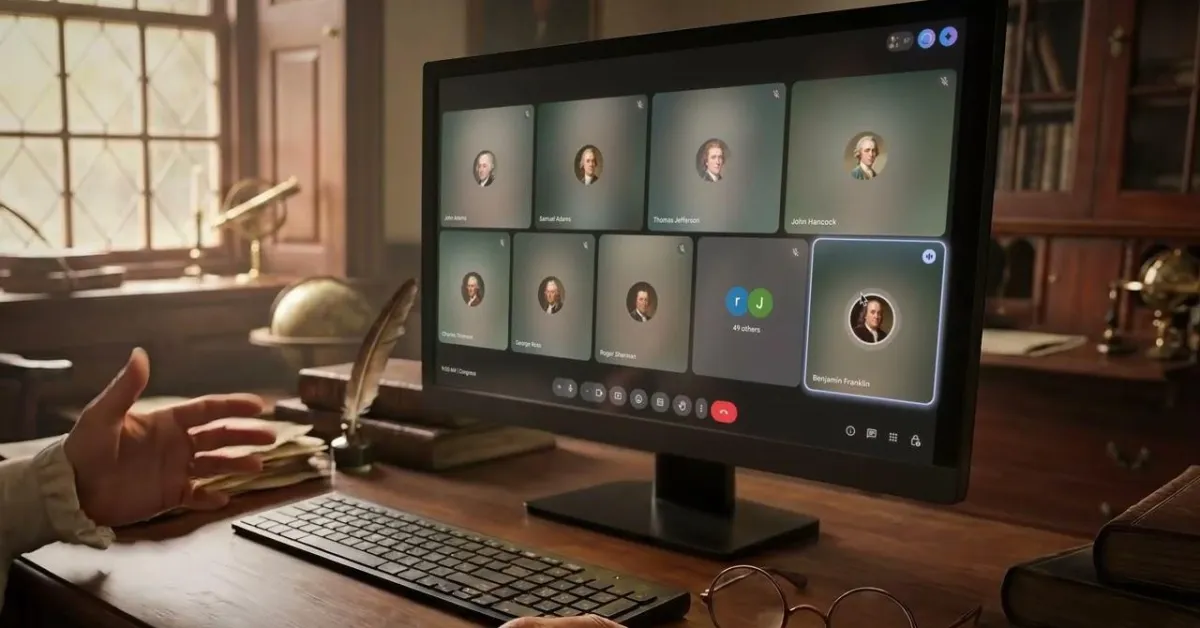
The commercial opens with a jokey premise — “group project, but make it 1776” — and then doubles down. Benjamin Franklin texts Thomas Jefferson about the draft, Jefferson scans a handwritten page into Google Docs, Franklin and John Adams edit together in suggestion mode, Gemini schedules a meeting, and Google Meet is used for collaborative note-taking. In the final scene, Google’s image generator Nano Banana is enlisted to create a new national seal, complete with a turkey rather than the more familiar eagle.
What might have been intended as playful brand storytelling has instead been read by many viewers as clumsy, self-congratulatory, and politically tone-deaf. The ad’s premise also raises a broader question: when technology companies describe AI as a universal productivity tool, are they helping people do real work, or simply using historical fantasy to sell the idea that every task should now run through a chatbot?
The ad’s premise: the Founding Fathers as workspace users
At the center of the controversy is a simple creative idea: take the gravitas of the nation’s founding and remix it into a modern software demo. The commercial imagines Thomas Jefferson, Benjamin Franklin, and John Adams using Google’s latest AI products to collaborate on the Declaration of Independence as though they were a startup team managing a shared project in a cloud suite.
The result is intentionally absurd, but not in a way that many viewers found charming. Rather than using irony to make a sharp point about productivity software, the ad treats major historical events as if they were a corporate onboarding video. The joke hinges on the founders using transcription, scheduling, note-taking, and writing assistance exactly the way an office team might today.
That framing would already be provocative, but the ad goes further by imagining Gemini as a kind of all-purpose assistant for political drafting and decision-making. The spot essentially says: if the founders had access to modern AI tools, they would have used them to produce one of the most important political texts in American history.
What happens in the commercial
- Benjamin Franklin messages Thomas Jefferson to ask about the draft’s status.
- Jefferson takes a photo of handwritten notes and uses AI transcription to move them into Google Docs.
- Franklin and John Adams make edits using suggestion mode.
- Gemini helps them coordinate a meeting time.
- Google Meet is used to take notes during a call.
- Nano Banana generates a redesigned U.S. seal featuring a turkey.
- The founders ask Gemini whether King George III should receive edit access to the Declaration.
The joke about granting the British monarch edit permissions was apparently meant to be the punchline. Instead, it became one of the most criticized elements of the entire ad, because it pushes the concept from silly into absurdly mismatched territory. The Declaration of Independence was an act of political rupture. Treating it like a shared Google Doc is the sort of metaphor that can feel clever in a boardroom and exhausting in public.
Why the response turned sour so quickly
Reactions came fast and were overwhelmingly negative. The commercial was mocked as corny, awkward, and misguided. For critics, the problem was not just that the ad was unserious; it was that it tried to make AI look central to political and civic collaboration in a way that many viewers found implausible and self-important.
Some of the sharpest criticism focused on the ad’s cultural tone. The founders are icons of American political identity, and any brand attempting to use them for a sales pitch is already entering risky territory. By combining that imagery with generative AI, Google ended up with a spot that seemed to some viewers to trivialize both history and the technology itself.
There was also a deeper irritation in the backlash. Many people already feel that AI companies are overselling what current systems can do. A commercial that depicts AI as an indispensable partner in drafting a foundational democratic document was therefore read as another example of inflated claims dressed up as friendly entertainment.
One history professor, Angus Johnston of CUNY, argued on Bluesky that even as a joke, the ad fails to make a convincing case that AI is truly useful for political organizing, writing, or human collaboration.
That critique gets to the heart of the issue. If a tech company wants to persuade users that AI improves everyday work, it has to show outcomes people recognize as valuable. A whimsical historical reenactment may be memorable, but memorability is not the same thing as credibility.
Google’s larger marketing challenge
The ad is not just a standalone embarrassment; it is part of a broader struggle for Google and the AI industry. As competition intensifies across consumer and enterprise AI, companies are under pressure to show that their products are not only impressive but also indispensable. That has encouraged a wave of marketing that blends futurism, convenience, and lifestyle branding.
But there is a problem with that approach: AI is not universally beloved, and it is not universally trusted. For every user who sees Gemini or another assistant as a helpful productivity tool, there is another who sees a pattern of overpromising, hallucinations, and intrusive automation. The more a company leans into sweeping claims, the easier it becomes for skeptics to dismiss the message as hype.
Google’s commercial seems to have stumbled precisely because it tried to make AI feel culturally foundational. Instead of showing a practical workflow improvement — faster drafting, better search, simpler collaboration — it used a grand historical symbol and asked viewers to accept that AI belongs in the same category as the nation’s founding ideas.
That is a risky place to be. Modern advertising often works best when it narrows the gap between product and everyday use. Here, Google did the opposite, stretching the product into a symbolic statement about innovation, history, and nationhood. The more dramatic the symbolism, the less room there is for nuance.
The politics problem no tech ad wants
Even if the commercial had been universally funny, it would still have invited political interpretation. The Declaration of Independence is not a neutral prop. It is a deeply charged document tied to questions of sovereignty, rights, and the contradictions at the birth of the United States. Putting it in the frame of a product demo invites scrutiny from every direction.
Some viewers were likely offended by the casual treatment of a revered historical moment. Others may have been put off by the implication that AI should sit at the center of political coordination and writing. And for anyone sensitive to the relationship between technology companies and public life, the ad probably looked like another example of Silicon Valley trying to claim a role in democratic culture it has not earned.
There is also the matter of what the joke leaves out. By imagining the founders asking whether King George III should have access to the draft, the ad substitutes corporate collaboration humor for the real conflicts embedded in the revolution. It sidesteps the difficult questions surrounding inclusion, rights, and power — questions that, in reality, were central to the country’s founding and remain unresolved in various forms today.
The commercial’s critics pointed out that this kind of fantasy is easy when the subject is a patriotic myth. It is much harder when the historical record includes slavery, exclusion, disenfranchisement, and the violent expansion of the nation. A lighter, cleverer ad might have acknowledged some of that complexity. Instead, Google chose a broad comedy sketch and invited viewers to laugh along.
Why AI ads keep running into skepticism
This backlash is part of a pattern that goes beyond one Google commercial. AI advertising has frequently struggled because the technology itself is both powerful and controversial. Companies want to present it as magical, but users often experience it as inconsistent, error-prone, or overbearing.
That tension creates a problem for marketers. If they underplay AI, the product seems unremarkable. If they overplay it, the pitch can sound absurd. In this case, Google chose a tone that made the tool feel more like a character in a comedy sketch than a business product. The result was predictable: viewers focused less on the utility of Workspace and more on the awkwardness of the premise.
There is a reason many of the most effective product ads stay close to concrete examples. People understand software when they can see it solve a familiar problem. A founder-based independence-day parody may be technically creative, but it does not make it easier to imagine how AI helps with email, documents, meetings, or search. It may even do the opposite by implying that the product only becomes useful when history is rewritten into a joke.
What the spot was probably trying to do
To be fair, the ad’s creative team likely wanted to convey a few straightforward messages:
- Google Workspace is built for collaborative drafting.
- Gemini can support planning, note-taking, and editing.
- AI tools can reduce friction across a team workflow.
- The products are meant to feel accessible, familiar, and integrated.
Those are ordinary advertising goals. The problem lies in how aggressively the company wrapped them in national mythology. When the concept is this ambitious, the execution has to be exceptionally sharp. Otherwise, the message collapses into parody.
The historical angle makes the joke even harder to sell
The choice of the Declaration of Independence as the ad’s setting is especially fraught because the document symbolizes both democratic aspiration and historical contradiction. It is one of the most revered pieces of political writing in the United States, but it was also created in a country that denied rights to many of its residents and later expanded through exclusion and violence.
That makes the joke about AI-assisted founding a double-edged one. If the ad is asking viewers to imagine an alternate America where the founders collaborated more efficiently, it also opens the door to uncomfortable questions about what, exactly, they were collaborating on and who was excluded from the process.
A more thoughtful campaign might have used the historical setting to explore the limits of innovation and communication. Instead, the spot treats the moment as a cute productivity puzzle. The resulting disconnect is part of why viewers found it so grating.
It also explains why critics were quick to read the ad as one more example of AI marketing flattening the world into generic efficiency. When every challenge becomes a workflow problem and every relationship becomes a collaboration feature, history itself starts to look like a template.
How the ad reflects the current state of AI branding
Google is not alone in trying to turn AI into a brand identity rather than just a feature set. Across the industry, companies are racing to position their models as indispensable creative and productivity partners. The marketing language is often grand, but the actual user experience is usually more modest: drafting help, summarization, planning, transcription, and conversational search.
That mismatch between promise and practice is where many campaigns get into trouble. Consumers can usually tell when a tech ad is trying too hard to mythologize a product. In this case, the attempt to fuse AI with the founding of the United States created an especially brittle image. The ad asked viewers not just to accept Gemini as useful, but to imagine it as historically transformative.
That is a hard sell in any market. It is even harder when the product category already faces skepticism about accuracy, bias, originality, and energy use. A joke that places AI at the center of a revolutionary political document does not reassure viewers; it makes the claims feel inflated.
What the backlash says about public sentiment
The reaction to Google’s commercial suggests that a growing share of the public is not interested in being told that AI belongs everywhere. People may be open to using these tools for work, but they are increasingly wary of claims that AI is the answer to collaboration, creativity, or judgment itself.
That distinction matters. Most users do not reject AI outright. They reject the idea that AI can substitute for human taste, leadership, or political reasoning. By imagining the founders asking Gemini for guidance on the Declaration, the ad stepped directly into that sensitive territory.
In other words, the backlash was not just about bad comedy. It was about what the comedy was trying to normalize: the notion that high-stakes human decisions can be framed as software problems. For many viewers, that is exactly the sort of framing they do not want from a company selling workplace AI.
Why humor matters in tech advertising
Humor can help technology feel less intimidating. It can also make a product seem approachable and memorable. But humor works best when the joke supports the product story rather than replacing it.
Google’s commercial appears to have reversed that formula. The joke was the product story. Once viewers stopped laughing — or never laughed at all — there was little else left to carry the pitch. That is often the danger with high-concept ads: if the concept is the only thing people remember, the product gets lost.
Key details at a glance
| Element | What the ad shows | Why it drew criticism |
|---|---|---|
| Creative premise | Founding Fathers using Google Workspace and Gemini to draft the Declaration | Seen as corny and historically tone-deaf |
| Core joke | AI helps with writing, editing, scheduling, and note-taking | Critics said it oversells AI’s role in human collaboration |
| Notable visual gag | A U.S. seal with a turkey instead of an eagle | Felt random rather than clever |
| Controversial punchline | Asking Gemini whether King George III should get edit access | Read as absurd and disrespectful to the historical moment |
| Public response | Mockery and backlash across social media | Ad was widely described as cringe-worthy and misguided |
Why this matters beyond one bad commercial
On the surface, this is just another failed tech ad that became a punchline. But it also reveals something important about the current AI moment. The industry is no longer only judged on technical benchmarks or feature lists. It is being judged on the stories it tells about itself.
When those stories become too grand, too symbolic, or too eager to rewrite human achievement as a software use case, audiences push back. That is especially true when the story involves politics, patriotism, or history. The more a company asks people to treat AI as central to civilization, the more likely it is to encounter skepticism about whether the technology has earned that status.
Google’s ad may ultimately be remembered less for the product it was trying to sell than for the reaction it triggered. That reaction is a reminder that in the AI era, marketing is not just about novelty. It is about trust, restraint, and the ability to make a convincing argument without turning history into a punchline.
The bottom line
Google appears to have aimed for a playful, high-concept showcase for Workspace and Gemini. Instead, it produced an ad that many viewers saw as awkward, overcooked, and politically oblivious. By turning the drafting of the Declaration of Independence into a software demo, the company invited criticism that went well beyond taste.
The backlash shows how delicate AI branding has become. If a company wants to persuade people that its tools are useful, it has to ground that message in believable human needs. Once the pitch starts treating the founding of the United States like a collaboration app, it is probably time to go back to the storyboard.
As one critic put it, the ad fails not only as comedy but as an argument for AI’s usefulness in serious human work.
That may be the most important takeaway. The problem was not that the commercial was ambitious. It was that it asked people to confuse spectacle with substance — and in the process, it turned a product pitch into a national eye-roll.