In short
Stanford students who walked out during Google CEO Sundar Pichai’s commencement appearance said the protest was about more than AI. They tied Google to surveillance, military technology, ICE, and the war in Gaza, turning graduation into a high-profile political statement.
- More than 100 Stanford students walked out during Sundar Pichai’s commencement appearance.
- Organizers Amanda Campos and Eva Jones said the protest targeted Google’s links to ICE, the U.S. government, and Israel.
- The students paired the walkout with a separate People’s Commencement ceremony.
- The protest spread widely online and drew coverage from major international media outlets.
- The demonstration reflected growing student anxiety about AI, Big Tech, and corporate power.
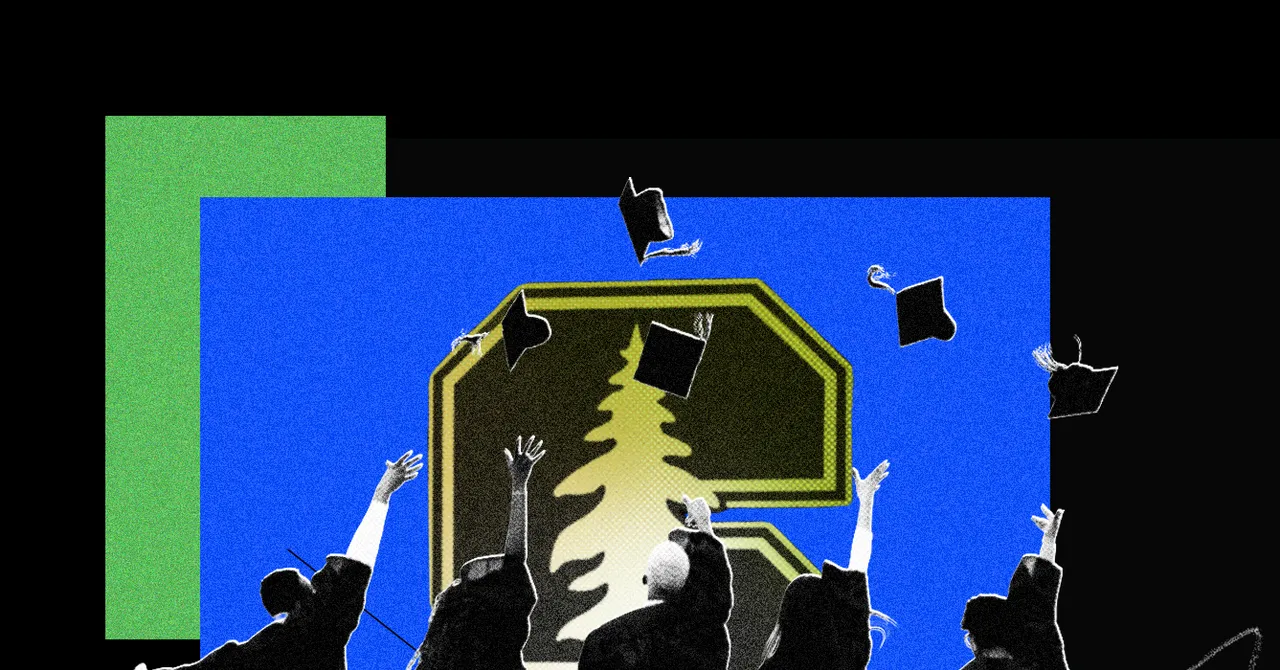
Stanford students who walked out during Google CEO Sundar Pichai’s commencement appearance in June turned a graduation protest into a wider indictment of Big Tech’s ties to government surveillance, military technology, and the war in Gaza. The demonstration, organized by graduating activists Amanda Campos and Eva Jones, drew international attention and became one of the most visible student disruptions of this year’s commencement season.
The walkout mattered because it went beyond a familiar campus objection to artificial intelligence and instead framed Google as a central player in systems students say enable repression at home and abroad. In interviews after graduation, the organizers argued that the issue was not simply whether AI threatens jobs, but whether the technology industry is helping power surveillance, conflict, and political control.
Why Stanford became the stage for a protest about Big Tech
Stanford is not just any university. It sits at the center of Silicon Valley recruiting, startup culture, and the pipeline from elite education into lucrative technology careers. That made Pichai’s presence at commencement especially loaded for students already critical of the industry’s influence on campus life and public policy.
According to the organizers, the decision to confront Google’s chief executive was shaped by years of campus activism around environmental justice, Palestinian liberation, anti-sexual-violence organizing, and opposition to military and surveillance technologies. They described Stanford as an institution deeply entwined with corporate money and tech-sector power, and said they viewed the ceremony as an opportunity to challenge that alignment in public.
What began as a protest against one speaker quickly became a statement about the broader relationship between universities, corporations, and state power. The students said they wanted to push back on what they see as a sanitized narrative of innovation that ignores who benefits from the technology industry and who bears its costs.
How the Stanford walkout was organized
The walkout was not an impulsive interruption. It was planned, coordinated, and paired with a parallel event that the organizers called the People’s Commencement, designed to give graduates and families an alternative ceremony focused on solidarity and social responsibility.
Campos, who studied environmental policy, said her political development began after arriving at Stanford and seeing what she described as the university’s dependence on fossil-fuel money and corporate influence. Jones, whose graduate work included hydrology and water resources, said she arrived already inclined toward activism and then moved deeper into organizing through campus campaigns on sexual violence and Palestine.
Both said the 2023 campus encampment movement for Gaza helped sharpen their understanding of how different activist struggles connect. They argued that the same systems driving environmental destruction, labor exploitation, and military contracting also shape the technology industry’s role in society.
Who were the organizers?
Amanda Campos and Eva Jones emerged as the public faces of the action, but they described the effort as the product of a broader student network. Campos was involved with Stanford Students for Justice in Palestine, while Jones said she had been active in several forms of student organizing before helping lead the graduation protest.
Campos said she had not arrived at Stanford imagining herself as an organizer, but felt pushed into that role by campus politics and by what she saw as an urgent need to act. Jones said she had come to university believing in collective problem-solving and left with a more skeptical view of power, which she now sees as something built through community rather than simply acquired through status.
The organizers said their aim was not simply to reject one speech, but to use graduation day to highlight what they view as Google’s role in systems of surveillance, war, and labor displacement.
What exactly were they protesting?
The students said the demonstration targeted more than AI hype. Their criticism focused on Google’s contracts and technologies tied to the U.S. government, Immigration and Customs Enforcement, and the Israeli government. They pointed in particular to Project Nimbus, the cloud-computing contract Google shares with Amazon for the Israeli government, and to Google services they say are used by U.S. agencies involved in surveillance and enforcement.
Campos argued that the company’s technology is not neutral when it can be used to support surveillance, targeting, or military systems. She said the students wanted to confront a CEO of a company they described as worth trillions and to make visible the consequences of the industry’s business decisions.
Jones expanded that critique by arguing that the protest should be understood as part of a global movement against extraction, disposability, and militarized technologies. For her, the issue was less about a single commencement speaker than about the institutions that channel elite talent into companies that shape warfare, policing, and labor markets.
How did the walkout differ from a standard graduation protest?
The answer is that it was paired with an alternative ceremony and a deliberate effort to reframe graduation itself. Rather than treating the day as a rejection of Stanford, the students portrayed it as a celebration of the education they said they had shaped through activism, often in opposition to the university’s corporate ties.
The People’s Commencement allowed graduates, families, and allies to gather around a different set of speakers and messages. The organizers said the goal was to create a more honest expression of what their time at Stanford had meant: not just prestige and career access, but political education and mutual responsibility.
For Jones, that alternative was especially meaningful because her family had not seen her graduate from high school during the pandemic. She said her parents initially worried that she was giving up a once-in-a-lifetime ceremony, but later came away impressed by the alternative event and by the community surrounding it.
Campos said the chance to have her father and younger sibling at the event gave the action emotional weight. She described the experience as a way of showing younger people that another future is possible and that students can have agency over what their education stands for.
What role did AI play in the backlash?
AI was part of the broader context, but not the sole target. The summer graduation season had already been marked by student anger at speakers who promoted artificial intelligence, and a Gallup survey had found that only a small share of Gen Z respondents were excited about the technology while a much larger share felt anxious about it.
At Stanford, however, the organizers said the concern over AI was inseparable from bigger questions about labor, power, and militarization. Campos said recent graduates are understandably worried about job losses, but argued that the stakes go further than employment.
They said AI systems built by major tech companies can assist surveillance, support military operations, and deepen inequality. In their view, the conversation should not stop with whether AI helps or hurts white-collar careers, but should include the people harmed by the underlying systems.
Why didn’t they focus only on jobs?
Because, the organizers said, a narrow jobs-and-careers framing obscures the deeper political and ethical implications of the technology industry. They argued that reducing the debate to employment risks overlooking how tech companies affect migrants, workers, people in conflict zones, and communities living near data centers and other infrastructure.
Jones said the media often presents student activism around tech as a reaction to the job market or a search for personal advancement. She rejected that framing, saying students are responding to what they see as a global system that extracts resources, intensifies inequality, and normalizes militarized technology.
| Key detail | What happened | Why it matters |
|---|---|---|
| Event | Stanford commencement walkout during Sundar Pichai’s appearance | Turned graduation into a public protest against Big Tech |
| Timing | June 2026 graduation season | Part of a wider wave of student protests at commencement ceremonies |
| Organizers | Amanda Campos and Eva Jones | Graduating students who linked the protest to campus activism |
| Primary targets | Google’s ties to U.S. agencies, ICE, and the Israeli government | Expanded the protest beyond AI concerns to surveillance and war |
| Alternative event | The People’s Commencement | Replaced a traditional ceremony with a politically grounded celebration |
| Public reaction | Videos spread widely online and across major news outlets | Gave the Stanford protest international visibility |
How did the protest spread beyond campus?
The short answer is that it went viral quickly. Video from the walkout circulated widely on social media, and major outlets including CNN and the BBC covered the episode, turning a campus confrontation into a national story about student resistance to the tech industry.
The organizers said they were focused primarily on the politics of the action, not on media performance, though they recognized that visibility mattered. They said student movements are often reduced by outside observers to a personality-driven spectacle, and they wanted their message to remain rooted in collective organizing and global solidarity.
That approach helped distinguish the Stanford protest from a simple anti-AI outburst. By connecting the walkout to Gaza, ICE, military technology, labor, and environmental extraction, the students broadened the frame well beyond a commencement spat.
What does the backlash reveal about students and AI?
The reaction suggests that the generational divide over AI is real and widening. Some students may be using the technology extensively, but the same age group is also increasingly skeptical of the industry’s social impact.
At Stanford, the walkout showed that criticism of AI is not just about fear of automation. It is also about who builds the systems, who profits from them, and how those systems intersect with war, migration enforcement, and corporate power.
That matters because universities like Stanford are not passive bystanders in the AI economy. They train the engineers, produce the research, and help supply the talent that feeds the biggest companies in the sector. When students challenge a commencement speaker, they are also challenging the pipeline that links education to industry.
What comes next for the organizers?
The organizers did not present the walkout as a one-off moment. Instead, they cast it as part of a long campaign to build pressure around climate justice, Palestinian solidarity, anti-surveillance work, and labor rights.
Campos said she sees organizing as a source of hope and empowerment, especially for young people who feel locked out of formal power. Jones argued that the real task is to move people from observation into participation, whether that means campus activism, anti-war organizing, or resistance to the expansion of data centers and military tech.
For both graduates, the Stanford episode was not the end of their political story. It was a proof of concept: students can still interrupt polished narratives about progress, and they can still force public attention onto the institutions and technologies they believe are shaping the future in dangerous ways.
Timeline of the Stanford protest
The walkout evolved over several months, from campus organizing to graduation-day disruption. The sequence below shows how the protest reached a national audience.
| Approximate date | Development |
|---|---|
| 2023 | Student activism around Palestine intensifies on campus, shaping later organizing |
| Early 2026 | Stanford announces Sundar Pichai as commencement speaker |
| Graduation day, June 2026 | More than 100 students walk out during Pichai’s remarks and hold the People’s Commencement |
| Immediately after | Video of the protest circulates broadly on social media |
| Following days | National and international media cover the demonstration |
The larger significance
The Stanford walkout landed at the intersection of several forces reshaping higher education and public life: the rise of AI, the political scrutiny of tech companies, the Gaza war, and a generation of students willing to challenge corporate power in public.
Its significance lies not only in the spectacle of booing a CEO, but in the argument the students made about what education should be for. They rejected the idea that a graduation ceremony should simply celebrate access to elite careers and instead insisted that their diplomas carry obligations to justice, accountability, and collective action.
That message resonates well beyond Stanford. Universities across the country are under pressure to explain their ties to donors, defense contractors, and technology firms, while students are asking whether the institutions shaping their futures are also helping sustain the systems they oppose.
For now, the Stanford protest stands as a sharp example of how campus activism is evolving. It is no longer just about tuition, free speech, or labor rights in isolation. It is about the moral architecture of the tech era itself — who builds it, who benefits from it, and who is expected to live with the consequences.
Frequently asked questions
Why did Stanford students walk out during Sundar Pichai’s speech?
Stanford students walked out to protest Google’s role in what they described as surveillance, militarized technology, and government-backed oppression. Organizers said the action was meant to challenge Google’s contracts and broader influence, not just its artificial intelligence products.
Was the Stanford walkout only about artificial intelligence?
No, the Stanford walkout was not only about artificial intelligence. The organizers said AI was part of the context, but the protest focused more heavily on Google’s ties to the U.S. government, ICE, and the Israeli government, especially Project Nimbus and related technologies.
Who organized the Stanford graduation protest?
Amanda Campos and Eva Jones were two of the public organizers behind the Stanford graduation protest. They said the effort grew out of broader student activism around Palestine, environmental justice, anti-surveillance work, and campus organizing.
What was the People’s Commencement?
The People’s Commencement was an alternative graduation event held alongside the walkout. It gave students, families, and allies a separate ceremony to celebrate their degrees while emphasizing activism, solidarity, and opposition to corporate influence on campus.
Why did the Stanford protest get so much attention?
The Stanford protest got so much attention because it happened during a major commencement ceremony, targeted a high-profile tech chief executive, and connected AI to broader political issues. Videos spread quickly online, and major outlets including CNN and the BBC covered the walkout.