In short
Yelp is launching an AI feature that can call restaurants to check wait times and text the results to users. The company is also expanding its assistant with OpenTable booking, better personalization, lists, reminders, and a new business lead-reply product.
- Check for Me lets Yelp users ask an AI agent to call restaurants and report wait times by text.
- Yelp is pairing the consumer feature with OpenTable reservations, chat memory, reminders and improved lists.
- The company is also launching Smart Lead Reply, a $30 monthly tool for businesses to handle customer inquiries.
- The update reflects a broader shift toward practical AI agents that can complete real-world tasks.
- Yelp plans additional personalization and interface changes, including weekly recommendations and a redesigned lists tab.
Yelp is rolling out a new AI feature that can phone a restaurant for you, ask about wait times, and text the answer back so you can decide whether to head out or make another plan. The update, called Check for Me, expands Yelp’s consumer-facing AI tools and underscores how quickly voice agents are moving from novelty to practical everyday use.
The feature arrives as a wave of AI assistants, including newer consumer tools from startups such as Instinct, Fo, and Muse, begin handling routine calls to businesses for tasks like bookings and customer service. Yelp is now applying that same pattern to one of the most common pre-dinner questions: whether a restaurant can seat you soon, or whether the line is too long to bother.
Alongside the restaurant-calling feature, Yelp is also updating its AI assistant with new reservation tools, deeper personalization, improved history, and new list-building functions. On the business side, the company is introducing a paid product designed to help restaurants and service providers respond to leads faster and qualify inquiries with AI assistance.
What Yelp’s new AI calling feature does
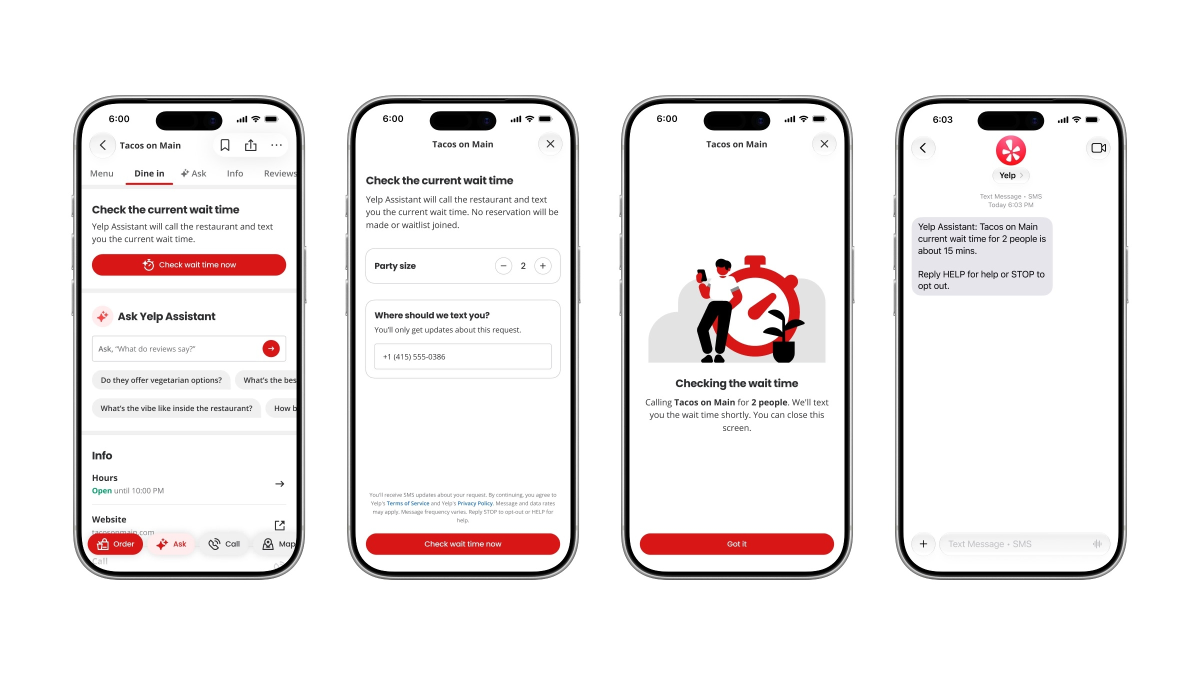
Check for Me lets Yelp users ask an AI agent to call a restaurant on their behalf and check current wait times. The feature appears on restaurant pages inside the Yelp app, where users enter basic details such as party size and phone number before sending the assistant to make the call.
Once the AI completes the call, Yelp texts the result back to the user. That gives diners a faster way to compare options without spending time dialing around themselves, especially during busy meal periods when wait times can change quickly.
The feature reflects a broader shift in consumer AI from text-only chatbots to action-oriented assistants. Rather than simply recommending restaurants, these systems are increasingly being asked to take the next step and complete the task directly.
How it works inside the app
Yelp says the new tool is embedded directly into restaurant listings, which means users do not need to switch to another app or website to use it. The process is designed to be simple:
- Open a restaurant page in Yelp.
- Enter your party size and phone number.
- Ask the AI to call and check the wait time.
- Receive a text message with the result.
That workflow positions Yelp less as a static directory and more as an active planning assistant. The company is betting that consumers will increasingly expect local discovery tools to do more than surface ratings and reviews.
Why Yelp is pushing deeper into voice AI now
Yelp’s latest move makes strategic sense because the company already has a foothold with restaurants and service businesses, and because voice AI is becoming more believable for short, structured conversations. Checking a wait time is a narrow task with a clear goal, which makes it a strong early use case for automation.
The company also introduced voice capabilities for restaurants and service providers last year. This new release fills in the consumer side of that equation, allowing the platform to connect a customer’s question with a business-facing AI layer already in place.
There is, however, a possible weak point: if both sides use agents, the conversation could become machine-to-machine rather than person-to-person. Yelp is effectively entering a world where one AI may be speaking to another AI, and that can create friction if the systems interpret prompts differently or fail to complete the exchange cleanly.
Yelp’s approach suggests the company sees voice AI not as a gimmick, but as a practical layer that can reduce friction in everyday local decision-making.
How Yelp’s assistant is changing beyond wait times
Yelp is not limiting the update to restaurant calls. The company is also upgrading its general AI assistant, which helps users find restaurants and services, with features aimed at making the experience feel more personal and more useful over time.
The changes make Yelp’s assistant more than a search wrapper. The company is trying to build a companion that learns from a user’s preferences, remembers prior chats, and helps organize choices across visits.
OpenTable integration brings booking into the app
One of the most important additions is a new OpenTable integration. With it, users can reserve a table without leaving Yelp, which reduces the steps between discovery and booking.
That matters because restaurant decision-making is often a chain of small actions: search, compare, check availability, book, and then possibly revisit the choice later. Yelp is trying to keep users inside its own ecosystem for as much of that process as possible.
Personalization is becoming a bigger part of the assistant
Yelp is also enhancing the assistant’s memory. It can now remember preferences mentioned in previous chats, which should make recommendations more relevant over time. The company is also adding access to chat history from the past 30 days, with full history due later.
That kind of memory matters because local search is often deeply personal. A user may prefer outdoor seating, a certain cuisine, a price range, or a neighborhood. Recalling those details can make the assistant feel less like a generic search bar and more like a concierge.
What new tools are coming to Yelp chats and lists?
Yelp is expanding the assistant’s utility with reminders and list features that help users organize their interests and return to them later. The company is clearly leaning into a more persistent planning experience rather than one-off search interactions.
Custom reminders for repeat planning
Users will be able to ask the chatbot to create recurring reminders. For example, someone could request weekly suggestions for weekend activities every Friday. That turns the assistant into a lightweight planning tool rather than just a reactive search feature.
New lists aim to make saved places easier to manage
Yelp is also introducing user-created lists, starting with two default options: Been Here and Want to Go. Those lists can be filtered by location, category, and cuisine, then reordered, annotated with notes, and shared with other people.
The ability to share and organize lists suggests Yelp wants users to treat the app as a living local guide, not just a review site. It also creates more opportunities for repeat engagement, since lists naturally invite revisiting, editing, and sharing.
| Feature | What it does | Who it helps | Status |
|---|---|---|---|
| Check for Me | AI calls a restaurant to check wait times and texts the result | Consumers deciding where to eat | Rolling out now |
| OpenTable integration | Allows booking a restaurant without leaving Yelp | Users who want faster reservations | Now available |
| Chat memory | Remembers preferences mentioned in earlier chats | Users seeking personalized recommendations | Now available |
| 30-day chat history | Lets users revisit recent conversations in the app | People comparing past suggestions | Now available |
| Smart Lead Reply | AI product for businesses to respond to and qualify leads | Restaurant and service owners | New paid offering |
What is Smart Lead Reply and who pays for it?
Yelp is also making a business-facing play with a new paid product called Smart Lead Reply. The service is designed to help companies answer customer inquiries, engage with potential customers, and qualify incoming leads more efficiently.
Business owners will pay $30 per month for the service. Yelp says companies can set rules for how the agent should handle a conversation, giving them more control over tone, response style, and likely follow-up behavior.
This is a significant extension of Yelp’s AI strategy because it mirrors a trend seen across the broader tech industry: companies are using AI not only to help consumers discover services, but also to help small businesses manage customer demand more effectively.
The company’s pitch is that AI can save small operators time by handling the first layer of communication before a human needs to step in.
How Yelp fits into the larger AI assistant race
Yelp’s update lands during a broader surge in agent-style AI features. New and emerging assistants are increasingly being trained to make calls, book appointments, and handle simple transactions on behalf of users.
That trend matters because it shows where consumer AI may be heading: not just answering questions, but completing specific tasks in the real world. Calling a restaurant may seem small, but it is representative of a larger shift toward delegating practical errands to software.
Yelp is well-positioned in that race because local commerce already depends on phone calls, reservations, and service inquiries. That makes it a natural testing ground for AI tools that bridge digital discovery with offline action.
Why local discovery is a strong use case for agents
Local business interactions are often repetitive, time-sensitive, and structured. Users want fast answers to questions such as:
- Is there a table available tonight?
- How long is the wait?
- Can I book now?
- Is this place busy on weekends?
Because those requests are so common, they are ideal candidates for automation. An AI agent can potentially save users time while helping businesses capture interest more quickly.
How businesses may benefit — and what the risks are
For restaurants and service providers, AI tools like these could increase lead quality and reduce the number of missed opportunities. Instead of forcing customers to wait for a callback or abandon the process, an automated agent can respond immediately.
But there are trade-offs. AI-driven customer interactions can feel impersonal, and if a business relies too heavily on automation, it may frustrate customers who want a human answer. There is also the technical risk that two AI systems, each interpreting intent differently, could miscommunicate or stall the exchange.
That tension will likely define the next phase of AI in local commerce. Businesses want speed and efficiency; customers want convenience without losing clarity or trust.
Timeline of Yelp’s recent AI expansion
Yelp’s latest move did not happen in isolation. It builds on a series of smaller steps that show the company steadily weaving AI into both consumer and business workflows.
| Timeframe | Yelp AI development | Why it matters |
|---|---|---|
| Last year | Introduced a voice solution for restaurants and service providers | Laid the groundwork for AI-driven business communication |
| Recent weeks | Marketed new consumer AI tools such as Check for Me | Extended voice AI to the customer side |
| Current update | Added OpenTable booking, memory, chat history, reminders, and list tools | Expanded the assistant into a broader planning platform |
| Next month | Weekly personalized recommendations based on saved items and rankings | Increases recurring engagement and personalization |
| Later this year | Lists tab redesign, conversion from collections to lists, and a map view | Improves navigation and strengthens the discovery experience |
What comes next for Yelp’s app?
Yelp says more personalization and interface changes are on the way. Next month, the app will begin showing weekly personalized recommendations based on saved items and user rankings. Later in the year, the company plans to redesign the lists tab, convert collections into lists, and add a map view.
Those changes suggest Yelp is aiming for a cleaner, more dynamic consumer experience that blends search, planning, reminders, and reservations. Instead of being just a place to read reviews, the app is becoming a decision-making hub.
That may be the right response to the current AI wave. As more digital tools promise to act on behalf of users, services that already sit at the point where people choose where to eat, book, or go next have a strong incentive to become more conversational and more automated.
For Yelp, the challenge will be execution. The company must prove that AI can make local discovery faster without making it confusing, and helpful without making it feel detached. If it can do that, the restaurant wait-time call may be the start of a much broader transformation.
Bottom line
Yelp is adding an AI feature that can call restaurants for users, check wait times, and text back the result, while also expanding its assistant with bookings, memory, reminders, and lists. The move pushes Yelp further into the emerging market for practical AI agents that handle real-world tasks, not just conversation.
Frequently asked questions
What is Yelp’s new Check for Me feature?
Yelp’s Check for Me feature is an AI tool that can call a restaurant on a user’s behalf, ask about wait times, and text the answer back. It appears on restaurant pages in the Yelp app and is meant to help people decide where to eat faster.
How does Yelp’s AI restaurant calling work?
Yelp’s AI restaurant calling works by asking the user for basic details such as party size and phone number, then having an AI agent place the call. After the restaurant responds, the app sends the result to the user by text message.
Is Yelp adding booking features too?
Yes. Yelp is also adding an OpenTable integration that lets users book a restaurant without leaving the app. That makes the platform more useful for both discovery and reservation, rather than just reading reviews and searching for options.
What is Smart Lead Reply on Yelp?
Smart Lead Reply is a new paid business product that helps owners respond to customer inquiries and qualify leads with AI. Yelp says businesses can control how the agent handles conversations, and the service will cost $30 per month.
Why does Yelp’s AI update matter?
Yelp’s AI update matters because it shows local discovery apps moving beyond recommendations into task completion. Instead of only suggesting restaurants, Yelp is using AI to help users check availability, book tables, and manage planning in one place.