In short
Eka Robotics raised $150 million at a $1.45 billion valuation after impressing experts with a force-sensitive physical AI system for robot manipulation. The company says its model can handle thousands of objects per hour and may help robots safely master dexterous tasks.
- Eka Robotics closed a $150 million Series A at a $1.45 billion post-money valuation.
- The startup’s system uses a vision-force-action model and a specialized gripper to improve dexterous manipulation.
- Eka says its robot can pick up about 1,500 objects per hour with more than 95% reliability.
- Experts say the demo stands out for its speed, adaptability and delicate handling of fragile objects.
- The company is now testing industrial pilots, but real-world durability and generalization remain key questions.
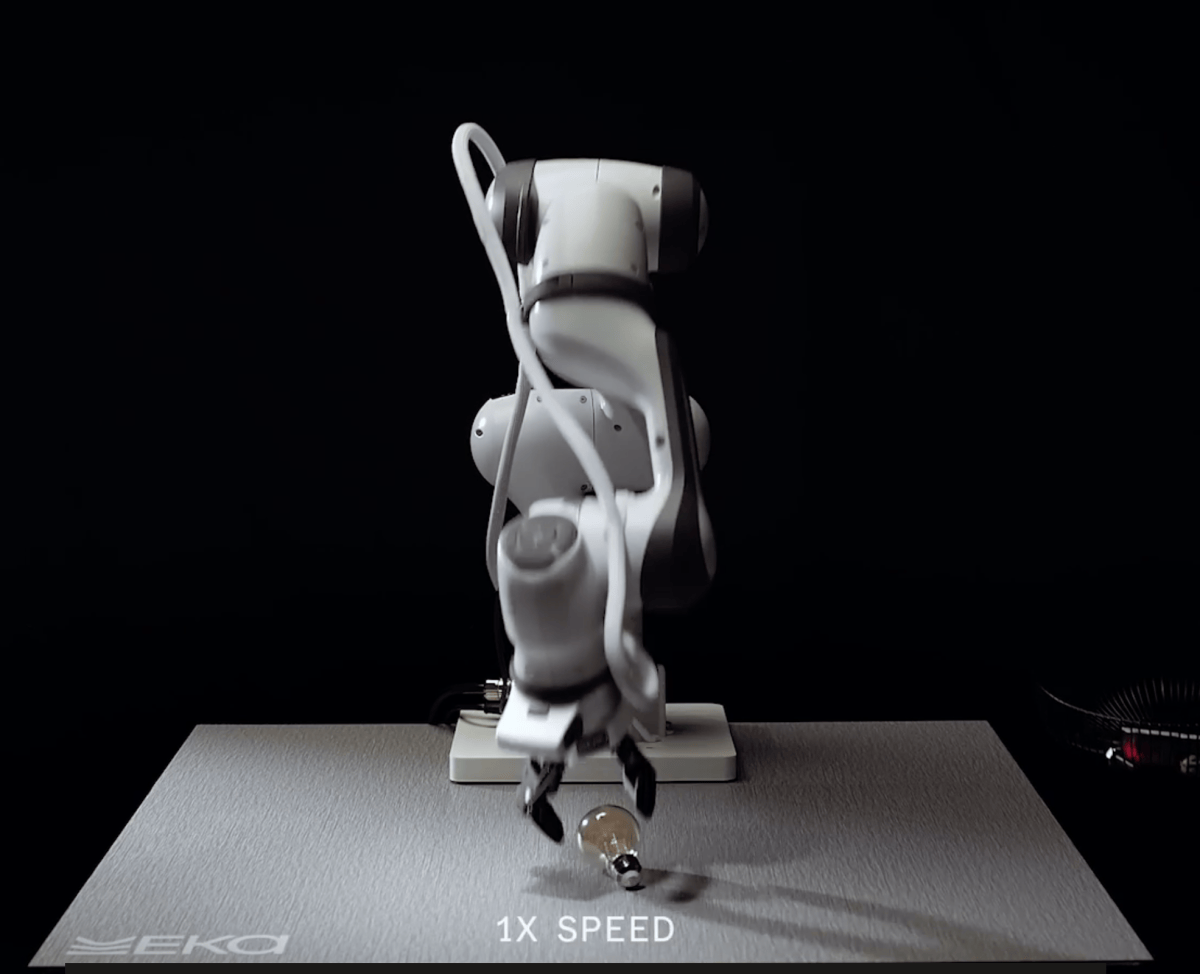
Eka Robotics has raised $150 million in a Series A round that values the company at $1.45 billion after money, a dramatic vote of confidence for a startup building what many in the robotics world have long wanted: a machine that can reliably pick up fragile and varied objects without crushing them. The funding was led by a16z and F-Prime and follows a wave of excitement around Eka’s physical AI system, which blends a force-sensitive gripper with a new deep-learning model.
The company’s pitch matters because robotics has spent years promising dexterity while continuing to struggle with one of the most basic industrial actions: grasping things safely and quickly. Eka says its system can handle around 1,500 objects per hour, with a success rate above 95%, and that it can outperform humans on certain pick-and-place tasks. If those claims hold up in real deployments, the startup could help reset expectations for automation in factories, warehouses and other settings where fine manipulation still depends heavily on people.
Founded by MIT professor Pulkit Agrawal and former Google DeepMind researcher Tuomas Haarnoja, Eka is part of a broader race to move AI from software into the physical world. But unlike many robotics efforts that lean on vision alone, Eka’s system is built around force, touch and reinforcement learning, a technical choice that some veteran researchers say could prove decisive.
Why Eka’s $1.45 billion valuation stands out
Eka’s valuation reflects more than just investor enthusiasm for AI. It signals that venture backers think robotics is approaching a turning point where physical manipulation can become both capable and commercially useful.
Robotics startups often raise money on the promise that models will eventually generalize across tasks and environments. The hard part has always been execution: a robot that can recognize an object is not the same as one that can grasp it gently, adjust to pressure, avoid slipping and complete thousands of cycles without failure. Eka’s backers appear to believe the company has made meaningful progress on that last mile.
According to a16z general partner Raghu Raguram, who co-led the financing, Eka’s system is already surpassing human performance in some tasks, and he expects broader superhuman dexterity in the near future. That is an unusually strong endorsement in a field that is still notorious for overpromising and underdelivering.
Raguram said the company is already beating people on some manipulation tasks and suggested that, within months, the system could reach superhuman performance across more dexterous work.
How Eka’s robot differs from typical AI robotics
Eka says the key difference is that it does not rely on the standard vision-language-action approach used by many modern robotic systems. Instead, it uses a vision-force-action architecture that places much more emphasis on contact, resistance and the physical feedback a robot gets when it touches an object.
That distinction may sound subtle, but it goes to the core of why robot hands remain so difficult to engineer. Cameras can estimate where an object is and how it sits in space. They cannot, by themselves, tell a robot exactly how much pressure to apply, when to adjust a grip, or how to recover when an object shifts in the hand.
Agrawal, Eka’s co-founder, argues that vision is useful for coarse positioning, but that the crucial part of grasping happens at the final millimeter, where force and touch determine success or failure. In his view, that is where many robotics systems break down.
What makes the gripper unusual?
The robot’s hand is designed to be more compliant than many conventional grippers and includes additional force sensors that let it respond to contact in real time. That responsiveness is why the system can interact delicately with objects such as a raspberry without simply crushing them.
The founders are not spelling out every engineering detail, but they say the model is built on a physics simulator that exposes the robot to many possible force interactions before deployment. That simulator feeds a reinforcement learning pipeline that can be run at large scale, allowing the company to generate what it describes as thousands of hours of robot experience in minutes.
Why experts say the demo feels different
Eka’s demonstrations have made an impression on researchers who have seen many robotic systems come and go. Several experts described the performance as unusually compelling, not just because it works, but because it appears fast, adaptive and physically cautious at the same time.
Kris Hauser, a University of Illinois Urbana-Champaign professor, said the demo had a strong visual impact and that the robot could adjust to many different objects without needing retraining. He also noted what he called a strangely human quality in the robot’s repeated attempts after an initial failure.
A separate roboticist with a frontier lab background, who asked not to be identified, said the demonstration felt emotionally significant, comparing it to the moment when legged robots first became dependable several years ago. The observer was especially struck by the speed and the way the machine slowed down at the last instant to avoid causing harm.
In one test, Eka handed the robot a raspberry, an object that would be easy to damage with a clumsy grip. The machine approached quickly, then eased off just before contact, touching the object gently. For experts accustomed to brittle demos, that kind of control can be more persuasive than a flashy but unreliable stunt.
What are the performance claims?
According to Eka, the system can pick up roughly 1,500 objects per hour and can manage items weighing up to 1 kilogram. The company says its success rate is above 95%, which would be a substantial benchmark if validated consistently outside the lab.
Those numbers matter because manipulation speed and reliability are central to whether robots can replace or augment human labor in real workflows. A robot may be impressive in a showcase, but if it slows an entire line, damages products or requires constant resets, the economics collapse quickly.
| Metric | Eka Robotics claim | Why it matters |
|---|---|---|
| Objects handled per hour | About 1,500 | Suggests high throughput for industrial pick-and-place work |
| Human comparison | About 600 per hour | Indicates potential speed advantage over manual labor |
| Success rate | More than 95% | Critical for dependable factory or warehouse deployment |
| Object weight range | Up to 1 kg | Shows capability across small consumer and industrial items |
| Gripper cost | Less than $1,000 | Lower hardware costs could improve commercial viability |
How does Eka train the model?
Eka’s approach is rooted in reinforcement learning, a method that lets a system improve by repeatedly trying actions and learning from success or failure. Rather than depending primarily on human demonstrations or video examples, the company says it uses simulation to expose the robot to many forms of physical interaction at scale.
That is an important strategic choice. In robotics, collecting real-world training data can be slow, expensive and messy. Human operators may need to perform the same task over and over to create examples, and even then, the range of possible object shapes, weights, textures and failure modes is limited. Simulation gives Eka a way to expand that dataset much more quickly.
Agrawal and Haarnoja have spent years working on reinforcement learning for robotic control, and Eka’s strategy builds on that background. The company believes the biggest opportunity is not simply teaching robots to imitate people, but creating systems that can improve beyond the level of the demonstrations they receive.
Hauser said the most interesting part of the approach is that it is not constrained by the limited examples fed into training. In his view, the robot can move beyond imitation and generate behavior that exceeds the data source.
Why simulation matters so much
Simulation is especially powerful for tasks that involve contact, because the robot can practice a huge number of possible force interactions without damaging real hardware. Eka says that this process allows it to generate the equivalent of thousands of hours of experience in a short time, which could accelerate iteration in a way traditional data collection cannot match.
That said, simulation-to-real transfer remains one of robotics’ most stubborn problems. A model can perform beautifully in a virtual environment and still struggle when faced with small physical differences in a real factory. Eka’s challenge is to show that its system can bridge that gap consistently.
What problem is Eka trying to solve?
Eka is trying to close the gap between generality and performance, a long-running problem in modern robotics. Broadly capable systems often work too slowly or unreliably to be useful. Highly specialized systems can be strong at one task but fail to adapt when the environment changes.
The company’s thesis is that the industry has spent too much time focusing on high-level planning while underinvesting in the mechanics of physical execution. In Eka’s view, robots need both an intelligent planning layer and a lower-level manipulation system that can actually carry out the movement without ruining the object in hand.
That distinction matters because many AI robotics efforts stop at the decision-making step. A model might know what to do in theory, but if the hand cannot grasp, adjust and release properly, the entire system stalls.
How Eka fits into the broader AI wave
The startup’s rise comes as the robotics industry is being reshaped by the same generative AI boom that transformed text, images and code. Large language models have made it easier to create systems that can understand instructions, reason through plans and coordinate actions. But physical work still depends on robust control, which is a much harder engineering problem.
Other AI systems can help a robot figure out what to do. Eka is trying to make sure the robot can actually do it.
What the company is doing in industry pilots
Eka says it is already working with a number of industrial customers in secretive pilot projects. The current applications reportedly include pick-and-place operations and wire manipulation, both of which require fine motor control and a high tolerance for variation.
Those use cases are a sensible starting point. They are complex enough to prove the value of the technology, but narrow enough that a startup can focus its engineering on a few repeatable workflows before attempting a broader platform strategy.
Still, industry pilots are not the same as sustained production use. A system that impresses in controlled testing must survive messy real-world conditions, shifting schedules, worn equipment, operator turnover and the constant pressure to run without downtime.
Hauser warned that the real test will come when the system is integrated into factory lines and has to operate continuously for long periods without failing.
What are the biggest risks ahead?
Even with strong investor backing and impressive demos, Eka faces several major hurdles before it can prove the business case for its technology. The first is reliability over time. A robot that works in a lab one afternoon is different from a machine expected to perform day after day in a plant.
The second is generalization. Pick-and-place is useful, but many higher-value industrial jobs involve additional steps such as sorting, assembly, alignment, inspection or tool use. It is not yet clear how far Eka’s force-first approach can stretch beyond its current core tasks.
The third is hardware durability. Agrawal says the company’s gripper costs less than $1,000 and is rated for 5 million duty cycles, but the longer-term goal is to reach 20 million cycles, the benchmark commonly associated with standard industrial arms. That gap highlights how far the company still has to go on wear, robustness and maintainability.
- Reliability: Can the robot run continuously without frequent failures?
- Generalization: Can the system do more than a narrow set of picking tasks?
- Durability: Can the gripper withstand industrial-scale use?
- Integration: Can it fit into real factory workflows and automation stacks?
- Economics: Does the performance justify the capital and operating cost?
How big could the opportunity be?
If Eka’s technology performs as advertised in industrial settings, the market opportunity could be significant. Fast, reliable manipulation is a foundational capability for many sectors, including logistics, electronics assembly, packaging and light manufacturing. In those environments, a robot that can safely handle many object types without custom retraining could reduce labor bottlenecks and improve throughput.
The larger promise is not just one robot arm doing one job. It is a workflow engine that can be adapted to new tasks without rebuilding the system from scratch each time. That is the kind of flexibility many industrial customers want, especially as supply chains and product mixes change more frequently.
Agrawal has described Eka’s ambition as starting with a couple of practical verticals and then expanding from there. The company’s immediate focus is on proving home-run use cases in areas such as arrangement, placement and wire handling before attempting broader deployment.
Timeline of Eka’s rise
The company’s journey reflects a broader shift in robotics, from brute-force mechanical automation toward data-driven physical intelligence.
| Stage | What happened | Why it matters |
|---|---|---|
| Research roots | Agrawal and Haarnoja developed expertise in reinforcement learning for robotics | Built the technical foundation for Eka’s approach |
| Startup formation | The founders launched Eka Robotics to focus on dexterous manipulation | Turned academic research into a commercial bet |
| Model development | The company built a vision-force-action architecture and a specialized gripper | Created a differentiated physical AI system |
| Investor validation | Eka closed a $150 million Series A at a $1.45 billion post-money valuation | Showed strong market confidence in the technology |
| Next phase | The company is testing pilots with industrial customers | Will determine whether the demo translates into revenue |
What this means for the robotics race
Eka’s funding round is another sign that investors now see robotics as one of the next major frontiers for AI commercialization. After years of hype, the field appears to be shifting toward systems that are less theatrical and more practical, with an emphasis on real tasks that can be measured, repeated and monetized.
If the company succeeds, it could influence how other robotics firms design their models. More emphasis may be placed on touch, force and physical feedback rather than treating vision as the primary path to dexterity. That could reshape how the next generation of robots is trained, deployed and sold.
But Eka’s real test is still ahead. For now, the company has done what many robotics startups struggle to do: persuade top-tier investors and respected researchers that something genuinely new is happening. The market will now wait to see whether those promising demos can become durable industrial systems.
In a field full of polished prototypes, that may be the most important challenge of all.
Frequently asked questions
What is Eka Robotics?
Eka Robotics is a robotics startup founded by MIT professor Pulkit Agrawal and former Google DeepMind researcher Tuomas Haarnoja. The company is building physical AI systems for dexterous manipulation, using a force-sensitive gripper and a reinforcement-learning-based model to help robots handle objects more reliably.
How much funding did Eka Robotics raise?
Eka Robotics raised $150 million in a Series A round. The financing valued the company at $1.45 billion post-money and was led by a16z and F-Prime, reflecting strong investor interest in robotics systems that can do more than basic perception or planning.
Why are researchers excited about Eka’s robot demo?
Researchers are excited because the robot appears fast, adaptive and unusually careful with fragile objects. Experts said it could adjust to many items without retraining and demonstrated a kind of tactile control that many robotics systems still lack, especially when dealing with delicate objects like a raspberry.
What makes Eka’s approach different from other AI robots?
Eka’s approach is different because it emphasizes force and touch rather than relying mainly on vision-language-action models. The company says manipulation depends on the final physical contact phase, where sensors, grip adjustment and reinforcement learning matter more than simple visual recognition.
Is Eka’s technology already being used in factories?
Eka says it is running secretive pilot projects with industrial customers, including work on pick-and-place and wire manipulation. The technology is not yet proven at full scale in long-term factory operations, so the company still has to show it can run reliably in real production environments.