In short
Moonshot AI and Alibaba have released new frontier models that intensify pressure on US AI leaders. The launches highlight China’s growing competitiveness on performance, pricing and open-weight access.
- Moonshot AI’s Kimi K3 and Alibaba’s Qwen3.8 are being framed as credible challengers to top US models.
- The bigger issue is not a one-off surprise, but China’s sustained progress in frontier AI.
- Lower prices and open-weight plans could make Chinese models attractive to startups and enterprises.
- The releases raise questions about US AI valuations, infrastructure spending and cybersecurity risk.
Two new Chinese AI systems released this month have intensified pressure on OpenAI, Anthropic and the broader US tech sector, not because they appeared out of nowhere, but because they further confirm a trend that has been visible for years: China is now producing frontier-grade models with enough regularity to challenge American assumptions about AI leadership.
Moonshot AI’s Kimi K3 and Alibaba’s Qwen3.8 have prompted fresh talk of a technological “wake-up call,” but the bigger story is that the surprise should have worn off by now. Their launch has rattled investors, revived debate over US spending on chips and data centers, and raised new questions about the economics, security risks and market power of the global AI race.
For much of the past year, each major Chinese model release has been framed as a dramatic turning point. The real significance is more structural: Chinese firms are now releasing systems that appear capable of competing with top Western models on performance, while often undercutting them sharply on price and, in some cases, offering more permissive deployment terms.
What happened with Kimi K3 and Qwen3.8?
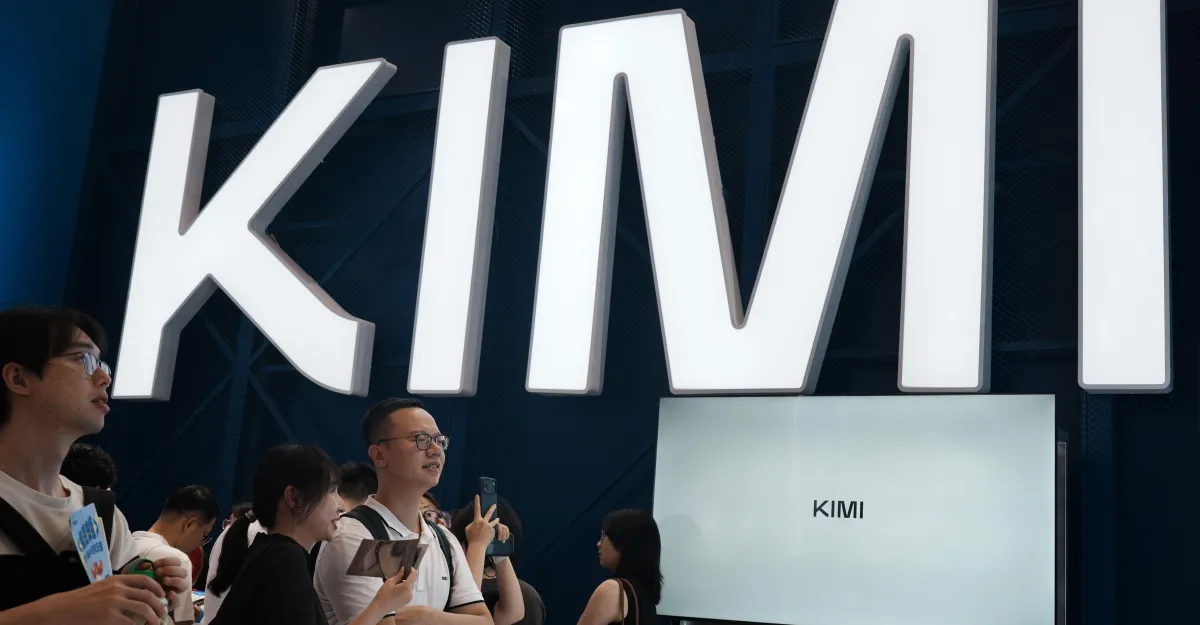
Moonshot AI and Alibaba each unveiled a new flagship model that they say can compete with the most advanced systems in the world. Moonshot launched Kimi K3 first, describing it as a model that sits just behind OpenAI’s GPT-5.6 Sol and Anthropic’s Claude Fable 5 in benchmark performance. Alibaba then introduced Qwen3.8, calling it one of the strongest models available and placing it just below Claude Fable 5 in its own ranking.
The immediate market reaction was familiar: analysts and commentators treated the releases as if they represented a sudden shift. Media coverage described the models as an unexpected breakthrough, while some investors interpreted the launches as a fresh threat to the economics of the US AI boom. The comparison to Sputnik quickly surfaced again, echoing the language used around DeepSeek’s earlier arrival.
But the notion that the release of a strong Chinese model is a complete surprise is increasingly hard to sustain. Chinese labs have been closing the gap for some time, and a growing share of the global AI leaderboard is already occupied by Chinese systems.
Why are these launches getting such a big reaction?
They matter because they challenge a central belief underpinning the US AI industry: that American companies will remain the default leaders in frontier AI, command the highest prices, and ultimately capture the lion’s share of global demand.
That belief is embedded not only in company valuations but also in the investment case for the wider AI infrastructure boom. If Chinese firms can offer models that are nearly as capable, easier to access, or much cheaper to run, customers may not remain loyal to US providers simply out of habit or prestige.
The reaction is also being amplified by the scale of money involved. US tech giants and AI labs have poured enormous sums into chips, cloud infrastructure, and data-center buildouts on the assumption that demand for American frontier models will keep rising. Any sign that customers could shift some of that spending toward Chinese alternatives threatens the returns on those bets.
How close are Chinese models to the US frontier?
They are close enough to matter commercially, even if the exact technical ranking remains uncertain. OpenRouter’s leaderboard, which tracks token consumption and benchmark performance, has shown a significant Chinese presence among the most-used tools. In the source material, six of the top 10 AI tools on that leaderboard were Chinese, underscoring how quickly the competitive landscape has evolved.
Recent models from companies such as DeepSeek and Z.ai have also drawn attention for reaching performance levels that make them credible alternatives to leading Western systems in at least some tasks. The implication is not necessarily that Chinese models have definitively overtaken the US frontier across the board. Rather, they are now competitive enough that the old expectation of a large and stable gap no longer holds.
That matters because even a narrow performance gap can be commercially irrelevant if the Chinese option is cheaper, more accessible, or easier to deploy in practice.
| Model | Company | Public positioning | Pricing cited in source | Deployment approach |
|---|---|---|---|---|
| Kimi K3 | Moonshot AI | Claims near-top-tier performance, behind the leading US models | About $15 per million output tokens | Planned open-weight release |
| Qwen3.8 | Alibaba | Described as one of the strongest models available | Not specified | Planned open-weight release |
| GPT-5.6 Sol | OpenAI | Used as a benchmark leader in the source comparison | About $30 per million output tokens | Closed/proprietary |
| Claude Fable 5 | Anthropic | Used as a benchmark leader in the source comparison | About $50 per million output tokens | Closed/proprietary |
What makes China’s AI strategy different?
China’s strategy combines industrial policy, state support and market pressure in a way that the United States has not matched consistently.
Beijing has encouraged domestic AI development through funding, policy support and a broader push to reduce dependence on foreign technology. The state has also sought to limit firms from distancing themselves from China, reinforcing the idea that AI leadership is a national strategic priority rather than just a commercial opportunity.
By contrast, Washington has often oscillated between heavy-handed intervention and a more hands-off reliance on market forces. That makes it harder to sustain a single, coherent long-term strategy when facing a rival willing to align state power, capital and industrial policy around one technological objective.
How does open-weight AI change the competition?
Open-weight releases lower the barrier for developers, startups and enterprises to use advanced models without depending entirely on a single vendor’s hosted service. Both Moonshot and Alibaba say they intend to release their new systems as open weight, meaning users can download the core trained parameters and adapt them for their own purposes.
That is a direct contrast to the closed-model strategy used by OpenAI, Anthropic and Google. It also gives Chinese companies a distribution advantage in markets where customers want control, customization or lower deployment costs.
Open-weight systems can spread quickly because they can be hosted independently, tuned for specialized tasks and embedded into products without the same vendor lock-in. For developers, that can be attractive. For US AI companies, it is a competitive problem.
Why the price gap matters more than the benchmark gap
Price may turn out to be the more important variable than raw benchmark score. In the source material, Moonshot’s Kimi K3 is said to cost roughly half as much as OpenAI’s GPT-5.6 Sol and less than one-third the price of Anthropic’s Claude Fable 5 on an output-token basis.
That comparison is imperfect, and economists caution against treating token prices as a direct measure of total cost. Models vary in efficiency, quality, tokenization and response length. A model with a higher per-token rate may still be cheaper to use if it answers more effectively or with fewer tokens.
Even so, pricing remains a critical commercial signal. AI companies often subsidize inference to win customers, and enterprises are increasingly sensitive to usage-based costs. If a Chinese model can deliver “good enough” quality at a substantially lower price, many businesses will consider it seriously regardless of prestige or national origin.
Chinese labs are not just chasing a technical milestone; they are increasingly shaping the market with cheaper, more accessible alternatives that can change buyer behavior even without a decisive performance lead.
Could Chinese models reshape the AI market?
Yes, because a small gap in capability does not necessarily translate into a small gap in business impact. A model that is slightly weaker than the US frontier can still win customers if it is cheaper, easier to deploy or available under friendlier terms.
That is what makes the latest releases strategically important. They may not need to be the single best systems in the world to alter purchasing decisions across startups, enterprises and public-sector organizations. They only need to be good enough to become a practical substitute in a growing number of use cases.
If that happens, the consequences could extend beyond AI vendors themselves. Cloud providers, chipmakers, data-center operators and energy companies have all benefited from expectations that the frontier AI buildout will continue at high speed and high cost. If demand fragments or pricing power weakens, the ripple effects could be wide.
Who stands to lose first?
US AI startups may feel the pressure earliest. Companies that rely on model APIs for product development are already sensitive to rising costs, and some are reportedly turning to Chinese alternatives when domestic options become too expensive.
Large incumbents are not immune either. OpenAI and Anthropic are both viewed as candidates for enormous future IPOs, with valuations built on the expectation that they can dominate a huge global market. The rise of competitive Chinese alternatives makes that assumption less secure.
Investors in the broader tech sector also have a lot at stake. Tech stocks make up a large share of major US indexes, and AI enthusiasm has played a central role in pushing those valuations higher. If the market begins to believe the spending spree on chips, servers and power infrastructure may not produce the expected returns, the correction could extend well beyond AI names.
What are the security concerns?
The security implications are serious because open-weight models can be widely distributed and adapted outside the control of the company that built them. That increases the likelihood that advanced tools could be used by both defenders and attackers.
One emerging concern is that organizations restricted from using certain US systems may look for alternatives elsewhere, including China. In some cases, those alternatives may be less restricted or more willing to assist on sensitive tasks such as cybersecurity analysis.
The source material notes that some reports suggest Kimi K3 has already been used to identify and fix vulnerabilities that OpenAI’s Codex and Anthropic’s Fable reportedly declined to address because of safety constraints. Even if such examples remain anecdotal, they point to a real dilemma: safeguards that make a system safer can also make it less useful for legitimate security work.
How do safety rules affect adoption?
Safety rules can reduce misuse, but they can also create friction for developers, researchers and defenders who need powerful tools to examine code, test systems and find weaknesses.
That tension has become more pronounced as frontier models grow more capable. When a US company tightens access or imposes more restrictions, the market does not simply stop needing the capability. It may instead search for a less constrained substitute.
This is one reason open-weight Chinese models are strategically important. They may not only compete on cost and performance; they may also compete by offering a different balance between access and safeguards.
Can the benchmark claims be trusted?
Only cautiously. Both Kimi K3 and Qwen3.8 have not yet been fully released at the time of the source report, so independent verification of their full capabilities remains limited.
Benchmark claims always deserve skepticism, especially when companies have strong incentives to present their products in the best possible light. Tests can be gamed, tuned or selectively emphasized. Token counts can be misleading. Real-world use cases can differ substantially from benchmark conditions.
Still, the source notes that there has been little public evidence suggesting that Moonshot or Alibaba are wildly misrepresenting their results. That does not prove their claims are fully accurate, but it does suggest the releases are being taken seriously by the market and by technical observers.
| Milestone | Approximate timing | Why it mattered |
|---|---|---|
| DeepSeek shocks the market | Last year | Showed a Chinese model could upend assumptions about frontier AI costs |
| Kimi K3 launch | Friday, last week | Reignited investor fears and renewed “Sputnik moment” language |
| Qwen3.8 preview | Days later | Added momentum to the argument that Chinese frontier models are arriving in sequence, not as one-off anomalies |
| Broader market reassessment | Ongoing | Could affect valuations, infrastructure spending and enterprise AI procurement |
Why this is not another “Sputnik moment”
The analogy is overused because it implies a single dramatic event has suddenly revealed a hidden national weakness. The reality is more gradual and more uncomfortable: China has been building a credible AI ecosystem for years, and the latest model launches are simply the newest evidence of that trend.
Calling every strong Chinese release a “Sputnik moment” risks understating what is actually happening. Sputnik was shocking because it was unexpected. Chinese AI progress should not be. Governments, investors and companies have been warned repeatedly that China was catching up.
The issue now is not whether the warning signs existed. It is whether US policy, business strategy and market expectations have caught up with them.
What happens next?
The near-term question is whether Kimi K3 and Qwen3.8 prove to be as strong in real-world use as their makers claim. If independent testing confirms the performance, they could accelerate a broader shift toward Chinese AI systems in certain segments of the market.
The longer-term question is harder: whether the US model has become too expensive to sustain. If frontier AI remains dependent on enormous capital outlays while Chinese rivals deliver comparable results at lower cost, the competitive advantage may shift from technical prestige to economic efficiency.
That would have consequences for product strategy, procurement, investor expectations and national security planning. It would also make future headlines about Chinese AI breakthroughs feel less like breaking news and more like a normal feature of the global technology landscape.
In other words, the real warning is not that China surprised Silicon Valley once again. It is that the industry still behaves as if it expects to be surprised, even as the evidence of sustained Chinese progress becomes harder to ignore.
Key facts at a glance
- Moonshot AI launched Kimi K3 and Alibaba previewed Qwen3.8.
- Both firms say the models are competitive with leading US systems.
- The companies plan open-weight releases, unlike most major US frontier labs.
- Moonshot’s pricing claim is about $15 per million output tokens, well below the cited US comparators.
- The releases have renewed debate over AI valuations, infrastructure spending and security risks.
The broader lesson is that China’s AI progress should no longer be treated as an anomaly; it is now a recurring feature of the frontier market.
Frequently asked questions
What are Kimi K3 and Qwen3.8?
Kimi K3 and Qwen3.8 are new large AI models from Moonshot AI and Alibaba. Both are being positioned as frontier systems that can compete with leading US models on capability, while offering lower-cost or more open deployment options.
Why are investors worried about Chinese AI models?
Investors are worried because Chinese AI models could undercut US pricing and weaken the assumption that American labs will dominate the global market. That could affect valuations at OpenAI and Anthropic, as well as spending on chips, cloud infrastructure and data centers.
Are Chinese AI models really cheaper?
Yes, in the examples cited they are significantly cheaper on a token basis, but token pricing does not tell the whole story. Total cost depends on quality, efficiency, response length and whether providers subsidize usage to gain customers.
Will Moonshot and Alibaba make the models open source?
Not exactly. The companies say they plan to release the models as open weight, which means users can download and modify the trained parameters. That is more permissive than the closed approach used by most leading US AI labs, but it is not the same as fully open source code and training data.
Why does open-weight AI matter for security?
Open-weight AI matters because it can be widely deployed and adapted outside a single company’s control. That can help defenders, but it can also make powerful tools easier for attackers to access, especially if US providers impose stricter safety limits.