Updated September 3, 2026 7:55 pm
In short
Nvidia’s PAIR is now in beta, with six-digit pairing and encrypted setup, while Nvidia is also helping three agent apps get easier local installs on Windows GPUs.
- PAIR is Nvidia’s free open-source software for pooling idle home computers into a local AI system.
- The tool supports RTX 20-series and newer GPUs, RTX Pro, DGX Spark, and Apple M4 or newer devices.
- Nvidia says PAIR is built for local inference and agent workflows, with dynamic load sharing when devices become busy.
- The software uses a six-digit pairing code and mTLS encryption to secure device connections.
- Nvidia also announced easier local setup for Perplexity Portable Computer, Hermes Agent, and OpenClaw on Windows.
Update — September 3, 2026 7:55 pm
Nvidia says PAIR is available now in beta, rather than just being announced as an upcoming tool.
The company also says the software has six-digit pairing-code setup with mTLS encryption, and that it works on Windows, Linux, and macOS.
Separately, Nvidia is lining up simpler local-install options for three agent apps — Perplexity Portable Computer, Hermes Agent, and OpenClaw — on Windows systems with Nvidia GPUs.
Nvidia has released PAIR, a free open-source tool that links idle home computers into a shared local AI system for running inference and agentic workflows. The software matters because it lets everyday users pool the unused power of a desktop, laptop, or MacBook instead of relying entirely on cloud servers.
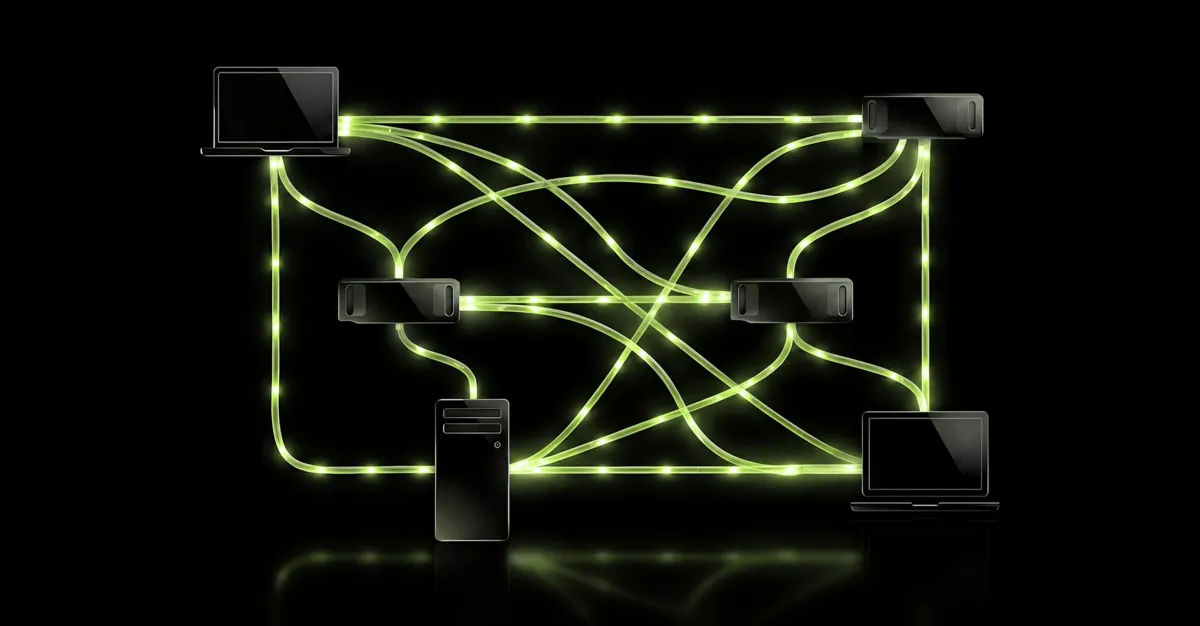
The Personal AI Router, as Nvidia calls it, is not a physical networking device. It is software that discovers compatible machines on the same network, connects them securely, and distributes AI tasks across them when they are not being used for other work.
What Nvidia launched at IFA 2026
Nvidia unveiled PAIR during IFA 2026, positioning it as a practical way to make local AI more accessible to people who already own multiple capable computers. The company’s pitch is straightforward: if a home has more than one reasonably powerful machine sitting idle, those devices can be organized into a private AI compute pool.
That approach reflects a broader shift in AI use. As more applications move from simple chat to multi-step agent workflows, the demand is no longer just for a single fast response. Users increasingly want systems that can search, summarize, plan, and execute several smaller tasks at once. PAIR is designed to spread that work out instead of forcing one GPU to handle every request alone.
Nvidia says the software is meant to work with popular local AI tools including Ollama and LM Studio, which are widely used by enthusiasts and developers who want to run models on their own hardware. By integrating with those tools, PAIR lowers the barrier for people who already experiment with local large language models but have not yet set up a distributed environment.
How does PAIR work?
PAIR works by detecting devices on a user’s home network, pairing them, and preparing them for coordinated AI computation. In practical terms, that means a desktop PC, a gaming machine, and a laptop can contribute spare capacity to the same task when they are free.
The software is built for disaggregated computing, a setup in which multiple systems cooperate instead of one machine doing everything. Nvidia says this can reduce bottlenecks when an AI workflow breaks into multiple smaller steps, because parallel machines can process different jobs at the same time.
PAIR also adjusts dynamically as the environment changes. If someone starts using a machine for something else, such as gaming or heavy editing, the software is designed to move away from that device and continue working with whatever hardware remains available.
Supported hardware
Nvidia is targeting a mix of hardware that already exists in many homes and small offices. The company says the software supports:
- GeForce RTX 20-series GPUs and newer
- RTX Pro GPUs
- DGX Spark systems
- Apple systems with M4 chips or newer
- Windows, Linux, and macOS installations
That broad support is notable because it extends beyond Nvidia-only rigs. While the company’s own GPUs are the core audience, Apple Silicon machines are also part of the mix, which could make PAIR more appealing in mixed-device households.
Why Nvidia thinks the home is an untapped AI data center
Nvidia’s argument is that many homes already contain powerful chips that spend a large portion of the day doing nothing. Instead of leaving that compute idle, PAIR attempts to convert it into a flexible local AI resource.
During a media briefing, Nvidia product manager Seth Schneider described a hypothetical household with several high-end systems: a gaming desktop, a pair of AI-capable laptops, a DGX Spark desktop, and a MacBook Pro. In that example, Schneider estimated the home could collectively offer around 165 teraflops of unused compute.
Schneider framed the idea as a reservoir of “free tokens” already sitting in homes, while also acknowledging the energy costs that come with running hardware in an average American household.
The point of the demonstration was not that most families own a lab’s worth of gear. It was to show that the market for local AI may already have a distributed infrastructure hiding in plain sight. Nvidia believes that infrastructure can be activated without new hardware purchases, at least for people who already have a capable desktop and laptop combination.
Who is PAIR really for?
Nvidia says the most realistic users are not necessarily power users with racks of machines. The company expects many customers will have a single laptop and one gaming PC, which is a much more common setup than Schneider’s extreme household example.
That matters because it shifts PAIR from a science-project concept toward a consumer-friendly utility. For an average household, the value proposition is not building an enterprise-style cluster. It is simply making use of the computer that is sitting idle in the corner while another family member is working, streaming, or browsing.
PAIR is especially appealing to people who prefer local inference for privacy, latency, or cost reasons. Instead of sending every prompt and task to a remote cloud service, the work can stay inside the home network. For users handling sensitive notes, personal documents, or private code, that local-first model can be a significant advantage.
| Feature | PAIR approach | Why it matters |
|---|---|---|
| Type | Open-source software | Users can inspect and adopt the tool without buying dedicated hardware |
| Primary function | Links idle home devices for local AI inference | Turns unused compute into a private shared resource |
| Compatible systems | RTX 20-series and newer, RTX Pro, DGX Spark, Apple M4 or newer | Covers a wide range of modern consumer and prosumer devices |
| Supported operating systems | Windows, Linux, macOS | Works across mixed-home environments |
| Security model | 6-digit pairing code plus mTLS encryption | Helps ensure devices are connected safely within the network |
What problem is Nvidia trying to solve?
Nvidia is trying to solve the mismatch between how AI workloads are growing and how most people’s hardware is actually used. Local AI models and agentic applications can be demanding, but home computers often sit idle for long stretches.
PAIR attempts to make that idle time productive without requiring users to manage a traditional cluster. In theory, the software can hide the complexity behind a simplified setup and distribute workloads automatically. That is especially useful for local agent systems, which can trigger several background steps in sequence or in parallel.
The company is also clearly responding to the growing popularity of local model runners. Tools such as Ollama and LM Studio have already created an audience of users who want control over the models they run. PAIR adds a distributed layer on top of that existing behavior, which could make Nvidia hardware more attractive in consumer environments.
Local AI versus cloud AI
Local AI offers control, privacy, and potentially lower recurring costs, but it typically depends on the user’s own hardware. Cloud AI scales faster but moves work offsite and can introduce subscription fees, rate limits, or privacy concerns.
PAIR sits in the middle. It does not eliminate the need for capable hardware, but it tries to squeeze more value out of the hardware people already own. That may be especially attractive to users who want to experiment at home without committing to an expensive always-on server.
How secure is Nvidia PAIR?
Nvidia says PAIR uses a simple pairing process followed by encrypted communication between machines. Devices are first connected using a six-digit code, then protected with mutual Transport Layer Security, or mTLS.
mTLS is designed to verify both sides of the connection, meaning each machine proves its identity to the other. That matters in a home network because the software is coordinating sensitive processing across multiple computers that may belong to different family members or run different operating systems.
While Nvidia is positioning PAIR as a local solution, any software that orchestrates multiple devices has to answer basic trust questions. What machines are allowed to join? How are jobs handed off? Can users tell when a machine has been paused because someone started using it? Nvidia’s security model appears built to address those concerns at the networking level, though real-world adoption will ultimately depend on how easy the tool is to configure and monitor.
Why agentic workflows matter here
PAIR is not just about raw performance. It is also about the kind of AI tasks people are starting to run. Agentic workflows are more fragmented than simple prompts, often involving planning, tool use, intermediate checks, and multiple downstream calls.
That makes them a natural fit for a multi-device system. One machine can handle one subtask while another handles a different piece of the workflow. Nvidia’s bet is that this kind of parallelism will become more valuable as AI assistants become more capable and more autonomous.
In that sense, PAIR is less a novelty and more a response to the structure of next-generation AI software. As tasks become more modular, the hardware can be modular too.
What else did Nvidia announce alongside PAIR?
PAIR was not the only local AI announcement Nvidia made. The company also said three agent applications — Perplexity Portable Computer, Hermes Agent, and OpenClaw — will get simplified local setup on Windows when used with Nvidia GPUs.
The goal is to reduce the number of manual steps required to launch those tools locally. Nvidia says the updated setup experience will let users get started in just a few clicks rather than navigating more involved configuration processes.
That is an important companion announcement because it shows Nvidia is not simply shipping infrastructure. It is also trying to make the software stack around local agents easier to adopt. If the model is that users can run AI on their own computers, then installation friction becomes one of the biggest barriers to entry.
Why the setup simplification matters
Many people interested in local AI run into the same problem: the hardware may be capable, but the software setup can be daunting. Drivers, model files, package dependencies, and model-routing choices can all create a steep learning curve.
By simplifying the installation path for agent applications, Nvidia is trying to remove one of the biggest obstacles to wider local AI adoption. If the process becomes easier, more users may be willing to experiment with on-device or in-home inference instead of defaulting to cloud services.
Timeline of the announcement
The rollout comes as AI vendors increasingly push beyond chatbots and into agentic systems, local inference, and hybrid cloud-edge setups. Here is a concise timeline of the key details around the launch:
| Timeframe | Event | Significance |
|---|---|---|
| IFA 2026 | Nvidia introduces PAIR | Signals a consumer-facing push into distributed local AI |
| Launch day | PAIR beta becomes available | Users can begin testing the software immediately |
| Launch day | Support expands across Windows, Linux, and macOS | Mixed-device households become a practical target |
| Same announcement | Perplexity Portable Computer, Hermes Agent, and OpenClaw get easier setup | Shows Nvidia wants an ecosystem, not just a single tool |
What this means for home AI adoption
PAIR could make local AI feel more practical for people who already own modern PCs and want to do more with them. Instead of buying a dedicated workstation or paying for more cloud compute, users can repurpose the devices they already have.
That could be particularly meaningful for enthusiasts, freelancers, and small households where one person’s laptop sits idle while another person’s desktop is unused. Even modest gains in efficiency may be enough to justify experimenting with local agents and on-device models.
At the same time, the software’s real-world impact will depend on adoption hurdles. Users will still need hardware that meets Nvidia’s requirements, a compatible home network, and enough technical comfort to install and manage a local AI stack. PAIR lowers some of the friction, but it does not eliminate the need for a capable setup.
Will PAIR change the AI hardware market?
It could influence how consumers think about hardware value. If multiple devices can contribute to AI workloads, then the appeal of buying a new laptop or desktop may no longer be limited to one machine’s performance. A second or third device could become part of a broader personal compute pool.
For Nvidia, that message is strategically useful. It reinforces the idea that the company’s GPUs are not only for gaming or workstations but also for the emerging local AI market. It also deepens the connection between consumer hardware and AI software, which has become a central theme in the company’s broader product strategy.
There is also a subtle industry implication: if local agent use becomes common, manufacturers may need to think more about how well devices cooperate within a household rather than only how fast a single device is in isolation.
Bottom line
Nvidia’s PAIR is an ambitious attempt to turn unused home computers into a shared private AI system. By supporting modern GeForce, RTX Pro, DGX Spark, and newer Apple hardware, the free software aims to make local inference and agent workflows more practical for ordinary users.
The launch suggests Nvidia sees a future where AI computing is not always centralized in the cloud. Instead, it may increasingly live across the machines already sitting on people’s desks, in their backpacks, and under their televisions — waiting to be put to work when they are otherwise idle.
Nvidia’s central argument is that homes already contain untapped AI-capable compute, and that software can unlock it without requiring a dedicated server.
Frequently asked questions
What is Nvidia PAIR?
Nvidia PAIR is a free open-source software tool that connects compatible home computers into a shared local AI setup. It is designed to distribute inference and agent tasks across idle devices instead of relying entirely on one GPU or the cloud.
Does PAIR require a physical router?
No, PAIR is not a hardware router. It is software that discovers machines on the same network, pairs them securely, and coordinates AI workloads across them when they are not being used for other tasks.
Which devices work with Nvidia PAIR?
PAIR supports GeForce RTX 20-series GPUs and newer, RTX Pro GPUs, DGX Spark systems, and Apple computers with M4 chips or newer. Nvidia also says the beta works on Windows, Linux, and macOS.
Why would someone use PAIR instead of cloud AI?
PAIR is useful for people who want local inference, lower latency, and more privacy. It lets users keep AI processing inside the home by combining spare compute from multiple devices, which can reduce dependence on cloud services.
How does Nvidia secure PAIR connections?
PAIR uses a six-digit pairing code and mutual TLS, or mTLS, to encrypt communication between devices and verify both ends of the connection. Nvidia says that creates a trusted communication channel within the home network.