In short
The EU’s AI transparency rules took effect on August 2, requiring clearer labeling of chatbots and synthetic media. Companies that fail to comply could face major fines, with older systems getting until December 2 to catch up.
- The EU’s AI Act transparency rules are now in force for new systems.
- Companies must disclose when users interact with AI and label realistic synthetic media.
- Providers and deployers have different obligations under the law.
- Noncompliance can trigger fines of up to €15 million or 3% of global revenue.
- Older AI systems launched before August 2 have until December 2 to comply.
The European Union’s new AI transparency rules took effect on August 2, 2026, giving regulators fresh power to punish companies that fail to label chatbots, synthetic media, and other AI-generated content. The rules matter because they are designed to make it easier for users to tell when they are talking to an AI system or looking at content that has been manipulated by one.
Under the European AI Act, companies that build or deploy AI systems must now provide clearer disclosures, and in some cases machine-readable marks, or face fines that can reach €15 million or 3% of global annual turnover.
What changed on August 2?
The EU activated a new layer of transparency obligations aimed at reducing confusion around synthetic media and conversational AI. The requirements sit inside the bloc’s broader AI Act, the sweeping law that sets different obligations depending on how risky or powerful an AI system is.
At the heart of the new rules is a simple principle: people should be told when they are interacting with AI, and when they are seeing content that has been generated or altered by AI. The European Commission says this is necessary because generative systems have become good enough to blur the line between machine-made and human-made content.
That change has major implications for platforms, app makers, model developers, and social networks that increasingly use AI to generate images, voice clips, videos, text posts, summaries, and customer service interactions.
Why the EU says labeling is necessary
Brussels argues that transparency is a prerequisite for trust. As AI tools become more embedded in everyday services, the Commission says users need reliable signals so they can decide how much to trust what they are seeing and hearing.
The Commission’s guidance says the rapid rise of generative and interactive AI makes it harder than ever to distinguish authentic human work from synthetic output. That confusion can create problems ranging from casual deception to serious misinformation, fraud, and political manipulation.
According to the European Commission, people should know when they are interacting with AI or being shown AI-generated material so they can make informed choices, judge credibility more accurately, and avoid deception.
The policy goal is not only consumer protection. It is also about preserving confidence in online communication at a time when deepfakes, voice cloning, and text-generation systems can be used at scale and with little cost.
How the new rules divide responsibility
The AI Act does not treat every company the same. It distinguishes between providers, who develop and market AI systems, and deployers, who use those systems in products or services.
That split matters because a model creator and a platform using the model may each carry separate obligations. In some cases, the same business can fall into both categories if it both builds and uses the system.
Providers: the companies building the AI
Providers must make sure users are told when they are dealing with AI rather than a human, unless that fact is already obvious from context. They also need to attach machine-readable labels to synthetic audio, images, video, and text so the material can be detected later as artificial or manipulated.
The machine-readable requirement is especially important because it gives platforms, researchers, and regulators a technical way to identify content, even after it has been reposted or repackaged.
Deployers: the platforms and services using the AI
Deployers are required to label AI-generated or AI-altered image, audio, and video content when it is meant to look real. That includes deepfakes and other realistic synthetic media that could mislead viewers if left unmarked.
This puts pressure on social platforms, content apps, streaming services, and any service that inserts AI-generated material into a user-facing product. The rules are especially relevant to feeds and messaging tools where synthetic content can spread quickly.
What counts as a deepfake under the new framework?
In practice, the EU is focusing on realistic content that can be mistaken for authentic material. That means media created or changed by AI in a way that makes it appear genuine, whether it is a video clip, a voice recording, an image, or a block of text.
The law is aimed at content that has the potential to deceive, not every harmless or obviously stylized AI creation. A cartoonish image made by a model may not raise the same concerns as a fake video of a public figure saying something they never said.
That distinction will likely become a major issue for companies trying to comply, because they will need to decide when an AI disclosure is required and how visible it should be to users.
What labels will users see?
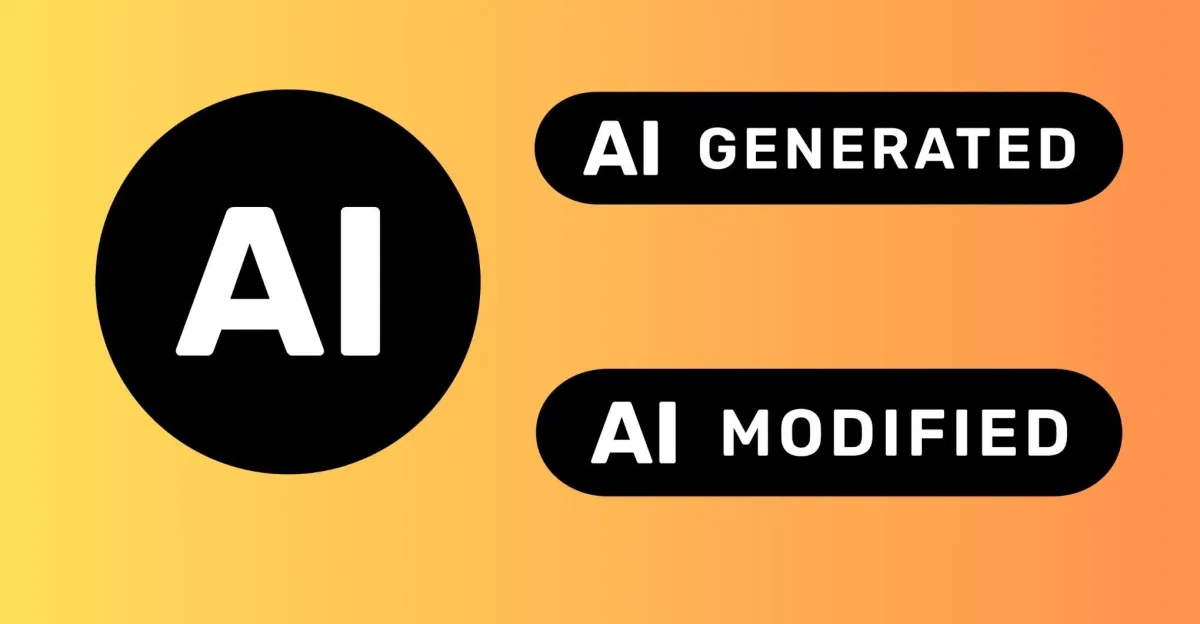
The European Commission has published suggested disclosure labels that companies can adopt to help meet the new requirements. The examples are intended to create a common visual language across platforms and reduce the need for each company to invent its own warning symbol.
These labels resemble the disclosure tools already used by several large social platforms, including TikTok, Instagram, and Facebook, which have experimented with AI labels for synthetic media. The EU’s approach tries to standardize that practice rather than leave it entirely to corporate discretion.
The Commission stresses that its sample icons are optional. What is mandatory is the underlying disclosure requirement itself.
| Requirement | Who must comply | What it means | Deadline |
|---|---|---|---|
| Notify users they are interacting with AI | Providers | Clear disclosure unless AI use is obvious | Effective now for new systems |
| Machine-readable marking of synthetic content | Providers | Labels for AI-generated or manipulated audio, image, video, and text | Effective now for new systems |
| Label realistic AI-generated or manipulated media | Deployers | Identify deepfakes and similar content designed to look real | Effective now for new systems |
| Grace period for existing services | Older systems launched before Aug. 2 | Extra time to add compliant disclosures | Until Dec. 2, 2026 |
How severe are the penalties?
The enforcement stakes are significant. Companies that ignore the rules could face fines of up to €15 million, which is roughly $17.2 million, or up to 3% of worldwide annual revenue, whichever figure is larger in a given case.
For large technology companies, the percentage-based penalty can be far more damaging than the fixed amount, especially for firms with global user bases and high annual turnover.
The fact that the rules are enforceable immediately for newly launched systems raises the pressure further. New products released after the start date cannot rely on a long transition period to defer compliance.
How much time do companies have?
Companies with AI systems already on the market before August 2 have a four-month window to catch up. That means legacy products and services must meet the transparency rules by December 2, 2026.
The grace period is designed to give companies time to update interfaces, train moderation teams, revise policies, and integrate technical watermarking or labeling tools. But the deadline also makes clear that compliance is not optional.
For businesses that ship AI features frequently, the transition will likely be a mix of technical and legal work. Teams will need to review product flows, user notices, and detection mechanisms across multiple markets and languages.
Who is most affected by the new regime?
The most exposed companies are those that combine generative AI with public-facing platforms. That includes social networks, chatbot makers, and companies that rely on synthetic media for advertising, entertainment, or customer support.
Firms that both build models and run user products may face the most complicated compliance burden, because they can be treated as both providers and deployers under the law.
- Chatbot developers must clearly tell users when they are speaking to AI.
- Social platforms must label realistic synthetic media.
- Media tools that generate or edit audio and video need built-in disclosure systems.
- Enterprise AI vendors may need to ensure customer-facing outputs are marked properly.
Why this matters beyond Europe
The EU’s move is likely to influence AI policy well outside its borders. Because many global technology companies prefer to build one compliance framework that can be reused across regions, the bloc’s rules often become de facto standards elsewhere.
That dynamic matters here because transparency labels are relatively easy to notice, but much harder to implement consistently. A company that operates across the United States, Europe, and Asia may decide it is simpler to label synthetic content everywhere than maintain separate product versions.
The EU has long used regulation to shape tech behavior globally, from privacy rules under GDPR to platform accountability measures. The AI Act may become another example of Brussels exporting its standards through market size and enforcement reach.
How is this different from platform self-labeling?
The new rules go further than voluntary product policies. Social companies have already added AI labels in some contexts, but those labels are not universal, and they can be inconsistent across features, regions, or media types.
By contrast, the EU is turning disclosure into a legal duty. The result is less flexibility for companies, but more consistency for users who need to know whether a post, voice note, or image is synthetic.
That legal shift could also force platforms to revisit edge cases, such as edited creator content, AI-assisted journalism tools, translated voiceovers, automated subtitles, or hybrid media where human and machine contributions are mixed.
What companies will need to do next
Compliance will likely require a combination of product design changes, policy updates, and backend detection tools. Companies may have to build prompts or interface notices that make AI use obvious, attach labels to outputs, and preserve metadata that identifies synthetic content across platforms.
They may also need to explain the rules to creators and users, especially if labeling affects workflows. For example, video creators, marketers, and customer support teams could see new steps added to publishing or deployment pipelines.
- Audit products that generate or alter content.
- Identify whether the company is acting as a provider, deployer, or both.
- Add user-facing notices where AI interaction is not obvious.
- Implement machine-readable marking for synthetic content.
- Label realistic audio, image, video, and text outputs.
- Train staff and update moderation and compliance processes.
What the timeline looks like
The rollout is immediate for new systems, but older services get until December 2 to adapt. That split timetable gives regulators a clear enforcement framework while allowing existing products some breathing room.
The following timeline shows the key milestones in the latest phase of the EU’s AI Act implementation.
| Date | Milestone | Significance |
|---|---|---|
| August 2, 2026 | Transparency rules take effect | New AI systems must comply immediately |
| August 2026 | Commission publishes disclosure guidance | Companies get examples of acceptable labels |
| August to December 2026 | Grace period for older systems | Existing products have time to add disclosures |
| December 2, 2026 | Grace period ends | All covered systems must comply |
What happens if companies try to stay vague?
Companies that rely on ambiguous wording, hidden notices, or inconsistent labeling could find themselves in regulatory trouble. The EU’s framework is intended to make disclosures understandable to ordinary users, not buried in fine print or inaccessible settings menus.
That means compliance will be judged not just by whether a label exists, but by whether it actually alerts people at the moment they need the information. A disclosure that is too obscure may fail the spirit of the rule even if it technically appears somewhere in the product.
What this means for the AI market
The biggest practical consequence may be that AI transparency becomes a product requirement rather than a nice-to-have feature. Companies that once treated disclosure as a public relations choice now have a legal reason to build it in from the start.
That could make AI products a little more explicit and, in some cases, a little less seamless. But it may also make the ecosystem more trustworthy by reducing the number of users who unknowingly mistake synthetic media for authentic content.
As generative systems become more powerful and more widely used, the EU is betting that transparency is the minimum standard needed to keep them socially usable. Whether companies embrace the rules as a trust-building measure or view them as a compliance burden, the message from Brussels is clear: if AI is in the loop, users should be told.
Frequently asked questions
What are the EU AI transparency rules?
The EU AI transparency rules are disclosure requirements under the AI Act that force companies to tell users when they are interacting with AI and when content has been generated or altered by AI. They also require labels for synthetic audio, images, video, and text.
Who has to label AI-generated content in the EU?
Both providers and deployers may have labeling duties in the EU. Providers must notify users they are dealing with AI and add machine-readable marks, while deployers must label realistic AI-generated or manipulated media that is meant to look authentic.
What are the penalties for breaking the EU AI labeling rules?
The penalties can reach €15 million or 3% of a company’s global annual turnover, depending on which amount is higher. That makes the rules particularly important for large tech companies with significant worldwide revenue.
When do existing AI systems need to comply?
Existing systems launched before August 2, 2026, have a four-month grace period. They must meet the transparency requirements by December 2, 2026, while new systems have to comply immediately.
Why is the EU requiring AI labels?
The EU says labels are needed because generative AI makes it harder to tell machine-made content from authentic human content. The goal is to reduce misinformation, help users make informed decisions, and improve trust online.