In short
Deezer says AI-generated music now accounts for more than half of daily uploads on its platform. The streamer is tightening anti-fraud and removal rules as the industry struggles to manage synthetic tracks.
- Deezer says AI-generated music is now more than half of its daily uploads.
- The company will remove AI tracks that have not been streamed in six months or appear tied to fraud.
- Streaming platforms are split on how to handle AI music, with policies ranging from bans to labeling.
- Deezer has been tracking the surge since January 2025, when AI uploads were about 10% of daily volume.
Deezer said on Tuesday that AI-generated music now accounts for more than half of the tracks uploaded to its platform each day, marking a new milestone in the fast-growing flood of synthetic songs hitting streaming services. The French music streamer says the surge matters because it increases fraud risk, dilutes royalty pools and forces platforms to decide how to label, limit and monetize AI-made content.
The company said the share of AI-generated uploads has climbed steadily since it began measuring the trend in 2025, and that the monthly average reached about 90,000 AI tracks per day in June 2026. Deezer is now removing some AI-generated songs that have gone unplayed for six months or that appear to be part of fraudulent streaming schemes designed to inflate payouts.
The announcement adds fresh urgency to an industry-wide debate over what streaming services should do as generative music tools make it possible to produce songs at scale in minutes rather than days or weeks. There is still no common standard across platforms, and the split response is becoming a defining feature of the AI music era.
Why Deezer’s update matters
Deezer’s latest numbers show how quickly AI music is moving from a niche experiment to a dominant upload category. More than half of daily uploads being AI-generated does not mean more than half of listening is AI-generated, but it does show how heavily synthetic content is now filling the pipes of digital music distribution.
That distinction is important. Streaming services are not only trying to satisfy listeners; they are also managing catalog quality, recommendation systems, royalty distribution and anti-fraud enforcement. A wave of low-cost AI tracks can crowd catalogs, muddy metadata and create opportunities for bad actors to manipulate streaming counts.
Deezer says it has been focused on fraud prevention and reducing royalty dilution tied to AI music for nearly two years. The company’s new action is part of that effort, aimed at keeping payment systems from being overwhelmed by content that exists mainly to game the platform rather than to attract listeners.
Deezer chief executive Alexis Lanternier said the company is stepping up defenses because half of all daily uploads are now AI-generated, and that the goal is to protect artists and songwriters while keeping attention on music that fans actually choose to hear.
How fast did AI uploads grow on Deezer?
They rose from roughly 10,000 per day in early 2025 to about 90,000 per day by June 2026, showing a steep, nearly uninterrupted climb over 18 months.
Deezer’s own tracking provides one of the clearest public snapshots of the AI-music surge. The company began publishing figures in January 2025, when AI-generated uploads represented about 10% of daily volume. By April 2025, that number had doubled in absolute terms and climbed to 18% of uploads. The momentum kept building throughout the second half of the year and into 2026.
What makes the trend notable is not just the final number, but the pace. Each update marked another jump in both track count and share of total uploads, suggesting that AI music creation tools are being adopted widely enough to transform the supply side of streaming at scale.
| Reporting period | AI-generated tracks per day | Share of daily uploads |
|---|---|---|
| January 2025 | 10,000 | 10% |
| April 2025 | 20,000 | 18% |
| September 2025 | 30,000 | 28% |
| November 2025 | 50,000 | 34% |
| January 2026 | 60,000 | 39% |
| April 2026 | 75,000 | 44% |
| June 2026 | 90,000 | More than 50% |
What Deezer is doing about AI music
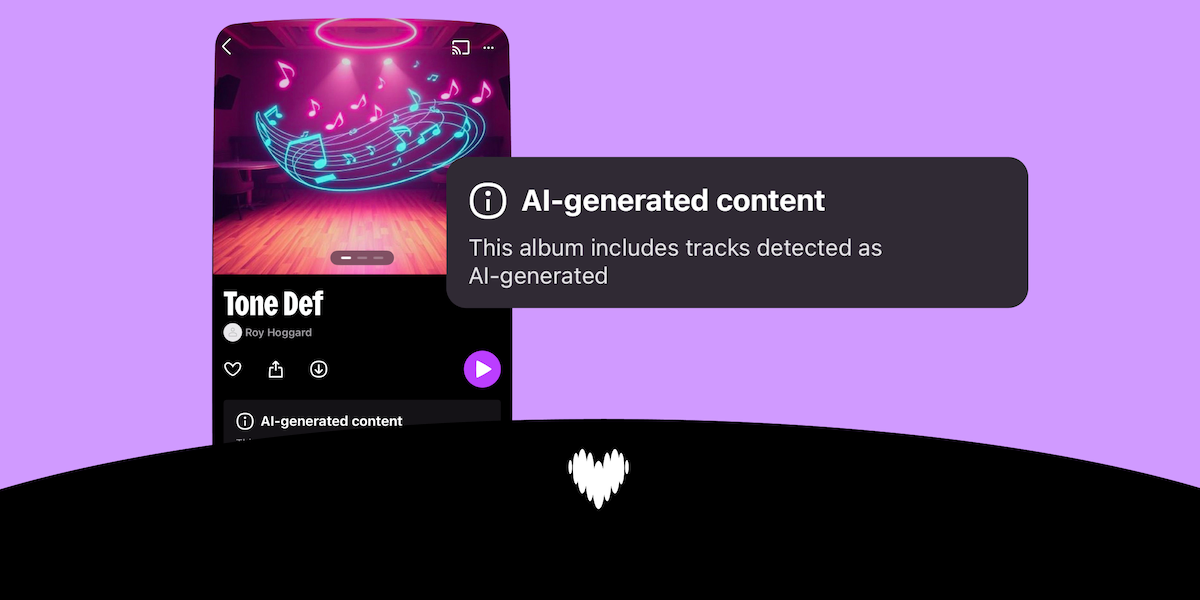
Deezer is combining labeling, detection and removal measures to deal with the influx. The company says it already labels AI-generated music on its platform and can identify tracks created with popular tools such as Suno and Udio, two startups that are currently facing copyright lawsuits over how their systems were trained and what they produce.
Now the platform is going a step further. Deezer says it will remove AI-generated tracks that have not been streamed in the past six months, as well as songs tied to suspicious activity intended to inflate revenue through fake plays. That policy is aimed at content that appears to be functionally useless to listeners but valuable to fraudsters because it can be used to farm streaming payments.
In practical terms, the move creates a filter between legitimate experimentation with AI-assisted music and content that seems designed only to exploit the system. Deezer is signaling that it wants to permit some AI music on the service, but not at the expense of the artists and rights holders whose work still drives the platform’s value.
How Deezer’s detection system is used
Deezer says its detection technology can recognize AI music even when it is associated with leading generative models. That capability matters because many AI tracks are not obviously machine-made to the average listener, especially once they are mixed, mastered and uploaded with standard metadata.
The company also made its detection tool available to other platforms earlier in 2026, though it is not yet clear whether any major streaming service has adopted it. Last month, Deezer added another consumer-facing tool that can search Apple Music and Spotify playlists for AI-generated tracks, broadening the company’s role from service operator to infrastructure provider in the fight over synthetic audio.
How are other music services responding?
Streaming platforms are taking different approaches, and the lack of consensus is shaping the market. Some services are imposing hard restrictions, while others are trying to create labeling systems or content policies that allow AI music to coexist with human-made tracks.
Bandcamp has banned AI-generated tracks, making a clear editorial and commercial choice to keep the platform focused on human artists. Tidal, meanwhile, has moved to cut off monetization for some AI-made music, limiting the financial incentive without necessarily banning uploads outright. Apple Music has adopted a voluntary tagging system, allowing artists and labels to disclose AI use. Spotify has also developed its own rules around how much AI may be involved in music creation.
That patchwork approach reflects the absence of an industry-wide standard. The services are being forced to answer several overlapping questions at once: What counts as AI-generated music? Should it be labeled, demoted, demonetized or blocked? And how can platforms protect royalties without discouraging legitimate uses of AI tools by musicians?
- Bandcamp: bans AI-generated music.
- Tidal: limits monetization for some AI tracks.
- Apple Music: uses voluntary AI labeling.
- Spotify: has created policy rules about AI use in music-making.
Why fraudulent streaming is a growing concern
Fraudulent streaming is a problem because it can siphon money away from legitimate artists and labels. If automated or low-value tracks are uploaded in huge numbers and then artificially streamed, they can inflate royalty payments from a shared pool while reducing the amount available to real listeners’ favorites.
That is what Deezer means when it talks about payment dilution. The more streams generated by manipulated or low-quality content, the more the payout pool gets spread across activity that may have little or no genuine audience demand. In a system where every stream can influence revenue, scale itself becomes a weapon for abuse.
AI music intensifies the issue because it lowers production costs dramatically. Instead of paying for studio time, session musicians and long production cycles, a creator can generate dozens or hundreds of songs quickly. That efficiency can be useful for experimentation and independent creation, but it also makes mass upload schemes much easier to execute.
What does ‘payment dilution’ mean?
Payment dilution means each legitimate stream can become less valuable when a platform’s royalty pool is shared across a larger volume of suspect or low-quality activity. In other words, the total money available does not necessarily rise just because more content is uploaded, so the per-stream value can decline for genuine artists.
The bigger copyright battle behind the numbers
Deezer’s figures arrive at a moment when AI music is already entangled in major copyright disputes. Suno and Udio, two of the best-known generative music startups, are facing legal challenges over whether they built their systems using protected material without proper authorization. Those cases have become central to a broader debate about how AI companies train models and how much creative work they can legally absorb.
The lawsuits matter to streamers because the outcome could influence what kinds of AI-generated music get produced, who owns it and whether platforms can confidently host it. If courts or settlements force changes in training practices, that could alter the economics of AI music generation and potentially reduce the pace of mass-upload content. If not, the supply of synthetic tracks may keep growing rapidly.
For Deezer and its peers, the legal uncertainty adds another layer to an already complicated operational problem. Platforms are not just deciding whether they like AI music; they are deciding how to handle content that may be tied to unresolved rights issues and possible reputational risk.
How did Deezer get here?
Deezer has been tracking AI-generated uploads since early 2025 because the trend was already visible then, and it has only accelerated. By publishing its own measurements, the company has effectively turned into one of the most transparent observers of AI’s impact on streaming catalogs.
That transparency has strategic value. Deezer is a smaller player than some of its global rivals, but it has used the issue to position itself as an early responder to a problem that is likely to affect the entire industry. By acting sooner, it can present itself as a protector of creators and a platform willing to make tough calls before the issue becomes unmanageable.
It also gives Deezer a way to frame AI music not as an abstract future threat but as a present-day operational challenge. The company’s statistics show that the issue is no longer theoretical: synthetic songs are now a large fraction of what is being uploaded every day.
What happens next for streaming and AI music?
The next phase will likely center on standardization, enforcement and disclosure. Streaming services will have to decide whether they want common definitions for AI-generated music, shared labels for disclosure and stronger systems to identify suspicious uploads before they cause harm.
There is also likely to be more pressure on the companies building generative music tools. If streamers continue to encounter fraud and catalog pollution, they may push upstream for tighter controls, provenance systems or publishing safeguards that make it easier to trace how a track was created.
For musicians, the outcome could cut both ways. AI tools may lower barriers for independent creators who want to sketch ideas quickly or experiment with new sounds. But the same tools can also flood services with disposable content, making it harder for human artists to stand out and harder for royalties to reach the right people.
In that sense, Deezer’s announcement is less a one-off product update than a snapshot of a larger industry shift. Streaming is entering an era where abundance is no longer just a creative promise; it is also a management challenge.
Timeline of Deezer’s AI-music tracking
The progression below shows how quickly AI-generated uploads moved from a minority share to a majority share of Deezer’s daily intake.
| Date | Deezer action | Why it matters |
|---|---|---|
| January 2025 | Started publishing AI-upload statistics | Gave the public a baseline view of the trend |
| April 2025 | Reported a higher daily AI upload volume | Showed rapid early growth |
| September 2025 | Reported further increase in share and volume | Confirmed the trend was accelerating |
| November 2025 | Expanded volume again | AI tracks became a major share of uploads |
| January 2026 | Reached 60,000 daily AI uploads | Signaled continued momentum into the new year |
| April 2026 | Reported 75,000 daily AI uploads | Approached parity with human uploads |
| June 2026 | Hit about 90,000 daily AI uploads | Crossed the majority threshold |
What the numbers do and do not show
Deezer’s data tells us a lot about upload behavior, but not everything about listening behavior. A platform can receive a flood of AI-generated tracks without those tracks becoming mainstream in playback charts, editorial playlists or user habits.
Still, upload volume matters because it reveals the pressure streaming platforms face behind the scenes. The more synthetic songs that enter the system, the more expensive and complex content moderation becomes. Metadata checks, rights management, recommendation quality and fraud detection all become harder when the catalog grows faster than human review can keep up.
That is why Deezer’s move is likely to be watched closely by competitors. If a platform concludes that more than half of uploads are AI-generated, other services may soon be forced to disclose similar figures or take comparable steps to control the flow.
Bottom line
Deezer’s latest report shows that AI-generated music has crossed a major threshold on one streaming service, accounting for more than half of all daily uploads. The company is responding with tougher removal rules and stronger fraud controls, but the broader industry still lacks a unified policy for how to handle the explosion of synthetic tracks.
As AI music creation tools become easier to use and harder to distinguish from human-made recordings, streaming platforms will continue to balance openness, artist protection and commercial integrity. Deezer’s numbers suggest that the debate is no longer coming — it is already here.
Frequently asked questions
How much of Deezer’s daily music uploads are AI-generated?
Deezer says more than half of its daily uploads are now AI-generated. The company reported that the share crossed the 50% mark in June 2026 after steadily rising throughout 2025 and early 2026.
What is Deezer doing about AI-generated tracks?
Deezer says it will remove AI-generated tracks that have not been streamed in the past six months or that are linked to fraudulent streaming activity. It is also using detection and labeling tools to identify synthetic music on the platform.
Why are streaming platforms worried about AI music?
Streaming platforms are worried because AI music can be uploaded at massive scale and may be used to game royalty systems. That can dilute payouts, pollute catalogs and make it harder to protect legitimate artists from fraud.
Which other services have rules for AI-generated music?
Several services already have different approaches. Bandcamp bans AI-generated music, Tidal limits monetization, Apple Music uses voluntary tagging and Spotify has created policies about how much AI can be involved in making a song.
Are Suno and Udio mentioned in Deezer’s AI detection work?
Yes. Deezer says its detection system can identify tracks generated with models from Suno and Udio. Both startups are involved in copyright lawsuits, which has made them central to the wider debate over AI music rights.