In short
Microsoft has launched new Nvidia-powered Surface PCs and a revised Windows 11 focused on running AI models and agents locally. The move targets developers, creators and premium buyers, while signaling a bigger push to make Windows an AI platform.
- Surface Laptop Ultra starts at $2,600 and can reach $5,900.
- Surface RTX Spark Dev Box starts at $6,000 and includes Microsoft dev tools.
- Windows 11 adds Execution Containers to sandbox AI agents.
- Microsoft is offering up to $1,000 off for MacBook Pro trade-ins.
- Dell also revealed pricing for its own RTX Spark-based creator PC.
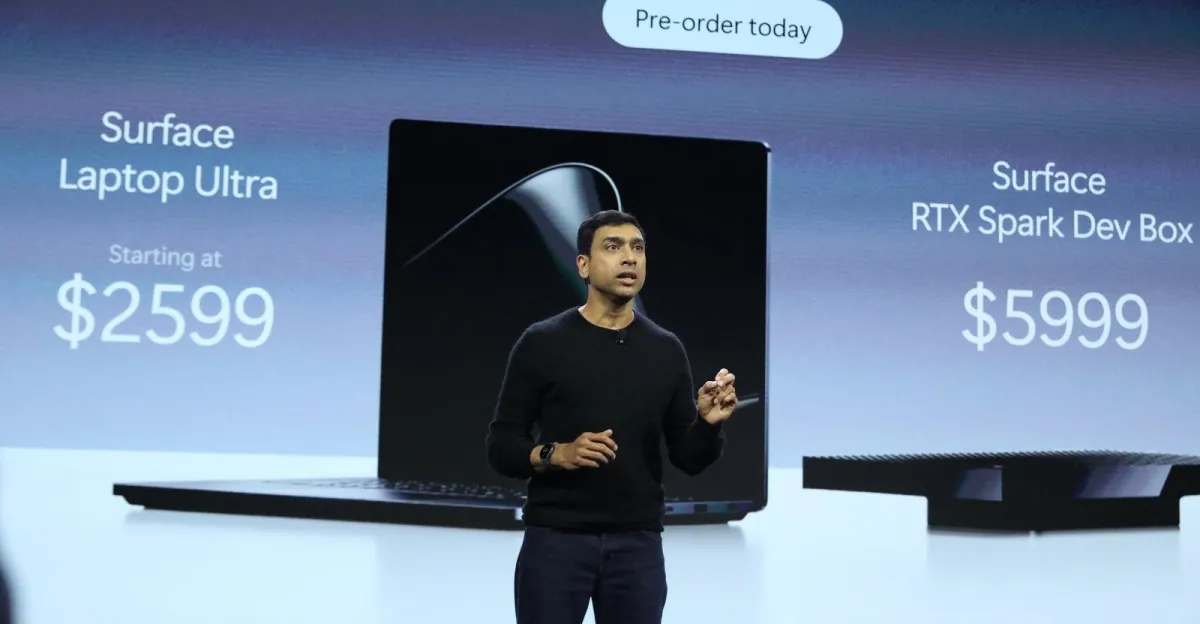
Microsoft has unveiled new high-end Surface PCs built around Nvidia’s RTX Spark chip, along with a revamped Windows 11 designed to make it easier for AI agents to run, coordinate and act on a user’s behalf. The announcement, made Wednesday in San Francisco during Tech Week, marks a clear push to bring local AI computing to Windows devices and to position Microsoft’s platform as a home for developer-focused agent tools.
The company’s new Surface Laptop Ultra starts at $2,600, while a higher-performance version begins at $3,700. Configurations can climb to $5,900, and Microsoft says its top-end model is already sold out. Microsoft also introduced a companion workstation, the Surface RTX Spark Dev Box, priced from $6,000 and bundled with developer software including VS Code, GitHub Copilot CLI, WSL and PowerShell 7.
What ties the products together is a bet that more AI work will move onto the device itself. Microsoft says the new machines are built to run models locally, without sending every task to the cloud, thanks to a combination of CPU, GPU, unified memory and thermal design changes meant to handle demanding AI workloads.
What Microsoft announced and why it matters
Microsoft’s latest Surface hardware is not a routine refresh. The company is pairing premium Windows machines with a broader software shift that is intended to make Windows 11 more useful for the next generation of AI applications, particularly those built around agents rather than simple chatbots.
That distinction matters because AI agents are increasingly being pitched as software that can do more than answer questions. In Microsoft’s framing, they need memory, orchestration and a secure environment for taking actions across multiple apps and models. The new products, and the updated operating system, are meant to support that workflow directly.
The reveal also signals a sharper competitive push toward developers and power users who have gravitated toward Apple hardware in recent years. Microsoft is even offering discounts of up to $1,000 for customers trading in a MacBook Pro, underscoring how explicitly the company is targeting the Mac-dev crowd.
How the new Surface devices are priced
The new devices sit at the premium end of the PC market, with prices reflecting the specialized hardware inside them. Microsoft is marketing the Surface Laptop Ultra as a machine for intensive AI work, creative workloads and other graphics-heavy tasks.
| Device | Starting price | Top configuration price | Primary audience |
|---|---|---|---|
| Surface Laptop Ultra | $2,600 | Up to $5,900 | Developers, AI power users, creators |
| Surface RTX Spark Dev Box | $6,000 | Not specified | Developers building and testing local AI apps |
| Dell XPS 16 Creator Edition | $3,800 | Not specified | Creators and developers |
Surface Laptop Ultra
Microsoft says the Surface Laptop Ultra comes in two base variants, one beginning at $2,600 and a stronger version beginning at $3,700. Buyers can add memory and storage, pushing the price to $5,900 on the highest-end configuration.
According to the company, demand is already strong enough that the most expensive version is unavailable for now. That detail suggests Microsoft may be seeing enthusiasm not just from enterprise buyers, but from developers and early adopters willing to pay a premium for local AI performance.
Surface RTX Spark Dev Box
The Surface RTX Spark Dev Box is Microsoft’s workstation entry in the same ecosystem, and it is even more clearly aimed at people building software rather than casual consumers. It begins at $6,000 and ships with a set of tools designed to help engineers test, build and run AI applications on Windows.
Microsoft says the machine includes VS Code, GitHub Copilot CLI, WSL and PowerShell 7 out of the box. That software stack makes the workstation especially useful for developers who want a ready-made environment for Linux-compatible workflows, scripting and AI experimentation.
Why Microsoft is emphasizing local AI
Microsoft’s central pitch is that AI should not always depend on remote servers. Instead, the company wants these new Windows machines to execute models on the device itself, where tasks can be faster, more private and potentially free from cloud inference costs.
To make that possible, Microsoft says the hardware was designed around the demands of local model execution. In practical terms, that means more capable graphics hardware, memory architecture that can feed large models efficiently and cooling systems able to sustain heavy loads without throttling performance.
This approach follows a larger industry trend: as AI systems become more capable, there is growing interest in running smaller or specialized models directly on PCs. That can reduce latency, lessen dependency on cloud subscriptions and give users more control over sensitive data.
What is new in Windows 11?
The updated Windows 11 build includes a feature Microsoft calls Execution Containers, which the company says helps sandbox AI agents more effectively. The goal is to let agents operate in controlled environments, reducing the risk that experimental or third-party automation tools can interfere with the rest of the system.
Microsoft says the feature will roll out to all Windows 11 users, not just buyers of the new Surface hardware. That broader release matters because it suggests the company sees agent support as a platform-level capability rather than a niche feature reserved for premium devices.
Satya Nadella argued at the event that models alone are not enough to deliver useful AI products, saying they need orchestration, memory outside the model and a harnessed layer that can combine multiple models, context and actions. He added that Microsoft is building this not only for its own applications, but for agents from other developers as well.
Nadella’s comments point to a broader shift in the way Microsoft is thinking about AI. The company is no longer positioning the model as the product; instead, it is treating the model as one layer inside a larger system that includes memory, permissions, planning and execution.
How execution containers change the Windows strategy
Execution Containers are Microsoft’s answer to a problem that becomes more serious as AI agents gain more autonomy: how do you give software enough access to be useful without handing it unrestricted control? By sandboxing agent activity, Microsoft is trying to create a safer environment for testing and deployment.
That is especially important for enterprise customers and developers building tools that need to perform real actions, such as reading files, invoking command-line tools or interacting with apps. In an agent-driven future, containment and permissions could become as important as model quality.
Microsoft is also signaling that Windows itself should be seen as an action platform, not merely a desktop environment. If AI agents are going to schedule tasks, interact with documents and coordinate across apps, then the operating system becomes the orchestration layer that ties everything together.
Who Microsoft is trying to win over
The new hardware and software appear aimed at three overlapping audiences: developers, creators and high-end Windows buyers looking for local AI performance. Microsoft’s trade-in offer for MacBook Pro owners makes its target especially clear.
For years, Apple laptops have been a common sight in startups, software teams and AI circles, especially in Silicon Valley. By offering a path away from the Mac, Microsoft is acknowledging that many of the people it wants to reach already own premium devices and may need a compelling reason to switch.
- Developers who want to test local AI agents
- Creators who need strong GPU performance for media work
- Enterprise teams building Windows-based automation tools
- MacBook Pro users looking for a Windows alternative
Why the MacBook trade-in offer matters
The trade-in incentive is more than a sales promotion. It is a statement about where Microsoft believes the next battle for developer loyalty will be fought. If local AI workflows become important to daily development work, then the operating system, chip architecture and software tooling all become part of the decision to switch platforms.
Microsoft’s willingness to discount its hardware by as much as $1,000 for MacBook Pro owners suggests the company is trying to accelerate that switch, especially among people already interested in AI agents and on-device model execution.
How Nvidia fits into the picture
Nvidia’s role is central to this story. In June, the chipmaker said it had reached agreements with Microsoft and several PC makers to develop AI- and agent-ready Windows PCs built around its RTX Spark chip. At the time, the announcements were high on ambition but short on specifics.
Wednesday’s Microsoft event fills in some of the missing details. The company is now showing how those partnerships translate into actual products, price points and software experiences. That makes the launch a meaningful step from concept to commercialization.
The partnership also reflects Nvidia’s wider strategy of moving deeper into the PC ecosystem, not only as a supplier of graphics hardware but as an enabler of AI computing across personal devices. For Microsoft, the deal helps ensure its premium Windows machines can compete on raw AI capability rather than relying solely on software promises.
What else launched alongside Microsoft’s machines?
Microsoft was not alone in showing off RTX Spark-based Windows hardware. Dell also disclosed more about its previously announced XPS 16 Creator Edition, another machine designed with the same new generation of AI-oriented PC hardware in mind.
Dell’s laptop is available for preorder now through Best Buy and is scheduled to ship later in October. It carries a starting price of $3,800, placing it below Microsoft’s top-end Surface Laptop Ultra configurations but still squarely in premium territory.
The simultaneous unveiling from multiple PC makers suggests a broader market push is underway. Rather than a single flagship device, the RTX Spark ecosystem is starting to look like a product family that several brands will use to sell the next wave of AI-capable Windows machines.
What this means for the PC market
The launch points to a changing definition of what makes a high-end PC worth buying. For years, faster processors, better displays and longer battery life were the main premium selling points. Now the pitch is shifting toward local AI inference, agent support and developer workflows that depend on specialized hardware.
That shift could reshape the Windows premium segment in at least three ways. First, it may create a new category of AI workstations for people who need to run models locally. Second, it could deepen the link between operating system features and chip partnerships. Third, it may force competitors to show how their own machines support on-device AI in practical, measurable ways.
The pricing also shows that these are not mainstream consumer products yet. At $2,600 to $5,900 for the Surface Laptop Ultra and $6,000 for the Dev Box, Microsoft is clearly targeting buyers who are willing to pay for capability first and affordability second.
Timeline: how Microsoft’s AI PC push developed
| Date | Event | Why it matters |
|---|---|---|
| June 2026 | Nvidia announces agreements with Microsoft and other PC makers | Signals the arrival of RTX Spark-based AI PCs |
| Wednesday, Oct. 7, 2026 | Microsoft unveils Surface Laptop Ultra and Surface RTX Spark Dev Box | Moves the concept into concrete products and pricing |
| Later October 2026 | Dell XPS 16 Creator Edition begins shipping | Shows the market is broadening beyond Microsoft hardware |
What comes next for Windows and AI agents?
Microsoft appears to be betting that the next major PC upgrade cycle will be driven by AI utility rather than by traditional hardware benchmarks alone. If users begin to rely on local agents for coding, content creation or workflow automation, then Windows machines with the right silicon and software stack could gain a meaningful edge.
The company’s challenge will be proving that these premium devices deliver real-world value beyond marketing language. Developers will want speed, compatibility and security. Enterprises will want control, compliance and predictable performance. Creators will want the hardware to handle video, graphics and multitasking without friction.
For now, Microsoft has made its intention unmistakable: Windows is being reshaped for a future in which AI is not just something you chat with, but something that lives on the device, coordinates tools and takes action inside a guarded environment. The new Surface line is the hardware expression of that plan.
Bottom line
Microsoft’s latest Surface launch is both a product announcement and a platform statement. The company is combining Nvidia-powered hardware, a redesigned Windows 11 and new security-oriented agent features to push local AI computing deeper into the Windows ecosystem.
If the strategy works, Microsoft will not just sell faster PCs. It will help define how AI agents run on personal computers, who gets to build them and how much control users can keep while they do it.
Frequently asked questions
What did Microsoft announce in its latest AI PC launch?
Microsoft announced new Surface PCs powered by Nvidia’s RTX Spark chip, including the Surface Laptop Ultra and the Surface RTX Spark Dev Box. The company also revealed a redesigned Windows 11 feature set aimed at helping AI agents run more safely and effectively on-device.
How much do Microsoft’s new AI PCs cost?
The Surface Laptop Ultra starts at $2,600 for one base model and $3,700 for a higher-end version, with top configurations reaching $5,900. The Surface RTX Spark Dev Box starts at $6,000, reflecting its workstation focus and bundled developer tools.
What are Execution Containers in Windows 11?
Execution Containers are Microsoft’s new sandboxing feature for AI agents in Windows 11. They are designed to isolate agent activity more securely, making it easier to run software that can take actions across apps while reducing the risk of broader system interference.
Why is Microsoft targeting MacBook Pro users?
Microsoft is targeting MacBook Pro users because many developers and AI enthusiasts prefer Apple hardware. By offering up to $1,000 in trade-in value, Microsoft is trying to persuade premium users to switch to Windows for local AI and agent workflows.
Is Dell also making an RTX Spark AI PC?
Yes. Dell announced pricing for its XPS 16 Creator Edition, a Windows PC based on Nvidia’s RTX Spark platform. It is available for preorder now through Best Buy and is scheduled for later October delivery, starting at $3,800.