In short
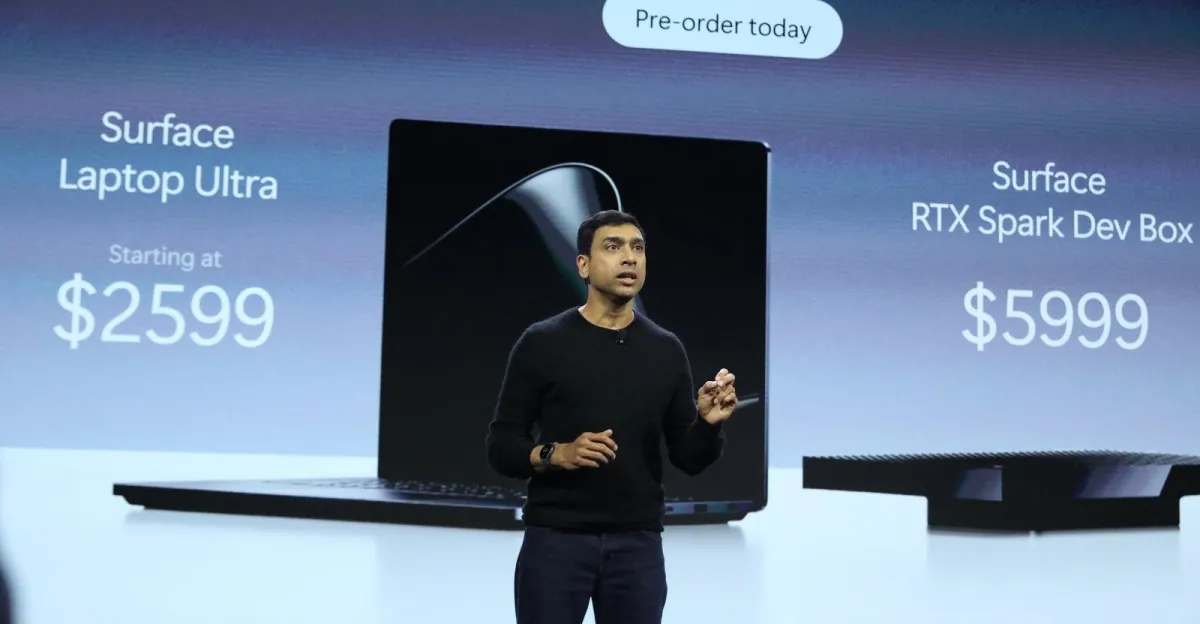
Microsoft introduced the Surface Laptop Ultra, a premium Windows laptop powered by Nvidia’s RTX Spark chip, and detailed Copilot upgrades that can work with local files. The company also opened preorders for a $5,999 Surface RTX Spark Dev Box aimed at developers building local AI tools.
- Surface Laptop Ultra launches October 16 starting at $2,599.
- Microsoft is pairing the laptop with a $5,999 RTX Spark Dev Box for developers.
- Copilot is getting deeper access to local files and Windows actions through Hybrid Intelligence.
- Microsoft wants Windows to become a stronger platform for on-device AI tasks.
- The new Surface hardware is aimed at premium users, creators, and AI developers.
Microsoft has unveiled the Surface Laptop Ultra, a new premium Windows machine powered by Nvidia’s RTX Spark Arm chip, with sales beginning October 16 and prices starting at $2,599. The launch matters because it marks Microsoft’s clearest push yet into high-end local AI computing on the PC, pairing a new laptop with a companion developer mini PC and fresh Copilot features that reach deeper into Windows and your files.
The announcements came during Microsoft’s Windows and Surface keynote in San Francisco, where the company framed the next wave of personal computing around on-device AI, faster workflows, and tighter integration between hardware and software. Alongside the laptop, Microsoft introduced a Surface RTX Spark Dev Box for developers and previewed Windows features that let Copilot take more useful actions across the operating system.
In practical terms, Microsoft is trying to sell a new category of PC: one that can handle demanding creative work, run local AI models, and blur the line between a traditional laptop and a compact workstation. The company is also signaling that it wants Windows to be the place where AI assistance becomes more action-oriented, not just conversational.
What Microsoft announced at the Surface event
Microsoft’s event focused on two linked themes: premium Surface hardware and a more capable version of Windows built around local AI. The centerpiece was the Surface Laptop Ultra, which arrives as the first laptop built around Nvidia’s RTX Spark Arm-based chip. The company also announced that the Surface RTX Spark Dev Box is now available to preorder, with shipping expected in November.
On the software side, Microsoft highlighted a set of Copilot updates under the company’s “Hybrid Intelligence” banner. The idea is that some AI tasks should happen locally on the PC, while others can lean on cloud models when needed. Microsoft showed how that mix could support file access, automation, and quicker actions from the Windows search bar.
The Surface Laptop Ultra: price, specs, and timing
The Surface Laptop Ultra goes on sale October 16, with a starting price of $2,599. That base model includes an 8-core CPU, 24GB of RAM, and 512GB of storage. Microsoft is clearly positioning it as a premium device rather than a mainstream productivity laptop.
The machine features a 15-inch HDR touchscreen display with peak brightness reaching up to 2,000 nits, a larger haptic trackpad, and a magnetic charging system that uses USB-C rather than Microsoft’s older Surface Connect port. The laptop is designed to showcase the capabilities of Nvidia’s RTX Spark platform, which can be configured with up to 128GB of unified memory.
Microsoft and Nvidia are both pitching these systems as tools for intensive work across creative software, gaming, and local AI tasks. That places the Surface Laptop Ultra in the same conversation as high-performance laptops that aim to do far more than browsing, video calls, and office apps.
Why the laptop matters to Microsoft’s hardware strategy
The Surface line has long served as Microsoft’s hardware showcase, but the Surface Laptop Ultra is more significant than most releases because it brings a new chip platform into the company’s consumer hardware story. Nvidia’s RTX Spark is not just another processor swap. It represents an attempt to redefine what an Arm-based Windows machine can do when GPU acceleration and AI workloads are part of the product pitch.
Microsoft is also making a statement about design priorities. Features such as the bright HDR screen, haptic touchpad, and magnetic USB-C charging suggest a product built for premium users who expect polish as well as power. The company appears to be aiming directly at creators, developers, and early adopters who want a Windows alternative to Apple’s highest-end laptops.
How Microsoft is changing Copilot in Windows
Microsoft is giving Copilot broader access to local files and system actions through a concept it calls Hybrid Intelligence. In simple terms, that means the assistant can combine on-device processing with cloud support to complete multi-step tasks more efficiently.
The company showed a demo in which the tool helped gather documents for a tax filing request. The assistant searched folders, renamed files, compressed them into a zip archive, and drafted an email with the attachment ready to send. Microsoft’s message was clear: Copilot is moving from answering questions to completing work.
During the demonstration, Microsoft framed the new approach as a way to let local and cloud AI cooperate so the PC can complete tasks with less friction.
That matters because many AI assistants today remain mostly conversational. Microsoft wants Windows to become an operating system where asking for help can trigger actual action: finding a file, preparing an attachment, or executing a sequence of steps that would normally require manual work.
What is “Hybrid Intelligence”?
“Hybrid Intelligence” is Microsoft’s label for a system that blends local AI models with cloud-based services. The local part is useful for speed, privacy, and offline responsiveness. The cloud part is useful when a task needs more compute or broader model capabilities.
This approach is becoming more important as PC makers chase the promise of AI PCs. The challenge is not just generating text or images, but doing useful things on the user’s own device without slowing everything down. Microsoft is betting that the best answer is not cloud-only or local-only, but a combination of both.
How the new search experience fits in
Microsoft also previewed a new Windows search experience that lets users trigger quick actions directly from the search bar. That may sound minor, but it points to a larger design change: search is no longer only about finding files, apps, or settings. It is becoming a command layer for the operating system.
In a world where AI is woven into the desktop, the search bar can evolve into a shortcut to common workflows. Rather than opening several apps, users may soon be able to start an action from one place and let Windows and Copilot handle the rest.
| Announcement | Details | When | Price |
|---|---|---|---|
| Surface Laptop Ultra | 15-inch HDR touchscreen, haptic trackpad, Nvidia RTX Spark, magnetic USB-C charging | October 16 | Starts at $2,599 |
| Surface RTX Spark Dev Box | Mini PC for developers, 128GB unified memory, local AI focus | Ships in November | Preorder at $5,999 |
| Copilot Hybrid Intelligence | Uses local and cloud AI to access files and perform OS actions | Announced at event | No separate price announced |
| Windows search updates | Quick actions from the search bar | Announced at event | Included in Windows updates |
What the Surface RTX Spark Dev Box is for
Microsoft’s Surface RTX Spark Dev Box is aimed squarely at developers rather than ordinary consumers. Available to preorder for $5,999, the mini PC is expected to ship in November and is built on the same Arm-based RTX Spark platform as the new laptop.
The Dev Box is designed for local AI work, including model testing, agent prototyping, and on-device coding tools. Microsoft says the machine is optimized for running models exceeding 120 billion parameters, which places it in the high-performance class of systems that developers use when they need serious memory and compute headroom.
Its design is also notable. The chassis is a flat, anodized aluminum block made with 3D printing techniques, and the enclosure doubles as a heatsink. Microsoft says the shape was inspired in part by Xbox Series X-style ventilation, giving the device a more sculptural appearance than a typical mini PC.
Why developers should care
For developers, the Dev Box offers a way to experiment with local AI without relying entirely on remote servers. That can reduce latency, improve iteration speed, and make it easier to simulate real-world use cases for AI-powered applications.
It also reflects a broader industry trend: as AI models get larger and more capable, hardware vendors are racing to provide systems that can run them locally. Microsoft is not just selling software tools for developers; it is now selling the hardware environment in which those tools can be tested.
How this event fits into the AI PC race
The Surface Laptop Ultra and Dev Box sit at the intersection of several fast-moving markets: premium laptops, AI-capable PCs, Arm-based systems, and developer hardware. Microsoft is trying to bundle all of those trends into one product narrative.
That strategy is partly defensive and partly opportunistic. Apple has already set expectations for high-end laptops that combine efficiency with strong performance. Chipmakers and PC brands are now trying to answer with systems that can do more AI work on-device, rather than routing everything through the cloud.
Microsoft’s answer is to make Windows feel indispensable in an AI-first era. If the company can convince users that its hardware is the best place to run local AI and its operating system is the best place to orchestrate it, the Surface brand could become more relevant than it has been in years.
How Nvidia’s role changes the equation
Nvidia is more than a supplier in this story; it is a strategic partner. The RTX Spark platform gives Microsoft access to hardware designed with AI acceleration in mind, while also bringing Nvidia’s reputation in graphics and machine learning into the PC conversation.
That matters because the value proposition is no longer just “faster laptop.” It is “laptop as local AI workstation.” That is a much more ambitious pitch, especially at a starting price above $2,500.
Why the charging change is more important than it looks
Microsoft’s new magnetic USB-C charging solution may sound like a small refinement, but it speaks to the company’s broader attempt to modernize Surface hardware while keeping the magnetic convenience many users liked in previous designs.
Instead of a separate Surface Connect port, the cable snaps onto the right-side USB-C port. The port still functions normally for data and video, so the magnetic attachment does not remove standard USB-C utility. Microsoft is preserving the easy-attach experience while simplifying the physical design.
This kind of detail matters in the premium laptop market, where user experience is often decided by small refinements rather than headline specs alone. A magnetic USB-C system is not a revolutionary feature, but it is the kind of practical design move that can make a costly device feel more cohesive.
How Microsoft’s event reflects a broader Windows strategy
The event was not just about one laptop or one mini PC. It was a preview of Microsoft’s broader plan to make Windows the operating system of local AI. By combining Surface hardware, Nvidia chips, and more capable Copilot features, Microsoft is building a stack that looks increasingly integrated.
That integration is the key competitive point. Instead of treating AI as a separate app or browser-based service, Microsoft is embedding it into the operating system, search, file management, and device hardware. The company wants AI to feel native to Windows, not bolted on.
If that approach works, Microsoft could create a stronger reason for buyers to choose Windows devices at the high end, especially as AI workflows become more common in creative, technical, and administrative jobs.
What users may notice first
The first visible changes will likely be practical rather than flashy:
- faster access to files through Copilot
- more guided task completion inside Windows
- new AI-aware search shortcuts
- premium Surface hardware designed for heavier workloads
Those are the kinds of features that can steadily change how people use a PC, even if they do not look dramatic in a demo. Microsoft appears to be betting that the useful parts of AI will matter more than the novelty.
Comparison of the new Surface lineup
The two hardware products announced at the event serve very different audiences, but both are built around the same local AI thesis. Here is a simple comparison of the main devices Microsoft highlighted.
| Device | Audience | Core Strength | Memory | Starting Price |
|---|---|---|---|---|
| Surface Laptop Ultra | Premium consumers, creators, pros | Portable high-end PC with local AI capability | 24GB RAM base, up to 128GB unified memory platform | $2,599 |
| Surface RTX Spark Dev Box | Developers, AI builders | Desktop-style local AI workstation | 128GB unified memory | $5,999 |
What happens next?
The immediate milestone is the October 16 launch of the Surface Laptop Ultra and the November arrival of the Dev Box. But the bigger story is how Microsoft uses these devices to shape the next phase of Windows.
Over the coming months, the company will need to prove that its AI claims translate into everyday value. The hardware must justify its premium pricing, Copilot has to be genuinely useful inside Windows, and local AI performance will need to feel like more than a marketing slogan.
If Microsoft succeeds, this event may be remembered as the point where Windows began its transition from a general-purpose desktop operating system into an AI-native computing platform. If it fails, the Surface Laptop Ultra could become another expensive showcase device in a crowded premium market.
Either way, the company has now made its bet clear: the next chapter of the PC will be written not just in the cloud, but on the device sitting on your desk or in your bag.
Timeline of the announcements
The rollout is happening in stages, with hardware and software updates landing on different schedules. This timeline captures the main milestones from Microsoft’s event.
| Date | Event | Details |
|---|---|---|
| October 7, 2026 | Microsoft event in San Francisco | Surface Laptop Ultra, Dev Box, and Copilot updates announced |
| October 16, 2026 | Surface Laptop Ultra release | Starts shipping at $2,599 |
| November 2026 | Surface RTX Spark Dev Box shipping | Developer mini PC begins arriving to buyers |
For now, Microsoft has set the table. The real test will come when users and developers start living with these products, and when Windows either proves itself as the home of practical AI computing or slips back into being just another PC platform chasing a trend.
What is already clear is that Microsoft wants to control both the hardware and software sides of that race. With the Surface Laptop Ultra, the Dev Box, and a more assertive Copilot, the company is trying to make the case that the future of Windows is local, intelligent, and much more deeply integrated than before.
Frequently asked questions
When does the Surface Laptop Ultra go on sale?
The Surface Laptop Ultra goes on sale on October 16, 2026. Microsoft says pricing starts at $2,599 for the base configuration, which includes an 8-core CPU, 24GB of RAM, and 512GB of storage.
What is Nvidia RTX Spark?
Nvidia RTX Spark is an Arm-based chip platform designed for high-performance laptops and mini PCs. Microsoft is using it to power the Surface Laptop Ultra and the Surface RTX Spark Dev Box, with a focus on local AI, creative workloads, and developer use cases.
What is Microsoft’s Hybrid Intelligence feature?
Hybrid Intelligence is Microsoft’s name for a mix of local and cloud AI models working together on Windows. It lets Copilot access files on the PC and take actions across the operating system, such as finding documents, renaming them, zipping folders, and drafting emails.
How much is the Surface RTX Spark Dev Box?
The Surface RTX Spark Dev Box costs $5,999 and is available to preorder now. Microsoft says it will ship in November and is aimed primarily at developers who need a local AI machine for testing models, prototyping agents, and running coding tools.
Is the Surface Laptop Ultra replacing Surface Connect charging?
Yes, at least on this device, Microsoft is moving to a magnetic USB-C charging solution instead of Surface Connect. The cable still snaps magnetically into the USB-C port, while the port itself continues to support normal data and video connections.