In short
Anthropic, Gamma and Clay will appear at TechCrunch Disrupt 2026 to discuss enterprise AI deployment and why some tools become essential while others fade after the demo. The session will focus on real-world adoption, workflow fit and what separates pilots from production use.
- Anthropic, Gamma and Clay will discuss AI adoption at TechCrunch Disrupt 2026 in San Francisco.
- The panel will focus on what happens after an AI demo and how products survive real enterprise use.
- Gamma’s growth and Clay’s workflow integration provide founder-level perspective on practical AI adoption.
- Anthropic’s enterprise experience with Claude offers a broader view of what makes deployments succeed or stall.
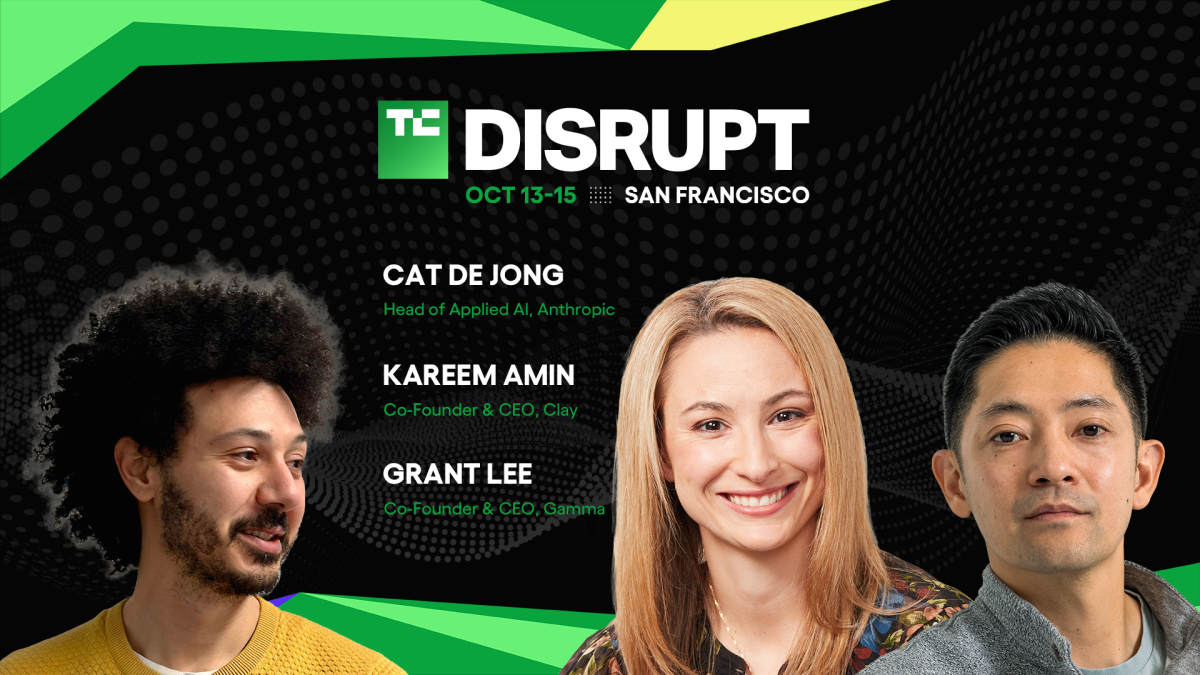
Anthropic, Gamma and Clay will share the stage at TechCrunch Disrupt 2026 on October 13–15 in San Francisco to discuss what happens when enterprise AI moves beyond flashy demos and into everyday work. The session matters because it tackles the question buyers and builders care about most: which AI tools survive real-world use, and which ones stall after the pilot phase.
The conversation, titled “What Anthropic Sees When Enterprises Actually Deploy Claude,” is designed to bridge two perspectives that are often separated in AI coverage: the view from a major model provider seeing enterprise rollout patterns across customers, and the view from product founders trying to turn AI capabilities into tools people return to again and again.
For companies evaluating AI investments, the timing is significant. Many organizations can be impressed by a polished demo in minutes, but the real test begins only when employees put a tool into sensitive workflows, apply it under deadline pressure, and decide whether it saves enough time or creates enough value to justify adoption.
Why this Disrupt session matters
This panel is important because it focuses on deployment, not just possibility. Much of the AI conversation still centers on what technology might do in theory, while the harder business question is whether it works reliably enough to become part of how teams actually operate.
TechCrunch is positioning the discussion around the gap between pilot programs and production usage, a gap that has become one of the defining issues in enterprise AI. Many firms launch trials, but far fewer make the leap to broad adoption. The difference often comes down to workflow fit, reliability, integration, user trust and whether the product solves a problem that is urgent enough to matter.
By bringing together Anthropic, Gamma and Clay, the event is set up to examine the adoption problem from both sides: the platform provider observing enterprise implementation patterns, and the startup founders building products that must earn daily usage rather than occasional curiosity.
Who is speaking at the AI Stage?
The panel features three leaders whose companies sit at different points in the AI product stack, giving the discussion a practical, end-to-end feel.
| Speaker | Company | Role | What they bring to the discussion |
|---|---|---|---|
| Cat de Jong | Anthropic | Head of Applied AI | Enterprise deployment insights from teams using Claude in real workflows |
| Grant Lee | Gamma | Co-founder and CEO | Founder perspective on building AI software people actively adopt |
| Kareem Amin | Clay | Co-founder and CEO | Experience embedding AI into sales and go-to-market workflows |
What Anthropic is expected to contribute
Anthropic’s Cat de Jong works with companies deploying Claude into operational settings, which means she has a close view of what happens once AI stops being a sandbox experiment and starts affecting day-to-day business tasks. Her perspective should shed light on where adoption succeeds, where it breaks down and what separates companies that move quickly into production from those that stay stuck in testing mode.
The core value of that experience is pattern recognition. A single enterprise rollout can reveal one company’s needs, but a role like de Jong’s offers a wider read on recurring obstacles: slow internal buy-in, unclear use cases, integration headaches and the challenge of proving enough return on investment to justify scaling.
Anthropic’s enterprise work suggests the central question is no longer whether AI can generate useful output, but whether organizations can make that output dependable enough to depend on.
What Gamma brings to the table
Gamma’s Grant Lee offers the viewpoint of a founder whose product has had to win over large numbers of users in the real world. Gamma began as an AI-powered alternative to conventional presentation software, but it has expanded into a broader visual communication platform that can help users create marketing assets and other content formats.
That growth makes Gamma a useful case study in product-market fit for AI. A company can launch with an impressive feature set, but sustained adoption depends on whether the product becomes part of people’s workflow. If users only open it when they want to test a novelty, the product may generate attention without lasting utility. If they come back repeatedly, the product has likely crossed into daily relevance.
TechCrunch reported earlier in 2026 that Gamma was approaching 100 million users, a milestone that underlines how quickly AI-powered tools can spread when they genuinely solve a common pain point. In Gamma’s case, that pain point is the time and effort required to produce polished visual content at scale.
Why Clay’s perspective is especially relevant
Clay’s Kareem Amin brings a workflow-focused view of AI adoption. Clay helps companies manage data, automate go-to-market processes and launch agentic workflows, which places it squarely in the category of tools that must integrate with existing systems rather than stand apart from them.
Clay’s relevance to the session is sharpened by its relationship with Anthropic. In January, TechCrunch reported that Clay was among the initial apps integrated into Claude when Anthropic unveiled interactive workplace tools inside the Claude interface. That background means Amin is not speaking from the outside; he is directly involved in the kind of product integration this panel is about.
That experience should make the discussion more concrete. Instead of treating AI as a generic productivity layer, the panel can explore the real mechanics of adoption: where users place trust, how agents fit into established processes, and what companies expect from AI once they start building it into customer-facing and internal systems.
How do AI products move from demo to daily use?
AI products move from demo to daily use by solving a problem that is frequent, costly and frustrating enough that users want the tool built into their routine. The problem with many early-stage AI demonstrations is not that they are technically weak; it is that they are context-free. They can dazzle in isolation while failing to fit the way people actually work.
The session at Disrupt is likely to focus on the hidden work behind adoption. That includes onboarding, trust-building, workflow integration, output quality and the unglamorous reality of change management inside companies. A tool may perform well in a controlled demo and still struggle when users need it to comply with internal policies, support collaboration or handle edge cases.
For enterprise buyers, the difference between “interesting” and “essential” often comes down to whether AI reduces friction rather than adding another layer of software overhead. If the product saves time but forces employees to change habits too much, it may be rejected. If it slips into an existing process and makes that process faster, clearer or more consistent, it has a better chance of becoming indispensable.
The factors that usually determine adoption
- Workflow fit: The product must match how people already operate or make the transition easy.
- Reliability: Users need consistent output, especially when the tool is used in revenue-critical or customer-facing tasks.
- Trust and control: Enterprises want visibility into how AI reaches its answers and what guardrails exist.
- Clear ROI: Decision-makers need evidence that the tool saves time, cuts costs or improves outcomes.
- Ease of repetition: Adoption grows when users come back because the tool is useful every week, not just impressive once.
What does Anthropic see when enterprises actually deploy Claude?
Anthropic sees the difference between early enthusiasm and operational reality. That is the central premise behind the session title, and it reflects a major shift in the AI market: the conversation has moved from what models can generate to how organizations operationalize them at scale.
When a company first experiments with Claude or another enterprise AI system, the questions tend to be broad and aspirational. Teams ask whether the model can summarize documents, draft text or support internal knowledge work. Once deployment begins, the questions become more specific: Is the output consistent enough for business use? Can the system be integrated with existing tools? Will employees trust it? Can the company measure value without creating more operational drag?
That transition matters because enterprise adoption is rarely a single decision. It is a sequence of decisions involving security teams, department leaders, operators and end users. A model can win technical approval and still fail in practice if the interface is clunky or if employees cannot find a reason to incorporate it into their day.
Why pilots often stall
Pilots stall because organizations underestimate the distance between testing and production. A trial can be successful in a limited environment, but scaling usually exposes problems that were invisible in the prototype stage.
Common reasons include unclear ownership, data integration challenges, concerns about governance, and difficulty proving a business case that is stronger than the status quo. In some cases, a pilot produces good output but fails to match the speed or simplicity employees expect. In others, the technology is promising but not yet stable enough for sensitive workflows.
De Jong’s role suggests Anthropic is paying attention not only to the technical performance of Claude but also to the organizational patterns around its adoption. That makes this session potentially valuable for buyers looking for a realistic picture of where enterprise AI is headed.
Why founders care about what customers do after launch
Founders care because launch day is not the end of the product story; it is the beginning of the product’s real test. Once customers start using a tool in their own workflows, they reveal what the product actually is, not just what the team hoped it would be.
Gamma’s growth illustrates that point well. A product may begin with a single core use case, but customers often expand it into adjacent jobs. In Gamma’s case, users did not stop at presentations; the platform broadened into other forms of visual communication. That kind of expansion is a sign that customers are pulling the product into more parts of their work.
For AI founders, that behavior is gold. It suggests the product is valuable enough to create habits. It also creates a feedback loop: once the tool becomes part of a workflow, the company can learn from repeated use and improve the product around actual demand rather than hypothetical scenarios.
From a founder’s perspective, the biggest signal is not initial excitement but repeat use that turns a clever AI feature into a working habit.
How Clay illustrates the next phase of AI workflow tools
Clay illustrates the next phase of AI workflow tools by showing how AI becomes useful when it is embedded in systems that companies already rely on to generate revenue. In go-to-market teams, efficiency is valuable only if it helps find, qualify and reach customers more effectively.
That is a very different challenge from building a consumer-facing chatbot or a standalone writing assistant. Sales and marketing teams need tools that work with data pipelines, customer records and outreach systems. They also need outputs that are relevant enough to save time without adding manual cleanup.
Amin’s perspective is therefore especially useful for understanding the practical reality of agentic AI. In this context, “agentic” does not mean futuristic autonomy for its own sake. It means automating tasks that are repetitive, data-heavy and tightly connected to business outcomes. If AI cannot help a team move faster or make better decisions, it is unlikely to stick.
What customers usually expect from workflow AI
- Better targeting and prioritization
- Less manual data entry and cleanup
- Faster generation of customer-facing materials
- More consistent execution across teams
- Clear connection between AI use and business results
What the Disrupt 2026 stage says about the AI market
The decision to spotlight this conversation at Disrupt 2026 reflects a broader shift in the AI market. The era of pure novelty is giving way to an era of proof. Investors, operators and enterprise buyers increasingly want to know not just whether an AI system is powerful, but whether it can deliver sustained value in a real business environment.
That change is visible across the industry. Companies are under pressure to show measurable results from AI budgets. Startups need to prove that their products can withstand real usage patterns. And model providers must demonstrate that their technology can be deployed safely, usefully and repeatedly inside organizations that are often cautious about change.
Sessions like this one help explain why the market is maturing. They move the discussion away from speculative capabilities and toward the daily mechanics of adoption, which is where most enterprise value is either created or lost.
Where and when is the event happening?
Disrupt 2026 will take place October 13–15 at Moscone West in San Francisco. The event is expected to draw more than 10,000 founders, investors, operators and technology leaders, with a program that includes more than 200 sessions across six industry stages, along with roundtables, breakouts, matchmaking and networking opportunities.
TechCrunch says the event will also feature more than 250 speakers and over 300 exhibiting startups. For attendees, the scale matters because it creates a rare setting where AI builders, buyers and investors can compare notes in one place and hear directly from companies that are shipping real products.
The session featuring Anthropic, Gamma and Clay fits that model well. It is not being framed as a distant forecast about AI’s future. Instead, it is being presented as a practical conversation about what happens once the technology leaves the demo stage and enters the systems people use every day.
| Event detail | Information |
|---|---|
| Event | TechCrunch Disrupt 2026 |
| Dates | October 13–15, 2026 |
| Location | Moscone West, San Francisco |
| Expected attendance | 10,000+ attendees |
| Program size | 200+ sessions, 250+ speakers, 300+ startups |
| Featured topic | Enterprise AI deployment and real-world usage |
Why this conversation is bigger than one panel
This conversation is bigger than one panel because it captures the central problem facing AI adoption in 2026: usefulness must survive contact with reality. In a market crowded with impressive demos, the companies that win are likely to be the ones that can turn technical capability into dependable behavior inside actual organizations.
That has implications across the industry. Investors are watching for products with durable usage, not just initial buzz. Enterprise buyers want tools that reduce work rather than create new layers of complexity. And startups need to understand that the real customer experience begins only after deployment, when assumptions are tested by daily use.
Anthropic, Gamma and Clay are useful participants in that conversation because they each represent a different step in the AI journey. Anthropic sees the deployment side from the platform level. Gamma sees what happens when users decide a product is worth returning to. Clay shows how AI becomes part of a company’s growth machinery. Together, they can offer a more grounded picture of where AI is actually delivering value.
What attendees are likely to learn
Attendees who sit in on this session are likely to come away with a sharper sense of what enterprise AI adoption really requires. The most valuable takeaway may be that the hardest part of AI is not building something that looks good in a demo; it is building something that changes behavior enough to become part of everyday work.
That insight is especially relevant for founders, product leaders and enterprise decision-makers trying to separate durable opportunities from short-lived experiments. A successful AI product usually does more than impress. It fits a workflow, earns trust, and remains valuable after the novelty fades.
For the AI market as a whole, that is the conversation that matters now.
Frequently asked questions
What is Anthropic, Gamma and Clay’s session at Disrupt 2026 about?
It is about how enterprise AI works after the demo phase. The panel will examine what Anthropic sees in Claude deployments and what founders at Gamma and Clay have learned about building AI products people actually use in real workflows.
Who is speaking at the Disrupt 2026 AI session?
The speakers are Cat de Jong, Anthropic’s head of applied AI; Grant Lee, co-founder and CEO of Gamma; and Kareem Amin, co-founder and CEO of Clay. Each brings a different perspective on AI deployment and product adoption.
Why is this panel important for enterprise AI buyers?
It is important because it focuses on the gap between pilots and production. Enterprise buyers will hear how AI tools succeed, stall or become embedded in daily work, which is often the deciding factor in whether a deployment delivers value.
When and where is TechCrunch Disrupt 2026 taking place?
TechCrunch Disrupt 2026 is scheduled for October 13–15, 2026, at Moscone West in San Francisco. TechCrunch says the event will include more than 200 sessions, 250-plus speakers and 300-plus exhibiting startups.
What makes Gamma and Clay relevant to an Anthropic AI discussion?
Gamma and Clay are relevant because they show how AI products win real users. Gamma has expanded beyond presentations into visual communication tools, while Clay embeds AI into sales and go-to-market workflows that depend on repeated, practical use.