Updated August 20, 2026 2:53 pm
In short
Calendly is adding an AI meeting note-taker and Callie assistant, while also emphasizing new recording-notification and pre-meeting disclosure features tied to its scheduling system.
- Calendly is entering the crowded AI note-taking market with transcription and follow-up automation.
- The company is also building Callie, an AI assistant tied to its scheduling platform.
- Calendly says privacy notices and user controls will be central to the product.
- The launch is aimed at sales, marketing and other meeting-heavy teams.
Update — August 20, 2026 2:53 pm
Calendly also said its note-taker will actively let people know when recording is underway, including posting a chat message to the meeting. Participants will be able to ask the assistant to leave the call.
The company added that the same scheduling integration can be used to warn attendees before a meeting starts that it will be recorded, a privacy-oriented step that was not part of the original launch details.
Update — August 19, 2026 5:25 pm
Calendly says its new note-taker will also notify everyone in a meeting that recording is happening, including sending a chat message about its presence. Users will be able to ask it to leave the call, and it can also warn participants ahead of time that a meeting will be recorded.
The company says those pre-meeting alerts are enabled by its scheduling integration, which lets the system surface the recording notice before a call starts. That privacy-oriented detail was not part of the original launch description.
Calendly is moving beyond scheduling and into AI meeting automation, unveiling a note-taking product that can join calls, record and transcribe them, then turn conversations into summaries, action items and follow-up drafts. The launch matters because it pushes the scheduling platform into one of the fastest-growing corners of workplace AI, where companies are racing to capture the post-meeting workflow as well as the meeting itself.
The Atlanta-based company, best known for helping people book meetings without the usual back-and-forth, is now pitching itself as a fuller productivity layer for teams that spend much of the day in conversations. Its first note-taking release is aimed at workers whose calendars are packed with client calls, sales discussions and internal check-ins, and it comes with an AI assistant called Callie that is designed to help users schedule meetings and pull relevant context from earlier interactions.
What Calendly is launching
Calendly’s new product is a meeting note-taker that behaves much like other AI transcription tools already on the market. It can join a meeting, capture the audio and video, convert the conversation into text and then produce a written summary, action items and draft follow-up emails.
The company is also experimenting with a more advanced capture method that uses system audio, similar to the approach popularized by note-taking app Granola. That feature would allow the software to listen to sound coming from the user’s device rather than relying only on a traditional bot joining the call.
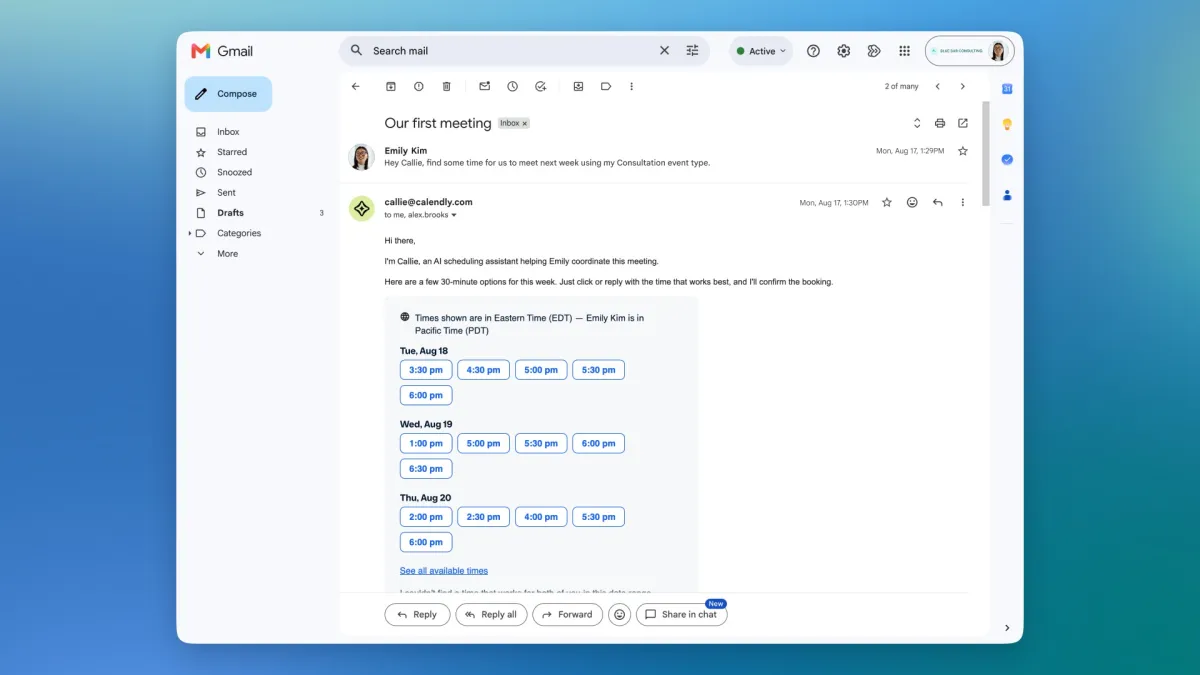
Alongside the note-taker, Calendly is preparing Callie, an AI assistant that connects to the company’s existing booking tools. Callie is meant to help users set up meetings, check availability across calendars and surface useful details from past conversations before the next call begins.
How does Calendly’s note-taker work?
It works by joining a meeting, recording the exchange and then transforming that recording into usable work outputs. In practical terms, that means the system is not only documenting what was said but also trying to reduce the manual steps that usually follow a call, such as writing recap emails or assigning next steps.
Calendly says the feature is intended to do more than preserve transcripts. Its pitch is that the real value comes after the meeting ends, when teams need to act on what was discussed.
Calendly’s chief executive, Tope Awotona, said the company sees a crowded market for transcription tools but believes the larger opportunity is in the work that happens after the notes are created.
That framing reflects a broader shift in the AI productivity market. A growing number of products can now capture meetings accurately, so the competitive edge increasingly depends on what they do next: recommending tasks, drafting messages, updating CRMs or triggering follow-up workflows.
Why Calendly is targeting meeting-heavy teams
Calendly says the first audience for these tools is people in outward-facing roles such as sales and marketing, whose jobs involve constant meetings with prospects, customers and partners. Those users already rely on scheduling software to coordinate their days, which makes them a natural fit for a product that combines booking, recording and workflow automation.
The company’s logic is straightforward: if scheduling is where a meeting begins, then note-taking and follow-up are where much of the operational work is completed. That creates a chance to keep users inside Calendly’s ecosystem for more of the meeting lifecycle.
This strategy also gives Calendly a path to expand its relevance beyond calendar links. Instead of being only the tool that gets a meeting on the books, it can become the system that helps prepare for the conversation, document it and move it forward afterward.
Who is the product built for?
It is built for teams that live in meetings, especially sales, customer success, business development and marketing functions. Those jobs often require repeated follow-ups, context retention and collaboration across internal and external contacts, all of which are labor-intensive if done manually.
Calendly is betting that users who already trust it for scheduling will be open to letting the company handle more of the surrounding workflow, particularly if the AI can save time after each call.
The crowded meeting-note market Calendly is entering
Calendly is not the first company to see opportunity in AI-generated meeting notes. The market already includes dedicated note-taking apps such as Granola, Fireflies, Read AI, Otter and Fathom, all of which compete on transcription quality, automation and integrations.
At the same time, broader productivity platforms have been adding similar features. Notion, ClickUp and Wispr have each moved into the space with their own AI assistants or note-taking capabilities, blurring the line between standalone transcription products and all-purpose work suites.
That makes Calendly’s entry notable for two reasons. First, it shows how attractive the category remains even as it becomes crowded. Second, it suggests that the real battle is shifting from note capture to workflow ownership.
| Company or product | Primary focus | Notable note-taking angle |
|---|---|---|
| Calendly | Scheduling and meeting coordination | Joins meetings, transcribes, summarizes and drafts follow-ups |
| Granola | AI note-taking | Uses system audio to capture meetings |
| Fireflies | Meeting transcription and search | Automates note capture and meeting intelligence |
| Read AI | Meeting summaries and assistant tools | Offers an email-based assistant for scheduling and context |
| Otter | Transcription and collaboration | Longstanding meeting recording and note product |
| Fathom | Meeting summaries | Automatic recap and action-item generation |
What is Callie and how is it different?
Callie is Calendly’s planned AI assistant, and its differentiator is access to the company’s scheduling infrastructure. Rather than functioning only as a meeting summarizer, it is designed to help users arrange calls, check who is free and bring forward context from previous meetings.
That combination could make Callie more useful than a generic assistant that only answers prompts. Because Calendly already sits in the middle of scheduling, it has visibility into meeting timing, participants and booking patterns that can be used to streamline the next action.
A similar idea is already being tested elsewhere. Earlier in the year, meeting note-taking startup Read AI introduced an email-based assistant with comparable ambitions. Calendly’s version differs because it is being built on top of a scheduling product that already has a strong foothold in many workplaces.
Why does scheduling data matter?
Scheduling data matters because it tells the assistant who is meeting, when they are meeting and how often those relationships recur. That information can help surface prior notes, suggest the right attendees and reduce the time it takes to coordinate recurring conversations.
In an era when AI products are increasingly judged by usefulness rather than novelty, integration depth may matter more than raw transcription accuracy.
Privacy is becoming a key differentiator
Calendly is entering a category that has already drawn scrutiny over how meeting data is collected, stored and disclosed. Some competitors, including Otter and Granola, have faced accusations related to privacy practices, putting pressure on newer entrants to be transparent about how their tools operate.
Awotona said Calendly intends to make the recording process obvious to everyone in the meeting. According to the company, the assistant will post a message in the chat to let participants know it is present and active, and any user can ask it to leave. Calendly also says it can notify participants before the meeting starts, using its scheduling system to flag that the call will be recorded.
Those safeguards are significant because AI meeting tools often create tension between convenience and consent. Users may appreciate automated notes, but they also want clarity about when recording begins and who has access to the content.
How is Calendly addressing recording transparency?
It is addressing transparency by warning participants in the meeting chat and by using pre-meeting notifications when possible. That approach is intended to make the assistant visible rather than hidden, which could help reassure users who are wary of silent recording or undisclosed note capture.
Calendly is also giving participants some control by allowing them to ask the assistant to leave the call. That does not eliminate all privacy concerns, but it does create a more explicit consent framework than some earlier tools in the category.
The larger business case behind the launch
Calendly’s move is not just about keeping up with a trend. It is also about deepening its business model. The company has built its reputation on reducing friction in scheduling, but AI note-taking creates a chance to own more of the follow-up cycle, where productivity gains can be easier to demonstrate and monetize.
The best-case scenario for Calendly is that users will not see the note-taker as a separate product at all, but as a natural extension of the scheduling flow. A meeting gets booked, the assistant joins, notes are captured, a summary is generated and the next meeting is arranged without the user switching tools.
That kind of integrated workflow is increasingly attractive to enterprise buyers, who often prefer fewer disconnected apps and more systems that can be governed centrally. For Calendly, that could mean stronger retention and potentially higher-value subscriptions.
- Scheduling is the entry point: Calendly already owns a high-frequency work task.
- Note-taking creates stickiness: Capturing the meeting and generating follow-ups increases daily utility.
- Assistant features widen the moat: Callie could make Calendly harder to replace.
How the product fits the broader AI productivity shift
Calendly’s announcement reflects a wider pattern in enterprise software: companies are using AI to move from passive record-keeping to active assistance. Tools that once only logged events now try to recommend decisions, automate paperwork and coordinate across apps.
Meeting transcription was one of the earliest successful workplace AI use cases because it solves a universal pain point. But as the market matures, vendors need to prove that their products do more than create another document nobody reads. That is why action items, reminders and follow-up automation are becoming core features rather than add-ons.
In that sense, Calendly is entering a market with both promise and risk. The promise is obvious: every company has meetings, and many teams struggle to keep track of what was decided. The risk is just as clear: if the AI is not deeply useful, users may treat it as just another bot in the room.
What the competition looks like now
Competition in this segment is unusually broad. Some players are specialized note-taking apps, while others are general productivity suites or assistant platforms that have simply added meeting features. That means Calendly must compete on precision, ease of adoption and the quality of the downstream workflow.
It also means the category is being defined less by transcription quality alone and more by how well the product fits into existing work habits. For a scheduling company like Calendly, that is an advantage: it already lives inside a routine that begins before the meeting and continues afterward.
- Meeting is scheduled.
- Assistant joins and records.
- Transcript becomes summary and action items.
- Follow-up emails and next steps are drafted.
- Next meeting is booked with context preserved.
What happens next?
Calendly has not positioned this as a one-off feature. The note-taker, the experimental system-audio capture and Callie all suggest a larger push toward an AI-powered workflow layer. The company appears to be testing how far it can extend from scheduling into meeting intelligence without losing the simplicity that made it popular in the first place.
If the rollout is successful, Calendly could become a more central part of knowledge work, especially for teams that depend on external conversations. If it struggles, the company will still have learned whether its brand can stretch into a much more competitive AI category.
Either way, the launch underscores a larger shift in workplace software. The value is no longer just in helping people arrange meetings or write notes. It is in helping them turn conversations into action, faster and with less manual effort.
Key facts at a glance
| Item | Details |
|---|---|
| Company | Calendly |
| New products | AI note-taker and AI assistant Callie |
| Core functions | Recording, transcription, summaries, action items, draft follow-up emails |
| Target users | Sales, marketing and other meeting-heavy teams |
| Privacy approach | In-chat notices, pre-meeting recording alerts and opt-out options |
| Competitive context | Granola, Fireflies, Read AI, Otter, Fathom, Notion, ClickUp, Wispr |
For now, Calendly’s pitch is simple: if the company already helps you get the meeting on the calendar, it wants to help you make the meeting useful too. In a crowded AI market, that end-to-end promise may be the strongest argument it has.
Frequently asked questions
What is Calendly’s new AI note-taking product?
Calendly’s new AI note-taking product is a meeting assistant that joins calls, records audio and video, transcribes the conversation, and turns it into summaries, action items and draft follow-up emails. It is designed to reduce the manual work that usually follows meetings.
What is Callie in Calendly’s product lineup?
Callie is Calendly’s planned AI assistant for scheduling and meeting context. It is meant to help users book meetings, check availability and surface relevant details from earlier conversations, using Calendly’s existing calendar and scheduling infrastructure.
How does Calendly say it will handle privacy for recordings?
Calendly says it will notify participants that a meeting is being recorded by posting in the chat and, when possible, alerting people before the meeting starts. The company also says participants can ask the assistant to leave the call if they do not want it present.
Who is Calendly targeting with its AI note-taker?
Calendly is targeting people in meeting-heavy roles, especially sales and marketing teams. Those users often spend much of the day on calls and need faster ways to capture decisions, organize follow-ups and keep context across repeated conversations.
How crowded is the AI meeting notes market?
The AI meeting notes market is very crowded. Dedicated products such as Granola, Fireflies, Read AI, Otter and Fathom are already competing there, while broader productivity tools like Notion, ClickUp and Wispr have also added meeting note features.