In short
Satya Nadella warned at the NYT DealBook Summit that AI is speeding up cyber threats while much critical infrastructure remains too difficult to patch. He said Microsoft will use lessons from the Outlook incident to improve architecture and operations.
- Nadella said critical infrastructure includes systems that are effectively unpatchable.
- He warned AI is shrinking the time between vulnerability discovery and exploitation.
- Microsoft plans to apply lessons from the Outlook incident to architecture and operations.
- TechCrunch says recent outages have increased concern about possible cyberattacks, though officials denied those claims.
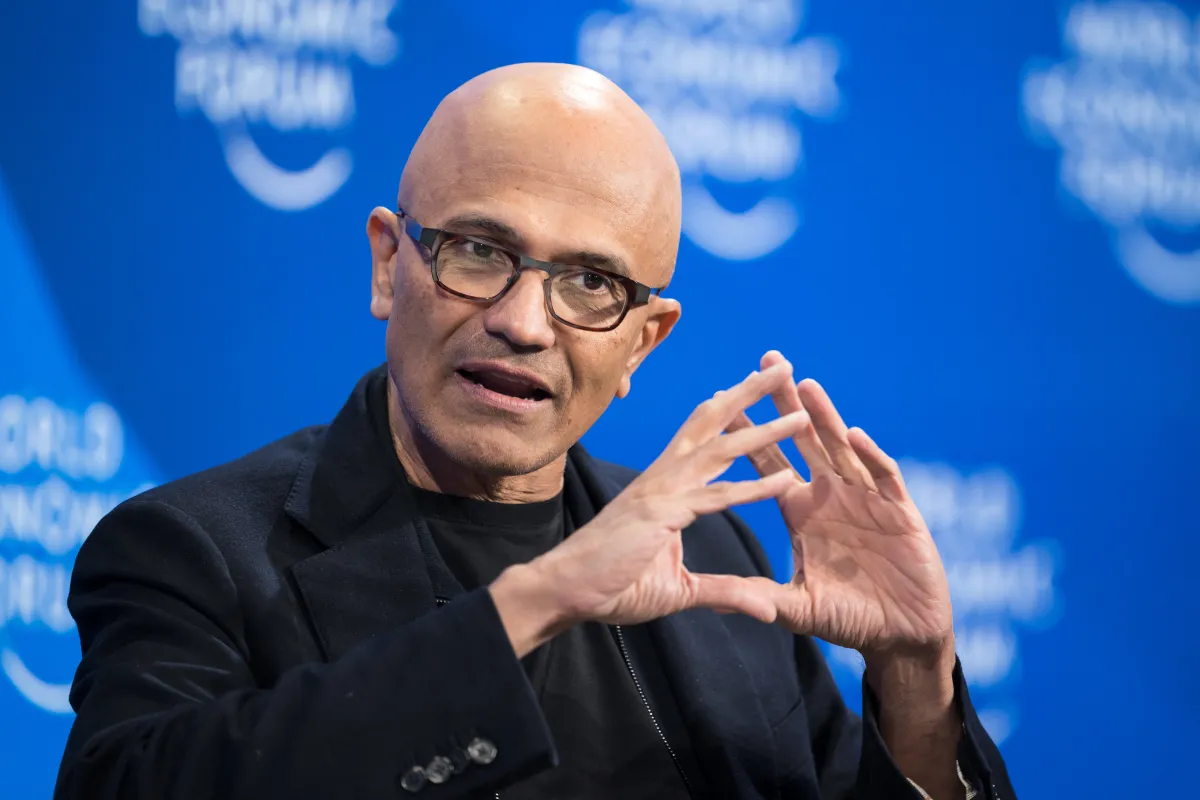
Microsoft CEO Satya Nadella warned at the NYT DealBook Summit on Wednesday that large parts of critical infrastructure remain too hard to fix quickly, leaving them exposed to AI-enabled cyberattacks. His message was blunt: as artificial intelligence speeds up vulnerability discovery, the gap between finding a flaw and exploiting it is shrinking.
What Nadella said at DealBook
Speaking at The New York Times’ DealBook Summit, Nadella described a security problem that is becoming more urgent as more operational systems come online and more attackers use AI to move faster. He said critical infrastructure can include internet-connected systems with firmware and hardware that are effectively impossible to patch on the kind of timeline modern threats demand.
“there is a lot of stuff in our critical infrastructure that’s unpatchable,” Nadella said, according to TechCrunch.
He pointed to systems such as chillers, HVAC gear and transportation-related technology, saying that even when the underlying firmware is discoverable, the systems themselves may still be difficult or impossible to update safely. In his view, that creates an uncomfortable mismatch: the world now expects near-instant remediation, but much of the installed base was not built for that pace.
Why it matters
The warning matters because it connects two trends that are increasingly colliding: AI is making it easier to find weaknesses, while the infrastructure that keeps buildings, networks and transport running often cannot be patched quickly without risk.
That combination narrows the time defenders have to react. If a vulnerability can be found and turned into a working exploit faster than operators can deploy a fix, then a flaw that once sat quietly for months can become an immediate operational threat. For readers, that raises the stakes not just for software companies, but for hospitals, campuses, factories, transit systems and other environments that depend on connected equipment.
It also highlights a practical problem for security teams: the safest patch may not always be the fastest patch. Nadella warned that pushing updates immediately from release to production can itself create instability, which means operators are balancing two kinds of risk at once — leaving a hole open, or rushing a change that breaks a system.
How AI changes the security equation
Nadella framed AI as an accelerant on both sides of the cyber equation. On the defensive side, AI tools can help teams look for weaknesses more quickly. On the offensive side, the same tools can help attackers discover and exploit vulnerabilities at a faster clip.
That speed matters most in environments with long upgrade cycles. Ordinary consumer software can often be updated overnight. Industrial equipment, embedded devices and operational technology are different: they may have maintenance windows, safety checks, compatibility concerns and vendor dependencies that slow down the fix.
TechCrunch reported that Nadella tied the issue to “critical infrastructure” systems that include unpatchable firmware and internet-connected HVAC equipment. Those are exactly the sorts of assets that can be overlooked in traditional cybersecurity planning because they sit between physical operations and software maintenance.
Why firmware is such a problem
Firmware sits low in the hardware stack and is often much harder to change than ordinary software. In practice, that means a vulnerability can persist longer, be harder to detect, and require more coordination to fix. Nadella’s point was not simply that patches are slow; it was that some systems were never designed for rapid software remediation in the first place.
That design gap becomes more visible when those devices are connected to the internet. Once a system is reachable remotely, the bar for exploitation falls, but the bar for safe repair may still be high. The result is a security blind spot that AI can widen.
Background: the pressure on Microsoft and the industry
The remarks came against a backdrop of concern about recent large-scale outages, including one involving Microsoft Outlook. TechCrunch noted that such incidents have fueled speculation about possible cyberattacks, although officials have denied those claims in the cases cited.
For Microsoft, the issue is both technical and reputational. Nadella said the company will use the lessons from the Outlook incident to fix upstream architecture and operations. He described that outage as a combination of a latent bug and “a perfect storm,” underscoring how complex systems can fail in ways that are not always caused by a single obvious trigger.
That framing matters because it suggests Microsoft is not treating resilience as a one-off patching exercise. Instead, the company appears to be looking at how upstream design choices, operational processes and incident response interact when systems are stressed.
“We put out an incident response, and we’re going to obviously take all of the learnings,” Nadella said.
He also emphasized the scale of the challenge by pointing to the role of AI in vulnerability discovery. “We now have a very powerful tool that finds vulnerabilities,” he said, according to TechCrunch. The implication is clear: defenders now have to assume that discovery and exploitation will move much faster than before.
What is changing for defenders?
Companies and infrastructure operators are increasingly searching for new ways to discover and remediate vulnerabilities as AI-aided attacks rise. That shift is not just about buying better tools; it also means rethinking architecture, maintenance windows, and how quickly patches move from release to production.
In older environments, security teams often had more time to test fixes before deploying them broadly. Nadella’s warning suggests that cushion is disappearing. The closer attackers get to real time, the more important it becomes to reduce exposure before a vulnerability is publicly known or actively abused.
For critical infrastructure operators, that may mean more emphasis on segmentation, stronger asset inventories, tighter remote-access controls and more deliberate planning around devices that cannot be updated quickly. The fact sheet does not list specific mitigation steps, and Nadella did not spell out a full playbook at DealBook, but the problem he described points directly toward those kinds of operational controls.
By the numbers
| Item | What the fact sheet says | Why it matters |
|---|---|---|
| Wednesday | Nadella spoke at the NYT DealBook Summit | The warning was delivered on a public stage focused on business and technology |
| Recent | A wave of large outages, including one involving Microsoft Outlook, raised cyberattack concerns | Those incidents sharpened attention on resilience and root causes |
| Critical infrastructure | Includes unpatchable firmware, chillers and HVAC gear connected to the internet | These systems are hard to secure because updates are difficult to deploy |
| AI | Can speed vulnerability discovery and make exploitation easier | Shortens the window defenders have to respond |
How did we get here?
Part of the answer lies in the evolution of cyber risk itself. Patching has long been the main response to software vulnerabilities: find the flaw, issue the fix, deploy it as quickly as possible. But that model assumes patches can move through development, testing and production without causing wider disruption.
That assumption is less reliable in infrastructure settings. Many connected systems were not built with constant software turnover in mind. They may run on embedded firmware, depend on legacy components, or support operations where downtime is costly and potentially dangerous.
AI compresses the timeline further. The fact sheet says Nadella sees AI as speeding up vulnerability discovery and making exploitation easier. That means defenders are now up against a faster and more automated offense while still dealing with the same old operational constraints.
TechCrunch’s reporting also places the issue in a broader industry context: companies are seeking new methods for vulnerability discovery and remediation as AI-aided attacks rise. In other words, Nadella’s warning is not an isolated comment; it reflects a growing concern across the tech sector about what happens when security tools and attack tools both improve at once.
What Microsoft is signaling
Nadella’s comments also show how Microsoft wants to frame its own response. By focusing on upstream architecture and operations, the company is signaling that incident response alone is not enough. Once a major outage or security event happens, the deeper question is whether the system was built to limit the blast radius in the first place.
That is especially relevant for cloud and productivity platforms, where a single failure can ripple widely. The Outlook incident, as described in the fact sheet, is being treated internally as a case study in latent bugs and systemic conditions rather than a simple isolated malfunction.
For customers, that means resilience will likely remain a major selling point. For Microsoft, it means the company has to prove that it can learn from disruptions and harden the layers above and below the software people actually see.
What happens next
The fact sheet leaves several open questions that will shape how this story develops.
- Which specific Microsoft or broader infrastructure vulnerabilities Nadella had in mind remains unclear.
- It is still not settled whether the recent outages were caused by bugs, cyberattacks, or some combination of both in the cited cases.
- Observers will be watching for concrete mitigation steps from Microsoft and operators of critical infrastructure.
- Any new approach to patching unpatchable systems will have to balance security gains against stability risks.
What to watch next is whether this warning turns into operational changes. That could include faster patch pipelines, broader use of AI in defensive scanning, or new engineering choices designed to make low-level systems easier to update safely. It could also push more attention toward the old equipment and embedded software that keep modern life running but rarely get the same scrutiny as consumer apps.
For now, Nadella’s core message is that the industry’s security clock is speeding up while much of its infrastructure remains stuck on an older one. That mismatch, he suggested, is no longer theoretical.
Key points for readers
At DealBook, Nadella argued that AI is making vulnerability discovery faster while many critical systems remain too difficult to patch quickly.
He linked the risk to unpatchable firmware and connected infrastructure such as HVAC and transportation systems.
Microsoft is promising to apply lessons from the Outlook incident to improve architecture and operations, not just incident response.
Frequently asked questions
Why is AI a cyber risk for critical infrastructure?
AI is a cyber risk for critical infrastructure because it can help attackers find vulnerabilities faster and make exploitation easier. That shortens the time defenders have to detect a flaw, test a fix and deploy it before damage occurs, especially in systems that are hard to update.
What did Satya Nadella say at the DealBook Summit?
Satya Nadella said much critical infrastructure is effectively unpatchable and warned that AI is speeding up both vulnerability discovery and exploitation. He also said Microsoft will take lessons from the Outlook incident and use them to improve upstream architecture and operations.
Why are unpatchable systems such a problem?
Unpatchable systems are a problem because they can stay exposed even after a vulnerability is known. Firmware, HVAC gear and transportation systems may be difficult to update safely, so defenders may have to rely on compensating controls instead of a quick software fix.
Did Microsoft say the Outlook outage was a cyberattack?
No. The fact sheet says recent large outages, including one involving Microsoft Outlook, raised cyberattack concerns, but officials denied those claims. Nadella described the Outlook problem as a latent bug plus a perfect storm rather than a confirmed attack.