In short
Relay is building a dedicated AI microphone called the Relay Q to make voice dictation and app actions easier than typing. The Mac app is in beta now, while the hardware is due in early 2027.
- Relay is pairing a macOS AI dictation app with a dedicated portable microphone.
- The startup says the device is designed to solve noisy, awkward office dictation.
- Its software uses Google Gemini models and can trigger app actions like Slack messages and calendar entries.
- The Relay Q is set to cost $150, with software priced at $15 per month after the first year.
- Privacy and permissions are a key issue because the app can request screen access for automation.
Relay, a London startup founded by two former Nothing executives, is launching an AI-powered voice-to-text system built around a dedicated microphone called the Relay Q. The company says the device and companion software are meant to let people dictate, edit, and trigger app actions more naturally than typing, with the hardware due in early 2027 and the software arriving first for Mac users.
The pitch matters because voice dictation is quickly becoming one of the most competitive consumer AI categories. As large language models improve transcription, cleanup, and context-aware editing, Relay is trying to stand out by pairing software with custom hardware designed for quieter, more private, and more reliable use at work or on the move.
For years, voice input on computers has been a compromise. It has been useful in bursts, but rarely good enough to replace a keyboard for serious work. That is changing fast. New AI transcription tools can remove filler words, smooth out interrupted thoughts, and even translate messages between languages, all while handling increasingly complex prompts. Relay is betting that the next leap will not come from software alone.
Instead, the startup is building a small microphone designed specifically for AI dictation, along with an app that can turn spoken instructions into text, messages, calendar entries, and other actions. The company’s idea is simple: if people are already using AI to “type” for them, why not build the best possible input device around that behavior?
What Relay is building and why it is different
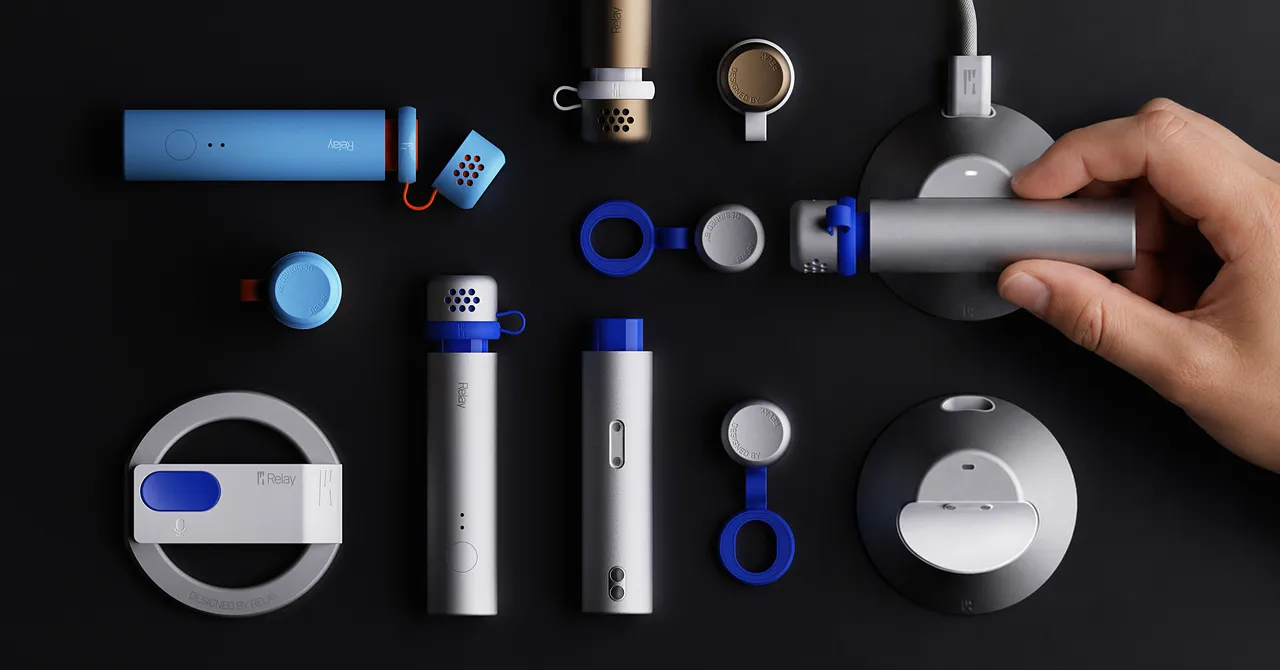
Relay is developing both a macOS app and a separate piece of hardware, the Relay Q, which is essentially a portable microphone with a button-based interface for triggering dictation. The software is available first, while the device itself is slated to ship in the first quarter of 2027.
Unlike many AI productivity tools that live entirely as apps or browser extensions, Relay is taking a hardware-first approach to voice capture. Its founders argue that better hardware can solve one of the biggest practical problems in workplace dictation: people do not always want to speak loudly enough for a laptop microphone to hear them.
The startup was founded by Cookie Xu, who previously led AI and services at Nothing, and Raymond Zhu, a former hardware product manager at the company. Their experience at Nothing helped shape the product idea. Zhu says the pair relied heavily on transcription software at work, but office conditions made it awkward to use.
Zhu said the team kept running into a familiar issue: they wanted the benefits of voice typing without having to raise their voices in front of colleagues. In his view, that made a dedicated microphone feel less like a luxury and more like a necessity.
The Relay Q is meant to address that friction. Users can hold the device while speaking, clip it to clothing, or place it in its dock on a desk. The company says the form factor is intended to let people dictate quietly and naturally, without hovering over a laptop or awkwardly using earbuds as makeshift microphones.
How does Relay work on a Mac?
Relay’s first public software release is built for macOS, and the app is designed to activate inside any text field using a keyboard shortcut. By default, the hotkey is Fn. Once the user holds that key, Relay begins listening and converts speech into text.
The transcription engine behind the app uses Google’s Gemini models. Relay says users can also opt into more advanced functionality, including contextual actions the company calls Skills. Those Skills allow the app to do more than rewrite speech into text. It can also launch other apps, retrieve recipients, create calendar events, and draft messages based on what the user says.
Relay is not positioning itself as a simple dictation tool. It wants to become an assistant that sits between speech and action. In practice, that means a user could ask Relay to write a message in Slack, schedule a meeting in Google Calendar, or open the relevant app and prepare a draft for review.
The company also plans to extend support beyond Apple’s desktop platform. Relay says it intends to add Windows, iOS, and Android later, but the Mac is the launch point because it believes work conversations are most complex there.
Why start with desktop?
Relay says desktop use cases are more demanding than mobile ones because they often involve work communication, multitasking, and longer-form thinking. On phones, people typically send short notes or casual replies. On computers, they are more likely to brainstorm, write at length, or coordinate across multiple apps at once.
That distinction matters for a product like Relay because its core selling point is not just transcription accuracy. It is the ability to translate more complicated speech into finished work with fewer corrections and less friction.
What the beta software can do today
Although the Relay Q hardware is still months away from release, the company’s macOS app is already in beta. The software can work independently of the physical microphone, which lets users test the voice-to-text system before buying hardware.
In testing, the app demonstrated a mix of useful automation and familiar beta-stage rough edges. It could draft calendar events in Google Calendar reliably, but some app-specific workflows were less consistent. For example, a Slack-related skill did not always behave as smoothly as expected.
Even so, the underlying structure is notable. Relay does not just transcribe speech. It also tries to interpret intent. If a user says something like “message this person” or “add this to my calendar,” the app attempts to separate the request from the content of the message and execute the appropriate action.
That is the kind of feature set that makes voice-to-text tools feel like true AI agents rather than simple dictation products. Instead of producing raw speech, Relay tries to help complete a task.
Customization is central to the experience
Relay also allows users to tune the system to their own habits. You can add notes that shape how the app formats output, such as avoiding periods in casual Slack messages or changing tone depending on who you are speaking to.
The company says the software can adapt to different people in a user’s contact list, which could let it generate more formal messages for managers and more casual ones for friends. Relay also says multilingual communication is part of the vision, including automatic translation when speaking to coworkers in other countries.
That emphasis on personalization reflects a broader trend in AI tools: the best products increasingly learn not just what users say, but how they want to sound. For many people, that matters as much as raw transcription accuracy.
Why hardware still matters in voice AI
Relay’s hardware pitch is built around a practical insight: microphones built into laptops and phones are good enough for calls, but not always ideal for private dictation. People may be in shared spaces, need better pickup at low volume, or want a faster way to begin and end dictation without clicking around a screen.
The Relay Q is designed as a cylindrical device with a microphone at one end. Users can press and hold the top to activate dictation, and a double tap can send the message. The top-down view of the microphone resembles the letter Q, which inspired the name.
Zhu says the company wants users to be able to whisper, rather than speak at normal volume, and still get reliable pickup. That is a small detail with big implications. If the microphone can actually perform well in quiet office settings, it could make voice input feel much more natural in daily work.
Relay is also preparing a magnetic accessory for phones. The company says it will offer a MagSafe-style grip for iPhone and Qi2-compatible devices so users can attach the microphone and trigger dictation on mobile more easily. That mobile product is expected to launch alongside the Relay Q in early 2027.
How privacy and permissions could shape adoption
Relay’s more ambitious features come with significant system access. To perform app actions, the software can request permission to see a snapshot of the screen when activated. That capability helps Relay identify what app is open, who the message should go to, or what field should be filled in.
The company says user data is stored locally on the device and can be manually edited or deleted by the user. When information needs to be processed, it is routed through Relay’s servers and then on to Google’s servers, but Relay says it does not keep the data.
Still, any product that gives an AI model visibility into the operating system introduces privacy and security concerns. That is especially true in a climate shaped by growing scrutiny of workplace surveillance features and computer-level assistants. Microsoft’s Recall, for example, raised similar questions about whether AI systems should be allowed to observe so much of a user’s screen activity.
Relay’s challenge is to prove that its access model is not only functional, but trustworthy. For a productivity product that wants to see what you are doing, trust is part of the product itself.
How good is Relay’s transcription compared with rivals?
Relay’s transcription is promising, but it is not yet perfect. In testing, it did not consistently match the accuracy of Google’s latest dictation tools on Pixel phones. It occasionally missed words or handled punctuation unevenly.
At the same time, it showed some of the smarter behavior that separates modern AI dictation from older speech-to-text systems. It could detect when a speaker corrected themselves mid-sentence and remove the false start. It also handled some emoji insertion tasks, although not always consistently.
That inconsistency is not surprising for a beta product, especially one that is still waiting on its dedicated microphone. Relay’s founders seem to be relying on hardware to tighten the loop between intention and output.
The company’s broader bet is that users care less about perfect benchmark results than about whether the tool feels effortless in real life. If Relay can make speaking faster, quieter, and more natural than typing, that may be enough to win loyal users even before the software becomes flawless.
A quick comparison with other voice-first products
Relay is entering a market that already includes both software-only and hardware-assisted approaches. Some products lean on app integrations, while others are experimenting with wearables that let users whisper privately into a ring or pendant.
Relay’s difference is that it is not trying to be a fashion accessory or a general-purpose wearable. It is positioning itself as a dedicated work tool with a microphone designed specifically for AI dictation and app automation.
| Product | Form factor | Primary focus | Status |
|---|---|---|---|
| Relay Q | Portable microphone | AI dictation and app actions | Hardware due early 2027; software in beta |
| Wispr Flow | Software | Voice-to-text and writing cleanup | Available |
| Google Pixel dictation | Built-in phone feature | On-device dictation and editing | Available on recent Pixels |
| Stream Ring | Ring wearable | Whisper-based voice input | Shipping to early buyers |
| Pebble Index 01 | Ring wearable | Whisper-based voice input | Shipping to early buyers |
Why did Relay reject a ring?
Relay considered a ring-style device but decided against it. Zhu said the market is already crowded with smart rings, which made the team less eager to add another product to that category.
The decision also reflects a design philosophy. A ring is subtle, but it may not be the most ergonomic or practical option for a system that depends on a microphone, a trigger button, and frequent daily use. Relay appears to have concluded that a small desk-and-pocket device would better match the habits of knowledge workers.
That choice also sets Relay apart from recent hardware startups that are focusing on whisper-based rings. Sandbar and Pebble have each introduced their own ring-shaped tools for private voice input, and both have begun shipping to early buyers. Relay is entering the same broader conversation, but with a different shape and a different workflow in mind.
What the launch means for the AI input market
Relay’s arrival underscores how quickly the AI input market is evolving. Not long ago, voice dictation was mostly a convenience feature. Today it is becoming a serious interface layer for work software, with products designed to compress the gap between thinking, speaking, and acting.
That shift could matter far beyond transcription. If voice becomes a preferred way to draft messages, schedule meetings, and move through apps, then the keyboard may no longer be the default interface for every task. Instead, users may choose between typing, talking, and hybrid workflows depending on context.
For AI companies, that opens a new frontier. The winners may not be the ones that merely produce the cleanest transcript, but the ones that make speaking feel like executing a command. Relay is trying to live in that middle ground.
The startup still has to prove that its software works well enough, that its hardware is worth paying for, and that users will trust a microphone that can also peek at their screen. But the idea is clear: the company wants to make the keyboard optional more often than it is today.
Key dates, features, and pricing
The most important details about Relay are easy to summarize, especially for readers tracking the startup’s next steps.
- Relay was founded in London by Cookie Xu and Raymond Zhu, both formerly of Nothing.
- The software is in beta and currently works on macOS only.
- The Relay Q hardware is scheduled for early 2027.
- The mobile companion launch is planned for the first quarter of 2027.
- The device will cost $150 and include one year of software.
- After that, the software subscription is expected to cost $15 per month.
For now, Relay is an early example of where AI hardware may be headed next: smaller than a laptop, more focused than a smartphone, and built for one specific job that AI can already do better than most people expected a few years ago.
The remaining question is whether enough users will decide that speaking their work is easier, faster, and more natural than touching a keyboard. Relay is betting that the answer is yes.
Timeline of Relay’s rollout
| Period | Milestone | What it means |
|---|---|---|
| Before launch | Relay beta app available on macOS | Users can test voice dictation and Skills without the hardware |
| 2026 | Software debut | Relay begins rolling out its app experience |
| First quarter 2027 | Relay Q release | The dedicated microphone ships to buyers |
| First quarter 2027 | Mobile support expansion | Planned launch for iPhone and Android use cases |
| After one year | Subscription begins | Software continues at $15 per month |
Relay is not the only company trying to reimagine how people enter text in the AI era, but it is one of the clearest examples of a startup building around the idea that the best interface may be a microphone you actually want to carry.
Frequently asked questions
What is Relay Q?
Relay Q is a dedicated AI-powered microphone designed to work with Relay’s voice-to-text software. It lets users trigger dictation, send messages, and carry out app actions more naturally than typing, with a hardware release planned for early 2027.
When will Relay Q be available?
Relay Q is expected to ship in the first quarter of 2027. Relay has already released a beta version of its macOS software, but the physical microphone itself is still months away from launch.
How much will Relay cost?
Relay Q will cost $150 and include one year of software access. After that, Relay says the subscription will cost $15 per month, though the software can also be used without buying the hardware.
Does Relay only work on Mac?
Yes, at launch Relay is exclusive to macOS. The company says it plans to add Windows, iOS, and Android support later, including a mobile launch tied to the Relay Q in early 2027.
Is Relay safe to use from a privacy standpoint?
Relay says it stores data locally on the user’s device and does not retain data after processing, but the app can request access to the screen to perform actions. That creates familiar privacy trade-offs for AI systems that need deep system permissions.