In short
Anthropic has launched Claude Personal Finance in beta, letting U.S. Claude Pro, Max and Ultra users link bank and card accounts through Plaid for spending analysis. The feature is read-only and marks a new push by AI chatbots into everyday money management.
- Anthropic launched Claude Personal Finance in beta this week for U.S. paid subscribers.
- Claude can analyze spending, balances, bills and savings potential through Plaid-linked accounts.
- The access is read-only: Claude cannot move, manage or invest money.
- Anthropic says the feature is a first step and wants input from banks and financial firms.
- OpenAI rolled out a similar bank-linking feature in May.
Anthropic has started testing Claude Personal Finance, a beta feature that lets Claude connect to U.S. bank and card accounts through Plaid so users can ask about spending, balances, bills and possible monthly savings. The rollout began this week and is limited to Claude Pro, Max and Ultra subscribers in the United States.
What Anthropic launched
According to reporting by The Verge, the new tool gives Claude read-only access to financial data after a user links accounts through Plaid. That means the chatbot can review transactions and balances, but it cannot move money, manage accounts or make investments on a user’s behalf.
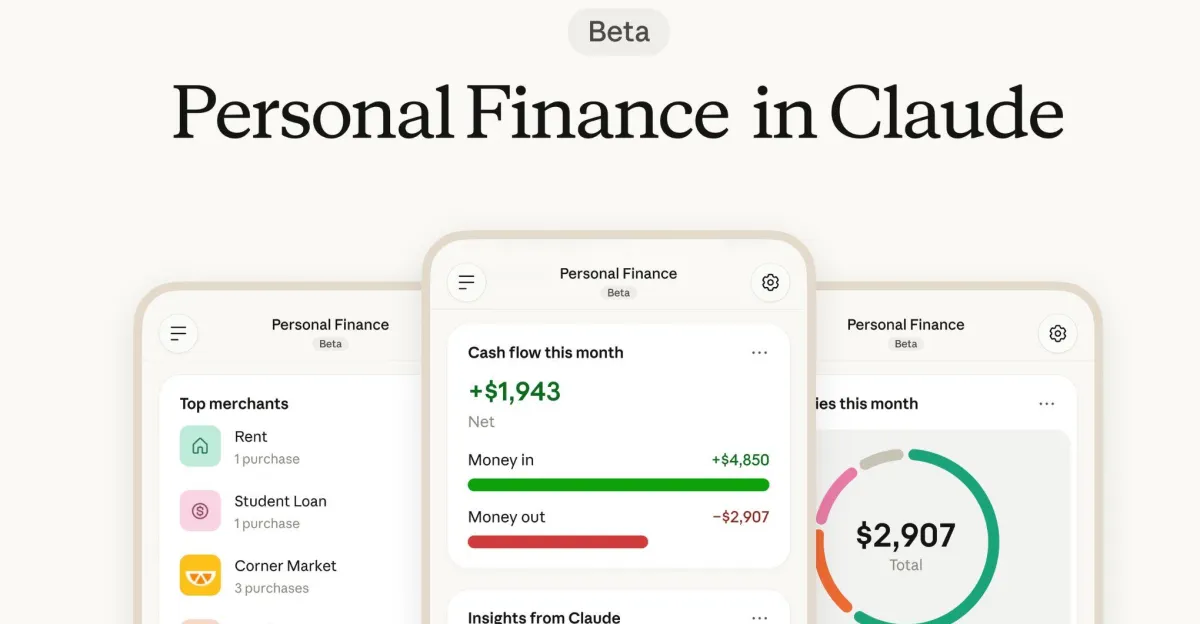
The company is positioning the feature as a practical assistant for everyday money questions. Users can ask where money went, get spending breakdowns by category, check upcoming bills, and look for places where they might save each month.
Anthropic says the feature is not designed to give investment advice, a boundary that matters in a category where chatbots can sound confident even when the stakes are high.
How does Claude Personal Finance work?
Claude connects to bank and card accounts through Plaid, the financial-data service that acts as the bridge between consumer apps and banking systems. Anthropic says users do not give Claude their banking passwords directly; Plaid handles the connection.
Once linked, Claude can see a user’s bank name, account names, account type, the last four digits of the account, balances, credit limits and up to two years of transactions. That data gives the chatbot enough context to answer questions about cash flow and spending patterns without granting it transaction authority.
| Feature | What Claude can see or do | What it cannot do |
|---|---|---|
| Account access | Bank name, account names, account type, last four digits, balances, credit limits | See banking passwords |
| Transaction history | Up to 2 years of transactions | Move or manage money |
| Money guidance | Spending breakdowns, bill questions, savings estimates | Provide investment advice |
| Availability | Beta rollout this week for U.S. Pro, Max and Ultra users | General public access outside those plans and markets |
Why it matters
This is more than another chatbot update. It shows AI companies are pushing deeper into routine consumer tasks, where usefulness depends on access to personal data rather than generic answers. For users, that could mean faster budgeting help and fewer spreadsheets. For the industry, it marks another step in the race to make chatbots sticky enough to sit at the center of daily digital life.
It also raises the privacy question that sits at the center of nearly every AI product built on personal information: how much access is useful, and how much is too much? Anthropic’s answer, at least for now, is to keep the system read-only and to make Plaid the intermediary. That reduces risk, but it does not remove the judgment call involved in linking a chatbot to financial accounts.
The launch also matters because financial data is unusually sensitive. Spending histories can reveal habits, subscriptions, debt stress, family changes and major purchases. A tool that can summarize that data may feel convenient, but it also needs a level of trust that general-purpose chatbots have only begun to earn.
What Anthropic says it is trying to build
Anthropic is framing Claude Personal Finance as an early step rather than a finished product. In its announcement, the company called the feature
“Personal Finance is a first step.”
The company also said it sees the strongest use cases in partnership with licensed professionals and regulated firms. Anthropic’s stated goal is to explore how Claude could work alongside those experts rather than replace them.
That positioning is notable. Instead of selling Claude as a one-stop financial adviser, Anthropic is drawing a line between simple financial analysis and regulated advice. The company says it wants input from banks, wealth managers and financial services firms as it develops the feature further.
How is this different from a generic chatbot?
The key difference is direct access to structured financial data. A standard chatbot can explain budgeting concepts or help build a spreadsheet, but it cannot summarize a user’s actual account history unless that data is provided manually. Claude Personal Finance changes that by letting the model analyze live account-linked information through Plaid.
That makes the product more useful, but also more consequential. The chatbot is no longer just reacting to prompts; it is working from a user’s financial footprint. That shift is why read-only access, data limits and a clear warning about investment advice are central to the launch.
Background: how we got here
Anthropic’s move follows a broader trend in the AI market: chatbots are steadily expanding from open-ended conversation into specific tasks that require access to real-world systems. Consumer finance is a natural target because it is repetitive, data-heavy and filled with questions people ask again and again.
OpenAI introduced a similar ChatGPT bank-linking feature in May, according to The Verge. Anthropic’s launch therefore lands in a competitive moment, with major AI companies trying to prove that their assistants can be useful outside of writing help, code generation and general Q&A.
That competition helps explain the timing. If one company can offer a smoother way to ask, “Where did my money go?” and get a useful answer instantly, rivals will likely be pushed to match it. The result could be a new phase in chatbot design, one defined less by chat and more by embedded utility.
Why Plaid matters here
Plaid is the infrastructure layer that makes the feature possible. Because it sits between apps and bank accounts, it can provide controlled access without handing over passwords to the AI model itself. That arrangement is designed to lower friction while preserving some basic safeguards.
Still, the trust burden does not disappear. Users have to decide whether they are comfortable letting a chatbot read their transaction history, even if it cannot move funds. For a finance product, that trust hurdle may be as important as the technical one.
What users can ask Claude
Anthropic says Claude Personal Finance can answer practical questions about spending and account activity. That includes:
- Where money went over a set period
- Spending breakdowns by category
- Upcoming bills
- Big purchases
- Possible monthly savings
Those are modest-sounding use cases, but they are the sort of questions that often lead people to open a banking app, scan a statement and do the arithmetic themselves. If Claude can reduce that time and effort, it could turn into a routine financial tool rather than a novelty.
Why it matters for consumers, banks and the AI market
For consumers, the promise is convenience. A chatbot that can interpret transaction histories may make it easier to understand cash flow, spot recurring charges and identify room to save.
For banks and financial firms, the launch is a signal that AI companies want a seat inside the consumer finance experience. That could create opportunities for partnerships, but it could also force institutions to think harder about how third-party AI tools handle account-linked data.
For the AI market, the significance is strategic. Consumer chatbots are becoming more differentiated by what they can access, not just how they answer. Finance is one of the highest-value categories because it is tied to everyday decisions and long-term trust.
By the numbers
| Metric | Detail | Source |
|---|---|---|
| 2 years | Maximum transaction history Claude can access | The Verge |
| This week | Beta rollout begins | The Verge |
| May | Month OpenAI introduced a similar bank-linked feature | The Verge |
| 3 subscription tiers | Claude Pro, Max and Ultra are eligible at launch | The Verge |
| U.S. only | Initial availability is limited to users in the United States | The Verge |
What happens next
The immediate question is whether Anthropic expands the beta beyond the United States and beyond paid subscribers. The company has not said when, or whether, that will happen.
Another open question is which banks, wealth managers or other financial services firms may work with Anthropic as the feature develops. The company says it wants input from those groups, suggesting the current product is only the first version of a larger effort.
Users will also be watching how much control and transparency Anthropic adds as the product matures. Financial tools live or die on trust, and trust is built not just by promises but by visible safeguards, clear data handling and plain language about what the system can and cannot do.
For now, the launch gives Claude a more practical role in daily life and puts Anthropic in direct competition with OpenAI on a consumer use case that is both highly useful and highly sensitive. The beta may be limited, but the direction is clear: AI assistants are moving closer to the bank account itself.
Timeline
- May: OpenAI introduced a similar ChatGPT bank-linking feature.
- This week: Anthropic begins beta rollout of Claude Personal Finance.
- Nov. 5, 2026: The Verge reported on the launch.
FAQ
What is Claude Personal Finance?
Claude Personal Finance is a beta feature from Anthropic that connects Claude to U.S. bank and card accounts through Plaid so users can ask about spending, balances, bills and savings opportunities.
Can Claude move money or make investments?
No. Anthropic says access is read-only, which means Claude can analyze financial data but cannot move, manage or invest money. The company also says the feature is not designed to give investment advice.
Who can use the feature right now?
Only Claude Pro, Max and Ultra subscribers in the United States can access the beta at launch. Anthropic says the rollout starts this week.
How much financial data can Claude see?
Claude can see the bank name, account names, account type, the last four digits, balances, credit limits and up to two years of transaction history once a user links accounts through Plaid.
Why is Anthropic launching this now?
Anthropic is moving into personal finance as AI companies compete to make chatbots more useful in everyday life. The launch follows a similar bank-linking feature from OpenAI in May and reflects growing demand for AI tools that can work with real consumer data.
Frequently asked questions
What is Claude Personal Finance?
Claude Personal Finance is a beta feature that connects Claude to U.S. bank and card accounts through Plaid so users can ask about spending, balances, bills and savings opportunities.
Can Claude move money or make investments?
No. Anthropic says the feature is read-only, so Claude can review and explain financial data but cannot move, manage or invest money. The company also says it is not designed to provide investment advice.
Who can use Claude Personal Finance at launch?
Only Claude Pro, Max and Ultra subscribers in the United States can use the beta at launch. Anthropic says the rollout begins this week.
How much account data can Claude see?
Claude can see the bank name, account names, account type, last four digits, balances, credit limits and up to two years of transactions once the user links accounts through Plaid.
Why is this launch important?
This launch matters because it shows AI chatbots moving deeper into personal finance, where convenience is high but privacy and trust concerns are even higher. It also puts Anthropic in direct competition with OpenAI on a sensitive consumer use case.