In short
Google is testing a Gemini feature that lets the AI call businesses for Pixel 11 owners in the U.S. The experiment, called Call for Me, aims to handle tasks like reservations, stock checks and appointment changes while keeping users in control.
- Call for Me lets Gemini place business calls and handle routine tasks.
- The test starts with U.S. Pixel 11 owners who pay for Gemini and use the beta Phone app.
- Users can monitor the call live, view transcripts and take over at any time.
- Google is positioning the feature as a cautious experiment because phone conversations are unpredictable.
- The move strengthens Google’s push into practical AI agents that can act on users’ behalf.
Google is testing a new Gemini-powered feature that lets its AI call businesses on behalf of users, starting with a limited rollout for U.S. Pixel 11 owners who subscribe to Gemini. The experiment, called “Call for Me,” could make everyday tasks such as checking stock, booking appointments and making reservations faster, while keeping the user in control of the conversation.
The feature is notable because it pushes Google further into the emerging race to build practical AI agents that can act in the real world, not just answer questions on a screen. It also shows how fast automated calling is moving from demo to product, with Google now joining a broader push that includes similar capabilities from other AI companies.
Google says the rollout will be small at first because live phone conversations are unpredictable. That cautious launch reflects both the promise and the risk of giving AI systems the ability to speak on a user’s behalf, especially when they must interact with businesses, automated menus and human staff.
What is Google’s “Call for Me” feature?
“Call for Me” is a Gemini feature that can place business calls for users and carry out routine tasks over the phone. Google says the system can ask whether an item is in stock, request price or service details, make restaurant reservations, move appointments and place items on hold.
The feature is designed to function like a virtual phone assistant. It can call a business, identify itself, work through automated menus, wait in a queue and continue the conversation until the task is completed or the user steps in.
Unlike older assistant tools that were mostly limited to routing calls or waiting on hold, Google says Gemini will be able to share certain personal details that the user explicitly approves as part of the call. That broader permission set is what makes the feature more capable, but also more sensitive.
How does the AI calling system work?
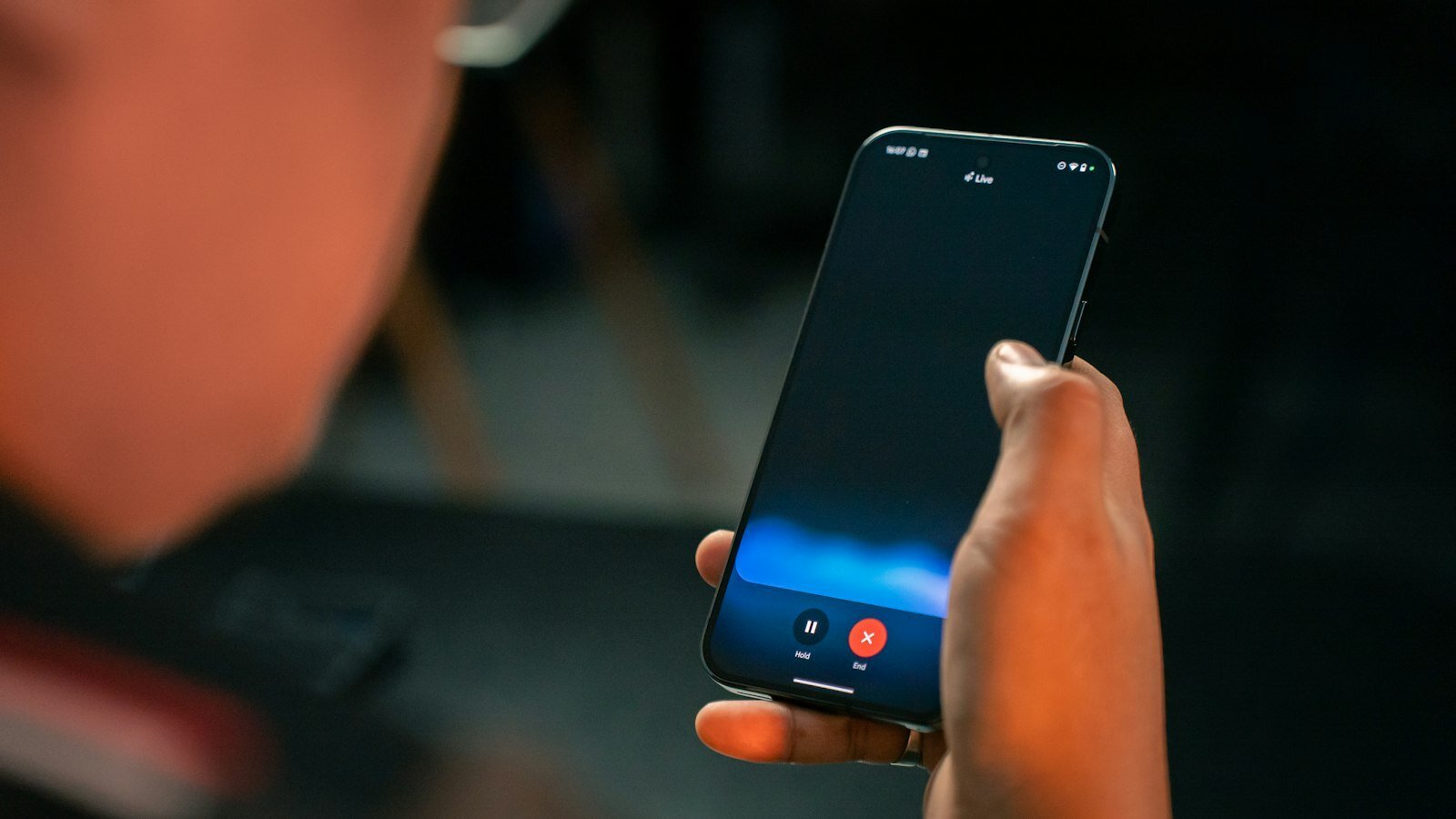
It works by making a call from the user’s own phone number and showing a live transcript while the conversation unfolds. Google says the user can monitor the call in real time and interrupt or take over whenever needed.
That direct oversight is a key part of the design. Rather than handing off total control, Google is positioning the feature as a supervised assistant that can do the tedious parts of calling while leaving the final judgment with the person using it.
The company has not described this as a fully autonomous agent. Instead, it is an experiment meant to reduce friction in routine calling scenarios while preserving transparency during the interaction.
| Feature | What it does | Availability |
|---|---|---|
| Call for Me | Lets Gemini call businesses and handle routine tasks | Testing now for U.S. Pixel 11 owners with a Gemini subscription |
| Live transcript | Shows the call in real time so the user can follow along | Included in the experiment |
| Takeover control | Lets the user jump into the call at any moment | Included in the experiment |
| Beta Phone app requirement | Requires Google’s beta Android Phone app | Needed for initial access |
Who can use it first?
The first users are limited to Pixel 11 owners in the United States who pay for a Gemini subscription. Google is also requiring the beta version of its Android Phone app, underscoring that this is still an early-stage test rather than a broad consumer launch.
That narrow starting point is consistent with Google’s approach to many AI features: release first to a controlled group, observe how people use it and adjust before moving toward wider distribution. For a feature that places an AI in direct contact with businesses, that is a cautious and logical strategy.
Pixel devices have often been the home for Google’s more experimental calling tools. The company appears to be using its own hardware and software stack as a proving ground for new interaction models before considering expansion to a broader Android audience.
Why is Google launching this now?
Google is moving now because AI agents are becoming more practical and competitive, and phone calls remain one of the most annoying everyday tasks for consumers. Automated calling has long been one of the clearest demonstrations of what assistant technology can do when it goes beyond chat and into action.
The timing also reflects the growing pressure on big tech companies to show that AI can save time in ordinary life, not just generate text or images. Booking a table, confirming stock or rescheduling an appointment may sound simple, but each of those tasks can involve hold music, transfers and repetitive menu prompts that users would rather avoid.
By offering a tool that handles those chores, Google is trying to make Gemini feel less like a chatbot and more like a practical agent embedded in daily routines.
Why does the company say it is starting small?
Google says it is limiting the rollout because real phone conversations are complicated and unpredictable. The company’s caution suggests it expects the system to run into edge cases involving accents, noisy lines, business policies, misunderstanding and social nuance.
That matters because phone calls are not scripted in the way many software interactions are. A business may ask unexpected follow-up questions, refuse to share information with an automated assistant, or route the call in a way the AI does not anticipate. Google is signaling that it wants time to refine the product before exposing it to more users.
Google has said the experiment is being introduced at a small scale because real-world conversations are nuanced and the company wants to get the feature right before expanding it more broadly.
How does this compare with Google’s earlier calling tools?
This is the next step in a long line of Google experiments with AI-assisted calling. The company has been testing and shipping phone-help features for years, but each generation has tried to take on more of the work.
Google first drew widespread attention when it showed off a clever Google Assistant demo at I/O in which the assistant called a salon to make an appointment and used natural-sounding hesitations such as “umm” and “ahh.” That demonstration helped popularize the idea that AI could sound human enough to get real tasks done over the phone.
More recently, Google introduced “Ask for Me,” which allowed Gemini to call businesses to ask about pricing or services. Pixel owners also have access to tools such as “Hold for Me,” “Talk to a Live Rep” and “Direct My Call,” which handle phone trees, wait in queues or display the numbers needed to navigate interactive voice systems.
The difference with “Call for Me” is that Gemini appears to be taking on a broader range of conversational tasks, rather than just waiting or routing.
What makes this different from a regular voice assistant?
The key difference is that Gemini is being asked to act, not just respond. A traditional assistant might answer a question or place a call, but Google’s new experiment is aimed at completing a task across the full life cycle of a phone interaction.
That means the system must do more than recognize a request. It must interpret business responses, choose whether to continue asking questions, understand when to wait, and know when to hand control back to the user. In other words, it needs to operate more like a service agent than a simple command interface.
This is why the feature is important beyond its immediate utility. If it works well, it could become a template for other agent-style tools that manage tedious communications across retail, travel, healthcare, hospitality and local services.
Where does this fit in the AI agents race?
Google’s move places Gemini squarely in the growing competition to build AI agents that can perform tasks on a user’s behalf. The company is not alone in that effort. Other AI systems have also started to broaden from conversation into action, especially in consumer-facing scenarios.
That shift matters because the most compelling AI products may no longer be the ones that generate the best answer, but the ones that remove the most friction from a task. Calling a business may seem mundane, but it is exactly the kind of annoying, repetitive process users are likely to delegate first.
By allowing Gemini to make those calls, Google is testing not just a product feature but a larger idea: whether people are ready to let AI intervene in real-world interactions that involve a mix of automation, social expectations and human judgment.
Why phone calls are a useful test case
Phone calls are a useful test case because they combine structure, repetition and uncertainty. Many business calls follow a predictable pattern, but the details vary enough to require flexibility.
- Automated menus can be navigated mechanically.
- Routine questions can be answered with approved details.
- Hold times and transfers can be handled without human attention.
- Unexpected questions can reveal where the assistant needs a human takeover.
That makes the domain ideal for an AI assistant that wants to prove its value. Success would show that AI can reduce busywork in a way that feels immediately useful, not just technically impressive.
What could users actually do with Gemini?
In practical terms, the feature could save time on the kinds of calls people often put off. Examples include checking whether a product is available before driving to a store, booking dinner plans without sitting on hold, or rescheduling an appointment when a conflict comes up.
Those may sound like small conveniences, but they add up. Many consumers spend significant time each week chasing down confirmations, availability and basic service questions. If Gemini can reliably handle even a portion of that work, the value proposition becomes easy to understand.
The feature also has potential appeal for users who dislike phone calls, struggle with time pressure or simply want to offload low-value errands to software. In that sense, it is part productivity tool and part accessibility aid.
How much control does the user keep?
Google says the user remains in control throughout the process. The person can follow the exchange via transcript and step in at any time, which is designed to reduce the feeling that the AI has taken over completely.
That control is important from both a trust and a safety perspective. Users may be comfortable letting Gemini handle the opening exchange, but they may want to take over if the call becomes complicated, sensitive or expensive. The ability to monitor and interrupt the conversation could also help users avoid mistakes before they become commitments.
The use of the user’s own phone number is another detail that may matter. It makes the call appear more directly tied to the owner, but it also raises familiar questions about how businesses will perceive AI-assisted calls and whether they will prefer to speak with a person.
What are the risks and limitations?
The main risks are misunderstanding, awkward interactions and the possibility that businesses may not respond well to AI callers. Even with a transcript and human takeover, there is still a chance the system could mishear, misinterpret or fail to handle a question cleanly.
There is also a reputational issue. Businesses may be cautious about talking with automated callers if they worry the interaction will waste staff time or create confusion. On the other hand, if the AI proves efficient and transparent, some businesses may welcome it as a way to reduce friction for customers.
Google’s early limited launch suggests the company understands that these factors could shape public reaction just as much as the underlying technology itself.
Potential limitations at launch
Users should expect an experimental product, not a polished universal assistant. Based on Google’s own description, the feature may be best suited to simple, repeatable tasks rather than sensitive or highly complex calls.
- It is limited to a narrow group of Pixel users in the U.S.
- It requires Gemini subscription access.
- It depends on the beta Phone app.
- It is still explicitly described as an experiment.
How Google’s experiment could reshape everyday business interactions
If the feature succeeds, it could change how consumers and businesses think about routine communication. In the short term, it may simply make phone errands easier. In the longer term, it could normalize the idea that a person does not need to be physically present in a conversation for a task to get done.
That would have implications well beyond restaurants and retail stores. Healthcare scheduling, service appointments, delivery confirmations and local business inquiries all rely on time-consuming calls. An AI agent that can handle those interactions reliably would be attractive to many users.
It could also pressure companies to modernize their communication channels. If more customers begin using AI callers, businesses may respond by improving self-service systems, offering better web-based booking tools or making phone interactions less cumbersome in general.
| Milestone | Google’s calling feature evolution | Significance |
|---|---|---|
| Google Assistant demo at I/O | Assistant called a salon to make an appointment | Showed early human-like calling ability |
| Hold for Me / Direct My Call | Helped users wait on hold and navigate menus | Reduced friction in routine calls |
| Ask for Me | Gemini called businesses for pricing or service details | Expanded from routing to inquiry |
| Call for Me | Gemini can handle broader conversations and tasks | Pushes closer to an AI agent model |
What happens next?
Google will likely use the experiment to learn how the feature performs in real-world situations before deciding whether to expand it. That means the company will be watching for reliability, user trust, business acceptance and the kinds of tasks the AI can handle without friction.
If the test goes well, “Call for Me” could become one of the clearest examples yet of consumer-facing AI agents moving from novelty to utility. If it falls short, it will still provide a valuable look at the challenges of applying AI to messy, everyday human interactions.
Either way, the feature marks another sign that the AI competition is shifting toward usefulness. The companies that can save people time on ordinary chores may be the ones that make the strongest case for AI in daily life.
Bottom line
Google is testing a Gemini feature that can call businesses for users, and the early launch is aimed at U.S. Pixel 11 owners with a Gemini subscription. The experiment highlights both the promise of AI agents and the care required to make them work reliably in the real world.
For now, the feature is deliberately limited. But if Google can make the experience dependable, transparent and genuinely helpful, it could become an important step in turning AI assistants into everyday task runners rather than simple answer engines.
Frequently asked questions
What is Google’s Call for Me feature?
Call for Me is a Gemini-powered calling tool that can contact businesses on a user’s behalf. Google says it can ask about stock, pricing or services, make reservations, reschedule appointments and place items on hold while the user watches the call live.
Who can use Gemini phone calls first?
The first users are limited to U.S. Pixel 11 owners who subscribe to Gemini and install the beta version of Google’s Phone app. Google is rolling the feature out as an experiment, so access is intentionally narrow at launch.
Can users take over the call if needed?
Yes. Users can follow the conversation in a live transcript and jump in at any moment. Google says the feature is designed to keep the person in control while Gemini handles the repetitive parts of the call.
Why is Google testing the feature slowly?
Google is testing it slowly because real phone conversations are unpredictable and nuanced. The company wants to refine how the AI handles menus, human replies and unexpected questions before expanding access more widely.