In short
Amazon devices chief Panos Panay said the company sees a future where AI-powered ambient devices reduce the need to use apps. He pointed to new Bee wearables as an early example and said privacy must be built into the experience.
- Amazon is betting on ambient computing instead of an app-first future.
- New Bee devices are designed to capture context and turn conversations into reminders and notes.
- Amazon says the devices delete raw audio and encrypt transcripts with device-controlled keys.
- Panos Panay believes smartphones will remain important, but new AI devices will handle more tasks in the background.
- Privacy and trust could determine whether ambient AI wearables gain mainstream adoption.
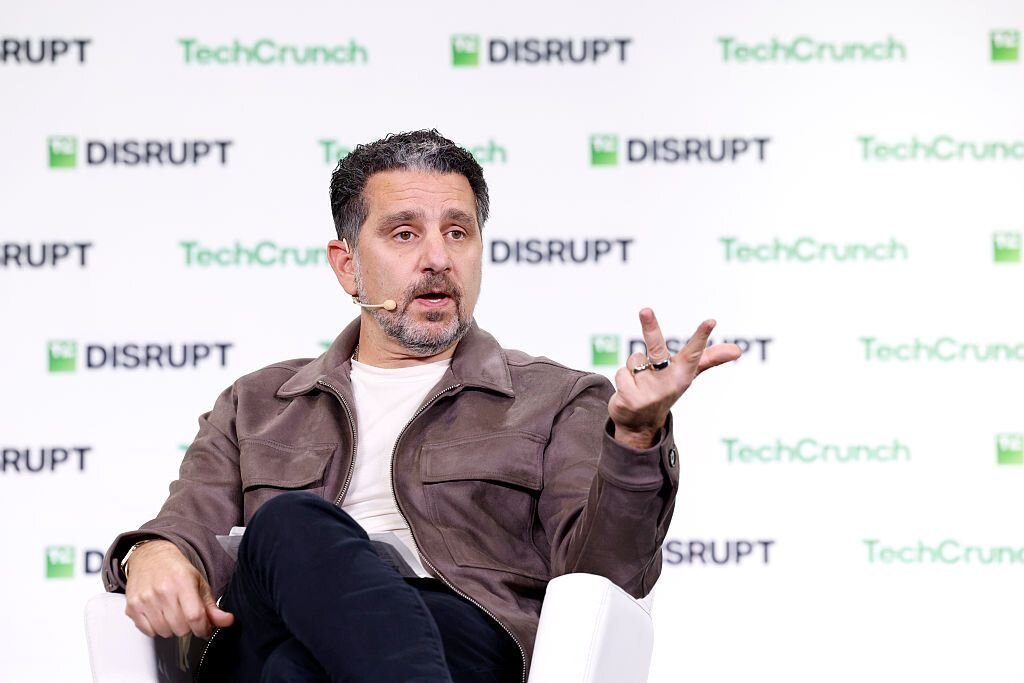
Amazon devices chief Panos Panay says personal computing is heading toward a future where people rely less on apps and more on AI-powered ambient devices that anticipate needs in the background. He made the case on Thursday at TechCrunch Disrupt, tying Amazon’s new Bee wearables to a broader shift he believes will redefine how people interact with technology.
Panay argued that the next generation of devices will not force users to repeatedly open apps, tap menus, and remember commands. Instead, he said, sensors and AI will work quietly around the user, helping capture context, surface reminders, and reduce the need to manually direct every task.
Amazon is betting on ambient computing, not app-first devices
Amazon’s latest pitch for consumer AI is rooted in what Panay described as ambient computing: a model in which devices stay aware of what is happening around a user and provide assistance without constant prompting. The company’s new Bee hardware, unveiled the same day, is the clearest example of that strategy.
Rather than positioning AI as something that lives in a chat interface or a standalone assistant app, Panay described a more distributed future. In that future, intelligence is embedded in the devices themselves, and the devices are designed to recede into the background until needed.
That vision has broad implications for the smartphone era. For more than a decade, mobile apps have been the main gateway to digital services. Panay’s argument suggests that layer could matter less if AI systems can understand what people want and act before they even open an app.
What are Amazon’s Bee devices?
Amazon’s Bee products are a new set of AI wearables designed to observe, summarize, and organize moments from a user’s day. One device can be worn on the wrist or detached as a pendant, while another is a compact gadget that magnetically attaches to the back of a smartphone.
The core purpose is practical memory support. The devices passively capture audio, identify useful details, and turn conversations into reminders, to-dos, and searchable insights that users can review later.
Amazon is positioning Bee as an answer to the friction of modern phone use. Instead of manually recording every detail, the system is meant to do the remembering for the user.
| Feature | Bee wrist/pendant device | Bee phone-attached device | Why it matters |
|---|---|---|---|
| Form factor | Wearable band or pendant | Credit-card-sized accessory | Expands AI beyond the smartphone screen |
| Main function | Records and organizes day-to-day context | Attaches to phone for ambient capture | Reduces manual note-taking and app use |
| Audio handling | Processes in real time, then deletes raw audio | Processes in real time, then deletes raw audio | Limits retention of sensitive conversations |
| Data access | Encrypted with device-controlled keys | Encrypted with device-controlled keys | Designed so only the user can unlock transcripts |
How does Amazon say privacy will work?
Amazon says privacy is central to how Bee is built. The devices do not retain the raw audio they capture; instead, they process it as it happens and then delete the original recording.
Conversation transcripts are encrypted using keys created and controlled by the user’s device. According to the company’s description, that means even Amazon employees would not be able to view the files unless the user deliberately shares them.
That approach is important because ambient devices raise obvious concerns. A product that is always listening, even if only briefly storing data, has to persuade users that convenience does not come at the cost of surveillance. Amazon is trying to get ahead of that skepticism by making privacy part of the product design rather than an afterthought.
Panay said that customer control is essential if this category is going to gain trust. He framed privacy not as a feature added later, but as a requirement for building any product that listens in the background.
Why privacy may determine whether ambient AI succeeds
Ambient AI only works if people allow it into their daily lives. That means the product has to feel useful enough to justify its presence and safe enough to avoid turning into a source of anxiety.
For a wearable that records context throughout the day, trust is as important as technical performance. Consumers are unlikely to adopt background AI tools if they fear transcripts could be accessed by the company, shared unintentionally, or misused in ways they do not understand.
Amazon’s privacy pitch is therefore not just a legal or reputational detail. It is a commercial requirement for the category it wants to build.
Who is Panos Panay and why does his view matter?
Panos Panay is Amazon’s senior vice president of Devices, Alexa and Leo, but he spent much of his career at Microsoft, where he spent 19 years helping lead Surface hardware. His background gives him credibility when he talks about how computing platforms evolve.
He has been involved in consumer device strategy long enough to see multiple shifts: from laptops to tablets, from desktop-first software to mobile apps, and now from app-centric interaction to AI-first experiences. That perspective makes his comments more than a routine product pitch. They reflect a broader hardware philosophy.
At the center of that philosophy is the idea that computing should adapt to people, rather than forcing people to adapt to computing.
Panay argued that today’s phones often require users to remember what to ask and then navigate through apps to get it done, while the next wave of devices should work more naturally in the background and reduce that burden.
What does “ambient computing” actually mean?
Ambient computing is the idea that devices can sense context, infer intent, and act with less direct instruction. In practical terms, that can mean a wearable flagging an important reminder from a conversation, a home device responding without a command phrase, or a system that understands what the user needs based on location, activity, or past behavior.
Panay’s version of ambient computing focuses on utility. The goal is not simply to make technology more invisible for its own sake. It is to reduce the cognitive load that comes with constant app-switching and command-entry.
In his view, a well-designed ambient device lets the user remain present. It can collect the details, surface the right information later, and help free up attention for work, relationships, and daily life.
Why Amazon thinks the app model is due for change
Amazon believes many routine tasks can be handled more naturally if the device understands context instead of waiting for a specific request. That is a significant challenge to the app economy, which is built around discovery, launching, and interacting with separate software products.
If AI systems can identify intent and produce useful outputs on their own, the user may no longer need to search for an app that solves the problem. In that scenario, software becomes more like an invisible service layer than a destination.
Panay suggested that younger users may increasingly expect devices to understand needs directly, rather than offering a list of apps to choose from. That does not mean the app disappears overnight, but it may mean the app becomes one option among many rather than the primary interface.
Will smartphones disappear?
No. Panay explicitly said he does not believe a single form factor will replace everything else. In his view, the smartphone remains important, even if it is no longer the only or most important way people interact with AI.
That distinction matters. Amazon is not claiming the phone is dead. It is arguing that phones are only one piece of a larger ecosystem, and that new devices with sensors and contextual awareness will take on responsibilities that phones handle poorly today.
He described the coming era as one in which an intelligence layer connects multiple devices, each of which is useful in a different setting. The emphasis, he said, should be on the usefulness of the whole system rather than on forcing one device to do everything.
How Amazon’s broader AI strategy fits this move
Amazon has long tried to make Alexa central to the connected home, but voice assistants alone have not transformed personal computing the way many once expected. The Bee launch and Panay’s comments suggest Amazon is now looking beyond the traditional smart-speaker model and toward wearables, sensors, and always-available context.
That is a logical extension of Amazon’s strengths. The company has deep experience in consumer hardware, cloud services, and AI infrastructure. It also has a commercial incentive to own the next major interface layer, especially if that layer could one day reshape search, shopping, reminders, and personal organization.
At the same time, the move raises questions about whether consumers want another category of device listening throughout the day. Amazon will need to prove not only that its AI works well, but that it can be trusted in intimate, real-world settings.
What makes this moment different from earlier AI hardware pushes?
This time, the pitch is less about novelty and more about workflow. Earlier generations of smart gadgets often promised convenience but still depended on rigid voice commands or clumsy companion apps. Panay’s argument is that AI can now handle more of the interpretation itself.
That makes the hardware less of a toy and more of a memory and context tool. If Bee can reliably turn everyday interactions into useful follow-up actions, it may feel meaningfully different from past attempts to put a smart assistant on your wrist or on your desk.
The timing also matters because consumers are already more familiar with generative AI. That familiarity could make them more open to devices that capture, summarize, and assist without requiring them to start every interaction from scratch.
Timeline: Amazon’s AI device pitch
| Date | Milestone | Why it matters |
|---|---|---|
| Thursday, Oct. 15, 2026 | Panos Panay speaks at TechCrunch Disrupt | Explains Amazon’s long-term vision for ambient AI and app-free computing |
| Thursday, Oct. 15, 2026 | Amazon introduces new Bee wearables | Shows how the company intends to commercialize ambient computing |
| Same period | Privacy architecture described publicly | Signals Amazon knows trust will be critical to adoption |
What this means for the future of personal computing
Panay’s comments point to a future in which computing is less about opening a specific app and more about having a device understand what is happening around you. That shift would change not only the hardware market, but also how software is designed, discovered, and monetized.
For users, the appeal is obvious: fewer steps, less cognitive friction, and more help with remembering the details of everyday life. For companies, the challenge is equally clear: they will need to build AI systems that are accurate, secure, and transparent enough to earn trust.
Amazon is making a sizable bet that the next major consumer platform will be ambient, contextual, and quietly helpful. Whether people embrace that vision will depend on two things at once: whether the devices are genuinely useful, and whether users are comfortable with AI listening closely enough to be helpful without being intrusive.
Why the app-free future still faces real hurdles
Even if ambient AI becomes more common, the transition will not be simple. Users have deeply ingrained habits around phones and apps, and developers have spent years building products around those expectations. Replacing that system would require a new level of reliability and a new standard for trust.
There is also a practical issue: many tasks still benefit from direct control. People often want to browse, compare, edit, and decide for themselves. That means the future Panay describes may be less about eliminating apps entirely and more about reducing how often users need to reach for them.
Still, Amazon’s direction is clear. It wants to shift the conversation from “Which app should I open?” to “What does the device already know that can help me now?” That is a profound change in how personal technology could work.
Panay said the next generation of devices will likely be defined by intelligence that understands the user’s needs instead of forcing the user to interact with every function manually.
If Amazon can make that feel natural, private, and genuinely useful, it may help define the post-app era it says is coming.
Frequently asked questions
What did Panos Panay say about the future of apps?
Panay said apps will likely become less central as AI devices get better at understanding what users need. He argued that future computing will be more ambient, with devices working in the background instead of forcing people to open apps and issue explicit commands.
What are Amazon’s Bee devices?
Bee is Amazon’s new line of AI wearables, including a band that can also be worn as a pendant and a small accessory that attaches to a phone. The devices are designed to record context, extract reminders and to-dos, and help users remember important details later.
How does Amazon say Bee protects privacy?
Amazon says Bee processes audio in real time, deletes the raw recording, and encrypts transcripts with keys generated and controlled by the user’s device. The company says this means even Amazon employees cannot access the files unless the user chooses to share them.
Will Amazon’s AI devices replace smartphones?
No. Panay said he does not believe one device form factor will replace all others. He said smartphones will remain important, but new ambient devices will complement them by handling tasks that are better done with contextual sensing and background AI.