Updated August 4, 2026 11:24 am
In short
June, the Benioff-backed startup, says its platform can help enterprises deploy AI agents by mapping messy internal systems and automating the fix, and it now has a customer example showing it can reduce the need for hands-on FDE support.
- June raised $20 million in pre-seed funding led by Marc Benioff’s Time Ventures.
- The startup focuses on enterprise AI deployment, not model development.
- June says it can scan existing systems, find bottlenecks, and guide agent rollout step by step.
- The founders previously built Bonobo AI and later worked at Salesforce after its acquisition.
- Early customer interest suggests strong demand for tools that simplify AI implementation.
Update — August 4, 2026 11:24 am
June’s latest source adds a concrete example of the startup’s appeal: CMG chief strategy officer Paul Akinmade said his team hit a wall trying to connect Claude Code to Salesforce, even after weeks of meetings with architects and forward-deployed engineers.
He said June gave the company a clearer path for where to deploy agents and let it move ahead safely before the two companies’ official kickoff call. Akinmade also said he was skeptical of any product that still depended on FDEs, and June appears to have won him over.
The updated source also says June’s platform automatically scans a company’s systems, generates a step-by-step implementation roadmap, and can start building tasks after users click through them.
June, a startup backed by Salesforce co-founder Marc Benioff, says it can solve one of enterprise AI’s biggest problems: getting AI systems to work inside real companies. The company emerged from stealth on Monday with $20 million in pre-seed funding and a pitch aimed at businesses struggling to move from AI demos to dependable production deployments.
The idea is straightforward but ambitious. Instead of asking customers to hire more specialists, consultants, and forward-deployed engineers to make AI usable, June wants to map a company’s systems, identify the data and workflow problems that block deployment, and then help build the agent-powered processes needed to fix them.
That bet arrives at a moment when many large organizations are discovering that the hard part of AI is not picking a model. It is wiring that model into years of legacy systems, fragmented databases, and cross-functional processes that were never designed for autonomous software.
What did June launch, and why does it matter?
June launched as an enterprise AI implementation platform designed to help companies deploy agents more reliably across their existing software stack.
The startup’s pitch matters because enterprises are racing to adopt AI while facing a stubborn operational reality: most business software environments are messy, interconnected, and expensive to change. A model may be strong in isolation, but it still has to interact with systems such as Salesforce, ServiceNow, Databricks, Workday, and other data-heavy platforms before it can produce real value.
That challenge has created a new market for forward-deployed engineers, often called FDEs, who are sent into customer organizations to untangle process issues and get AI tools running. June argues that this growing reliance on human intervention is evidence of a deeper flaw in the current approach to enterprise AI.
“AI, paradoxically, increases the demand for professional services,” said Efrat Rapoport, June’s cofounder and chief executive. She said the industry often responds to implementation problems by adding more people rather than reducing complexity.
For June, the opportunity is not just to build another AI tool. It is to build the system that helps other AI tools survive contact with the enterprise.
Who is behind June?
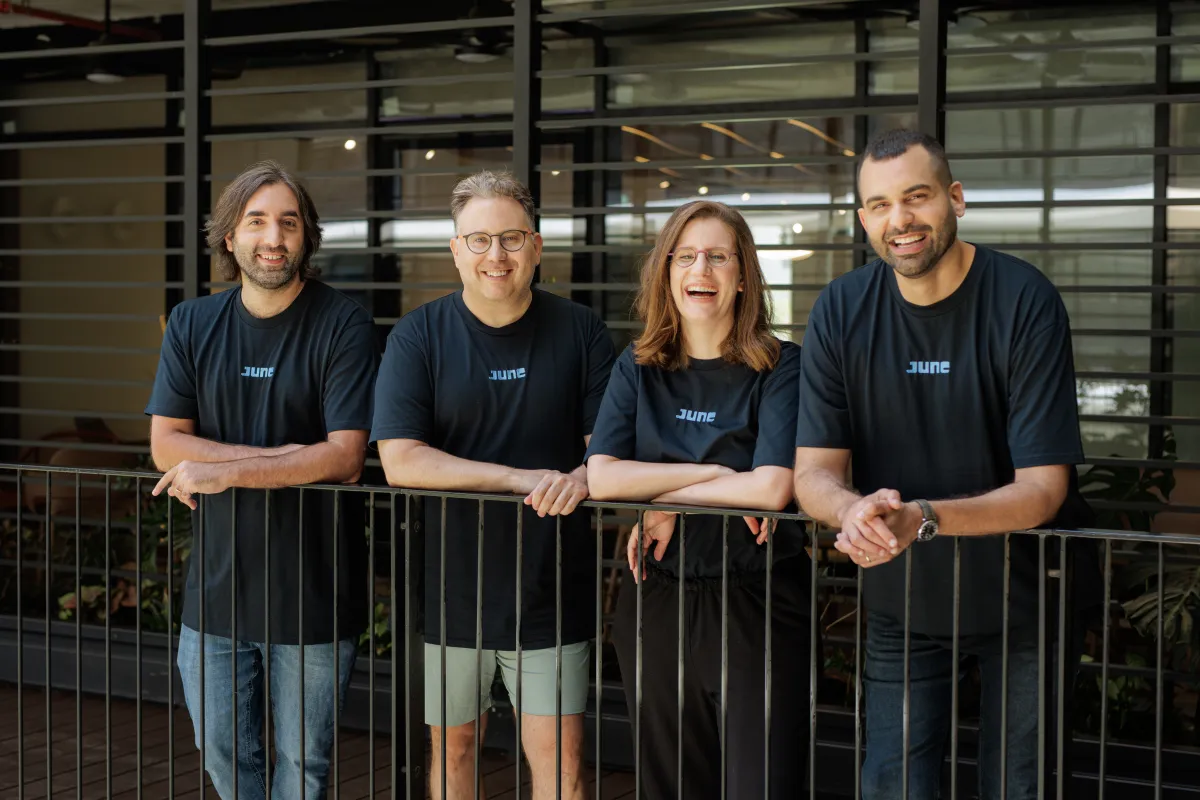
June was founded by Efrat Rapoport, Ohad Hen, Barak Goldstein, and Idan Tsitiat, a team with a direct history of building and selling AI products for enterprise use.
The founders previously launched Bonobo AI, a voice-to-text and language model company that came out in 2017, before the modern transformer era reshaped the AI landscape. Salesforce acquired Bonobo AI two years later, and the team spent subsequent years working on AI initiatives inside the company.
That experience appears to have strongly influenced June’s thesis. Rapoport said the team saw firsthand how difficult it was for customers to integrate AI into existing platforms, especially when those systems were sprawling, old, and inconsistently configured. Rather than repeating the cycle as consultants or internal specialists, the founders chose to build software aimed at removing some of that implementation burden altogether.
In a crowded AI market full of model wrappers and workflow tools, June is leaning on a rare combination of operator experience and enterprise familiarity. That may help explain why the startup was able to raise capital quickly.
How much funding did June raise?
June raised $20 million in pre-seed financing led by Marc Benioff’s Time Ventures, with participation from a group of prominent tech investors including Michael Dell, Aaron Levie, and George Kurtz.
The company did not disclose its valuation. Rapoport said the fundraising process moved quickly enough that the team did not need a traditional investor deck, suggesting strong early interest in the problem June is targeting.
The size of the round is notable for a pre-seed, particularly in a market where investors are increasingly sorting through a wave of AI infrastructure and agent startups. A backing group that includes Benioff, Dell, Levie, and Kurtz also signals that June’s pitch resonates with leaders who understand enterprise software, cybersecurity, cloud workflows, and business operations at scale.
| Key detail | June’s position | Why it matters |
|---|---|---|
| Funding | $20 million pre-seed | Gives the startup capital to build and sell an enterprise implementation platform |
| Lead investor | Time Ventures | Signals support from Marc Benioff, a major enterprise software figure |
| Founding background | Former Salesforce AI team | Brings direct experience with large-customer deployment pain points |
| Core product | Enterprise AI deployment platform | Aims to turn AI pilots into functioning business systems |
| Main buyer pain | Legacy systems and process complexity | These are the main reasons enterprise AI projects stall |
Why enterprise AI is still so hard to deploy
Enterprise AI is difficult because the underlying business environment is not clean enough for automation to work without help.
Many vendors market agentic AI as if companies can simply plug it into a workflow and let it run. In practice, most large organizations are dealing with overlapping databases, inconsistent field definitions, years of technical debt, and business processes spread across multiple departments and platforms.
June’s founders argue that the first challenge is not building an agent. It is understanding what the agent should connect to, what data it should trust, and what needs to be fixed before deployment can happen safely.
Rapoport said that creating an agent template is often the easiest part of the process. The much harder task is making it function in a real enterprise setting, where even simple workflows can break if the underlying records are duplicated, mislabeled, or incomplete.
That point is central to June’s product strategy. The startup is trying to turn deployment into a structured, software-driven process rather than a bespoke consulting exercise.
What problem are forward-deployed engineers solving?
Forward-deployed engineers solve the gap between an AI product and a company’s actual operating environment.
In the enterprise AI market, FDEs have become a kind of bridge between vendors and customers. They analyze workflows, adapt integrations, and help teams overcome the friction that standard product demos usually hide. Their rise is a sign that AI adoption still depends heavily on human labor.
Rapoport sees June as compatible with that reality, but also as a way to reduce the number of times a customer has to rely on expensive hand-holding. In her view, if a company needs a deep bench of engineers and consultants just to get started, the product may not be doing enough of the work itself.
How does June say its platform works?
June says its platform scans a company’s current systems, identifies process bottlenecks, and then helps generate a step-by-step deployment plan for agentic automation.
According to Rapoport, the software is meant to assess the existing business environment before a company builds anything. It looks for duplicated records, data-source issues, and workflow blockages, then produces a roadmap that tells the customer what should be fixed and in what order.
After that, users can move through tasks one by one. June’s system then helps build the agent-powered process inside the organization and can notify teams through the communication channels they already use.
The company’s pitch is not just that it recommends what to do. It is that it helps execute the cleanup and deployment steps that normally slow AI projects down.
- Scan existing enterprise systems
- Map business workflows and bottlenecks
- Identify duplicate or conflicting data fields
- Generate a deployment roadmap
- Build agentic workflows task by task
- Notify relevant teams through company channels
What happened at CMG?
CMG, a major U.S. mortgage lender, became an early example of June’s value proposition in practice.
Paul Akinmade, CMG’s chief strategy officer, said his team had quickly moved its software engineering work toward Claude Code, but ran into serious trouble when trying to integrate it with Salesforce. That became especially sensitive because Akinmade had publicly said at a Salesforce annual conference the year before that he intended to return with 100 working agents.
Instead of seeing that goal accelerate, his team spent weeks trying to make progress. Akinmade said they met with architects, contacted forward-deployed engineers, and searched for help across the organization, but still could not get the integration moving in a meaningful way.
June, he said, clarified where agents should be deployed and provided a safer path for moving ahead, even before the companies’ official kickoff call.
Akinmade said that in considering the pilot, he made clear he did not want a product that depended on FDEs or felt like a black box. He wanted something straightforward enough that his team could use it without specialized gatekeepers.
That response is important because it reveals the tension at the heart of the enterprise AI market: customers want both expert help and product simplicity. June is betting it can offer both, or at least enough of each to win trust.
Why is Marc Benioff’s involvement significant?
Marc Benioff’s support is significant because he is one of the most recognizable figures in enterprise software, and his backing lends credibility to a startup trying to solve a problem that sits at the center of the enterprise stack.
As Salesforce’s co-founder and executive chairman, Benioff has long championed software that changes how businesses operate. His investment through Time Ventures also suggests a strategic belief that the next wave of AI value will come not just from models, but from the hard work of making them operational inside real companies.
That matters in a market where countless startups are competing to become the interface layer, orchestration layer, or agent platform for business users. Benioff’s name can help June stand out, but the startup will still need to prove that its automation can genuinely reduce deployment friction rather than simply shifting the burden elsewhere.
How June fits into the broader AI market
June’s launch reflects a broader shift in the AI economy: the center of gravity is moving from model capability to operational deployment.
Early AI excitement focused on whether systems could answer questions, generate text, or perform isolated tasks. The current challenge is more practical. Can AI safely interact with live customer records, financial workflows, internal approvals, and department-specific systems without breaking compliance or creating new errors?
That question is especially urgent for large companies, which often have the most to gain from automation and the most to lose if it goes wrong. They also tend to be the least able to re-architect their systems from scratch.
June is entering a market where many vendors are promising agents that can act autonomously, but few are selling the boring, essential work that makes autonomy possible. That gap is exactly where the startup sees its opportunity.
What makes June different from a typical AI startup?
June is different because it is selling implementation infrastructure rather than a standalone AI app.
Instead of positioning itself as a new assistant, chatbot, or vertical agent, the company is trying to become the layer that helps enterprises figure out how to deploy AI at scale. That means the product must deal with messy operational details that are often ignored in glossy product launches.
In effect, June is arguing that the future of AI in large organizations will depend less on flashy demos and more on disciplined systems integration.
Why investors may see this as a big opportunity
Investors may like June because the startup is targeting a costly, recurring pain point rather than a speculative use case.
Every large company experimenting with agents eventually runs into implementation problems. Those problems create spending on consulting, internal engineering, integrations, and process redesign. If June can reduce the time and labor needed to get AI into production, it can potentially sit in the center of a meaningful enterprise budget category.
The startup also benefits from a strong market narrative. As AI hype matures, buyers are looking for tools that work in the real world. The companies that win the next phase may be the ones that make AI boring, reliable, and operationally useful.
That does not guarantee success. Enterprise software sales cycles are long, and integration platforms must prove they are secure, accurate, and flexible enough to handle many different environments. But if June’s product works as advertised, it could become part of the standard toolkit for companies trying to move from experimentation to adoption.
What are the risks for June?
The main risk is that enterprise AI deployment is a moving target, and startups in this category can easily get trapped between software and services.
If June leans too heavily on manual implementation help, it could end up looking more like a consulting business with software features. If it overpromises full automation, customers may discover that their environments still require too much human oversight for the platform to remove the burden entirely.
There is also competitive pressure from established software vendors. Large platforms may eventually build similar deployment helpers into their own ecosystems, reducing the need for a separate layer. Meanwhile, other startups may aim at adjacent problems such as data cleaning, workflow orchestration, or agent governance.
Still, June’s founders appear to believe the pain is large enough to support a dedicated company. Their experience at Salesforce likely gave them a close view of how often AI initiatives fail not because the model is weak, but because the business context is too complicated.
What comes next for June?
June’s next test is whether it can convert investor enthusiasm and early customer interest into repeatable deployments across different enterprise environments.
The company now has money, a strong investor base, and a clear thesis. What it needs to prove is whether its platform can consistently shorten the path from AI idea to operational system. That will likely depend on how well it handles integrations, data quality, workflow mapping, and customer trust.
If the startup succeeds, it could become a key enabler for the next wave of enterprise AI adoption. If it falls short, it may still be an indicator of where the market is headed: toward more tools that try to tame the deployment problem, not just the model problem.
Either way, June is making a strong claim about the future of enterprise AI. The most valuable innovation may not be a better chatbot or a smarter model, but software that can navigate the chaos of real companies and make AI usable there.
Key details at a glance
| Item | Details |
|---|---|
| Company | June |
| Founded by | Efrat Rapoport, Ohad Hen, Barak Goldstein, Idan Tsitiat |
| Funding | $20 million pre-seed |
| Lead investor | Marc Benioff’s Time Ventures |
| Other investors | Michael Dell, Aaron Levie, George Kurtz |
| Main customer problem | Deploying AI across fragmented enterprise systems |
| Target users | Large companies and enterprise teams |
For enterprises, the message is clear: the next phase of AI adoption may belong to the companies that can make deployment as routine as the model itself.
Frequently asked questions
What is June, the Marc Benioff-backed startup?
June is an enterprise AI deployment startup that helps companies integrate AI agents into their existing systems. It focuses on the difficult operational work of connecting models to legacy software, fixing workflow bottlenecks, and guiding organizations through implementation.
How much funding did June raise?
June raised $20 million in a pre-seed round. The financing was led by Marc Benioff’s Time Ventures and also included backing from Michael Dell, Aaron Levie, and George Kurtz.
Why is enterprise AI deployment so difficult?
Enterprise AI deployment is difficult because companies typically have fragmented data, duplicate fields, outdated systems, and complex workflows spread across multiple platforms. Those issues make it hard for AI agents to operate safely and reliably without extensive integration work.
How does June say its platform works?
June says its platform scans a company’s systems, identifies business process bottlenecks, and produces a step-by-step plan for deployment. The product then helps users build agent-powered workflows and connect them to the organization’s existing data and communication tools.
Who founded June?
June was founded by Efrat Rapoport, Ohad Hen, Barak Goldstein, and Idan Tsitiat. The team previously founded Bonobo AI, which Salesforce acquired in 2019, and later worked on AI initiatives inside Salesforce.