In short
Anthropic has added Docs and Slides to Claude, letting users create and edit documents and presentations directly from chat. The launch also folds Claude’s separate productivity surfaces into one interface, bringing it closer to Google Workspace.
- Anthropic is launching Claude Docs and Slides in beta.
- The company is merging its chat and Cowork experiences into one Claude interface.
- The update narrows the gap with Google Gemini inside Workspace.
- Pro and Max users get the new experience first, with broader access coming later.
Anthropic is rolling out new Docs and Slides tools inside Claude, allowing users to generate, edit, and share documents and presentations without leaving a chat. The update matters because it moves Claude closer to Google’s productivity suite, narrowing one of the biggest practical advantages Gemini has over Anthropic’s chatbot platform.
The company is also collapsing its separate chat experiences into a single interface called “one Claude,” bringing productivity features such as Artifacts and Claude Design into any conversation. The change is designed to make Claude feel less like a chatbot with add-ons and more like a full work environment where the system can decide which tools a task needs.
What Anthropic launched in Claude
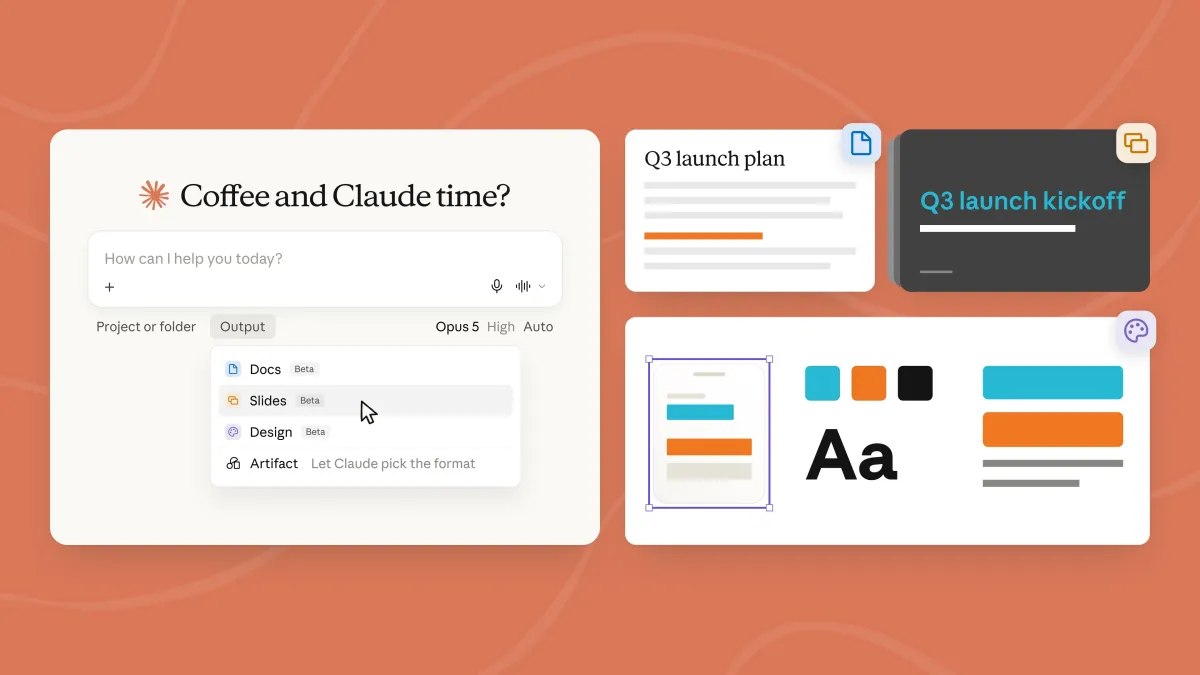
Anthropic’s new beta release adds two familiar workplace staples to Claude: document creation and slide generation. In practice, that means a user can ask Claude to draft a report, shape it into a formatted document, or build a presentation deck from the same conversation.
The tools are intended to be interactive rather than one-shot generators. After Claude creates content, users can ask for revisions through follow-up prompts or make manual changes themselves. Anthropic is positioning the experience as collaborative, not merely automated.
Docs and Slides join Claude Design
The new additions arrive alongside Claude Design, which is part of Anthropic’s broader productivity push. Together, the three tools are meant to cover the common work outputs people typically create inside office software: prose, visuals, and slide decks.
Anthropic says the system can now decide what a task requires and surface the relevant capability automatically from any conversation. In the company’s framing, that means a user should not need to open a special workspace or choose a specific mode before asking for a document or presentation.
Anthropic says the platform can determine what a task needs and make the capabilities that once lived in separate experiences available from any chat, using the context, skills, and connectors already tied to the account.
How the new “one Claude” interface works
The short answer is that Anthropic is trying to remove friction. Instead of switching between standard chat, Cowork, and Design, users will increasingly see one shared Claude interface where the assistant can handle multiple job types from the same starting point.
That design change is important for both usability and competition. The more users can do without leaving a conversation, the more likely they are to stay inside Claude for a longer stretch of work. That is especially relevant in the productivity-software market, where seamless integration often matters as much as model quality.
What changes for users
For everyday users, the main difference is that Claude becomes a more complete workspace. A user can ask for a briefing memo, turn it into slides, review the result, and share it from a single thread.
Anthropic says anything produced through Claude Design, Slides, or Docs will live at one shareable link that can be opened on a phone. That suggests the company wants to make its outputs easier to distribute across devices and teams, not just easier to generate.
- Create documents and presentations directly from chat
- Edit content with prompts or manual changes
- Collaborate with others in shared documents
- Leave comments, including comments from Claude
- Access outputs through a single shareable link
Why this matters in the battle with Google
The direct competitive target is clear: Google. While Anthropic’s models are often regarded as stronger on raw capability, Google still has a structural advantage because Gemini is embedded in Docs, Sheets, and Slides, where many office workers already spend their time.
By adding Docs and Slides to Claude, Anthropic is trying to close that gap. The company may not be matching Google’s ecosystem depth yet, but it is reducing the need for users to move from Claude to a separate productivity app to finish the work.
How Claude compares with Gemini
Google spent earlier this year expanding Gemini’s role across its productivity products, including a Gemini chat panel in Docs, the ability to generate and revise full documents, and support for creating presentations with AI assistance. Anthropic’s new features are similar in spirit, but they sit inside Claude rather than inside a mature office suite.
That difference still matters. Google’s tools are native to Docs and Slides, which means they inherit the familiar interface, collaboration model, and file workflow of Google Workspace. Claude, by contrast, is building a productivity layer around the chat experience and hoping users will treat it like a work hub.
| Platform | New productivity tools | Integration model | Current status |
|---|---|---|---|
| Claude | Docs, Slides, Design | Built into chat with one shared interface | Rolling out in beta |
| Google Gemini | Document and presentation generation | Native inside Docs, Sheets, and Slides | Already expanded this year |
| Claude chat | Artifacts and connectors | Unified under “one Claude” | Rolling out gradually |
What does “one Claude” change?
“One Claude” is Anthropic’s way of merging its split product surfaces into a single workflow. The company says regular chat and Cowork are no longer separate experiences in practice, because the AI productivity tools are now accessible from any conversation.
That consolidation is more than a naming tweak. It signals that Anthropic is trying to make Claude feel like one continuous assistant rather than a set of distinct modes that users must learn to navigate.
Why consolidation matters
Productivity tools often fail when they feel bolted on. Users don’t want to remember which tab or mode handles which task. Anthropic’s new approach is meant to let the model route the request for the user.
That could reduce confusion for new users and speed up work for experienced ones. It also gives Anthropic a better platform for adding future features without making the interface feel fragmented.
How Claude Docs works in collaboration
Claude Docs are meant to behave like shared working files rather than static exports. Anthropic says documents begin as private, then can be opened to other editors who are able to work on them at the same time.
Collaboration is a central part of the pitch. Anthropic says both humans and Claude can leave comments, which makes the tool sound closer to a live co-author than a simple drafting engine.
What that means for teams
For teams, the feature may be most useful as a first-pass drafting tool. A manager could ask Claude to prepare a proposal, share it with colleagues, and then use comments to steer revisions. In theory, that makes the early stages of document work faster and more structured.
It also suggests Anthropic sees an opportunity in office workflows where people spend more time revising and discussing documents than writing them from scratch. AI that can participate in that loop is more valuable than AI that only generates text once.
What is Anthropic trying to achieve?
Anthropic is trying to make Claude indispensable for knowledge work. The company’s strategy appears to be moving beyond chat as a question-answering tool and into chat as the place where work actually gets done.
That ambition puts Anthropic in direct competition not just with Google, but with every platform trying to turn AI into a daily productivity layer. If users can write, design, present, comment, and share without exiting Claude, the service becomes harder to replace.
The business logic behind the feature set
There is also a retention play here. The more output types Claude supports, the more reasons users have to stay within the app. A single platform that can handle drafting, slides, and design reduces the need to bounce between tools, which can increase engagement and subscription value.
That matters because the AI market is increasingly about habit formation. If users begin their work in Claude, they are less likely to reach for a competing assistant later in the day.
Rollout details and availability
Anthropic says the “one Claude” experience is being rolled out first to Pro and Max subscribers on the web, desktop, and mobile over the next few weeks. Team and free users will get access later.
The company also says there is nothing users need to toggle on manually. The update should appear automatically, while the normal Claude chat experience remains available for people who do not want to use the new productivity tools.
Who gets access first?
Paid customers are first in line. That is a common pattern for new AI features, especially those that rely on heavy model use or involve more complex file workflows.
For Anthropic, that approach also helps the company test performance and gather feedback from users who are more likely to push the product in professional settings.
| Rollout group | Access timing | Platforms |
|---|---|---|
| Pro users | First wave, over the next few weeks | Web, desktop, mobile |
| Max users | First wave, over the next few weeks | Web, desktop, mobile |
| Team users | Later rollout | Web, desktop, mobile |
| Free users | Later rollout | Web, desktop, mobile |
Why this launch is strategically important
This is not just a feature update; it is a competitive positioning move. Anthropic has built a reputation around strong models, but model quality alone does not win the productivity market. Distribution, workflow depth, and interface convenience are just as important.
Google’s edge has long been that it owns the apps people already use for work. Anthropic cannot easily replicate that footprint, but it can narrow the gap by making Claude itself feel like a destination for office tasks.
Could Claude become a workspace?
Potentially, yes. That is the direction Anthropic appears to be taking. If the company continues to fold document creation, slide generation, design, and collaboration into one interface, Claude could evolve from a chat assistant into a general work surface.
That would not make it identical to Google Workspace, but it would make switching away less appealing. For a company trying to build a durable consumer and enterprise AI business, that kind of product gravity is valuable.
What users should watch next
The most important question now is whether Claude Docs and Slides feel genuinely useful in real workflows or merely impressive in demos. AI writing and presentation tools often look similar on paper, but the winner is usually the one that best handles revision, collaboration, and file sharing at scale.
Users will also want to see how well Claude handles complex formatting, multi-step editing requests, and collaborative comment threads. Those details will determine whether the feature becomes an everyday tool or just a novelty inside the app.
Key tests ahead
- How well Claude preserves formatting in exported documents
- Whether shared editing feels smooth across devices
- How useful Claude’s comments are during revision
- Whether slide generation can produce polished, business-ready decks
- How quickly free and Team users gain access
The bigger picture for AI productivity
Anthropic’s move reflects a broader shift in AI. The competition is moving away from simple chat interfaces and toward full-featured work environments where the assistant can produce the final artifact, not just offer advice.
That shift is visible across the industry, but Claude’s new tools show how quickly the category is converging. Once an AI system can draft, edit, comment, and present, it stops behaving like a chatbot and starts acting like an operating layer for office work.
For now, Anthropic is still playing catch-up with the deep integration that Google has inside Workspace. But with Docs and Slides now part of Claude, the company has taken a meaningful step toward making its assistant a place where real work can happen from start to finish.
In a crowded AI market, that may be the difference between being useful and being essential.
Frequently asked questions
What are Claude Docs and Slides?
Claude Docs and Slides are new beta tools that let users create, edit, and share documents and presentations directly from Claude chats. They are designed to work alongside Claude’s other productivity features, with follow-up prompts and manual editing available after generation.
How is Claude competing with Google Workspace?
Claude is competing by bringing document and presentation creation into the chat experience, reducing the need to switch apps. Google still has the advantage of native integration inside Docs and Slides, but Anthropic is narrowing that workflow gap.
Who gets access to the new Claude features first?
Pro and Max users are getting the rollout first across web, desktop, and mobile. Anthropic says Team and Free users will receive access later, and the update will appear automatically without any manual setup.
What does ‘one Claude’ mean?
'One Claude' is Anthropic’s new unified interface for chat and productivity tools. It merges separate experiences so users can access features like Docs, Slides, Artifacts, and Design from any conversation instead of switching between modes.