In short
The Verge reports that a $50 Waveshare ESP32-S3 dev board, paired with Claude Code, can be hacked into a Muse-like AI pendant with more features than Meta’s starter build. The story raises broader questions about whether the real product is the wearable or the platform behind it.
- The Verge says a $50 Waveshare ESP32-S3 board can be turned into a Muse-like pendant.
- Claude Code added features Meta’s starter build lacked, including history, voice output and more avatars.
- Meta’s servers were still the main source of lag in the build.
- The report leaves open whether the retail Muse Charm will be equally modifiable.
The Verge says a $50 Waveshare ESP32-S3 dev board can be hacked into a Muse-like AI pendant with Claude Code, months before Meta’s Muse Charm is due to arrive. The comparison matters because it suggests the real draw may not be the finished wearable itself, but the platform underneath it.
What The Verge built
Reporter Sean Hollister described putting together a Muse-style pendant from a Waveshare ESP32-S3 1.75C board, a small hobbyist device that Meta itself appears to have blessed as one of its suggested “Muse Gadget” starter boards. The result, according to The Verge, was a homemade pendant that could talk to Meta’s Muse cloud, display avatars, function as a pocket watch and act as a camera viewfinder.
The significance is not just that the hardware worked. It is that the build began with a cheap, off-the-shelf dev board and then evolved into something that looked closer to a finished consumer accessory than a toy project. In The Verge’s account, the setup started simply: plug the board into a PC, point Claude at Meta’s GitHub, and pair the device with the Muse phone app.
Why it matters
This is a consumer-tech story about control. Meta has been showing off a small, cute AI wearable called Muse Charm, but The Verge’s experiment raises a different question: do buyers want Meta’s hardware, or do they want a platform they can shape themselves?
If a $50 board can be turned into a more flexible version of the same concept, that changes the way the device is judged. It suggests the most appealing part of Muse may be the software ecosystem and the ability to customize it, not the pendant design alone. That is an awkward proposition for any company trying to sell an AI wearable as a polished product instead of a tinkerer’s kit.
The story also matters because it exposes the tension between an accessible developer platform and a locked-down consumer device. The Verge’s report leaves open whether Meta will allow that same level of modification once Muse Charm ships, or whether the retail version will be more constrained than the board-based build.
Why a cheap board can change the conversation
When a low-cost dev board can be turned into something that mimics a company’s showcase wearable, the comparison immediately shifts from aesthetics to openness. That is especially true in AI hardware, where the underlying cloud service can matter more than the shell around it.
In practical terms, the board-based version gave The Verge a preview of what a flexible Muse device could become if users were allowed to modify it freely. It also showed how quickly a product idea can be upgraded when it sits on top of open components and a coding assistant that can fill in the gaps.
How the build worked
The first version of Muse, according to The Verge, was functional but rough around the edges. It misread commands as transcription requests, replied slowly and stayed silent when it should have spoken. The base build also lacked conversation history, loud voice output and a full on-device display of messages.
That is where Claude Code entered the picture. The Verge says the Anthropic coding assistant filled in most of the missing pieces, adding reply history, voice output, better photo controls and a wider selection of avatars. It also improved the camera experience with both a high-quality live preview and a lower-quality Bluetooth preview for remote photos.
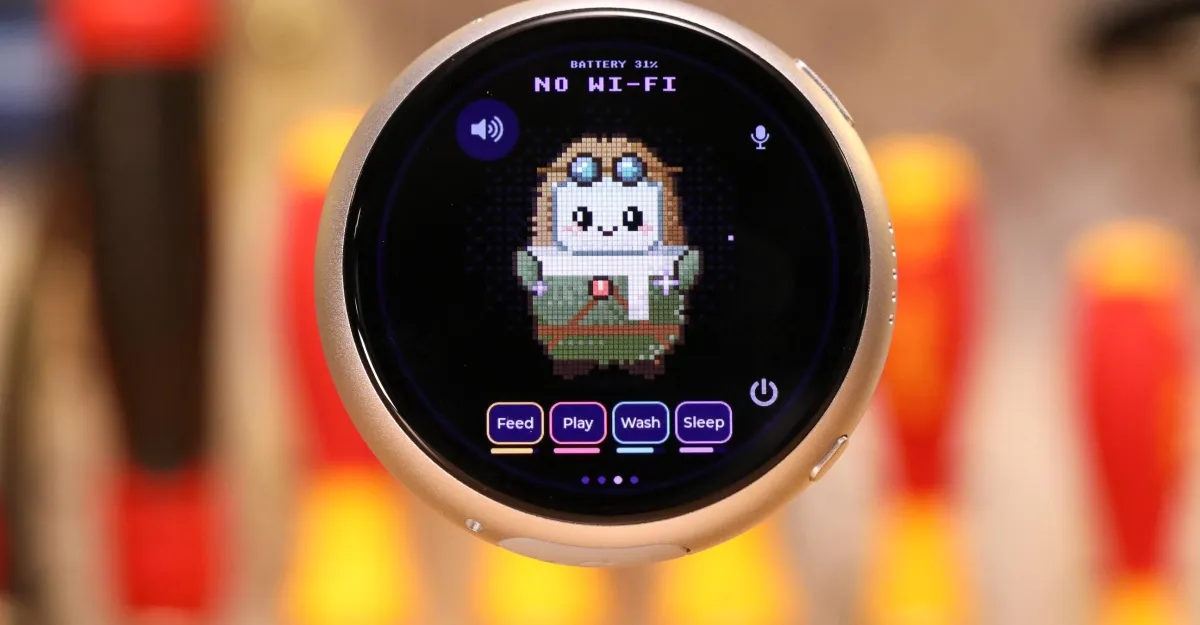
One of the clearest markers of the upgrade came in the form of playful utility. Claude also added a Tamagotchi-like care game with hunger, boredom, dirt, play, food, sleep and bath mechanics, turning the pendant into something that felt less like a demo and more like a device with a personality.
What Claude Code added
- Reply history on the device
- Voice output that Meta’s starter build lacked
- Better photo controls
- More avatars beyond the single Jolly avatar in Meta’s baseline build
- A high-quality live camera preview
- A low-quality Bluetooth preview for remote photos
- A care game with hunger, boredom, dirt, play, food, sleep and bath features
What was missing from Meta’s starter build?
Meta’s baseline version, as described by The Verge, left out several things that users might reasonably expect from an AI wearable. There was no conversation history, no loud voice playback and no full-message display on the pendant itself. It also shipped with only one Jolly avatar and no automatic discovery of smart-home devices.
Those omissions matter because they define the product’s first impression. A wearable can look charming in a teaser and still feel limited in daily use if it cannot remember a conversation, speak clearly or surface the right information at a glance.
In other words, the board did not merely imitate the shape of Muse Charm; it exposed where Meta’s own starter build felt thin. The Verge’s account suggests that the missing features were not exotic engineering feats, but basic quality-of-life improvements that dramatically changed the experience.
Background and context
Meta has been showing off Muse Charm as a small, cute AI wearable, part of a broader push to make AI feel personal and portable. The company’s Muse system, according to the fact sheet, connects hardware to its AI cloud using open-source components and tokens. That approach makes the platform unusually approachable for experimenters willing to tinker.
Waveshare, meanwhile, sells ESP32-based development boards that are already familiar to hobbyists working on embedded projects. The Waveshare ESP32-S3 1.75C used in The Verge’s build fits that mold: inexpensive, compact and designed to be modified rather than admired from afar.
Claude Code is Anthropic’s coding assistant for software changes, and in this case it became the missing layer between Meta’s starter kit and a more complete wearable. The Verge’s report shows how an AI coding tool can act as an accelerant for hardware prototyping, especially when the underlying system is already built from accessible parts.
By the numbers
The details of the build show why the project resonated beyond a hobbyist audience. It was cheap, compact and fast to modify.
| Detail | Figure | What it referred to |
|---|---|---|
| Board cost | $50 | Price of the Waveshare ESP32-S3 1.75C dev board |
| Screen size | 1.75-inch | Display on the Waveshare board |
| Audio minimum | One second | Shortest audio length Claude used to avoid truncated push-to-talk clips |
| Watch-face build time | 15 minutes | Time Claude took to build the working pocket-watch face |
How did the reporter actually use it?
The Verge says the homemade pendant became more than a novelty. It could show avatars, serve as a pocket watch and work as a camera viewfinder, which made it useful in more than one mode. The reporter also built a working three-hand pocket-watch face and a video player for Zuck intro clips, underscoring how much the device could be repurposed with a bit of code.
One interesting detail is how quickly the build became practical once Claude entered the loop. The Verge says Claude took only 15 minutes to build the pocket-watch face. That speed helps explain why the story is not just about a gadget, but about how AI-assisted coding can reshape what a single person can do with a hardware platform.
The camera setup also points to a split between local convenience and remote limitations. The Verge reports that Claude added both a high-quality live camera preview and a low-quality Bluetooth preview for remote photos. That kind of dual approach suggests the project was optimized for real-world use, not just a polished demo.
What went wrong, and what still lagged
Even after the upgrades, the system was not perfect. The Verge said Meta’s servers remained the main source of lag. That matters because it places the slowest part of the experience outside the pendant itself and inside the cloud service behind it.
The reporter also noted a more personal limit: they have no coding experience and did not trust Meta or Muse with email or home network access. To reduce risk, The Verge says the device was used on guest Wi-Fi, partly because of a reported home-address leak involving another reviewer.
That precaution underscores the privacy side of wearable AI. A device like Muse can only be as safe as the permissions and network access granted to it, and the report makes clear that not every user will feel comfortable giving a new AI gadget broad access to their digital life.
“I want you to understand I have no coding experience”
What happens next
The biggest unanswered question is whether the retail Muse Charm will allow this kind of user modification. The Verge frames that as the central issue: if the shipping product is open enough to support experimentation, then the gap between Meta’s teaser and a more capable DIY version may narrow quickly.
Another question is whether Meta will encourage third-party coding on Muse devices or draw a tighter line around what users can change. That decision will shape not only the product’s appeal, but also how it is perceived by the hobbyist and developer communities that often amplify early AI hardware.
Durability and security are also still open questions. The Verge’s homemade setup may be clever, but the report does not suggest it has been tested like a mainstream consumer wearable in daily use. That leaves practical issues unresolved: battery life, robustness, cloud dependence and the risk profile of a device that is always connected.
And then there is the matter of replication. The Verge’s build was completed by a reporter who openly described themselves as non-technical, but it still depended on Claude Code and a willingness to tinker. The next test is whether other users can reproduce the same result without relying on a reporter’s guided experiment.
What to watch
- Whether Meta ships Muse Charm with the same openness shown in the developer board build
- Whether users can add avatars, voice features and watch faces without advanced coding
- Whether Meta’s cloud performance improves enough to reduce lag
- Whether the device remains safe to use on personal networks
- Whether the market responds more to the pendant’s form or to the platform behind it
The bottom line
The Verge’s experiment suggests that Meta’s Muse idea may be more compelling as a programmable system than as a finished piece of hardware. A $50 Waveshare ESP32-S3 board, paired with Claude Code, produced a pendant that did more than Meta’s own starter build and did it with surprising speed.
That does not settle whether Muse Charm will be a success. But it does sharpen the question Meta now faces: when the retail product arrives, will people be buying the pendant, or the freedom to make it their own?
“I guess we’ll see when it ships.”
Frequently asked questions
What is Meta's Muse Charm?
Meta's Muse Charm is a small AI wearable the company has been showing off as a cute pendant-style device. In The Verge's reporting, the product sits on top of Meta's Muse system, which connects hardware to Meta's AI cloud using open-source components and tokens.
Can you build a Muse-like AI pendant from a cheap dev board?
Yes. According to The Verge, Sean Hollister turned a $50 Waveshare ESP32-S3 1.75C board into a Muse-style pendant that could connect to Meta's Muse cloud, show avatars, work as a pocket watch and serve as a camera viewfinder.
What did Claude Code add to the device?
Claude Code filled in many of the missing features. The Verge says it added reply history, voice output, better photo controls, more avatars, a high-quality live camera preview, a Bluetooth preview for remote photos and a Tamagotchi-like care game.
Why does this story matter for consumers?
It matters because it suggests the appeal of Muse may come from the platform's openness, not just the hardware design. If a cheap board can do more with the help of Claude Code, buyers may care as much about customization as they do about the finished pendant.