In short
OpenAI has launched ChatGPT for Teens, a safer version of its chatbot with default protections, parental controls and a new Study Mode aimed at learning instead of cheating. The release comes amid lawsuits, school concerns and growing scrutiny of AI’s impact on minors.
- OpenAI launched ChatGPT for Teens with protections turned on by default.
- Study Mode is designed to guide students step by step instead of giving direct answers.
- Parents can use family tools, safety alerts and Quiet Hours to manage access.
- OpenAI also announced a CodeAI partnership to improve teen AI literacy.
- The launch comes amid lawsuits and concern over chatbot use by minors.
OpenAI has launched a teen-specific version of ChatGPT designed to add stronger safety protections and new learning tools at a moment when schools, parents and regulators are still grappling with the risks of AI chatbots. The new ChatGPT for Teens package arrives alongside a Study Mode intended to steer young users toward understanding material rather than simply generating answers.
The move matters because it signals a more formal attempt by one of the world’s most influential AI companies to adapt its consumer chatbot for minors after years of criticism over safety, privacy and academic misuse. It also comes as lawsuits, school policy debates and mental-health concerns have intensified scrutiny of how teenagers interact with generative AI.
OpenAI said the teen experience will include protections turned on by default, parental oversight tools, and education-focused features such as quizzes, visual learning aids and reminders that encourage study instead of shortcutting schoolwork. But the company will still face a difficult test: whether these controls can hold up in the hands of tech-savvy teenagers who often know how to bypass digital guardrails.
What OpenAI changed for teen users
ChatGPT for Teens is OpenAI’s latest effort to tailor its flagship chatbot for a younger audience. The company says the new experience automatically applies age-appropriate protections meant to reduce exposure to harmful or developmentally unsuitable content.
According to OpenAI, those safeguards are grounded in its Under-18 Principles in the company’s Model Spec and informed by developmental research and outside expert guidance. In practice, that means a version of ChatGPT that is supposed to behave differently for teens than for adults, especially when the system detects topics that may be risky or inappropriate.
OpenAI is also giving parents more control through familiar family tools. Guardians can manage settings, receive safety alerts and set Quiet Hours, among other options. The company is positioning the release as a more supervised way for teens to use AI at home and in school-related settings.
OpenAI said the new teen experience is built around default safety protections, parental tools and a more learning-oriented style of interaction for younger users.
Why this release now?
The launch comes after years of criticism that AI chatbots can be too open-ended for minors, too persuasive in conversation and too easy to use for cheating. It also arrives against the backdrop of a growing number of lawsuits and public concerns tied to the role of chatbots in teen mental health crises.
For OpenAI, rolling out a dedicated teen product is as much about risk management as it is about product design. The company is trying to show that it can support educational use while reducing the kinds of interactions that have drawn the most concern from parents, schools and lawmakers.
How Study Mode is supposed to work
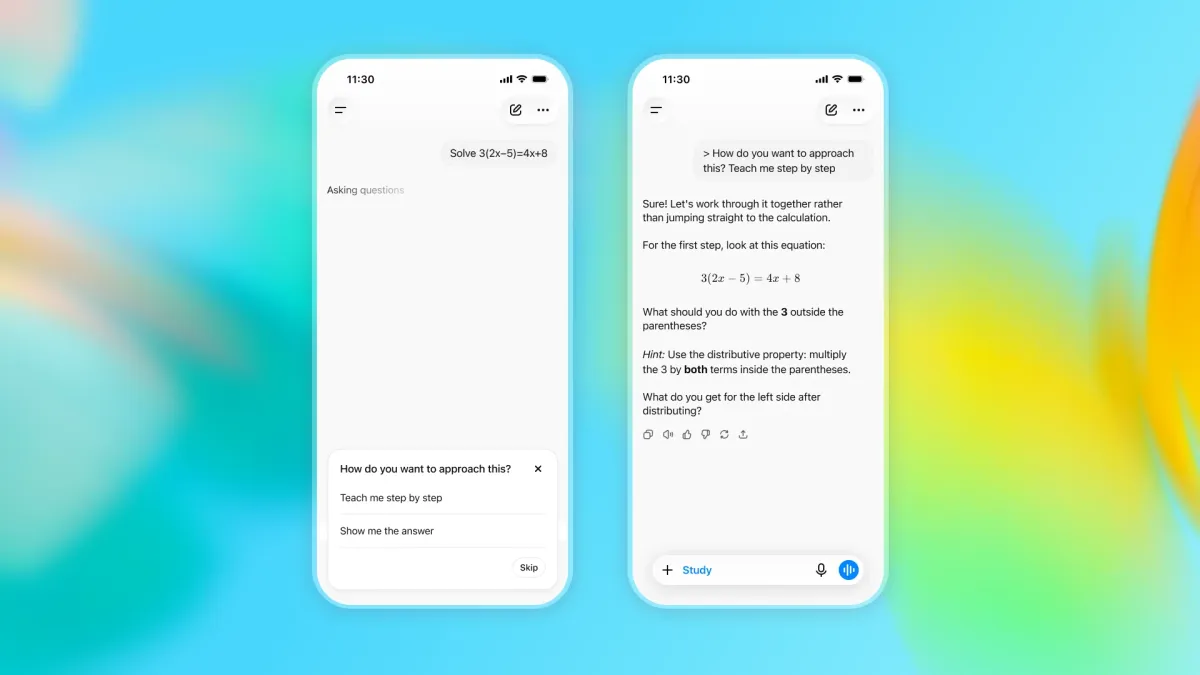
Study Mode is designed to make ChatGPT act more like a tutor and less like an answer machine. OpenAI says the feature will guide teens through questions step by step, offering prompts that help them reason through a problem instead of dropping a direct solution immediately.
The company’s description suggests an intentional shift in product behavior. Rather than encouraging students to paste in an assignment and copy out a finished response, Study Mode is meant to slow the process down and make the chatbot a more interactive learning tool.
OpenAI says the feature will include:
- Guiding questions that lead students through a topic
- Step-by-step help for working through tasks
- Quizzes to check understanding
- Visualizations that make concepts easier to grasp
- Homework reminders when the system suspects a teen is trying to cheat
In those situations, ChatGPT will push the user toward Study Mode instead of simply producing a ready-made answer. The company is clearly trying to reduce the temptation to use the chatbot as a shortcut for schoolwork.
Can teens get around it?
The short answer is probably yes, at least in some cases. Any system that depends on user cooperation, age-based settings or softer educational nudges will be tested by teenagers who are often skilled at navigating around restrictions.
That does not mean the controls are meaningless. But it does mean the real-world effectiveness of ChatGPT for Teens will depend on how resilient the protections are under pressure, especially when a user is determined to ignore them.
OpenAI has not yet shown how difficult it will be to defeat the new guardrails, and that uncertainty will likely remain one of the biggest open questions around the product. For parents and schools, the issue is not whether the controls exist, but whether they can withstand normal attempts to work around them.
What safety features are built in by default?
OpenAI says the teen version will ship with app-appropriate protections enabled automatically. The goal is to limit access to content the company believes could be harmful or inappropriate for younger users.
These safeguards are tied to OpenAI’s internal policy framework for users under 18. The company says the design is informed by developmental science and expert advice, though it did not spell out every technical detail of how the protections work.
The company’s broader family controls, introduced earlier, remain part of the package. Those tools are intended to let adults set boundaries and monitor how the account is being used.
Key controls and protections
| Feature | What it does | Who controls it |
|---|---|---|
| Age-appropriate protections | Reduces exposure to harmful or unsuitable content | On by default |
| Study Mode | Guides teens through learning instead of giving direct answers | Teen user, with parent/guardian options |
| Homework reminders | Nudges students away from suspected cheating behavior | System-driven |
| Family tools | Lets adults manage settings and receive notifications | Parent or guardian |
| Quiet Hours | Limits access during selected times | Parent or guardian |
That table reflects OpenAI’s stated approach: a combination of automatic protections, parent-managed settings and interaction-level nudges meant to shape behavior before problems start.
Why schools care so much about this update
Schools care because ChatGPT has already changed how students complete homework, study for exams and interact with classroom material. For many educators, the question has moved beyond whether AI belongs in schools and toward how it should be used without weakening learning or fairness.
Generative AI has given students a fast way to summarize readings, draft essays and solve problems. That has made it useful for some learning tasks, but it has also created a fresh academic integrity challenge.
OpenAI’s Study Mode appears aimed squarely at that problem. Instead of trying to ban the behavior, the company is trying to redirect it. If students are going to use ChatGPT anyway, the company wants the experience to feel more like tutoring than cheating.
That approach mirrors a broader trend across the AI industry: companies are increasingly trying to present their tools as educational partners rather than replacements for student effort. Whether that strategy satisfies teachers is another question.
What teachers may gain
- A potentially more structured way for students to study difficult material
- Quizzes and visual learning tools that may reinforce concepts
- More explicit nudges away from copy-paste behavior
- Institution-facing tools already available through ChatGPT for Teachers
OpenAI is already offering a teacher-oriented product that gives schools institution-managed access to AI. That suggests the company sees the classroom as a long-term market, not just a battleground over cheating.
How does this fit OpenAI’s broader education strategy?
The teen launch fits into a larger push by OpenAI to build age- and role-specific products around ChatGPT. The company has been carving out distinct versions of the chatbot for different contexts, including adults, teachers and now teens.
That segmentation is important for both safety and adoption. A general-purpose chatbot can be useful to many people, but it can also be hard to control in sensitive settings. By tailoring the product, OpenAI is trying to make the technology feel safer and more practical for each audience.
The company’s educational push also includes a partnership with CodeAI, which OpenAI says will help teens learn how AI works and how to direct, question and evaluate it. That emphasis on AI literacy suggests OpenAI wants young users not only to consume outputs, but also to understand the limits and mechanics of the system.
OpenAI said its partnership with CodeAI is meant to help teens learn how AI works and how to question it, not just use it.
What does AI literacy have to do with safety?
AI literacy matters because a user who understands how a model works is more likely to spot mistakes, question confident-sounding errors and avoid treating outputs as unquestionable truth. For teens, that can be especially important in schoolwork, research and online decision-making.
It also helps set expectations. If students know that a chatbot can be wrong, biased or incomplete, they are less likely to use it as a final authority. In that sense, the educational angle is also a safety feature.
How OpenAI is trying to balance opportunity and risk
OpenAI is attempting to thread a difficult needle: keep ChatGPT useful enough to attract teens while making it safe enough to reassure adults. The company is now operating in a space where convenience, supervision and harm reduction all matter at once.
That balancing act is not unique to OpenAI, but the company has become one of the most visible symbols of generative AI’s promise and its risks. Every product adjustment is being watched closely because ChatGPT has become the default reference point in the public debate over AI.
On one side is the case for access. Teens are already using AI tools for homework help, brainstorming and explanation. On the other side are concerns about overreliance, dependency, misinformation, emotional vulnerability and the possibility of harmful interactions.
OpenAI’s answer is to narrow the experience for minors without fully shutting it off. The result is less a ban than a supervised mode of use.
Potential benefits
- More guided homework help
- Reduced exposure to inappropriate content
- Better parent oversight
- Fewer incentives to use ChatGPT as a cheating tool
- More explicit AI education for teens
Persistent concerns
- Teens may bypass restrictions
- Safety protections may be inconsistent in edge cases
- Schools may still struggle to detect AI-assisted work
- Parents may not know how often the tool is being used
- Public trust may remain cautious after earlier controversies
What the lawsuit and mental-health backdrop means for OpenAI
The launch lands in a climate shaped by litigation and intense scrutiny over chatbots’ effects on vulnerable users. That context gives OpenAI’s teen-specific release added significance beyond a typical product update.
AI chatbots have been criticized for sometimes responding in ways that are overly affirming, emotionally intense or otherwise risky when users are in distress. Concerns about teen safety have only sharpened as more young people have adopted these tools for personal conversations as well as schoolwork.
By emphasizing default protections and expert-informed principles, OpenAI is trying to show that it has learned from the backlash. The company is no longer presenting ChatGPT as a single universal product. It is now acknowledging that age matters, context matters and the same tool should not behave identically for everyone.
Still, a teen-specific interface does not remove the broader debate over whether chatbots should be allowed to interact so directly with minors in the first place. That argument is likely to continue even if the new controls work as intended.
How does ChatGPT for Teens compare with the adult product?
ChatGPT for Teens appears to be a more constrained version of the standard experience, with tighter content protections and more educational prompts. The adult product remains broader and less prescriptive, while the teen version aims to shape both what users see and how they use it.
For adults, ChatGPT is often marketed as a flexible assistant for work, research and creativity. For teens, OpenAI is trying to add guardrails that shift the product toward learning and away from potentially harmful or distracting uses.
| Audience | Main objective | Primary design emphasis | Oversight level |
|---|---|---|---|
| Adults | General-purpose AI assistance | Flexibility and productivity | User-managed |
| Teens | Safer learning and support | Protection and study guidance | Parent/guardian-supported |
| Teachers | Institution-managed classroom access | School deployment and control | Institution-managed |
This kind of product differentiation may become increasingly common across the AI industry as companies face pressure to demonstrate that one-size-fits-all chatbot design is not enough.
What happens next?
The next test is whether the product performs as promised in real-world teen use. Launch announcements can describe safeguards in ideal terms, but the practical outcome depends on behavior, enforcement and long-term adoption.
Parents will want to know whether the controls are easy to understand and meaningful to use. Teachers will want to know whether Study Mode genuinely helps students learn. Regulators and critics will want to know whether the protections reduce harm or merely create the appearance of safety.
There is also a business angle. If OpenAI can make ChatGPT feel safer for minors, it may expand the chatbot’s role in education without triggering as much backlash. If it cannot, the product could become another example of how quickly safety promises are outpaced by user behavior.
For now, OpenAI is betting that a more structured teen experience can help the company address its two biggest education-related problems at once: student misuse and adult concern. Whether that bet pays off will depend on how well ChatGPT for Teens works after the announcement and beyond the initial rollout.
Timeline of OpenAI’s teen-focused shift
| Period | Development | Why it matters |
|---|---|---|
| Previous years | Teens increasingly adopt ChatGPT for school and personal use | Creates demand and raises risk |
| Recent period | Safety lawsuits and mental-health concerns grow | Intensifies scrutiny of chatbot design |
| Earlier product phase | OpenAI introduces family tools and teacher-facing access | Builds the foundation for supervised use |
| Aug. 18, 2026 | ChatGPT for Teens and Study Mode are announced | Marks a dedicated teen product launch |
OpenAI is now trying to prove that generative AI can be re-engineered for younger users without abandoning usefulness. That is a high-stakes challenge, and one that will likely shape how the rest of the industry approaches teen access to chatbots.
For families and schools, the launch may offer a more responsible option than the open-ended chatbot experience that has defined the past few years. For OpenAI, it is another step in a larger effort to turn ChatGPT from a controversial general-purpose assistant into a set of tightly managed products for different audiences.
Frequently asked questions
What is ChatGPT for Teens?
ChatGPT for Teens is a new version of OpenAI’s chatbot designed specifically for minors. It includes stronger default safety protections, parental controls and learning-oriented features meant to reduce harmful content exposure and make the tool more useful for studying.
How does Study Mode work in ChatGPT for Teens?
Study Mode works by guiding teens through problems with step-by-step prompts, quizzes and visual supports instead of immediately giving full answers. OpenAI says it is meant to encourage understanding and discourage cheating or passive copy-and-paste homework use.
Can parents control ChatGPT for Teens?
Yes. OpenAI says parents and guardians can use family tools to manage settings, get safety notifications and set Quiet Hours. The company is also giving adults options to decide when Study Mode should be enabled by default.
Why did OpenAI launch a teen version now?
OpenAI launched the teen version now because ChatGPT has become widely used by students while facing criticism over cheating, harmful content and mental-health concerns. The company is trying to respond with a safer, more supervised product for younger users.
Will ChatGPT for Teens completely stop cheating?
No, not necessarily. OpenAI’s features are designed to discourage cheating and redirect students toward Study Mode, but determined teens may still find ways around restrictions. The real-world effectiveness of the controls remains to be tested.