In short
Apple is testing Audio Intelligence on the Apple Watch in a developer beta, adding Live Rewind, Siri Recaps, sound detection, and song ID. The company is pitching the feature as a privacy-safe way to summarize conversations instead of storing recordings.
- Audio Intelligence is in developer beta through iOS 27.3.
- The feature set includes Live Rewind, Siri Recaps, sound detection, and song ID.
- Apple says the system deletes snippets quickly and does not store raw audio.
- TechCrunch and Mashable agree on the privacy focus but differ on rollout timing details.
- Support is tied to Apple Watch Series 12 and Apple Watch Ultra 4.
Apple is testing Audio Intelligence on the Apple Watch in a developer beta, adding a set of ambient-listening tools designed to capture snippets of what is said around the wearer without storing full recordings. The feature set, reported by TechCrunch and Mashable, is built around summaries, short rewinds, and automatic deletion rather than permanent audio capture.
The move matters because it shows Apple trying to make AI on wearables feel useful without sounding intrusive. Instead of turning the watch into a recorder, Apple is positioning the feature as a privacy-conscious assistant for meetings, classes, and other moments when users may want a quick recap of what was said.
What Apple is rolling out in beta
According to TechCrunch, Audio Intelligence is now available to developers in an iOS 27.3 beta build. The feature set is opt-in and includes four tools: sound detection, song ID, Live Rewind, and Siri Recaps.
Apple has tied support to the Apple Watch Series 12 and Apple Watch Ultra 4. Mashable said the features will arrive later this year on Ultra 4 and Series 12, while TechCrunch described them as already being supported in the developer beta. That difference appears to reflect timing and access: the tools are entering developer testing now, while broader availability is still ahead.
How the new tools work
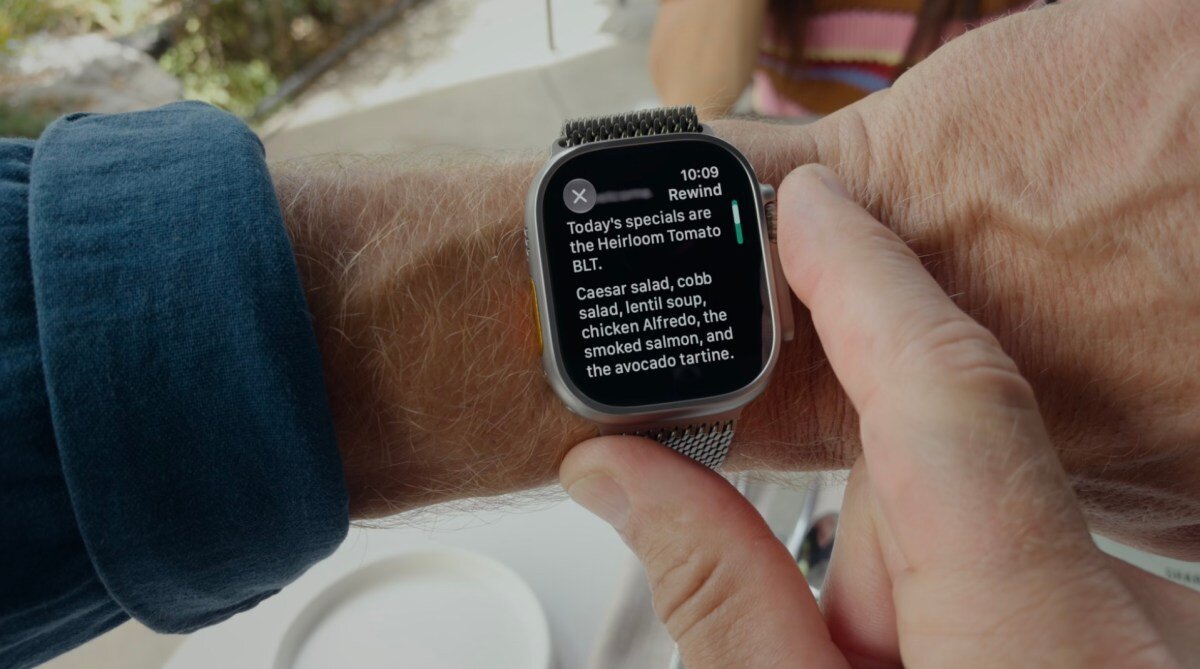
The most novel feature is Live Rewind. After a user double-presses the digital crown, the watch shows the last 15 seconds of a conversation as text on the screen. Apple says those snippets delete themselves after 30 seconds unless the user saves them.
Siri Recaps is a more ambitious version of the same idea. Rather than producing a transcript, it turns conversations into a short summary with bullet points. Apple says these recaps delete automatically after seven days if they are not saved, and users can keep them by sending them to Notes or exporting them to Journal.
Two other features are more straightforward. Sound recognition is intended to spot sirens, alarms, and doorbells, especially for deaf and hard-of-hearing users. Song recognition uses Shazam to identify music, artist, and track name.
Why it matters
Wearables have long faced a trust problem. The more useful they become as always-on sensors, the more they risk feeling like surveillance devices. Apple’s answer here is to narrow what the Watch captures and to make the output disposable by default.
That privacy-first framing is important for Apple because the company has faced scrutiny over ambient-listening and recording features on AI wearables. By promising summaries instead of recordings, Apple is trying to draw a line between convenience and surveillance. The company says the feature is meant for meetings, parent-teacher conferences, training sessions, and similar situations where people may want a memory aid rather than an audio archive.
For users, the practical payoff is simple: less need to scribble notes, more ability to catch up on what was said, and a lower-stakes way to use a watch as a listening device. For Apple, the payoff could be strategic. If the company can make AI on a wrist feel trustworthy, it strengthens the case for more ambient intelligence across its devices.
Why does Apple think this is safe?
Apple says the system is designed to avoid storing raw audio and to skip identifying speakers. The company also says it omits sensitive data and does not listen during music playback or while headphone noise cancellation is active.
That is the core of Apple’s pitch: the watch hears enough to help, but not enough to build a lasting record of the conversation. As Mashable quoted Apple, the company says users should “do not create or store audio recordings.”
There are still limits to that promise. Voice-driven tools can reassure users with short retention windows and on-device processing, but the practical question is whether people trust the system enough to turn it on in sensitive environments. Apple is clearly betting that defaults, deletion rules, and controls will matter as much as the AI itself.
How Apple says the data flows
Apple says processing is split across the Watch, the paired iPhone, and Apple’s cloud stack. According to TechCrunch, the system uses the S11 chip, iPhone-side Apple Intelligence models, and Private Cloud Compute. The report says audio moves to a secure enclave on the iPhone, then condensed text is cloud-processed into a recap before being deleted from Private Cloud Compute.
Mashable described Apple’s explanation a little differently, saying raw audio is processed separately, then deleted, and is inaccessible to Apple, the user, and on-board apps. The two accounts are not necessarily contradictory; they reflect different emphasis on the same privacy story. One focuses on the path of the data, the other on the end state: no persistent audio file.
Apple also says the features can be scheduled for certain hours or disabled from Control Center. That means users can decide when the watch is allowed to listen, which is likely to be as important to adoption as the summaries themselves.
| Feature | What it does | Retention policy | Who it helps most |
|---|---|---|---|
| Live Rewind | Shows the last 15 seconds of a conversation as text after a double-press of the digital crown | Deletes after 30 seconds unless saved | People who miss part of a conversation and need a fast catch-up |
| Siri Recaps | Turns conversations into a short summary plus bullet points | Deletes after 7 days unless saved | Users who want notes from meetings or classes |
| Sound recognition | Identifies sirens, alarms, and doorbells | Not specified in the fact sheet | Deaf and hard-of-hearing users |
| Song recognition | Uses Shazam to identify music, artist, and track name | Not specified in the fact sheet | Users trying to identify music quickly |
Background: how Apple got here
The Apple Watch has gradually moved from a notification screen and fitness tracker into a broader health and sensing platform. The Ultra models sit at the high end of that lineup, and Apple has now paired that hardware ambition with AI software meant to work in the background rather than demand constant attention.
That strategy fits with Apple Intelligence, the company’s broader AI stack that blends on-device processing with cloud support. The watch is a natural place to test that approach because it is already close to the body, always present, and tied to microphones, notifications, and quick interactions. But it is also the place where privacy anxieties are strongest.
Apple first announced Audio Intelligence in September 2026 at its Surprise and Shine hardware event, according to the fact sheet. The Apple Watch Ultra 4 was unveiled on 2026-09-09 at the same broader event cycle. Mashable later said the Ultra 4 would ship on Friday, Sept. 18, 2026.
Seen in that context, the developer beta is not a surprise product launch but the next step in a staged rollout. Apple is not just adding a feature; it is testing whether a privacy-forward AI utility can become normal on the wrist.
How the privacy pitch fits Apple’s bigger playbook
Apple has often tried to make powerful features feel less invasive by limiting what gets stored and where processing happens. With Audio Intelligence, that pattern becomes especially visible. The company is not promising perfect recall of every word. It is promising a useful enough approximation to help users remember what they heard.
That distinction matters. A transcript can be searched, shared, and repurposed indefinitely. A summary that expires after a week is much harder to misuse. Apple appears to be betting that most people want the utility of recall without the burden of archiving every conversation they enter.
How much hardware does this require?
The fact sheet ties support to the Apple Watch Series 12 and Apple Watch Ultra 4, and it suggests the feature depends on a mix of watch hardware, the paired iPhone, and Apple’s cloud processing. That implies this is not a purely local trick, even though Apple is trying to present it as privacy-first.
Mashable’s reporting on the Ultra 4 also includes a hardware angle beyond Audio Intelligence. The publication said the Ultra 4 has a starting price of $799, compared with $1,499 for the Apple Watch Hermès Ultra 4 and $3,149 for a Hermès Ultra 4 with a Grand H titanium band. It also said the Ultra 4 offers 50 hours of battery life, up from 42 hours on the previous Ultra generation, and 84 hours in low power mode, with 15 minutes of charging delivering 18 hours of use.
Apple says the new audio features should not materially affect battery life. That claim will be watched closely, because any feature that leans on microphones, on-device processing, and cloud handoffs can quickly become a battery story on a wearable.
By the numbers
Here is a quick snapshot of the figures attached to the rollout, as reported in the fact sheet.
| Number | What it refers to |
|---|---|
| iOS 27.3 | Developer beta build carrying Audio Intelligence |
| 4 | Opt-in Audio Intelligence features |
| 15 seconds | Conversation window shown by Live Rewind |
| 30 seconds | Retention before Live Rewind snippets auto-delete |
| 7 days | Retention before Siri Recaps auto-delete |
What happens next
The immediate question is when the public beta starts and when general availability follows. The fact sheet does not give those dates, which means Apple’s next move is still partly opaque. That matters because developer access is one thing; consumer trust is another.
There are also unanswered product questions. The sheet does not say whether any Apple Watch models beyond the Series 12 and Ultra 4 will support the features, or whether Apple plans regional and language restrictions. Those details could determine whether this is a niche tool or a broader part of the Apple Watch experience.
Another open issue is how much Apple changes the feature after beta testing. The company could alter defaults, shorten retention windows, add clearer controls, or change when the watch listens at all. If early users find the feature useful but uneasy, the safeguards may change as much as the AI models.
What to watch in the beta
- Whether Apple expands Audio Intelligence beyond Series 12 and Ultra 4.
- Whether the company publishes clearer rules for regional and language availability.
- Whether users can easily understand when the watch is listening and what gets deleted.
- Whether Apple keeps the current retention windows for Live Rewind and Siri Recaps.
- Whether battery life remains unchanged in real-world use.
The bigger bet
Apple’s bet is not just that people want AI on their wrist. It is that they will accept AI on their wrist if it behaves unlike a recorder and more like a temporary memory aid.
That is a subtle but important shift. Summaries are less threatening than transcripts, and ephemeral snippets are easier to sell than full archives. If Audio Intelligence works as Apple intends, it could become one of the company’s clearest examples of AI designed around restraint rather than maximum capture.
If it does not, the feature will run into the same problem that shadows most ambient-listening devices: even when the technology works, users may still ask what else the device heard. Apple is trying to answer that question before it becomes the story.
Timeline
The rollout has been moving through a short, fast sequence of announcements and reporting.
| Date | Event |
|---|---|
| September 2026 | Apple first announced Audio Intelligence at the Surprise and Shine hardware event |
| 2026-09-09 | Apple Watch Ultra 4 unveiled at Apple’s Surprise and Shine iPhone event |
| Friday, Sept. 18, 2026 | Mashable said Ultra 4 release date |
| 2026-11-03 | TechCrunch reported Audio Intelligence entering developer beta |
For now, the watch feature is still in testing. But Apple’s direction is clear: it wants AI that can listen, summarize, and disappear.
Frequently asked questions
What is Apple Watch Audio Intelligence?
Apple Watch Audio Intelligence is Apple’s new set of ambient-listening tools for the watch, including Live Rewind, Siri Recaps, sound detection, and song recognition. Apple is framing it as a privacy-conscious way to summarize conversations rather than store recordings.
Which Apple Watch models support Audio Intelligence?
Apple says Audio Intelligence supports the Apple Watch Series 12 and Apple Watch Ultra 4. The fact sheet does not say whether older watches will get the feature later or whether support will expand to additional models.
How does Live Rewind work on Apple Watch?
Live Rewind shows the last 15 seconds of a conversation as text on the watch after a double-press of the digital crown. Apple says the snippet deletes after 30 seconds unless the user saves it.
Does Apple store the audio for Siri Recaps?
No, Apple says raw audio is not stored and speakers are not identified. Siri Recaps turns conversations into a short summary with bullet points, and Apple says unsaved recaps delete after seven days.
When will Apple Watch Audio Intelligence be available to everyone?
That has not been announced in the fact sheet. TechCrunch says the feature is in developer beta now, while Mashable says the Ultra 4 version will arrive later this year, so public availability still appears to be ahead.