In short
Google launched Dreambeans in India, its first market outside the U.S., betting that a personalized AI story app can work in a multilingual mass market. Early U.S. download data suggest the product has niche appeal, making India a crucial test of its broader potential.
- Google launched Dreambeans in India, the app’s first market outside the U.S.
- The app supports 13 local languages plus English, but not code-switching yet.
- Dreambeans uses connected Google services to generate personalized illustrated stories without prompts.
- Sensor Tower data suggest U.S. downloads have been modest compared with other major AI app launches.
Google has launched its experimental AI app Dreambeans in India, making the country its first market outside the United States. The rollout, announced on Monday, extends the app to Android and iOS users in India and will serve as an early test of whether a highly personalized, prompt-free storytelling tool can resonate in a multilingual mass market.
What Google launched
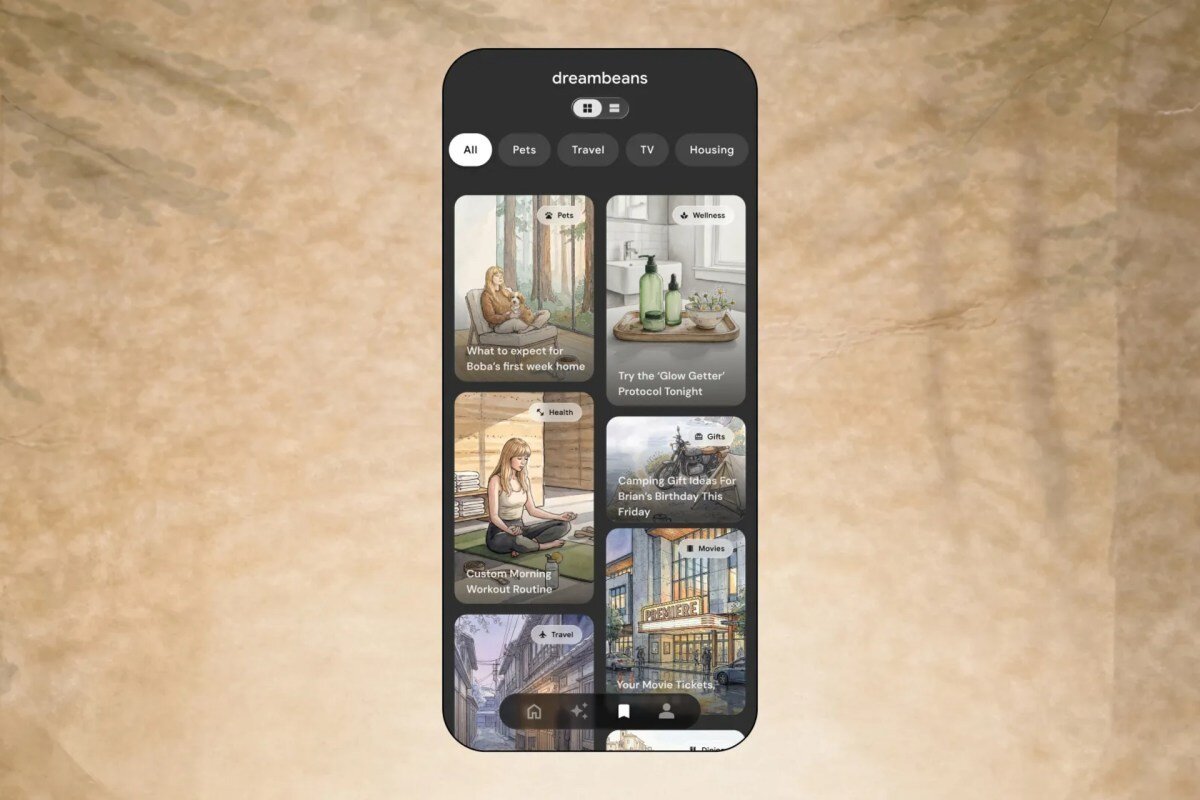
Dreambeans generates illustrated stories tailored to each user by drawing on information from connected Google services rather than waiting for a written prompt. According to TechCrunch, the app can tap Calendar, Gemini, Gmail, Photos, Search and YouTube to assemble stories that reflect a user’s own data and habits.
The India launch comes less than two months after Google opened Dreambeans to all eligible U.S. users aged 18 and older. In its latest step, the company also added Veo-based animation to select stories, broadening the product beyond static images.
Google is positioning Dreambeans as a personal entertainment and memory product, but the launch also places a consumer-facing AI experiment into one of the world’s largest internet markets. That makes India a consequential proving ground for the company’s next phase of AI products.
How does Dreambeans work?
Dreambeans is designed to create stories without asking users to type a prompt. Instead, it builds from services already connected to the user’s Google account, creating a result that is meant to feel more like a personalized feed of fiction than a conventional chatbot exchange.
TechCrunch reported that the app can generate stories from data or material linked to Google Calendar, Gemini, Gmail, Google Photos, Search and YouTube. Google has also added an option for some stories to include Veo-based animation, which gives the app a more polished, media-rich feel.
Connected services and controls
Google is keeping several guardrails in place, at least on paper. Users can connect or disconnect services and delete Dreambeans data. Only personal Gmail accounts are allowed, enterprise users are excluded, and stories are visible only to the account holder.
Users can also set exclusions for the kinds of material Dreambeans should not use. That includes business-related topics, an important limit for people who may not want work emails or calendar entries repurposed into a creative story.
Why India, and why now?
Google product manager Gozde Oznur told TechCrunch that “India stood out for its high overlap of users across Gemini, Gmail, and Google Photos”. That overlap matters because Dreambeans depends on connected Google services to function as intended. The more users already live inside Google’s ecosystem, the more material the app has to work with.
India is also a natural stress test because it is multilingual and highly diverse. Google said Dreambeans supports 13 local languages plus English, expanding the app far beyond a single-language launch. But the company has not yet added code-switching support, and users can choose only one language at a time.
That limitation may matter in India more than in the U.S. The country’s digital users often move fluidly between languages, especially in informal settings. A tool that cannot yet mix languages or handle Hinglish-style usage may feel less local than Google hopes, even if it offers broader language coverage than many consumer AI products.
Why it matters
Dreambeans is more than a novelty app launch. It shows how Google is trying to turn generative AI into a consumer product that is less about answering questions and more about producing personalized output from a user’s own digital footprint.
That shift raises three big issues:
- Adoption: India gives Google a chance to find a larger audience for a product that has not yet seen breakout traction in the U.S.
- Privacy: The app’s value depends on connected personal data, which makes trust and controls central to whether people use it.
- Localization: Supporting 13 languages is a start, but language mixing and cultural nuance will likely determine whether Dreambeans feels useful or gimmicky.
The launch also arrives as Google keeps pushing generative AI across consumer products. Dreambeans is part of that broader strategy, but it is unusual because it sits at the intersection of creativity, memory and account-based personalization rather than productivity or search alone.
Background: how Google got here
Google has spent the past several years adding generative AI features across its consumer products, from search-adjacent tools to products tied to photos, mail and assistants. Dreambeans fits that pattern, but it goes further by building stories out of a user’s connected services instead of answering a direct prompt.
The product also draws on a familiar Google strength: account-level data. Gmail, Photos and Calendar give the company a deep reservoir of personal context, and Google’s consumer products increasingly work best when users already live inside that ecosystem.
Google Photos, in particular, has long had memory-style features that surface past moments to users. Dreambeans extends that idea into a more synthetic and creative format, turning scattered personal data into an illustrated story rather than a reminder or gallery prompt.
The company first introduced Dreambeans in June 2026. In September, it expanded access to all eligible U.S. users 18 and older. By Monday, November 2, 2026, India became the first international market to receive the app.
By the numbers
| Metric | Figure | What it refers to |
|---|---|---|
| Local languages in India launch | 13 | Languages supported by Dreambeans, plus English |
| Eligible U.S. users | 18+ | Minimum age for access in the U.S. |
| Time between broad U.S. rollout and India launch | Less than 2 months | Speed of Google’s international expansion |
| U.S. downloads since debut | Nearly 55,000 | Estimated total since June |
| Share of U.S. downloads in September | 63% | Concentration of activity after broader access opened |
| Estimated U.S. downloads in October | About 5,500 | Downloads fell 84% month over month |
| First 30 days after broad U.S. rollout | 29,000 | Dreambeans download estimate |
How did Dreambeans perform in the U.S.?
Early U.S. download figures suggest that Dreambeans has not yet broken out as a mass-market hit. Sensor Tower estimated nearly 55,000 downloads in the U.S. since the app debuted in June, with roughly 63% of those downloads arriving in September.
The same data showed about 5,500 U.S. downloads in October, down 84% month over month. After Google widened access in the U.S., the app registered an estimated 29,000 downloads in its first 30 days.
Those numbers are modest when stacked against the biggest AI app launches. In the first 30 days after launch, Sensor Tower estimated Meta Muse at 7.4 million downloads, ChatGPT at 2.8 million, Grok Bot at 362,000 and Claude at 155,000.
Google’s challenge is not just growth, but relevance. Dreambeans appears to be a niche consumer product, and the company is now asking whether a niche can scale when adapted to a market with more languages, more users and more complicated expectations around privacy and personal data.
What the app can and cannot do
What it can do
- Generate personalized illustrated stories.
- Use connected Google services as source material.
- Support 13 local languages and English in India.
- Add Veo-based animation to select stories.
- Let users connect and disconnect services.
- Allow users to delete Dreambeans data.
What it cannot yet do
- Support code-switching between languages.
- Allow enterprise Gmail accounts.
- Show stories to anyone other than the account holder.
- Avoid all sensitive or upsetting content, including references to deceased people.
That last point is especially notable. Oznur told TechCrunch that the app can generate stories involving people who have died, a reminder that highly personalized AI can surface intimate memories as easily as it can create playful fiction.
“can generate stories involving people who have died”
That capability could make Dreambeans emotionally resonant for some users and unsettling for others. Google is offering controls, but the app’s usefulness depends on how closely it draws from a user’s own life.
Privacy and trust questions
Dreambeans sits in a sensitive part of Google’s product stack because it is built from personal account data. The company says users can disconnect services and delete data, but those assurances will matter only if people understand exactly how the app uses their information.
Google’s decision to keep stories private to the account holder is meant to reduce some of the risk. Even so, the app relies on material from calendars, mail, photos and search history, which may be more revealing than many people expect from an entertainment product.
The sensitivity is not only about data collection. It is also about what the app chooses to synthesize. When an AI tool pulls in dates, photos, messages and viewing history, the result can feel uncannily personal. That may be the point, but it also makes the line between delight and discomfort thinner than in many other consumer AI products.
What happens next?
The key question is whether Dreambeans will gain more traction in India than it did in the U.S. Google is entering a market where multilingual use is normal, but where users may also be more demanding about local relevance, language flexibility and cost-to-value.
Several open questions will shape the next phase:
- Will Indian users adopt Dreambeans at a higher rate than U.S. users did?
- Will Google add language-mixing or Hinglish support?
- How will the company address privacy concerns around connected account data?
- What more actionable features will Google add beyond stories and recommendations?
Google has said it is exploring more actionable features beyond stories and recommendations, suggesting the app may evolve from a creative feed into something more interactive. If that happens, Dreambeans could become more than a curiosity. If not, it may remain a narrow experiment in personalized AI storytelling.
For now, India is the first real test of whether Google can translate a U.S.-built AI storytelling app into a multilingual market where the appeal of personalization will be judged alongside concerns about privacy, relevance and language support.
Timeline
| Date | Milestone |
|---|---|
| June 2026 | Google introduced Dreambeans |
| September 2026 | Google opened Dreambeans to all eligible U.S. users 18+ |
| October 2026 | Estimated U.S. downloads fell to about 5,500 |
| Monday, November 2, 2026 | Google launched Dreambeans in India |
Frequently asked questions
What is Google Dreambeans?
Google Dreambeans is an experimental AI app that generates personalized illustrated stories from connected Google services. It does not require a written prompt, and it can draw on data from Calendar, Gemini, Gmail, Photos, Search and YouTube.
Why did Google launch Dreambeans in India?
Google launched Dreambeans in India because the company said the market showed strong overlap among users of Gemini, Gmail and Google Photos. India also gives Google a multilingual testing ground for a product that now supports 13 local languages plus English.
Does Dreambeans support Hindi and other Indian languages?
Yes. Google says Dreambeans supports 13 local languages plus English in India. However, users can select only one language at a time, and the app does not yet support code-switching.
Is Dreambeans available to enterprise users?
No. Google is limiting Dreambeans to personal Gmail accounts, and enterprise users are excluded. The company also says stories are visible only to the account holder.
How popular has Dreambeans been in the U.S.?
Dreambeans has had a modest start in the U.S. Sensor Tower estimated nearly 55,000 downloads since its June debut, with about 5,500 downloads in October, down 84% from the previous month.