In short
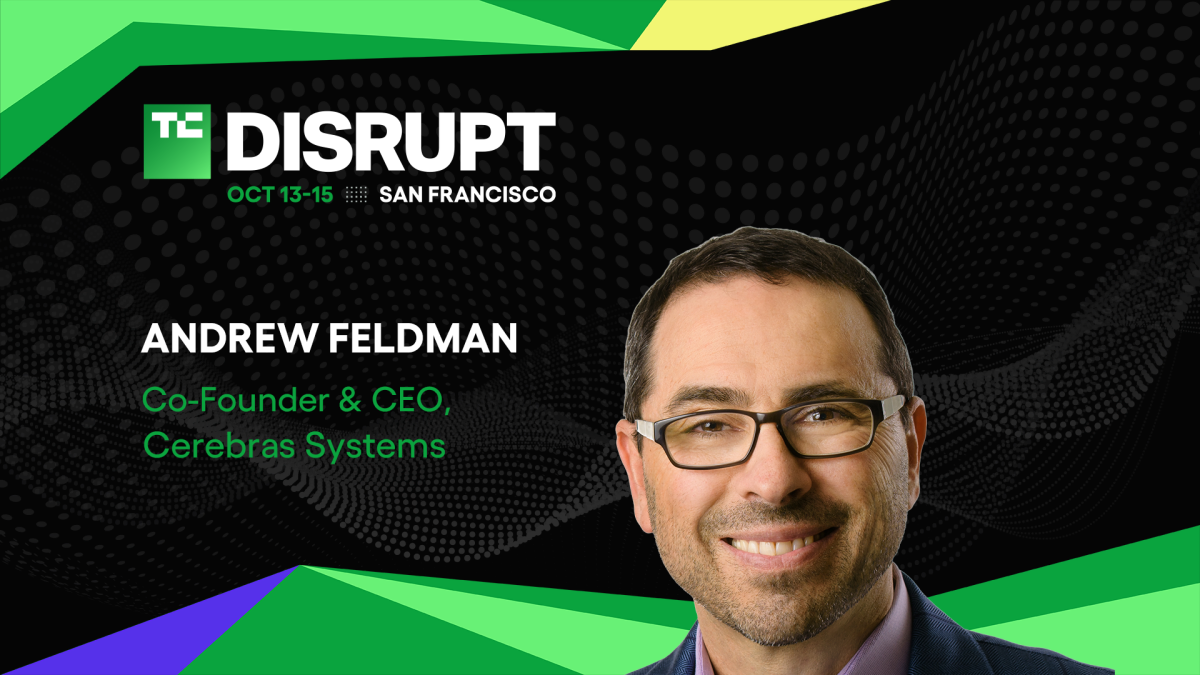
Cerebras CEO Andrew Feldman will speak at TechCrunch Disrupt 2026 about whether AI can keep scaling as compute, energy and infrastructure demands surge. The talk comes as Cerebras expands wafer-scale computing capacity and deepens its dealmaking with major AI customers.
- Andrew Feldman will address the limits of AI scaling at TechCrunch Disrupt 2026.
- Cerebras is betting on wafer-scale computing as an alternative to conventional chip design.
- The company says it has more than 600 megawatts of capacity live or under contract by 2027.
- Cerebras signed a multiyear agreement with OpenAI for 750 megawatts of systems from 2026 to 2028.
- The broader AI industry is increasingly constrained by power, manufacturing and data-center capacity.
Andrew Feldman, the co-founder and chief executive of Cerebras Systems, will take the stage at TechCrunch Disrupt 2026 to tackle one of the AI industry’s most urgent questions: how long can model scaling continue before compute, power and infrastructure become binding constraints? The session matters because the answer will help shape where the next wave of AI hardware, data centers and investment dollars go.
Feldman’s appearance comes as demand for AI infrastructure intensifies across the sector. Cerebras, which has spent years promoting wafer-scale computing as an alternative to conventional chip design, is positioning itself as both a hardware company and a provider of AI compute through its own systems and cloud platform. The company is now using its Disrupt spotlight to argue that the future of AI will be decided as much by physical constraints as by algorithmic progress.
What Andrew Feldman will discuss at Disrupt 2026
Feldman is scheduled to speak on the Disrupt Stage in a session titled “Can AI Keep Scaling?” where he will examine whether today’s rapid advances in AI can continue at the same pace if the industry keeps running into limits on chips, power, cooling and manufacturing.
The event is part of TechCrunch Disrupt 2026, which will run October 13-15 at Moscone West in San Francisco. Organizers say the conference will feature more than 200 sessions across six stages, along with roundtables and breakout discussions, and is expected to draw more than 10,000 founders, investors, operators and technology leaders.
That makes Feldman’s session especially relevant for people building or backing AI companies. The question is no longer only how powerful a model can become, but how much physical capacity is needed to train and run it at scale.
Feldman’s talk is expected to focus on the growing pressure AI places on compute, electricity and data-center infrastructure, and on how Cerebras is trying to approach those constraints differently.
Why AI scaling is becoming an infrastructure story
AI progress has increasingly become an infrastructure race. Every jump in model capability typically requires more computing power, more energy and more specialized facilities to support the workload.
That shift has changed the conversation inside the industry. A few years ago, the debate centered on model architecture, training data and software performance. Today, the bottleneck often lies in whether companies can secure enough hardware, land enough energy and build enough data-center capacity to keep up.
Cerebras is using Feldman’s Disrupt appearance to underline that point. The company has argued that AI cannot be understood purely as a software problem. It is also a manufacturing problem, a power problem and a logistics problem.
How big is the infrastructure challenge?
The challenge is already measurable. More powerful AI systems require more than faster processors. They depend on a chain of physical assets that includes chip fabrication, racks, cooling systems, network connectivity, real estate and access to reliable electricity.
If any one of those inputs lags, scaling slows down. That is why the biggest AI players are increasingly investing in their own infrastructure or striking long-term agreements for compute capacity.
- Compute: Enough processing capacity to train and serve large models
- Energy: Electricity supply to power dense AI clusters
- Cooling: Thermal management for high-performance hardware
- Manufacturing: The ability to produce hardware at scale
- Data centers: The physical sites where systems operate
How Cerebras is trying to break the chip industry’s assumptions
Cerebras was founded in 2015 by Feldman and his co-founders with the goal of challenging the idea that ever-larger AI workloads must be served by conventional chip architectures. The company bet early on wafer-scale computing, a design approach that keeps processing on a full silicon wafer rather than cutting that wafer into individual chips.
That architectural choice is central to Cerebras’ identity. In practical terms, it is meant to reduce bottlenecks associated with conventional chip layouts and deliver a different kind of system for large-scale AI workloads. The company has spent the past decade trying to prove that this approach can be commercially viable at a time when AI demand is exploding.
Feldman’s background helps explain why Cerebras has focused so intensely on infrastructure. Before starting Cerebras, he co-founded SeaMicro, an energy-efficient microserver company that AMD bought in 2012. He also held leadership roles at Force10 Networks and Riverstone Networks, giving him a long history in networking and compute infrastructure.
That experience makes him a fitting voice for a discussion about the physical ceiling facing AI. His career has repeatedly intersected with the question of how to move more compute through less power, less space and less waste.
| Milestone | What happened | Why it matters |
|---|---|---|
| 2015 | Cerebras was founded by Andrew Feldman and his co-founders | Marked the launch of the wafer-scale computing bet |
| May 2026 | The company raised $5.5 billion in its IPO | Gave Cerebras a major capital base for expansion |
| August 2026 | Cerebras introduced its CS-4 system | Showed the company’s latest generation of AI infrastructure |
| 2026-2028 | Cerebras signed a multiyear deal with OpenAI for 750 megawatts of systems | Signaled large-scale demand for alternative AI compute |
| October 13-15, 2026 | TechCrunch Disrupt 2026 takes place in San Francisco | Feldman will explain Cerebras’ strategy to a major tech audience |
What Cerebras says about demand for compute
Cerebras has recently disclosed a rapid expansion in both customer demand and physical capacity. In August, the company said it had more than 600 megawatts of data-center capacity either live or under contract for delivery by the end of 2027. It also said it was increasing manufacturing capacity more than tenfold during 2026.
Those numbers illustrate the scale of the opportunity — and the scale of the challenge. Securing capacity is one thing; building it is another. Megawatts of future capacity depend on permitting, equipment, construction schedules, supply chains and the ability to bring hardware online in a timely way.
The company also said it plans to bring its first European data-center capacity online this year and reach 200 megawatts in Europe by the end of 2027. That international expansion suggests Cerebras sees demand not just in the United States but across global markets where AI adoption is accelerating.
What does the OpenAI agreement signal?
The OpenAI deal signals that demand for specialized AI infrastructure is no longer theoretical. Cerebras said it signed a multiyear agreement to deploy 750 megawatts of its systems from 2026 through 2028, a commitment that indicates large AI developers are exploring multiple paths to secure compute.
While the agreement does not reveal the full operational details, it does point to one of the clearest trends in the market: leading AI companies want access to more compute than traditional channels can comfortably provide. That is opening the door for alternative hardware architectures and new infrastructure providers.
According to Cerebras, the expansion reflects rising demand for its systems and the broader need to scale the physical backbone behind AI development.
Who is Andrew Feldman, and why does he matter now?
Andrew Feldman matters now because he has spent years arguing that the AI industry’s biggest limits are not only about model design but about the hardware beneath it. He is one of the few executives in the sector with deep experience across compute, networking and energy-efficient infrastructure.
Before Cerebras, Feldman built SeaMicro into a notable microserver company and later helped lead the effort to sell it to AMD. That background gave him an early view of the trade-offs involved in building efficient systems for large-scale computing. At Cerebras, he took those lessons further by betting on a radically different chip strategy.
In a moment when many AI companies are competing for the same limited pool of chips, energy and data-center capacity, his perspective is especially timely. The scaling conversation is no longer academic. It is now central to how AI products are deployed and monetized.
How far can AI keep scaling?
AI can likely keep scaling only as long as the industry can expand the supporting infrastructure quickly enough. That means more electricity, more manufacturing throughput, more data-center space and more efficient systems that can deliver better performance without unsustainable cost growth.
There are two broad paths forward. One is brute-force expansion: building bigger data centers, adding more chips and consuming more power. The other is architectural innovation: designing hardware and systems that make each unit of compute more effective.
Cerebras is clearly staking its future on the second path, even as it aggressively expands capacity in the first. Feldman’s Disrupt session will likely explore whether that strategy can hold up if the industry’s appetite for AI keeps rising at the current pace.
What could limit the next phase of AI growth?
The biggest risks are physical rather than conceptual. The industry may know how to build more capable models, but it may not always be able to secure enough power, equipment and production capacity to support them.
- Energy constraints: Data centers need enormous and reliable electricity supplies.
- Manufacturing bottlenecks: Hardware can only scale as fast as factories and supply chains allow.
- Cooling needs: Dense compute clusters generate heat that must be removed efficiently.
- Capital intensity: The cost of scaling infrastructure remains very high.
Those constraints create a strategic challenge for everyone from startups to hyperscalers. AI firms that can secure capacity early may have an edge, while those that cannot may be forced to slow deployment or look for alternative architectures.
Why Disrupt 2026 is a fitting stage for this debate
Disrupt has long been a venue where startup ideas, funding trends and platform shifts are debated in front of a large cross-section of the technology world. This year’s event arrives at a moment when AI infrastructure is one of the most valuable and contested parts of the market.
That makes Feldman’s session more than a product pitch. It is a window into the economics of the AI boom. Founders want to know how much capacity they will need. Investors want to know which infrastructure bets can endure. Operators want to know what it will take to keep systems running. Feldman sits at the intersection of all three questions.
TechCrunch says the event will also include matchmaking, dealmaking and networking, reinforcing the idea that the conference is not only about ideas but also about the business relationships that help turn those ideas into products and companies.
What the Cerebras story says about the future of AI hardware
The Cerebras story suggests that the next phase of AI may reward companies that can think beyond standard chip design. As model demands rise, the pressure on conventional infrastructure rises with them. That creates an opening for new architectures, new data-center strategies and new forms of compute delivery.
At the same time, Cerebras’ own expansion shows that even unconventional hardware companies must play by the rules of the physical world. They still need manufacturing capacity, electricity, cooling and capital. Innovation may change the shape of the stack, but it does not remove the stack itself.
That is the central tension Feldman is expected to address on stage: can AI keep scaling indefinitely, or will the industry eventually need to rethink the assumptions behind how its infrastructure is built? The answer will influence not only chip makers but also cloud providers, model developers, investors and the broader startup ecosystem.
For now, Cerebras is betting that there is still plenty of room to grow — provided the industry can build fast enough to keep up.
Frequently asked questions
Who is speaking about AI scaling at Disrupt 2026?
Andrew Feldman, the CEO and co-founder of Cerebras Systems, is scheduled to speak at TechCrunch Disrupt 2026. His session will focus on whether AI can continue scaling as compute, power and infrastructure demands rise across the industry.
Why is Cerebras relevant to the AI scaling debate?
Cerebras is relevant because it has built its business around wafer-scale computing, an alternative to conventional chip design. The company argues that AI’s future depends not just on models and software, but on the physical systems needed to power them at scale.
How much data-center capacity does Cerebras say it has?
Cerebras said in August that it had more than 600 megawatts of data-center capacity either live or under contract for delivery by the end of 2027. The company also said it is expanding manufacturing capacity more than tenfold during 2026.
What is the OpenAI deal with Cerebras?
Cerebras said it signed a multiyear agreement with OpenAI to deploy 750 megawatts of Cerebras systems from 2026 through 2028. The deal suggests major AI developers are looking beyond traditional compute sources to secure enough capacity.
When and where is TechCrunch Disrupt 2026?
TechCrunch Disrupt 2026 will take place October 13-15 at Moscone West in San Francisco. TechCrunch says the event will include more than 200 sessions, plus roundtables, breakouts, networking and startup exhibitions.