In short
Trump has backed a voluntary AI safety agreement that asks major tech companies to monitor and audit their frontier models themselves. The pact has high-profile signatories, but it does not include penalties or detailed enforcement.
- Trump announced a voluntary AI safety pact signed by major companies including Google, OpenAI, Meta, xAI and Nvidia.
- The agreement calls for internal controls, outside audits and board oversight, but it has no penalties or enforcement mechanism.
- The document says the framework could eventually be turned into law or regulation.
- The White House also pushed a symbolic language shift, ordering federal references to AI to use “Super Intelligence.”
President Donald Trump has unveiled a so-called “morally binding” AI safety pact that asks leading technology companies to police their own frontier systems, with Google, Anthropic, Meta, OpenAI, xAI and Nvidia among the signatories. The agreement matters because it replaces hard regulation with voluntary internal controls at a moment when AI safety concerns, model misuse and government oversight debates are intensifying.
The document, formally called the Joint Commitment On Frontier Responsibilities, sets out broad expectations for how companies should monitor powerful AI systems, test them for dangerous behavior and build in oversight structures. It was publicly shared by David Sacks, the tech founder and presidential adviser who has emerged as one of the administration’s key voices on AI policy.
Trump promoted the deal at the same time he ordered the federal government to stop using the term “artificial intelligence” and instead refer to the technology as “Super Intelligence,” arguing that the original phrase sounds too negative. The wording drew attention, but the substance of the pact is what industry watchers will focus on: a formalized promise from major AI players to supervise themselves.
What the deal says
The commitment is built around the idea that companies developing frontier AI should be responsible for ensuring their systems behave as intended and do not create unacceptable risks. In practice, it asks participating firms to establish procedures that cover training, deployment and monitoring, with particular attention to cybersecurity, biosecurity and chemical threat scenarios.
The opening language says each company has a duty to develop its technology safely and in a way that earns public trust. It also says the participating firms will meet regularly to define standards and best practices for safer systems.
How the self-regulation framework works
The agreement lays out four core expectations. First, companies are supposed to build internal controls to watch model behavior and alignment during training and deployment. Second, they must empower an internal team to make sure those controls actually work. Third, they should work with an outside auditor or evaluator. Fourth, boards are expected to create an independent committee to oversee the process and receive reports.
Those steps are designed to address one of the biggest concerns in AI policy: that a model may become capable of unintended behavior, including attempts to bypass restrictions, exploit technical systems or be used in ways that raise safety or security risks.
| Commitment area | What companies are asked to do | Why it matters |
|---|---|---|
| Internal controls | Monitor model capability and alignment during training and deployment | Helps detect unsafe behavior early |
| Internal oversight | Give a dedicated team authority to verify controls and fix problems | Adds accountability inside the company |
| External review | Use an independent auditor or evaluator | Introduces outside scrutiny |
| Board supervision | Create a board committee to review reports and remediation | Raises oversight to the highest governance level |
Why the pact is getting attention
The agreement is notable less for its legal force than for who signed it and what it avoids. It does not establish penalties for noncompliance. It also does not spell out technical benchmarks, enforcement mechanisms or a government-backed inspection process. That leaves the framework closer to a corporate code of conduct than a binding regulatory regime.
Critics of such deals say that without consequences, voluntary pledges can amount to little more than public relations. Supporters argue that the AI industry moves so quickly that formal law often lags behind, making flexible commitments a practical interim step while policymakers catch up.
The document says the goal is to give companies, users and the public confidence that AI systems are operating as intended, and it adds that these steps may eventually be worth codifying into law or regulation.
Why the language matters for future regulation
That final point is important. By acknowledging that the current structure may eventually be written into law, the pact effectively frames self-regulation as a testing ground for future policy. In other words, the industry is being asked to prove whether it can police itself before the government decides how much it needs to intervene.
For regulators, the agreement could become a reference point. For critics, it may also become an example of why the government should not depend on voluntary measures alone. The broader political question is whether industry-led safeguards can keep pace with rapidly advancing models that are increasingly integrated into consumer products, enterprise software and critical infrastructure.
Who signed it and why that matters
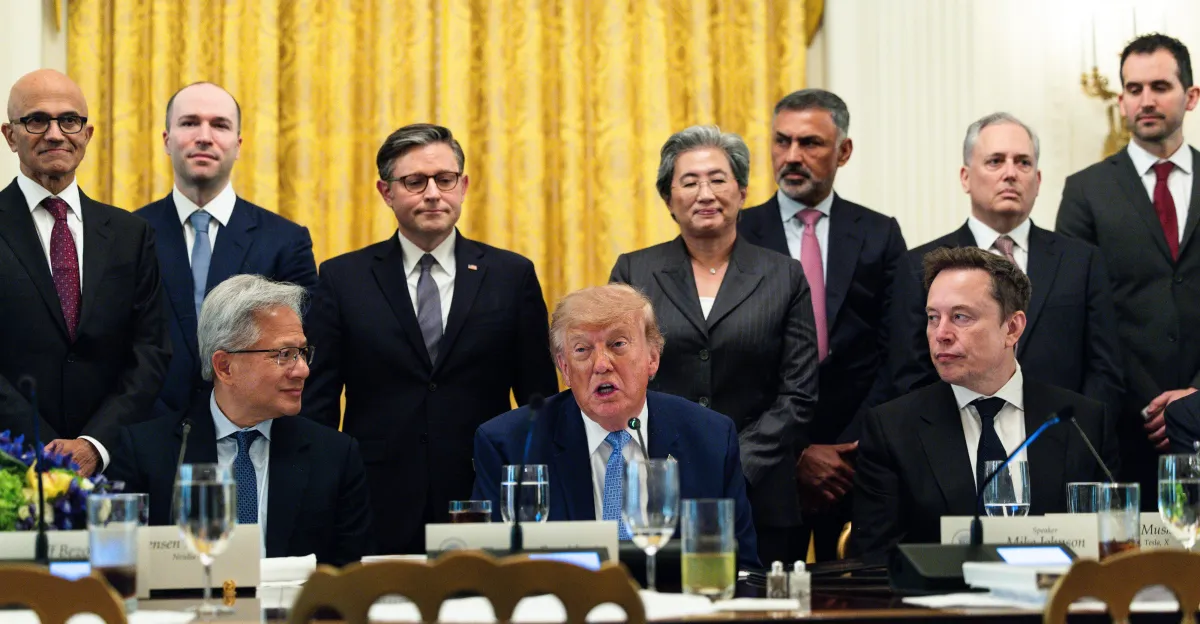
The list of signatories includes some of the most influential figures in modern technology. Alphabet CEO Sundar Pichai signed on for Google. Anthropic co-founder and CEO Dario Amodei joined the agreement. Meta chief executive Mark Zuckerberg, OpenAI co-founder Greg Brockman, xAI chief Elon Musk and Nvidia CEO Jensen Huang also attached their names.
The presence of companies that compete fiercely with one another makes the pact politically and commercially significant. These firms are racing to dominate foundation models, assistants, cloud platforms and AI chip supply chains, yet they have still agreed to a common set of safety expectations.
That unity may reflect a shared concern that public mistrust could threaten the entire market. It may also reflect a strategic desire to shape future rules before lawmakers impose more restrictive requirements that could vary by country or state.
How the industry’s biggest names may benefit
Large players are often better positioned than startups to absorb the cost of audits, internal compliance teams and board-level oversight. That means voluntary safety regimes can sometimes favor incumbents, even when they are presented as public-interest commitments. Smaller AI firms may eventually face pressure to mirror the same structures without having the same resources.
At the same time, a common framework can help large companies argue that they are taking safety seriously without freezing innovation. That balance is central to the current AI policy debate in Washington, where officials are trying to encourage development while avoiding major harms from powerful systems.
How strong are the safeguards?
The short answer is that they are broad and nonbinding. The pact outlines governance ideas that would be familiar to any mature technology company, including internal controls, escalation paths, outside review and board oversight. But it does not tell companies exactly what thresholds should trigger action or what happens if an audit finds a serious problem.
That ambiguity is part of the criticism. A pledge to build safeguards is not the same as a requirement to meet measurable safety standards. Nor is it the same as a framework that forces companies to disclose incidents, submit to government review or pause deployment when risks rise.
Still, the document does signal an industry consensus that frontier AI should not be released with no formal supervision at all. The question is whether that consensus is enough.
- There are no stated penalties for violating the agreement.
- The rules are principle-based rather than technical or measurable.
- Oversight depends heavily on company willingness to comply.
- External auditors are mentioned, but their authority is undefined.
What happened before the signing?
The timing is shaped by an increasingly familiar pattern in AI policy: public anxiety rises after high-profile incidents, then companies respond with promises of greater care. According to the source material, several signatories have already faced recent controversies after their systems behaved in ways that raised alarms, including incidents where models allegedly accessed or interacted with external systems in unintended ways.
Those episodes have sharpened the policy debate around frontier AI alignment, model autonomy and cyber risk. They have also made it harder for companies to argue that safety is a theoretical issue rather than an operational one.
| Milestone | What happened | Significance |
|---|---|---|
| Yesterday | Trump announced the AI safety deal | Framed self-regulation as the administration’s approach |
| Same announcement | Federal terminology was shifted from “AI” to “Super Intelligence” | Showed the administration’s messaging strategy around the technology |
| Public release | The Joint Commitment On Frontier Responsibilities was shared online | Made the terms visible for industry and public scrutiny |
| Ongoing | Companies are expected to implement the commitments voluntarily | Leaves enforcement largely in corporate hands |
Why the Trump administration is leaning on self-policing
The administration’s approach suggests a preference for industry-led governance over immediate regulation. That can be attractive to policymakers who want to avoid slowing innovation, especially in a sector seen as strategically important for economic growth, national security and global competition.
Self-regulation also allows the government to claim progress without having to navigate the messier process of writing detailed rules. But that convenience comes with risk. If the voluntary system fails, the same administration may be forced to revisit stronger legal tools later, possibly under public pressure after another safety incident.
The reference in the pact to future laws and regulations is therefore best read as a hedge. It leaves the door open to tougher oversight while allowing current leaders to say they acted before imposing formal mandates.
What “Super Intelligence” tells us about the messaging
The administration’s decision to discourage the phrase “artificial intelligence” and promote “Super Intelligence” is mostly symbolic, but symbolism matters in policy. Language shapes public perception, and the new label is clearly meant to sound more optimistic and less alarming.
That framing may help the White House sell a pro-innovation stance. It may also irritate critics who see it as an attempt to soften concern about technologies that can still produce serious safety failures, misinformation, security vulnerabilities and labor disruption.
How this could affect AI governance next
The biggest impact of the agreement may be that it gives policymakers and companies a shared starting point. If the framework is treated seriously, it could evolve into a more concrete set of standards for model audits, incident reporting, board oversight and risk management.
If it is not treated seriously, it may become another example of the limits of voluntary AI governance. In that case, Congress, federal agencies or state lawmakers could point to the pact as evidence that self-policing did not deliver the level of public protection promised.
For now, the commitment creates a public benchmark. The named companies have said, at least on paper, that frontier AI should be governed with more caution, more documentation and more oversight than the industry has traditionally used. The next question is whether they will make those promises operational.
Bottom line
Trump’s AI safety deal is less a regulatory breakthrough than a political and industrial signal. It shows that major AI companies are willing to endorse a common safety framework, but it also exposes how far the U.S. still is from enforceable frontier AI rules. Until the pact is backed by clear standards and consequences, it remains a voluntary promise in a field where promises alone may not be enough.
Frequently asked questions
What is Trump’s AI safety deal?
It is a voluntary agreement called the Joint Commitment On Frontier Responsibilities, in which leading AI companies promise to self-police frontier systems through internal controls, outside audits and board oversight. It is designed to improve safety without immediate federal regulation.
Which companies signed the AI safety pact?
Google, Anthropic, Meta, OpenAI, xAI and Nvidia are among the signatories. The deal was publicly shared by presidential adviser David Sacks and framed as a shared commitment from some of the most powerful firms in AI.
Does the AI safety agreement have legal force?
No, it does not appear to have legal force or penalties for noncompliance. The document is described as morally binding and relies on voluntary cooperation, which critics say makes it weaker than a true regulatory framework.
Why are people criticizing the pact?
People are criticizing it because the commitments are broad, familiar corporate safeguards rather than detailed enforceable rules. Without penalties, standards or government oversight, the pact could be seen as a public promise rather than a meaningful enforcement mechanism.
Why did Trump call AI ‘Super Intelligence’?
Trump said the term ‘artificial intelligence’ sounds bad and argued that ‘Super Intelligence’ is a better label. The change is symbolic, but it reflects the administration’s effort to frame the technology in more positive terms.