In short
OpenAI and Meta are preparing new AI hardware bets built around cute, software-first agents. Both companies hope useful assistants can succeed where earlier standalone AI devices failed.
- Meta plans a pendant-like Muse Charm before the holiday shopping season.
- OpenAI is developing hardware with Jony Ive, with shipping not expected before February 2027.
- Both companies are launching software agents first to build user familiarity before hardware.
- The strategy is meant to avoid the failures that hit devices like Humane AI Pin and Friend.
- The core pitch is that AI hardware must be both useful and emotionally approachable.
OpenAI and Meta are preparing to test a new theory in consumer AI: that people may finally embrace dedicated AI hardware if the software is genuinely useful and packaged in a way that feels playful, approachable, and even adorable. Meta plans to bring out a pendant-style device tied to its Muse agent before the holiday shopping season, while OpenAI is developing hardware with Jony Ive and has signaled it will not arrive before February 2027.
The stakes are high. Personal AI gadgets have repeatedly stumbled in the market, but two of the industry’s biggest players are now betting that a softer launch strategy — introduce the agent first, then the device later — could turn the category into something consumers actually want to wear or carry every day.
For years, AI has spread rapidly through phones, laptops, and web apps, yet standalone AI gadgets have struggled to find traction. The latest wave of products from Meta and OpenAI suggests the next attempt will lean less on raw novelty and more on familiar, friendly interfaces that make the technology feel less intimidating and more useful in everyday life.
Why OpenAI and Meta are circling AI hardware again
OpenAI and Meta appear to share a conviction that the problem with earlier AI gadgets was not simply technical capability, but timing, trust, and product framing. Both companies are now trying to introduce AI in a more gradual way, starting with software agents that users can understand before asking them to commit to a physical device.
This matters because dedicated AI hardware has a poor recent track record. Products such as the Humane AI Pin and Friend drew attention, but often for the wrong reasons: limited usefulness, awkward interactions, and doubts about whether consumers needed another device in their lives. Those failures left the category looking more like a cautionary tale than a growth opportunity.
Still, OpenAI and Meta are large enough, well-funded enough, and influential enough to believe they can reshape the category. Their approach suggests a common business logic: if consumers first become attached to an AI agent in software, the leap to a companion device may feel natural rather than forced.
What changed in the market?
What changed is that AI agents are no longer being pitched only as futuristic demos. Both companies are trying to present them as practical assistants that can help over time, learn preferences, and feel like part of a user’s routine. That shift from novelty to utility is central to the hardware strategy.
There is also a branding advantage in making the software look less threatening. The more an agent seems like a helpful character — a friendly blob, a screen-faced charm, a pocket assistant — the easier it may be to imagine people forming habits around it.
| Company | Hardware plan | Associated agent | Expected timing | Core pitch |
|---|---|---|---|---|
| OpenAI | New physical device developed with Jony Ive | Dots | No earlier than February 2027 | Long-term personal assistant and collaborator |
| Meta | Pendant-like wearable called the Muse Charm | Muse | Before the holiday shopping season | Fast way to talk to Muse and show it what you see |
How OpenAI is trying to make AI hardware feel useful first
OpenAI’s hardware effort is being built around a simple premise: people may adopt an AI device if they already depend on the software behind it. At this week’s DevDay event, the company introduced Dots, a new agent platform built around colorful, customizable blobs with eyes. The visual design is intentionally soft and friendly, making the product feel closer to a digital companion than a cold utility.
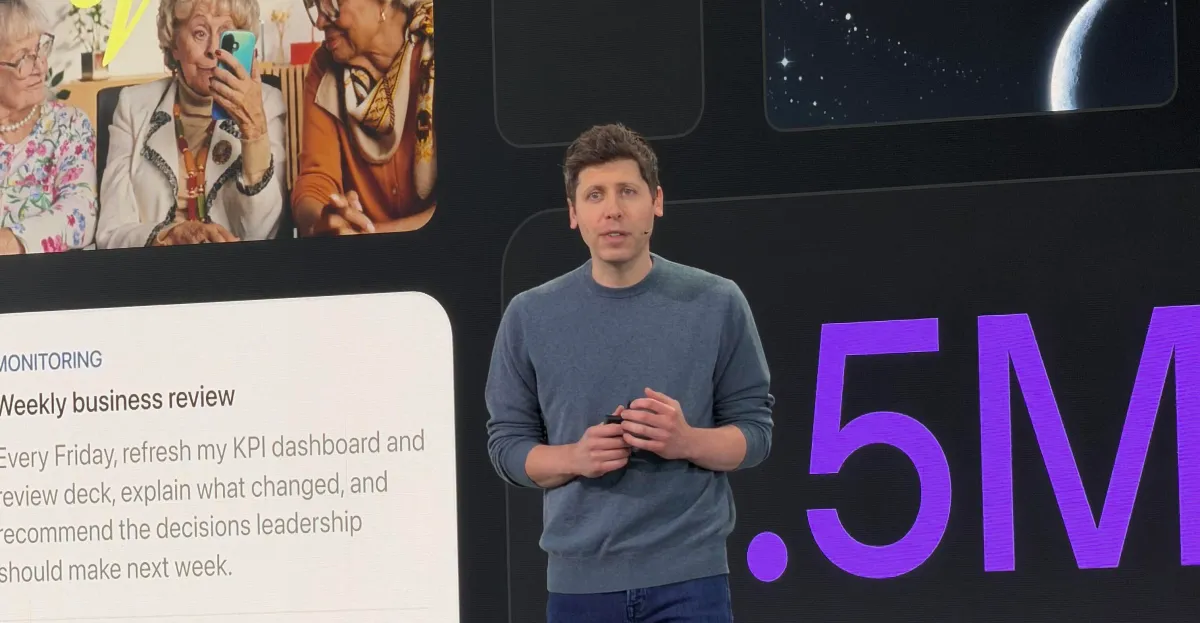
OpenAI did not unveil hardware at DevDay, but it did use the event to suggest that physical devices could come later. In a question-and-answer session after the keynote, CEO Sam Altman said it would be reasonable to assume the company may someday create hardware for Dots, though he did not offer specifics.
Altman framed Dots as an always-on helper that could take on large tasks, learn from the user over time, and actively assist instead of merely responding when prompted.
That description is notable because it positions the agent as more than a chatbot. OpenAI is trying to sell a relationship: the software is supposed to become more valuable the longer it is used, making it easier to imagine a future where the same experience is available in a wearable or pocketable form.
What did OpenAI say about ChatGPT’s future?
What OpenAI said is that ChatGPT itself may evolve into a more personal assistant experience. Thibault Sottiaux, who leads core products at OpenAI, told reporters that the company expects ChatGPT to become an “incredible personal assistant” soon and that future access through email, text, or phone calls could blur the very idea of where the interaction happens.
That is an important clue about product strategy. Rather than treating hardware as a separate business, OpenAI appears to see it as one possible surface for a broader personal-AI ecosystem. If users are already reaching the same assistant through multiple channels, a dedicated device may simply become one more doorway into the same service.
Why Meta is tying its device to the Muse agent
Meta’s strategy is more immediate and more visually concrete. The company has linked its upcoming wearable to Muse, an agent it recently introduced, and has presented the hardware as a small charm-like device that can be worn or carried. Zuckerberg compared it to a keychain, but the presentation gave it a more whimsical identity, with a screen and a cute, Tamagotchi-like personality.
The product is called the Muse Charm, and the company says it is designed to make interacting with the agent fast and easy, especially when users are not wearing Meta’s glasses. In Meta’s telling, the charm provides a direct route to the assistant and a simple way to show it what is happening in the world around the wearer.
Zuckerberg said the device contains a surprising amount of technology for its size and described it as the quickest way to talk to Muse when glasses are not being used.
That comment underscores a larger business point. Meta is not treating the charm as a standalone gimmick. Instead, it appears to be one part of a wider personal-AI system that can live across wearables, visual interfaces, and agent-driven services.
How is Meta positioning the Muse Charm?
How Meta is positioning the Muse Charm is as a lightweight bridge between users and their AI. The device is meant to reduce friction, not replace a phone outright. It is an always-with-you companion that can surface answers, capture context, and keep the interaction feeling quick and informal.
That framing may be designed to avoid the trap that hit earlier devices: asking consumers to make a big behavioral change before the product had proven itself. Meta seems to believe users are more likely to adopt a small, expressive accessory that feels easy to wear than a new handheld computer with a steep learning curve.
What both companies learned from failed AI gadgets
What both companies appear to have learned is that hardware cannot be sold on futuristic promises alone. The category needs a reason to exist today, and it needs software that can demonstrate value before anyone starts talking seriously about the device around it.
The recent history of personal AI gadgets is full of examples that collapsed under the weight of user frustration. Some devices were too slow, others were too limited, and many struggled to answer a basic question: why use this instead of a phone?
OpenAI and Meta are trying to answer that question by changing the sequence. First, they want users to interact with the agent in a form that is low-risk and easy to understand. Then, if the relationship deepens, they may convert that software familiarity into hardware demand.
- Introduce the agent in software before shipping a device.
- Use friendly, character-like visuals to build emotional familiarity.
- Emphasize utility and long-term assistance over novelty.
- Offer the hardware as a convenient interaction layer, not a replacement for a phone.
Why “cute” matters in this strategy
Why “cute” matters is that consumer electronics often succeed when they feel personal, not just powerful. A device that looks warm, soft, or playful can lower the psychological barrier to adoption, especially for tools that listen, watch, and respond continuously.
That does not guarantee success, but it can make the first encounter feel less like entering a surveillance product and more like meeting a digital companion. For companies chasing mass-market adoption, that distinction is increasingly important.
How this differs from earlier companion products
How this differs from earlier companion products is that OpenAI and Meta are not just selling companionship. They are framing their agents as practical helpers that can handle work, remember context, and assist across longer time horizons. That makes the proposition more useful and potentially more durable than a chatbot built mainly for emotional attachment.
Friend, one of the most visible attempts at a companion-oriented AI device, followed a similar software-first logic. But its concept centered more on being a conversational presence than a task-oriented tool. OpenAI and Meta are trying to push the conversation toward productivity, coordination, and proactive assistance.
If that pitch works, the device becomes the natural extension of a service people already rely on. If it fails, it risks becoming another well-designed object looking for a problem to solve.
What could make these launches succeed?
Several conditions would need to align for these products to gain traction. They need the software to be clearly useful, the hardware to be comfortable and attractive, and the agent’s behavior to be reliable enough to avoid user disappointment.
They also need to avoid the credibility gap that hurt earlier releases. AI hardware can look impressive in demos, but consumers quickly notice when a device is slow, awkward, or unable to deliver on the promised experience.
Key success factors
- Clear everyday utility that people can explain in one sentence.
- Strong design that feels wearable, portable, or pleasant to keep nearby.
- Reliable performance across common tasks and contexts.
- A software experience that creates habits before the hardware launch.
- Trust that the device is helping rather than distracting or surveilling.
Even if those conditions are met, timing will matter. OpenAI’s hardware is still far away, while Meta’s device is closer to market. That gives Meta a chance to test appetite before the holiday season, but it also means the company will have less room for error if the product feels unfinished.
How much of this is about competition?
How much of this is about competition is a lot. OpenAI and Meta are each trying to define the next consumer interface for AI before rivals do. In that race, hardware is not just another product line; it is a way to control how people experience the assistant every day.
If AI agents become central to personal computing, the company that owns the primary interface could enjoy a major advantage in distribution, habit formation, and brand loyalty. A wearable or pocket device could become the most visible manifestation of that control.
The competition is therefore not just between two gadgets. It is between two visions of how AI should live in daily life: as a phone-like service that expands across channels, or as a physical companion that is always within reach.
What happens next?
What happens next is that Meta is likely to be the first of the two to test consumer response with a tangible device. OpenAI’s hardware remains in development and is not expected to arrive before early 2027, which gives the company more time to refine both the agent and the product category around it.
The coming months will show whether consumers are willing to embrace AI in a more intimate form, especially after a run of misfires in the category. The companies seem convinced that the answer lies in making the software genuinely useful and the hardware emotionally approachable.
If they are right, this could be the start of a more durable consumer AI market. If they are wrong, the latest wave of cute AI gadgets may join the long list of tech experiments that generated more headlines than loyal users.
Either way, the message from two of the biggest names in artificial intelligence is clear: the next phase of consumer AI may not look like a bigger chatbot window, but like a small object you can wear, carry, or keep within arm’s reach.
Timeline of the key announcements
| Date | Event | Company | Significance |
|---|---|---|---|
| This week | DevDay introduces Dots | OpenAI | Shows the software-first agent that could later support hardware |
| This week | Muse Charm revealed | Meta | Demonstrates a concrete wearable tied to an AI agent |
| Before holiday shopping season | Planned Meta launch window | Meta | First real consumer test for the pendant-like device |
| No earlier than February 2027 | OpenAI hardware target | OpenAI | Suggests a longer development cycle and a later market entry |
The broader lesson is straightforward: the next attempt at AI hardware will not be judged only on specifications. It will be judged on whether people find the software indispensable enough to want it closer to their bodies, their routines, and their lives.
Frequently asked questions
What are OpenAI and Meta launching?
OpenAI and Meta are developing new AI hardware concepts tied to their software agents. Meta is preparing a pendant-like Muse Charm, while OpenAI is working on a device with Jony Ive that could eventually pair with its Dots agent platform.
When will OpenAI’s AI hardware ship?
OpenAI’s AI hardware is not expected to ship before February 2027. The company has signaled that the device is still in development and that it plans to build consumer familiarity through software first.
When is Meta’s AI wearable expected to launch?
Meta is aiming to launch its Muse Charm before the holiday shopping season. The company has presented the device as a small wearable companion for its Muse AI agent.
Why are these companies focusing on cute design?
They are focusing on cute design to make AI feel more approachable and less intimidating. Friendly visuals and wearable form factors may help users build habits around the software before deciding to buy dedicated hardware.
Why have past AI gadgets struggled?
Past AI gadgets have struggled because many users found them limited, awkward, or unnecessary compared with phones. Products like Humane AI Pin and Friend drew attention but did not prove that consumers wanted another dedicated device.