In short
Maine’s Senate race has turned into a referendum on AI data centers, as Susan Collins and Troy Jackson face a flood of outside spending and a voter backlash over energy, water and local control. The issue could shape both the election and how states respond to the physical expansion of AI infrastructure.
- Maine’s Senate race has become a fight over data centers, AI money and local backlash.
- A September poll found 76% of Mainers opposed a data center in their community.
- Outside spending in the race is massive, with Democrats projected at $81 million and Republicans at $114 million.
- Susan Collins has drawn scrutiny for donor ties and federal support for a central Maine data-center project.
- Troy Jackson is campaigning for guardrails, union jobs and more skepticism toward AI buildout.
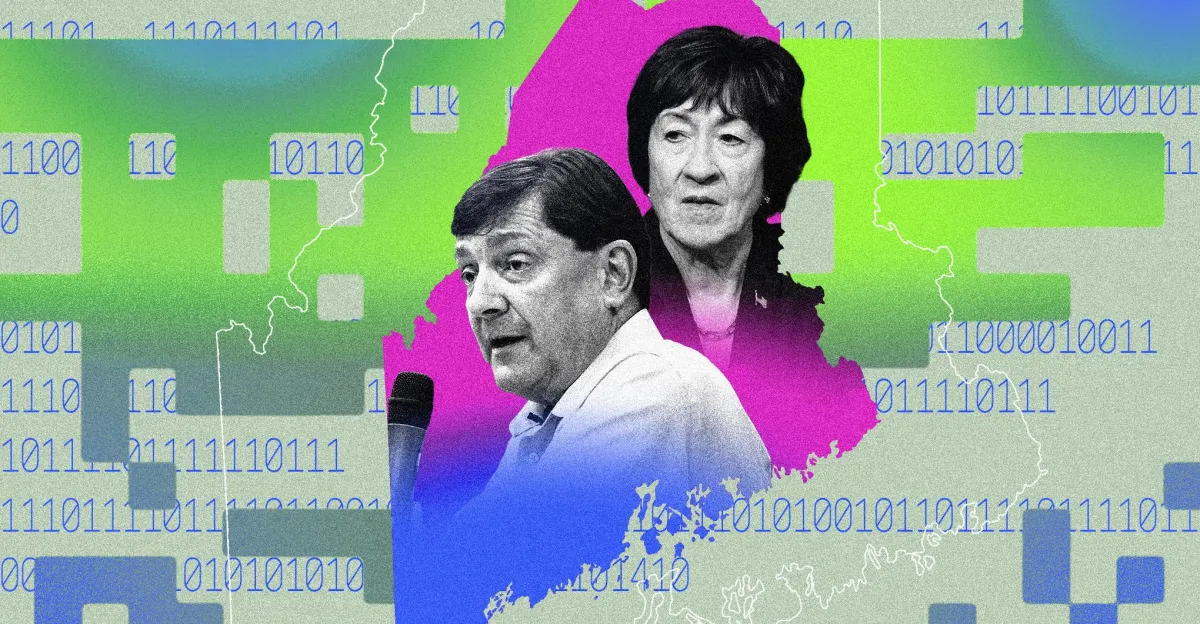
Maine’s Senate contest has become a referendum on data centers, with Susan Collins and Troy Jackson competing in a race reshaped by huge outside spending, local backlash, and growing fears about AI’s footprint on power and water. Just days before Election Day, the issue had moved from the margins into the center of the campaign, according to The Verge, which reported that data centers were dominating the final stretch of the 2026 race.
Why the data-center fight suddenly matters
Maine is not just arguing about one industry. It is wrestling with what kind of development it wants, who should pay for it, and whether the state should welcome the infrastructure needed for AI growth at all.
That debate matters beyond Maine because the state’s Senate race has become a proxy battle over a national question: how much political power tech and AI money can buy when communities start pushing back. The outcome could shape not only the balance of power in Washington, but also the tone of state-level resistance to data-center expansion elsewhere.
The Verge reported that data centers emerged as a top campaign issue in the final stretch before the midterms. The timing was not accidental. Maine lawmakers had already tried to slow the rush. In April, the state legislature passed the first statewide moratorium on large data centers, only for Gov. Janet Mills to veto it 10 days later. After that, towns across Maine began adopting temporary moratoriums of their own or sending expansion plans to local votes.
The public mood, at least in one major poll, was clear. A September UMass Lowell/YouGov survey found 76% of Mainers opposed having a data center in their community, including 58% who were strongly opposed.
How did Maine get here?
The state’s resistance to data centers grew out of local concerns that these projects could bring heavy electricity demand, water use, and little in the way of visible return. That skepticism is especially sharp in a state with a long history of extractive industries and an economy shaped by timber and paper. As The Verge noted, Maine has long relied on those industries, which helped foster a culture wary of outside promises and outside control.
That background helps explain why the debate landed with unusual force. A data center is not a typical warehouse or office building. It is a large facility designed to store and process cloud and AI workloads, and it can require substantial power and water. In a state already sensitive to environmental tradeoffs, that has made the issue politically combustible.
The situation also intersects with the broader stakes of the Senate race. Maine’s contest matters for party control of the U.S. Senate, which has encouraged national groups to pour money into the state. The Verge projected Maine as the most expensive U.S. Senate race per capita, with Democrats expected to spend $81 million and Republicans $114 million.
Who are the candidates and why are they tied to data centers?
Susan Collins, Maine’s longtime Republican senator, sits at the center of the controversy because of both her institutional power and the donor network around her campaign. As Appropriations Committee chair, Collins secured $6.2 million for a central Maine high-performance computing hub data center. That has made her an obvious target for critics who see the race as a test of whether major federal spending decisions align with local skepticism.
Her support network has also drawn scrutiny. The Verge reported that Collins’ donors include Alex Karp, Marc Andreessen, Ben Horowitz, and donors tied to Google, Meta and Microsoft. According to the Tech Influence Watch tracker cited by the outlet, Collins received $325,644 from AI and crypto donors. The Verge also said nearly 100 billionaires have contributed to her reelection effort in some form.
Troy Jackson, the Democratic challenger, has leaned into the backlash. He says he wants guardrails for AI and data-center development, along with union jobs tied to both construction and long-term maintenance. His pitch is not anti-technology so much as pro-condition: build, but regulate; invest, but demand a labor benefit for residents.
The contrast between the two campaigns has widened as the race has become more expensive and more nationalized. The Verge reported that the Republican Senate Leadership Fund spent nearly $42 million on Maine ads, while Pine Tree Results PAC spent $29.1 million to back Collins. At the same time, outside tech and AI money flowed into the state through PACs and direct donations, intensifying a campaign already saturated with national spending.
By the numbers
The scale of spending helps explain why Maine’s race has become a national talking point.
| Metric | Figure | What it refers to |
|---|---|---|
| Projected Democratic spending | $81 million | Expected campaign spending in Maine’s Senate race |
| Projected Republican spending | $114 million | Expected campaign spending in Maine’s Senate race |
| Community opposition | 76% | September UMass Lowell/YouGov respondents opposed a data center in their community |
| Strong opposition | 58% | Respondents who were strongly opposed to a local data center |
| Federal funding secured by Collins | $6.2 million | Money for a central Maine high-performance computing hub data center |
| AI and crypto donor money to Collins | $325,644 | Amount reported by the Tech Influence Watch tracker |
| Negative attack ad spending or commitments | $54 million | Amount Maine Monitor said had been spent or committed by mid-October |
What role is Big Tech playing in the race?
Big Tech is not just a topic in the campaign; it is helping finance the political environment around it. The Verge reported that tech and AI money flowed heavily into Maine through PACs and direct donations, putting the state squarely in the path of national industry influence.
One of the most striking figures came from Elon Musk. The Verge said he gave $158 million to the Senate Leadership Fund this summer, and that his America PAC spent about $2.1 million in Maine. In August, SpaceX PAC gave Collins’ Victory Committee $55,000 and also sent $50,000 to Pine Tree Results PAC, according to an FEC filing flagged by Maine Newsroom and cited by The Verge.
That broader funding picture helps explain why the race has felt unusually saturated with outside interests. It is not only a question of party strategy. It is also about whether AI and data-center advocates can shape the politics of a state that is increasingly wary of the industry’s footprint.
The campaign-finance contours are hard to ignore:
- Republican Senate Leadership Fund: nearly $42 million in Maine ad spending
- Pine Tree Results PAC: $29.1 million spent to support Collins
- America PAC: about $2.1 million spent in Maine
- SpaceX PAC: $55,000 to Collins’ Victory Committee and $50,000 to Pine Tree Results PAC
Why do voters sound so skeptical?
Because the public conversation has moved beyond abstract promises and into practical concerns. At the final debate of the 2026 midterms, an audience member interrupted the candidates to voice anger over AI data centers and their environmental costs. One attendee said,
“I’m terrified”
, while another warned,
“AI data centers are destroying our climate. They are poisoning our water.”
Those remarks reflected the mood that has been building around the issue. The backlash is not just about electricity bills or land use. It is also about whether local communities are being asked to absorb the environmental burden of a boom that benefits faraway companies and investors.
Molly White, a researcher, writer and software engineer who founded Tech Influence Watch, told The Verge,
“Certainly there’s a lot of questions about the economy, the war, all these different things, but AI is the new one.”
Her comment captures why the issue has broken through now: data centers have become the physical symbol of an abstract technology debate.
Mark Brewer, chair of the political science department at the University of Maine, argued in The Verge’s reporting that the economic selling point is overstated. He said
“the jobs part of it’s not there”
, a reminder that the buildout is often sold as development even when many residents doubt the payoff will be broad or durable.
What are the economic stakes for Maine?
The fight over data centers is being framed partly as a jobs issue, but also as a question of what kind of jobs. Jackson has argued for union jobs tied to construction and maintenance, while critics say the projects may not generate the kind of employment base communities expect.
That debate lands in a state where economic identity matters deeply. The Verge noted that Maine’s timber industry contributed $8.3 billion to the state economy in 2024, a figure that underscores how central resource-linked industries remain to the state’s sense of itself. The concern now is whether data centers will follow a familiar pattern: big investment, narrow local benefit, and a set of costs borne by residents.
For Collins, the issue is also personal and political. Forbes ranked her household fifth in the Senate for AI/data-center-linked investments, estimating them at $300,000 to $800,000 in Thomas Daffron’s name. Collins and her husband reported assets worth $4 million to $10 million. Jackson and his wife reported assets worth $147,000 to $430,000.
Those figures do not by themselves prove anything about policy influence. But they sharpen the optics in a race where money, access and industry alignment are already central to the story. In a state where many voters see data centers as something imposed from outside, the financial asymmetry around the race only deepens suspicion.
What the backlash says about the AI boom
Maine’s fight may be local, but the implications are national. The AI industry depends on enormous physical infrastructure: land, power, transmission lines, cooling systems and community consent. If more states begin resisting those projects, the economics of rapid AI buildout become more complicated.
That is one reason the Maine race has caught the attention of tech watchers. It is not simply a Senate contest with a side issue. It is a case study in whether the backlash against AI’s physical footprint can become politically decisive. The answer could influence how aggressively companies seek new sites, how candidates talk about AI in rural communities, and how much opposition local governments are willing to mount.
The state legislature’s failed moratorium showed the limits of one approach. Town-level resistance has filled part of that gap, but the broader fight is still unresolved. If the election produces a senator seen as more protective of data-center growth, that could embolden supporters. If it rewards a candidate promising guardrails, it could strengthen local skepticism elsewhere.
Background: how outside money changed the race
Maine’s Senate contest was already unusual because of its cost. It became even more unusual when the issue set broadened from taxes and party control to AI infrastructure, environmental anxiety and tech philanthropy.
The Verge reported that nearly 100 billionaires have given to Collins’ reelection effort in some form. That kind of donor profile matters because it links the campaign to a wider class of investors and technology backers who see data centers as critical infrastructure for the next phase of computing. When those donors align with a candidate who can also steer federal spending as appropriations chair, the political symbolism becomes hard to miss.
At the same time, Democratic and progressive critics have tried to frame the race as a local referendum on who benefits from the AI economy. Jackson’s message has been to slow the buildout until communities get clearer protections, labor standards and environmental safeguards. Collins’ allies, by contrast, appear to see the projects as part of a broader development strategy that can bring federal investment into the state.
The race has therefore become a referendum on more than one thing at once:
- How much AI infrastructure Maine should host
- Whether local communities should have veto power
- Whether outside money is distorting the debate
- How much of the promised economic benefit is real
- How national tech policy gets filtered through local elections
What happens next?
The immediate next step is obvious: voters will decide whether the anti-data-center backlash translates into a change at the ballot box. But the more interesting question is what happens after the election, regardless of who wins.
If Collins is reelected, Maine may continue to serve as a testing ground for whether major federal lawmakers can back data-center development even as local communities resist it. If Jackson wins, the state could become a more explicit model for regulatory caution, labor conditions and environmental review. Either result would send a message beyond Maine.
Several open questions remain:
- Will the data-center backlash materially change the Senate result?
- How much of the outside spending is directly tied to AI and data-center interests versus broader partisan spending?
- Will Maine towns keep adopting moratoriums after the election?
- How much influence do the reported donations and investments have on Collins’ policy positions?
For now, the only certainty is that a race once defined by familiar partisan lines now carries a much larger argument about the future of AI infrastructure. In Maine, the political question is no longer just who wins the Senate seat. It is whether voters are willing to accept the physical cost of the AI economy that outsiders are trying to build around them.
Frequently asked questions
Why are data centers a major issue in Maine’s Senate race?
Data centers became a major issue because they combine local environmental concerns with huge national tech spending. In Maine, voters are hearing about power use, water use and outside influence at the same time that the race has attracted unusually large amounts of money.
How much opposition is there to data centers in Maine?
Opposition is very strong. A September UMass Lowell/YouGov poll found 76% of Mainers opposed a data center in their community, and 58% said they were strongly opposed.
How much money is being spent in Maine’s Senate race?
The Verge projected $81 million in Democratic spending and $114 million in Republican spending, making the race the most expensive U.S. Senate contest per capita. Outside groups have also poured millions into advertising and support spending.
What has Susan Collins done on data centers?
Susan Collins, as Appropriations chair, secured $6.2 million for a central Maine high-performance computing hub data center. The Verge also reported donor ties connecting her campaign to major tech figures and AI-related contributors.
What does Troy Jackson want to do about data centers?
Troy Jackson says he wants guardrails for AI and data-center development, along with union jobs for construction and maintenance. His campaign is positioning him as the candidate more willing to slow or condition the buildout.