In short
Satya Nadella warned that companies using AI models may be paying both with money and with valuable proprietary data. He urged enterprises to keep ownership of their data, use orchestration layers and consider open-source models run in private environments.
- Nadella says AI buyers often trade not just money but sensitive business knowledge.
- He argues model makers should not restrict distillation if they train on public data.
- Enterprises are increasingly using orchestration layers to swap between AI providers.
- Open-source models running on-prem are gaining traction with large companies.
- The warning aligns with a broader shift toward data control and vendor flexibility.
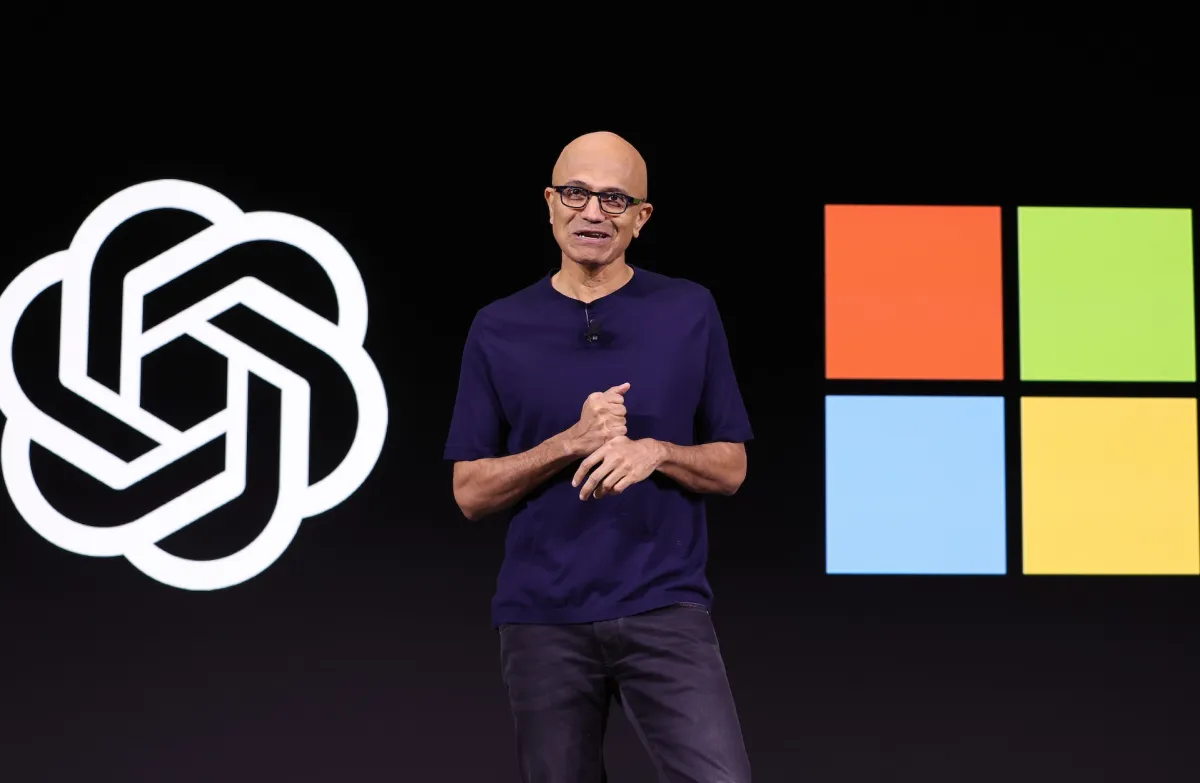
Microsoft CEO Satya Nadella says companies adopting proprietary AI models are not only paying for tokens, but also surrendering valuable internal knowledge in the process. His warning, published Monday, puts one of the industry’s biggest names on the side of enterprises that fear AI vendors could turn customer usage into a competitive advantage.
The message matters because Nadella is effectively telling businesses to rethink how they use tools from companies such as OpenAI and Anthropic: keep control of proprietary data, build systems that can swap models more easily, and consider open-source alternatives that can run inside their own environments.
Why Nadella’s warning is resonating now
The debate over AI’s downside has usually focused on job losses, hallucinations, copyright, or safety. Nadella’s intervention pushes a different concern to the front: data leverage. In his view, enterprises risk training the very companies they pay to serve them.
That idea has been circulating in Silicon Valley for months. Venture capitalists, security executives and AI skeptics have argued that proprietary model providers may gain privileged insight into how companies operate when employees feed those systems with emails, product plans, support logs, customer records and workflow instructions.
Nadella’s blog post gave that argument a much louder platform. Because Microsoft is both a cloud giant and a major backer of frontier AI labs, his caution carries unusual weight.
Nadella’s central point is that companies “pay twice” for AI: once in money and again in the sensitive knowledge they must expose to make the systems useful.
That framing is blunt, but it captures a real tension in enterprise AI adoption. The more useful a model becomes, the more context it needs. And the more context it receives, the more an outside provider may learn about the business using it.
What exactly is Microsoft’s CEO warning about?
He is warning that companies may unknowingly give AI vendors a detailed map of their operations, strategies and institutional know-how. In Nadella’s telling, the danger is not just that prompts are stored somewhere; it is that every correction, follow-up and tool interaction can become training material.
He argues that models absorb “exhaust” from usage: the prompts people type, the tools agents call, and the human fixes applied when the system gets something wrong. Over time, those interactions can capture the subtle, hard-to-document rules that make a business work.
That matters because this information is often the kind of knowledge a rival could not easily acquire through ordinary market research. It lives in workflows, edge cases, internal jargon and decision habits. If a model provider can learn from it, the provider may gain insight far beyond the original task the customer wanted automated.
Nadella’s warning is also a response to a broader bargain embedded in modern AI. Large model makers routinely defend their training practices by pointing to public data and fair use arguments. The Microsoft chief is saying customers should have comparable freedom to study the systems they pay for.
How does distillation fit into the fight?
Distillation is the process of using a model’s output to help train another model, often smaller and cheaper. In practical terms, it can allow companies to capture much of a leading model’s behavior without paying frontier-model prices or depending on a single vendor.
Nadella’s blog post frames distillation as an issue of symmetry. If AI vendors believe they have the right to train on broad public data, he suggests, enterprises should also have the right to learn from the systems they use. His argument is that it is inconsistent for model makers to claim broad training rights for themselves while limiting the same tactic when customers use the models as teaching material.
The issue is not hypothetical. In February, Anthropic accused some Chinese open-source models of sending large volumes of prompts to Claude in what it described as an effort to improve their own systems. Anthropic urged tougher government action, including stronger export-control enforcement. That episode underscored how valuable model behavior has become as a training resource.
Nadella did not endorse any specific crackdown. Instead, he used the controversy to make a broader point: the AI ecosystem is already treating model outputs as valuable fuel, so customers should be allowed to do the same.
Why the “two-way” argument matters
The debate is no longer just about who owns data at rest. It is about who gets to learn from data in motion.
Enterprises often assume they are buying software, but modern AI products behave more like adaptive services. They improve through interaction, and that makes the relationship between vendor and customer more intimate than in traditional software licensing.
That is why Nadella’s warning is landing as more than a philosophical point. It is a practical warning about bargaining power in the AI supply chain.
How enterprises are responding
Many large companies are increasingly asking whether they need to be locked into any one AI model at all. The answer, for a growing number of them, appears to be no.
According to executives in the enterprise infrastructure world, customers are moving toward systems that can route requests across multiple providers or swap models as pricing, performance and privacy requirements change.
One increasingly common strategy is to create a “gateway” or orchestration layer. That layer sits between the company’s applications and the AI models underneath, allowing the business to direct traffic to whichever model is best for the job.
Another strategy is to avoid sending sensitive workloads to outside model providers entirely. Companies can instead run open-source models on their own infrastructure or in a private cloud setup, reducing how much business knowledge leaves the organization.
What is an orchestration layer?
An orchestration layer is a control point that manages which AI model handles each request and how the request is routed. It can let a company choose between different models based on cost, speed, security needs or output quality.
For enterprises, that flexibility matters because it weakens vendor lock-in. It also creates leverage in negotiations with model providers, since businesses are less dependent on any one system.
- It can route traffic to different AI vendors.
- It can protect against overreliance on one provider.
- It can help businesses compare cost and performance.
- It can support privacy policies and data controls.
Why open-source models are gaining momentum
One of the clearest subtexts in Nadella’s argument is that companies should think more seriously about open-source AI. He never says that directly in the post, but his recommendations point in that direction.
Open-source models can be deployed inside a company’s own environment, including on-premise systems still used by many large organizations. That gives enterprises more control over where data goes and who can access it. It also lowers the risk that a model provider can quietly learn from a customer’s workflow in ways the customer cannot observe.
Idit Levine, founder and chief executive of Solo.io, says she is already seeing that shift among enterprises that tried proprietary models first and then started asking whether a smaller open-source model could deliver most of the same value at a lower cost.
Levine’s view is that many customers are concluding that an open-source model deployed on their own systems can deliver “almost 90%” of what the biggest proprietary models offer, while being cheaper and easier to control.
Solo.io sells networking and security tools for enterprise AI deployments. Its technology was chosen last year to support the Linux Foundation’s Agentgateway project, and its customer list includes organizations such as T-Mobile, ADP and SAP. Levine says these companies are not just experimenting with open models anymore; they are increasingly treating them as part of a longer-term enterprise strategy.
What customers want from open models
Enterprises are not necessarily chasing the largest possible model. They are looking for a combination of control, cost efficiency and acceptable performance.
- Control: keep sensitive data inside trusted infrastructure.
- Cost: reduce ongoing token and inference bills.
- Flexibility: avoid dependence on a single model vendor.
- Customization: tune systems for internal workflows and domain language.
That combination is especially attractive to companies handling regulated or proprietary information. For them, the question is not whether the biggest model is impressive. It is whether the model is worth the privacy and vendor-risk trade-offs.
How much traffic is shifting to open models?
Traffic data from AI infrastructure companies suggests the migration is already underway. Vercel, which is best known for website hosting and developer tooling, has added model-switching tools that let customers work across AI providers. OpenRouter, a company that routes developer requests across multiple models, is seeing similar demand.
Vercel said open-source models represented 29% of the traffic through its gateway last month. That is a substantial share for systems that once sat at the edge of enterprise experimentation rather than mainstream production use.
The number does not prove that open-source models are replacing proprietary ones. But it does show that they have moved from niche interest to meaningful traffic in the routing layer where businesses make practical choices about cost, privacy and reliability.
| Topic | What it means | Why it matters |
|---|---|---|
| AI token spending | Companies pay for model usage in the normal way | Direct financial cost of AI adoption |
| Data exposure | Prompts, feedback and corrections may reveal internal knowledge | Creates hidden strategic cost |
| Distillation | Using model outputs to train another model | Raises questions of fairness and reciprocity |
| Orchestration layers | Routing systems that can swap models | Reduces vendor lock-in |
| Open-source on-prem deployments | Models run inside a company’s own environment | Improves control and limits data leakage |
Why Microsoft’s position is so notable
Nadella’s comments are striking because Microsoft has deep ties to the most powerful proprietary AI companies. The company has invested heavily in OpenAI and also holds a stake in Anthropic, placing it at the center of the commercial AI ecosystem it is now warning customers to approach carefully.
That does not mean Microsoft is turning against proprietary models. The company still benefits enormously from cloud AI usage and from enterprises building on Azure. But Nadella’s post suggests Microsoft sees a market opening in helping customers manage AI more cautiously, with better data control and model portability.
In other words, Microsoft can simultaneously benefit from the AI boom and advocate for a more defensible enterprise architecture around it. That position could resonate with customers who like AI but do not want to hand over strategic leverage to a single vendor.
It also fits Microsoft’s cloud strategy. If enterprises build proprietary learning environments in the cloud, as Nadella urges, they are likely to need storage, security, orchestration and inference infrastructure. That is exactly the kind of stack major cloud vendors want to own.
What does Nadella mean by “retain ownership”?
He means companies should keep control over the data that makes AI useful, including prompts, feedback and other interaction records. In his view, the value created by AI use should stay with the customer rather than quietly flowing back to the model provider.
This is a practical data-governance argument disguised as a business philosophy. Nadella is urging enterprises to treat AI interactions as proprietary assets, not disposable chat logs.
That approach would require companies to think more carefully about where data is stored, which systems can access it, and whether model vendors have contractual rights to learn from it.
He also wants businesses to build architectures that let them move between models easily. That means less dependence on a single provider, more negotiating power and better protection if prices rise or policies change.
How this differs from traditional software
Traditional software does not usually learn from each customer in a way that makes the customer’s behavior a competitive input. AI systems do.
That makes enterprise procurement different from buying ordinary cloud software. A company is not just choosing a feature set. It is choosing a learning relationship.
For many buyers, that is the real shift Nadella is calling out. The product is no longer static. The vendor may be improving from the same usage that the customer pays to generate.
What happens next?
Expect the market for enterprise AI routing, private deployment and open-source model hosting to grow if Nadella’s warning lands with CIOs and security teams. The trend was already visible, but a public caution from Microsoft’s chief executive could accelerate it.
That does not mean proprietary models are in trouble. They remain the best-known option for many high-end tasks and will continue to dominate many consumer and enterprise use cases. But customers may become more selective about where they use them and what data they expose.
Businesses will likely split their AI usage into categories:
- low-risk tasks that can go to a frontier model
- sensitive workflows that stay inside private infrastructure
- cost-sensitive automation handled by open-source systems
- model-agnostic routing for experimentation and resilience
If that happens, the AI market could become less about one winner taking all and more about a layered stack of providers, routers and on-prem deployments. Nadella’s post is an endorsement of that future.
His final message is simple: the value created by AI should not be captured entirely by the companies selling the models. If organizations are contributing the knowledge that makes the systems smarter, he argues, they should own the result.
That is a powerful idea coming from the head of one of the world’s biggest technology companies. It is also a sign that the enterprise AI conversation is moving beyond novelty and into questions of power, ownership and long-term leverage.
“In consuming intelligence, you are creating intelligence,” Nadella wrote, adding that what customers create should belong to them.
For AI buyers, that line may become a rallying cry. For model vendors, it is a warning that enterprises are starting to look much more closely at what they are really paying for.
Key numbers and developments at a glance
| Item | Detail |
|---|---|
| Warning source | Microsoft CEO Satya Nadella |
| Date | Monday, July 13, 2026 |
| Main concern | Enterprises may expose proprietary knowledge while using AI models |
| Related tactic | Model distillation |
| Open-model traffic at Vercel | 29% last month |
| Example enterprise customers mentioned | T-Mobile, ADP, SAP |
As the AI race intensifies, Nadella’s warning suggests the next major corporate question may not be which model is smartest, but which model leaves the business in control of its own intelligence.
Frequently asked questions
What did Satya Nadella warn companies about?
Satya Nadella warned that companies using proprietary AI models may be handing over sensitive internal knowledge while paying for the service. He argued that the real cost of AI can include valuable business data, not just token fees.
What is AI distillation in this context?
AI distillation is the practice of using a model’s outputs to train another model, often a smaller one. Nadella argued that if AI companies can learn from public data, enterprises should also be able to learn from the models they pay for.
Why are companies interested in open-source AI models?
Companies are interested in open-source AI models because they can run them in private or on-prem environments, which improves control over data and reduces dependence on a single vendor. Many enterprises also see them as cheaper alternatives for many tasks.
What is an orchestration layer in enterprise AI?
An orchestration layer is a system that routes requests across different AI models and providers. It helps companies avoid vendor lock-in, manage cost and performance, and keep more control over where sensitive data flows.
Why does Microsoft’s warning matter?
Microsoft’s warning matters because the company is deeply invested in the AI ecosystem and works closely with major model providers. When its CEO cautions customers about data exposure, it signals that enterprise caution around proprietary AI is becoming mainstream.