Updated September 3, 2026 6:25 pm
In short
Google’s WeatherNext 3 is a larger, station-targeted AI weather model that now ingests raw hourly satellite observations, while Google says it can improve forecasts across Search, Maps, Gemini, Cloud, and renewable energy planning.
- WeatherNext 3 is Google’s latest AI weather model and will feed into several Google products.
- Google says the model improves rain forecasts by 60% over WeatherNext 2 and can forecast at 5 km resolution.
- The system can produce hourly forecasts by using real-time satellite observations.
- Google says WeatherNext 3 outperformed leading AI and traditional weather models in benchmark testing.
- AI forecasting is becoming a serious alternative to slower, expensive supercomputer-based weather systems.
Update — September 3, 2026 6:25 pm
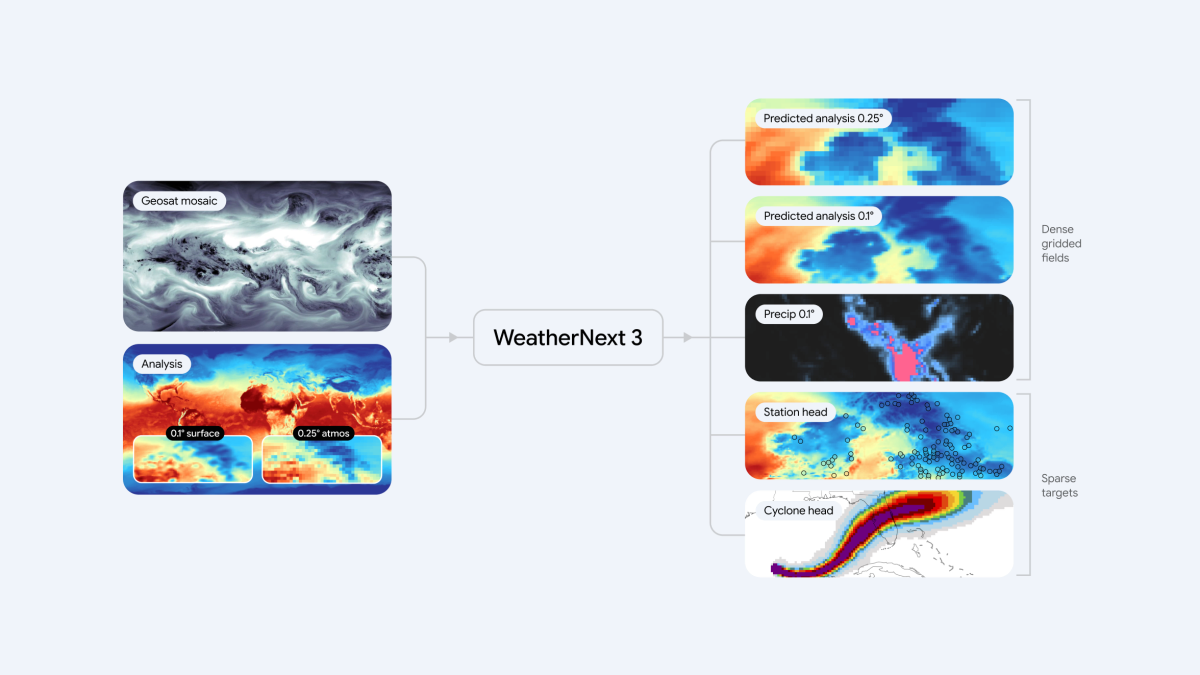
Google says WeatherNext 3 is larger than its predecessor, with 2.4 times more parameters. The company also says it was trained to make predictions against specific weather stations, which should make the outputs easier to verify against local ground-truth readings.
The updated source also adds that WeatherNext 3 can directly ingest raw hourly satellite observations, which Google describes as a first for a high-resolution global AI forecast. It notes, though, that rival WeatherMesh 6 from WindBorne has already been using raw observations from balloons and other sources since late 2025.
Google says the model still works alongside national weather datasets rather than fully replacing them, and the source highlights Ferran Alet’s view that higher-resolution wind, rain, and cloud forecasts could make renewable energy projects more reliable.
Update — September 3, 2026 3:24 pm
The Verge adds that WeatherNext 3 is also meant to improve forecasts for renewable energy generation, including wind predictions at 100 meters — roughly turbine height — as Google looks to better serve power planning use cases.
The company also says the model should be especially helpful in places with sparse ground sensors, since it leans on real-time satellite observations to fill gaps outside the U.S. and Europe. Google tells The Verge its precipitation forecasts can be up to 50% more accurate at least a day ahead, and that the system is now built into Search, Maps, Gemini and other products.
The Verge also quotes Google’s Ferran Alet saying the energy transition makes better renewable forecasts increasingly important, and notes Google has been working with the U.S. National Hurricane Center and agencies in Asia. It adds that WeatherNext 3 is still used alongside traditional physics-based models, rather than replacing them outright.
Google has launched WeatherNext 3, a new artificial intelligence weather model that it says is more accurate, faster, and more granular than earlier systems, with forecasts soon appearing across Search, Google Maps, Gemini, and Google Cloud. The upgrade matters because it could make everyday weather predictions more precise while also advancing a broader shift away from slow, supercomputer-based forecasting.
Released on September 3, 2026 by teams at Google DeepMind and Google Research, WeatherNext 3 is designed to predict atmospheric behavior at higher resolution, with better rain forecasts and hourly updates instead of the standard six-hour cycle. Google says the model is already outperforming major AI and traditional forecasting systems in benchmark testing, including models from Microsoft, Nvidia, and the European Centre for Medium-Range Weather Forecasts.
The company is also positioning the system as a practical product, not just a research breakthrough. According to Google, key outputs from WeatherNext 3 will begin informing the weather information people see in its consumer apps and services, while cloud customers and researchers will be able to access the model infrastructure more directly.
What is WeatherNext 3?
WeatherNext 3 is Google’s latest AI forecasting model, and it represents a more ambitious attempt to use machine learning for global weather prediction. Built by teams at DeepMind and Google Research, the model aims to estimate the state of the atmosphere using patterns learned from large quantities of weather data rather than relying only on the physics equations that power conventional forecasting systems.
The model is the newest version in Google’s WeatherNext line, and it builds on a trend that has transformed meteorology over the past several years. Traditional weather prediction still depends heavily on government-run supercomputers that process complex physical equations. Those systems remain essential, but AI models are increasingly being used because they can run faster, cost less, and sometimes match or exceed established forecasts on important measures.
Google says WeatherNext 3 is now the most accurate model among a set of leading AI competitors evaluated on Operational WeatherBench, a benchmarking system developed by startup Brightband. That test compares models on core forecasting variables such as temperature, wind speed, and humidity.
Why this weather model matters
Weather forecasting is one of the clearest real-world examples of AI moving from novelty to infrastructure. If WeatherNext 3 performs in the field the way it does in benchmark tests, it could influence not only what people carry with them before leaving home, but also how cities, farms, and energy systems prepare for changing conditions.
Forecasting improvements can have direct economic value. Better rain predictions affect farming decisions, more precise wind and cloud data help renewable energy operators, and more reliable short-term forecasts can support transport planning, emergency response, and public safety alerts.
That is why Google is framing the model as a foundation for product features rather than a standalone research demo. Samier Merchant, a senior staff engineer at Google, said the company expects the model’s core weather outputs to feed into several of its most widely used products.
Merchant said WeatherNext 3 will be the first time some of the model’s core atmospheric variables directly power multiple Google products, including Search, Maps and Gemini.
The company’s argument is straightforward: if Google can use AI to improve weather information in the products people already rely on, then forecasting becomes not just a scientific exercise but a daily utility.
How WeatherNext 3 is different from earlier models
WeatherNext 3 is not merely a larger model. Google says it has been redesigned to solve several of the long-standing weaknesses of AI weather forecasting, especially coarse resolution, weak rain prediction, and dependence on preprocessed government datasets.
Higher resolution forecasts
The model can forecast at a resolution of about 5 kilometers for key variables, according to researchers who spoke to TechCrunch. That is a major step up from the broader 15 to 25 square kilometer area often associated with AI weather products and forecasts, and it brings predictions closer to the level needed for practical local planning.
In weather terms, finer resolution matters because conditions can change dramatically over short distances. A storm cell may affect one neighborhood and miss the next. A model that can see smaller geographical differences is more useful for people making immediate decisions.
Better rain prediction
Rain has been one of the hardest problems for AI meteorology, in part because precipitation can be highly localized and harder to model than more stable atmospheric patterns. Google says WeatherNext 3 improves rain forecasting by 60% compared with WeatherNext 2, a sizable jump for a category that directly affects consumer usefulness.
For many users, this is the part of weather prediction that matters most. Temperature and cloud cover are important, but getting rainfall right often determines whether forecasts feel accurate in the real world.
Hourly forecasts instead of six-hour intervals
The new model can also generate hourly forecasts, a notable shift from the six-hour cadence that has been common in standard weather prediction outputs. More frequent updates should make the system better at capturing fast-moving weather events and more useful for short-term planning.
Google says this improvement became possible because the model can consume satellite data as it arrives on an hourly basis. That tighter loop between fresh observations and prediction output is a key part of why the company believes the model is now more practical for operational use.
How does WeatherNext 3 work?
WeatherNext 3 uses deep learning to find structure in weather data and turn that structure into forecasts. Instead of computing every detail of the atmosphere from first principles, the model learns from patterns in historic and live measurements, then estimates how those patterns are likely to evolve.
That approach is part of a larger transformation in meteorology. Researchers have increasingly shown that neural networks can identify useful patterns in atmospheric data at a fraction of the cost and time required by older numerical models. The result has been a wave of AI forecasting products from startups, research labs, and major technology companies.
Ferran Alet, a staff research scientist manager at DeepMind, described the weather problem as one where small uncertainties can quickly expand into very different outcomes.
Alet explained that weather is inherently chaotic, so tiny initial differences can compound rapidly; in that setting, machine learning is useful because it can learn statistical patterns from large datasets even when the underlying physics is noisy and only partially observed.
That logic helps explain why AI has taken hold in forecasting. The atmosphere is extremely complex, and the available measurements are always incomplete. Machine learning can exploit those gaps by identifying signals that are difficult to represent in hand-built equations.
What changed in the model design?
Google says several architectural choices helped WeatherNext 3 improve. First, it is much larger than its predecessor, with 2.4 times more parameters than WeatherNext 2. In AI, more parameters often mean a model can represent more complex relationships, although scale alone does not guarantee better performance.
Second, Google adjusted the decoder heads so that they produce more useful outputs. That may sound technical, but it matters because the final stage of a model determines how raw internal representations become practical forecast data.
Third, the system was trained to make predictions against specific weather stations, not just broad gridded averages. That helps in two ways: it makes the model more useful for local forecasting, and it also allows for a more precise comparison with ground-truth measurements.
Daniel Rothenberg, an atmospheric scientist at Brightband, said this kind of design makes the forecasting task feel more end-to-end because it ties predictions to what a real station, such as Denver International Airport’s weather sensor, will actually record.
That station-based approach is important because one of the long-running criticisms of AI weather systems has been that they can appear impressive on paper but remain awkward to evaluate in the exact places where weather impacts people most directly.
What does the benchmark data show?
Google says WeatherNext 3 has already produced the strongest results among leading AI weather models evaluated on Brightband’s Operational WeatherBench. The benchmark is intended to assess not just overall model quality, but practical forecast skill across the kinds of variables that matter most in operations.
The model also outperformed traditional forecasts from the US National Weather Service and the ECMWF in Google’s reported comparisons. That is an important claim, though it is also one that should be understood in context: forecasting performance can vary by region, weather type, lead time, and metric.
Even so, the result reinforces a larger trend. AI systems are increasingly competitive with traditional numerical weather models on at least some tasks, and in some areas they are moving ahead. The competition is no longer whether AI can participate in meteorology, but how quickly it can become embedded in operational systems.
| Forecast system | Approach | Notable strength | Google’s reported standing |
|---|---|---|---|
| WeatherNext 3 | AI / deep learning | 5 km resolution, hourly updates, improved rain forecasts | Best among leading models on Operational WeatherBench |
| WeatherNext 2 | AI / deep learning | Earlier Google weather model | Outperformed by WeatherNext 3 |
| Microsoft model | AI / deep learning | Competing weather forecast system | Beaten in benchmark comparisons |
| Nvidia model | AI / deep learning | Competing weather forecast system | Beaten in benchmark comparisons |
| ECMWF traditional forecast | Numerical weather prediction | Gold-standard physics-based forecasting | Beaten in benchmark comparisons |
What are the limits of AI weather forecasting?
AI weather models are improving quickly, but they are not yet a total replacement for established forecasting infrastructure. They still depend heavily on public datasets created by government meteorological agencies, and true direct assimilation of live raw data remains a difficult engineering challenge.
There is also the issue of scale. Although WeatherNext 3 improves on earlier AI models, all such systems must balance resolution, speed, coverage, and reliability. A forecast that looks good globally may still struggle in a specific place or during a specific kind of event, especially extreme rainfall and rapidly evolving storms.
In addition, weather prediction remains one of the hardest tasks in applied science. The atmosphere is chaotic, observations are incomplete, and the systems that feed models can be inconsistent across regions. AI can help, but it cannot eliminate the fundamental uncertainty involved in predicting a complex fluid system.
Can AI really use raw weather observations?
Yes, but only partially for now. Google says WeatherNext 3 is the first AI model to directly incorporate raw observations into a high-resolution global forecast, yet that claim is complicated by another startup already working in the same direction.
WindBorne, an AI weather company, says its WeatherMesh 6 has been ingesting raw observations from its balloon fleet and other sources since late 2025. Google responded by emphasizing that WeatherNext 3 offers higher global resolution, but both systems still rely on national weather datasets in important parts of the forecasting pipeline.
The practical takeaway is that the race is not simply about who can say they use raw data first. It is about how completely models can move from formatted datasets to real-time empirical inputs without losing stability, accuracy, or operational value.
Who benefits from better AI forecasts?
Better AI weather models can help a wide range of users, from individuals checking whether they need an umbrella to governments planning disaster response. The most immediate beneficiaries are likely to be ordinary consumers, but the broader economic effects could be larger.
- Households: More accurate local forecasts reduce daily uncertainty.
- Farmers: Better rain and wind prediction can improve planting and harvesting decisions.
- Energy operators: More reliable forecasts can help schedule solar and wind output.
- Public agencies: Faster forecasts can support emergency management and alerts.
- Developing regions: Low-cost AI systems may improve access to high-quality forecasts where supercomputers and dense sensor networks are limited.
That last point is drawing increasing attention. Because AI systems are cheaper to run than traditional numerical models, they may make better weather forecasting more available in places that historically lacked the infrastructure to support it.
Bill Gates has recently highlighted AI-driven weather forecasting as an example of technology that can produce concrete benefits, including better agricultural yields in lower-income countries. That argument is not just about convenience; it is about economic resilience and food security.
How Google plans to use WeatherNext 3 across its products
Google’s rollout strategy suggests it sees WeatherNext 3 as a core data layer rather than a niche research achievement. The company expects weather predictions from the model to flow into Search, Google Maps, and Gemini, where users already turn for quick answers and location-based guidance.
That matters because weather is one of the most common reasons people consult digital services. Whether checking a commute, planning a trip, or deciding whether to reschedule an outdoor event, people often need weather information inside the app they are already using.
Google Cloud will also provide access to the model for users and researchers. That could let outside developers build on top of WeatherNext 3, test it in specialized settings, or compare it with other forecasting tools.
If Google executes well, the company could turn weather forecasting into a more deeply embedded part of its product ecosystem, much the way maps, translation, and search have become core utilities.
Why this is part of a bigger AI shift
Weather prediction is one of several scientific domains where AI is quietly becoming transformative. Unlike chatbots, which can generate headlines and controversy, weather systems demonstrate the practical side of machine learning: faster inference, lower operating costs, and broad public utility.
That is one reason meteorology has become a benchmark field for the entire AI industry. The value proposition is unusually clear. A better forecast can be measured against real outcomes, and its benefits can be felt in everyday life.
It also shows that the AI revolution is not confined to language models. The same transformer-based techniques that made modern generative AI possible are now helping rework scientific prediction, with weather as one of the most mature examples.
In that sense, WeatherNext 3 is not only a Google product update. It is another sign that the boundaries between research systems and public infrastructure are blurring. Forecasting, once dominated by supercomputers and government agencies, is now an increasingly competitive AI market.
What happens next?
The most important question is not whether WeatherNext 3 looks good in a benchmark, but whether it delivers consistent value in the real world. That will depend on how well it performs after deployment across different regions, seasons, and weather extremes.
Users will also be watching to see whether Google’s consumer-facing products noticeably improve. If Search, Maps, and Gemini can give more timely and precise weather guidance, the model may become one of the most visible examples of AI improving everyday services without fanfare.
For researchers and competitors, WeatherNext 3 adds more pressure to the rapidly evolving field of AI meteorology. Startups like WindBorne, benchmark builders like Brightband, and large rivals including Microsoft and Nvidia are all pushing toward the same goal: forecasts that are faster, cheaper, and more local.
For now, Google has made its message clear. Weather prediction is no longer just about supercomputers reading equations. It is also about models learning the atmosphere well enough to tell you, with increasing confidence, whether you should take the umbrella.
Timeline of key developments
| Date | Development | Why it matters |
|---|---|---|
| 2018 | ECMWF released decades of weather data for research use | Helped unlock modern AI weather forecasting |
| Late 2025 | WindBorne says WeatherMesh 6 began using raw observations | Showed early movement toward direct data assimilation |
| 2026 | Google developed WeatherNext 3 | Introduced higher resolution, better rain forecasts, and hourly updates |
| September 3, 2026 | Google announced WeatherNext 3 publicly | Signaled wider rollout across Search, Maps, Gemini, and Cloud |
Bottom line
WeatherNext 3 is Google’s strongest push yet to make AI weather forecasting both scientifically serious and consumer-friendly. If its benchmark performance holds up in everyday use, it could sharpen forecasts for millions of people while further reducing the industry’s dependence on slower, more expensive traditional systems.
For Google, that makes weather not just another feature. It makes weather a showcase for how AI can move from the lab into the daily decisions people make before they leave home.
Frequently asked questions
What is Google’s WeatherNext 3?
WeatherNext 3 is Google’s new AI weather forecasting model. It uses deep learning to predict atmospheric conditions at higher resolution, with better rain estimates and hourly updates, and Google plans to use its outputs in Search, Maps, Gemini and Cloud.
How accurate is WeatherNext 3 compared with other models?
Google says WeatherNext 3 ranked as the most accurate model in testing on Brightband’s Operational WeatherBench, outperforming other AI forecasts from Microsoft, Nvidia and the ECMWF, as well as traditional forecasts from the US National Weather Service and ECMWF.
Why does WeatherNext 3 matter for everyday users?
WeatherNext 3 matters because it could make forecasts more precise, especially for rain and short-term changes. That means better day-to-day decisions for commuters, travelers, event planners and anyone trying to avoid being caught without an umbrella.
Will WeatherNext 3 replace traditional weather forecasting?
No, not immediately. Traditional supercomputer-based forecasting still plays a major role, and AI models like WeatherNext 3 depend on public weather datasets and operational infrastructure. The likely outcome is a hybrid system where AI increasingly complements existing methods.
How is WeatherNext 3 different from WeatherNext 2?
WeatherNext 3 is larger, with 2.4 times more parameters, and it is designed to produce more useful outputs. Google says it improves rain forecasting by 60%, supports hourly predictions and can resolve weather down to about 5 kilometers.