Updated September 24, 2026 6:24 pm
In short
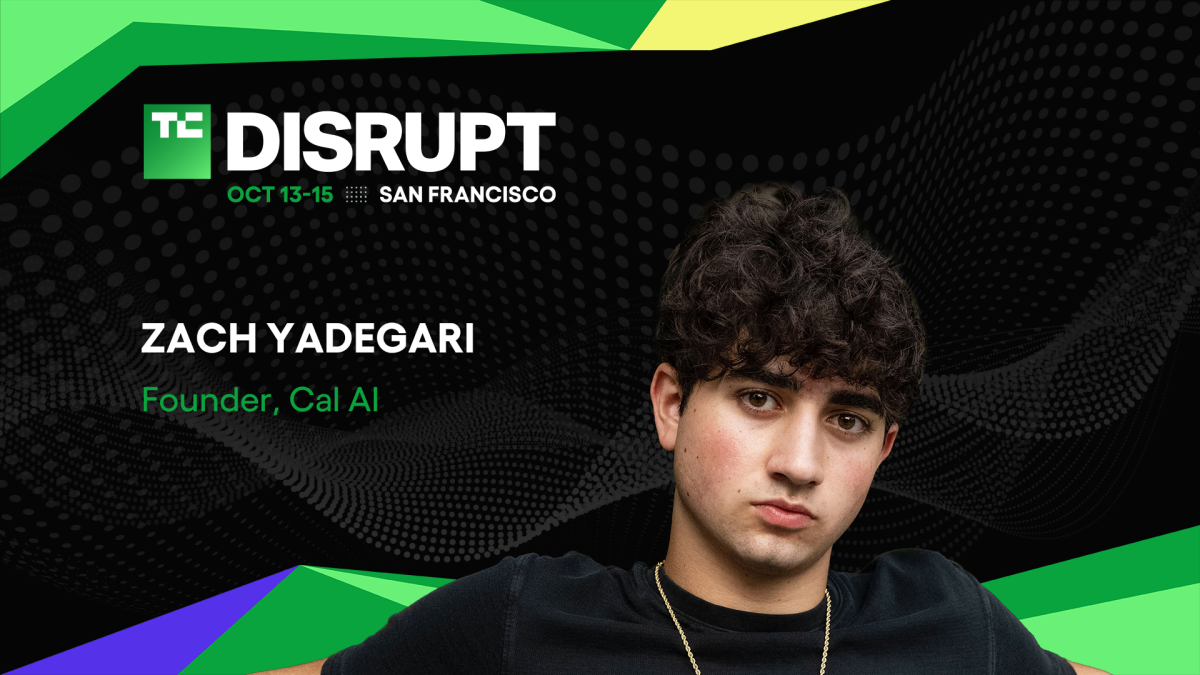
Zach Yadegari, who co-founded Cal AI at 17, will discuss how the app’s viral rise turned into a $30 million business and MyFitnessPal acquisition at a Disrupt 2026 session focused on retention, product pressure and sustainable growth.
- Cal AI grew to more than 15 million downloads and over $30 million in annual revenue in less than two years.
- MyFitnessPal acquired Cal AI in December 2025, while keeping the app standalone and retaining its seven-person team.
- Founder Zach Yadegari will discuss viral growth and retention at TechCrunch Disrupt 2026 in San Francisco.
- Yadegari previously founded Totally Science, a gaming platform sold for six figures after attracting more than 5 million users.
Update — September 24, 2026 6:24 pm
TechCrunch’s updated story adds that Yadegari was 17 when he co-founded Cal AI and that the app’s photo-based tracking relies on image recognition and the phone’s depth sensor to estimate calories and macros.
The new version also spells out more of the Disrupt appearance: his session is titled “How to Create Viral Growth and Capitalize On It,” and TechCrunch says it will focus on the product pressure that came with Cal AI’s breakout and how the team worked to turn attention into durable retention.
It also notes a few fresh event details, including that Disrupt 2026 will feature 200+ sessions, 250+ speakers and 300+ exhibiting startups, and that attendees can still save up to $200 on passes by Sept. 25, with a second pass available at 50% off select ticket types.
Zach Yadegari, the co-founder of Cal AI, is set to appear at TechCrunch Disrupt 2026 to explain how a teenage startup turned viral traction into a business with more than 15 million downloads, over $30 million in annual revenue, and a sale to MyFitnessPal. His story matters because it shows how consumer apps can explode quickly — and how hard it is to convert that attention into lasting value.
Yadegari will join the Builders Stage for a fireside chat focused on one of the most important questions in consumer tech: once an app catches fire, what comes next? The session is expected to dig into Cal AI’s growth playbook, the pressure that followed its breakout success, and the operational decisions required to keep users engaged after the hype fades.
What is Cal AI, and why did it scale so quickly?
Cal AI is a nutrition app that estimates calories and macronutrients from a photo of a meal. Users simply take a picture of food, and the app applies computer vision and sensor data from the phone to generate a nutritional estimate, including protein, carbohydrates, and fat.
That simple workflow helped the product stand out in a crowded consumer health market. Instead of requiring users to manually log every ingredient or scan barcodes item by item, Cal AI reduced friction to a single action: snap a photo and get an answer.
The company’s rise was unusually fast. In less than two years, Cal AI surpassed 15 million downloads and reached more than $30 million in annual revenue. The company’s momentum was strong enough to attract the attention of MyFitnessPal, which ultimately bought the business in a deal that closed in December 2025.
How did a high school founder build a breakout app?
Yadegari was still in high school when he co-founded Cal AI, but the app was not his first attempt at building an audience. Earlier, at age 16, he founded Totally Science, a gaming platform that grew to more than 5 million users during the COVID-19 pandemic before being sold for six figures.
That earlier experience appears to have given him a useful template: build something people want to use repeatedly, distribute it where users already spend their time, and move quickly when interest starts building. Cal AI followed that formula on a much larger scale.
The company’s growth also reflected a broader shift in startup building. Consumer apps can now spread rapidly through social platforms, creator ecosystems, and short-form video, but those same channels can make growth volatile. A product can become a sensation before the business is fully ready for scale.
Why does Cal AI matter to founders right now?
Cal AI is relevant because it highlights both the promise and the fragility of viral consumer growth. A large audience can appear almost overnight, but retention, pricing, support, product stability, and team execution determine whether that audience becomes a business or just a spike in downloads.
Yadegari’s experience is especially useful for early-stage founders because it sits at the intersection of product-market fit and distribution strategy. Many founders struggle to get noticed. Cal AI’s challenge was different: how to capitalize on attention before momentum evaporated.
That is a familiar dilemma in the startup world. Viral growth can create enormous leverage, but it also creates expectations that may outpace staffing, infrastructure, and product maturity. In Cal AI’s case, the company sold before it had to solve every scaling problem on its own, but the lessons from the journey still apply to founders trying to build the next breakout app.
What happened after the acquisition?
MyFitnessPal’s purchase of Cal AI did not fold the app into the larger company and disappear it from view. Instead, Cal AI remained a standalone product, and Yadegari stayed in charge. The seven-person team was also retained, suggesting the buyer valued the startup’s identity, product direction, and operating speed as much as its user base.
That structure is notable in a market where acquisitions often lead to assimilation. By keeping Cal AI independent, MyFitnessPal signaled that the app’s appeal likely rested in the product itself and in the team that built it. For Yadegari, it also meant the story did not end with a sale; it shifted into the harder work of sustaining a business inside a larger ecosystem while preserving the qualities that made it grow in the first place.
How will Disrupt 2026 frame the conversation?
TechCrunch says Yadegari’s session will focus on how to create viral growth and then make the most of it once it arrives. That makes the talk less of a victory lap and more of a case study in execution under pressure.
The appearance is part of a broader Disrupt 2026 program running October 13–15 at Moscone West in San Francisco. Organizers say the event will feature more than 200 sessions across six industry stages, with over 250 speakers, 300-plus startups exhibiting, and more than 10,000 founders, investors, operators, and technology leaders expected to attend.
For attendees, the value of the event is not limited to stage programming. TechCrunch positions the conference as a place for matchmaking, dealmaking, and networking, with opportunities to meet investors, partners, prospective customers, and peers confronting similar challenges.
Who is likely to get the most from this session?
Founders building consumer apps are likely to benefit most, especially those trying to grow through social distribution, creator-led discovery, or product-led sharing loops. Investors and operators watching the consumer AI space may also find the session useful, because Cal AI sits at the intersection of AI, mobile software, and health tech.
The talk may also resonate with startup teams facing a familiar trade-off: scale fast enough to keep momentum, but not so fast that product quality, user trust, or team structure breaks down. That tension is one of the central themes of the modern app economy.
| Milestone | Cal AI / Zach Yadegari | What it shows |
|---|---|---|
| Age 16 | Founded Totally Science | Early proof of audience-building ability |
| High school senior | Co-founded Cal AI | Built a consumer AI app before college |
| Under 2 years | More than 15 million downloads | Rapid viral adoption |
| Annual revenue | Above $30 million | Turned attention into meaningful business value |
| December 2025 | Acquired by MyFitnessPal | Exit after breakout growth |
What founders can learn from Cal AI’s rise
Cal AI’s story offers several practical lessons for startup teams trying to chase breakout growth without losing control of the company.
- Simplicity matters: The app solved a familiar problem with a low-friction interaction.
- Distribution is a product feature: Rapid growth did not happen by accident; it depended on how the app spread.
- Retention matters as much as downloads: Viral attention only becomes durable value if users keep coming back.
- Small teams can move quickly: The retained seven-person team suggests lean execution was part of the formula.
- Timing affects outcomes: Selling after a breakout can preserve momentum while reducing execution risk.
Why the market is paying attention to consumer AI apps
Cal AI’s rise also reflects a larger trend in artificial intelligence: the most visible opportunities are often not the most technical, but the most immediately useful. Consumer-facing AI products that save time, reduce effort, or automate everyday tasks can gain traction quickly when they feel intuitive from the first use.
Nutrition tracking is a strong example because it combines a recurring user need with a painful manual process. People want better awareness of what they eat, but many abandon tracking apps because logging meals takes too long. By reducing the task to a photo, Cal AI attacked the core reason users disengage.
That principle is likely to echo across other consumer AI categories. Whether the use case is fitness, productivity, education, or communication, the winners are often the products that make the AI invisible and the outcome immediate.
How does this connect to the broader startup economy?
It connects because founders are under pressure to show growth quickly, and investors increasingly reward products that demonstrate clear user behavior rather than abstract potential. A breakout app that can prove traction, revenue, and retention now often becomes acquisition-ready faster than older startup playbooks would suggest.
Cal AI’s trajectory also highlights how quickly brand, product, and exit strategy can become intertwined. The startup did not spend years proving itself before becoming a major consumer business. It moved from launch to scale to acquisition in a compressed window, which is increasingly common in the current market for AI-enabled applications.
Disrupt 2026 and the business of startup visibility
TechCrunch is using Yadegari’s appearance to underscore what the conference is meant to do: connect founders with the kinds of lessons, contacts, and opportunities that can accelerate growth. The company says attendees can save up to $200 by securing a pass by September 25 at 11:59 p.m. PT, with some ticket types offering a second pass at 50% off.
That sales pitch is part of the broader Disrupt formula, which blends stage content with networking and startup exposure. For a founder, a conference like this can serve as both a classroom and a marketplace — a place to learn from others’ mistakes, meet potential backers, and surface the next stage of company-building.
Yadegari’s session fits that mission well because it addresses a challenge most entrepreneurs understand but few solve cleanly: how do you turn sudden popularity into a real, sustainable enterprise?
Table: Key facts about Zach Yadegari and Cal AI
| Topic | Details |
|---|---|
| Founder | Zach Yadegari |
| Company | Cal AI |
| Core product | AI-powered nutrition tracking from meal photos |
| Downloads | More than 15 million |
| Annual revenue | More than $30 million |
| Acquirer | MyFitnessPal |
| Deal closed | December 2025 |
| Team size retained | Seven people |
| Disrupt appearance | October 13–15, 2026 |
| Venue | Moscone West, San Francisco |
What comes next for Yadegari?
For now, the next chapter is public speaking and knowledge sharing rather than a new product launch. At Disrupt 2026, Yadegari is expected to focus on the mechanics behind growth, the limits of virality, and the decisions that determine whether a breakout app becomes a lasting company.
That perspective is likely to attract attention because it comes from someone who experienced the full arc unusually early: first the challenge of finding users, then the challenge of keeping them, and finally the challenge of turning all that momentum into an outcome big enough to attract a major buyer.
In an industry filled with theoretical advice about growth loops and product-market fit, Cal AI offers something more concrete. It is a real example of what happens when a high school founder combines a simple AI product with effective distribution and lands on a market that was ready to move quickly.
TechCrunch says Yadegari’s Disrupt session will explore how Cal AI built viral momentum, managed the pressure that followed, and converted rapid attention into a durable business outcome.
For founders, that makes the session worth watching. Viral growth is rare. Knowing how to use it when it appears is even rarer.
Frequently asked questions
What is Cal AI?
Cal AI is an AI-powered nutrition app that estimates calories and macronutrients from a photo of a meal. Users take a picture of their food, and the app uses image recognition and phone sensor data to generate a breakdown of protein, carbs, fat, and calories.
How big did Cal AI become before it was acquired?
Cal AI became a major consumer app very quickly, reaching more than 15 million downloads and more than $30 million in annual revenue in less than two years. That scale helped put the company on MyFitnessPal’s radar.
Who is Zach Yadegari?
Zach Yadegari is the co-founder of Cal AI and one of the startup’s key operators. He was still in high school when he helped launch the app, and he had earlier founded Totally Science, a gaming platform that he sold for six figures at age 16.
Why is Zach Yadegari speaking at Disrupt 2026?
He is speaking at Disrupt 2026 because Cal AI offers a timely example of how a consumer app can go viral, scale quickly, and then convert that attention into a real business outcome. His session is expected to focus on growth, retention, and execution.