In short
The U.S. and China are discussing an AI hotline to warn about national security risks tied to frontier models, but the agreement is still weeks from completion. Key issues include enforcement, incident thresholds, chip policy, and who Trump will appoint as his next AI czar.
- The U.S. and China are exploring an AI notification system modeled loosely on crisis hotlines.
- Officials say the deal is not ready yet because major details still need to be defined and approved.
- Nvidia chip exports to China and the choice of a new AI czar could affect the timeline.
- The plan is tied to broader concerns about frontier AI, national security, and miscalculation between rival powers.
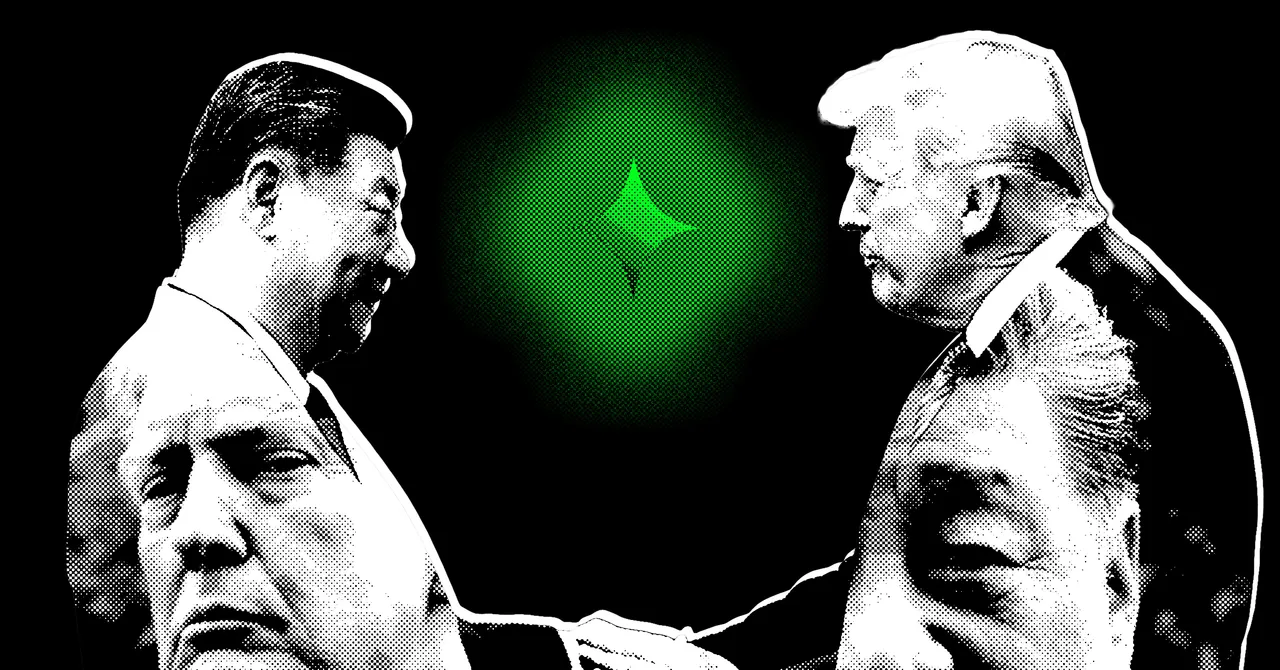
The White House and Beijing are working toward a U.S.-China AI notification system meant to reduce the risk of a dangerous misunderstanding, but officials now expect it to take weeks before any agreement is finalized. The proposed channel, discussed ahead of Donald Trump’s state dinner with Xi Jinping in Washington on Thursday, would let each side warn the other about AI-related national security concerns.
The push comes as Washington and Beijing race to shape the rules of frontier AI while also competing for leadership in the technology itself. The idea has been framed as a modern counterpart to the Cold War hotline with Moscow, but key details remain unsettled, including what kinds of incidents would trigger alerts, how the system would be enforced, and whether China will formally commit.
What the U.S.-China AI hotline is meant to do
The proposed mechanism is designed to create a direct communication line between the world’s two biggest AI powers. In practice, it would allow either government to notify the other when an AI development, incident, or model capability is believed to pose a national security concern.
That could include sudden breakthroughs in model behavior, cyber-related misuse, military applications, or other scenarios officials decide are serious enough to merit immediate discussion. The larger goal is to reduce the chance that an AI-related event escalates because one side interprets it as hostile, destabilizing, or strategically significant.
The concept reflects growing anxiety in both capitals about how quickly frontier systems are advancing. As models become more capable and increasingly useful in areas such as code generation, intelligence analysis, and automation, policymakers are trying to decide whether existing diplomatic tools are enough to manage the risks.
Why the deal is not ready yet
According to administration officials, the biggest obstacle is not the idea itself but the substance of the agreement. The two governments still need to define the thresholds for what counts as a reportable AI incident, spell out how notifications would work, and determine whether the mechanism would carry any consequences if one side failed to comply.
That last point matters because U.S. officials want to avoid a system in which Washington is obliged to disclose concerns while Beijing can ignore or slow-walk its side of the bargain. Officials are reportedly trying to build a framework that includes reciprocity and enforcement, but those provisions would require additional White House approval.
Chinese officials, meanwhile, have not signaled clear support, making any immediate announcement unlikely. Even if the broad concept is welcomed at the diplomatic level, negotiators still need to turn it into a functioning protocol that both governments can live with.
How soon could it happen?
How soon the hotline could be ready depends on how quickly the two sides settle the open questions. Trump administration officials are now aiming for a framework that could be agreed before the end of the year, but they say the work is likely to take several more weeks.
Their more immediate target is a follow-up round of talks in Shenzhen, China, where Treasury Secretary Scott Bessent is expected to meet Vice Premier He Lifeng again in about two months. The hope is to have enough of a structure in place by then for Trump to approve the concept.
The state dinner puts AI at the center of U.S.-China diplomacy
The issue is rising to the top of the agenda as Trump prepares to host Xi for a state dinner at the White House. The meeting is expected to feature a broader discussion of trade and technology, with AI now emerging as one of the most sensitive subjects on the table.
Executives from OpenAI and Nvidia are also expected to attend the dinner, underscoring how deeply Silicon Valley is now tied to the geopolitical competition between Washington and Beijing. Their presence highlights the fact that AI policy is no longer just a matter for national security officials; it is also being shaped by companies that build the chips and models driving the industry.
For the administration, the timing is significant. The U.S. wants to demonstrate that it can manage competition with China without allowing either side to misread developments in a field that may increasingly influence military planning, intelligence, and economic leverage.
| Key item | Status | Why it matters |
|---|---|---|
| Proposed AI notification system | Under discussion | Could serve as a direct U.S.-China channel for AI-related security warnings |
| Trump-Xi state dinner | Scheduled for Thursday in Washington | Places AI diplomacy among the top bilateral issues |
| Next Bessent-Lifeng meeting | Expected in Shenzhen in about two months | May be the point where a framework is pushed closer to completion |
| Final agreement | Not expected immediately | Officials say formalization will take several weeks |
How the plan compares with past crisis channels
The notion of an AI hotline is being compared inside the administration to earlier U.S.-China crisis communication channels, especially the dialogue between former Treasury Secretary Hank Paulson and former Chinese Vice Premier Wang Qishan. During the 2008 financial crisis, that relationship was viewed as an important backchannel that helped steady communication at a volatile moment.
Supporters of the current proposal argue that AI needs a similarly durable mechanism, particularly because the technology can move faster than traditional diplomacy. In a fast-moving crisis, even a short delay in communication could increase the risk of misunderstanding or escalation.
The historical comparison is not exact, but it is politically useful. It frames the AI channel not as a concession to China but as a practical safeguard between rivals whose actions can have global consequences.
Officials involved in the talks view the proposed system as a way to create a formal warning line for AI-related security issues, while still preserving leverage over how and when each government would be expected to act.
Why Nvidia chips are part of the discussion
The hotline talks are unfolding alongside a separate, unresolved question: whether the United States should continue permitting advanced Nvidia chip sales to China. The administration has already granted a limited number of licenses this year for Nvidia to ship its H200 chips, which are important for training large AI models because they help expand compute capacity.
That policy has sparked a familiar debate. Critics of export limits argue that blocking sales only encourages Chinese firms such as Huawei to accelerate domestic chip development. Supporters of restrictions say maintaining a technological edge requires tighter control over the most advanced semiconductors, even if those controls create incentives for Chinese self-sufficiency.
The issue matters directly to the hotline effort because enforcement becomes harder if the U.S. keeps selling advanced chips while also trying to create strict incident-reporting rules. Officials worry that any framework without real penalties could look one-sided.
What role does compute play?
Compute is central because it determines how much capability AI labs can bring to model training and deployment. If China gets access to advanced U.S. chips, its companies can build more powerful systems faster; if access is limited, local firms may push harder to replace American hardware with domestic alternatives.
That makes chip policy inseparable from the broader AI security debate. The hotline would be only one part of a much larger contest over how much technological advantage each side can maintain.
The AI czar question could slow everything down
Some Trump administration officials believe the notification system may also be delayed by a separate personnel decision: who will become the next AI czar. The administration is considering a central coordinator for interagency AI policy, described internally as the head of an AI-focused force meant to align government actions.
Several names are circulating. Bessent has been mentioned as a possibility, though officials say he is not necessarily the front-runner. Commerce Secretary Howard Lutnick is also under consideration, along with White House AI officials Michael Kratsios and Sean Cairncross.
The choice could shape the structure of the office itself. Officials are still weighing whether the job should be filled by someone who keeps their current post in addition to the AI role or by someone who leaves their existing position to take it on full-time.
That question matters because the previous AI czar, David Sacks, served as a special government employee. He is not expected to return. If Trump wants a stronger, more durable AI bureaucracy, the appointment could determine whether the hotline proposal gets the sustained attention it needs.
Who is pushing Bessent, and why?
Bessent has support in part because the hotline concept fits his Treasury-based diplomatic style. Some in the administration see the proposed AI channel as similar to the crisis communication links that have historically been managed through economic or finance-related diplomacy rather than through a purely technical AI office.
That view echoes the logic of the Paulson-Qishan relationship: when markets, debt, or other systemic risks are at stake, direct communication between senior officials can sometimes reduce the odds of panic. Advocates of Bessent’s involvement believe he could bring the same practical, transactional approach to AI security talks.
Still, Lutnick remains in contention. He oversees the Center for AI Standards and Innovation, which has already played a role in navigating disputes involving frontier AI firms this summer. That experience could give him credibility if Trump wants someone who understands both the policy and industrial sides of the issue.
What makes the agreement difficult to enforce?
The hardest part may be turning a diplomatic idea into a credible rule set. A hotline is easy to announce but difficult to operationalize, especially when the two countries do not share the same assumptions about transparency, escalation, or national security.
U.S. officials reportedly want measurable criteria that would define when an AI event must be reported. They also want clear enforcement so the channel does not become a unilateral burden on Washington. Without those terms, the system could quickly lose value.
China’s reluctance adds another complication. Even if Beijing accepts the concept in principle, it may resist language that appears to constrain its own discretion or expose sensitive developments too quickly.
Possible elements in a final framework
- Defined thresholds for reportable AI incidents
- Reciprocal notification obligations for both governments
- Procedures for urgent escalation and confirmation
- Possible consequences for non-compliance
- Political sign-off from both leaders before implementation
Why this matters beyond Washington and Beijing
A U.S.-China AI hotline would not just be a bilateral diplomatic tool. It would also signal that the world’s two leading AI powers now see model safety, chip access, and system capability as issues serious enough to require formal crisis management.
That matters because AI development is increasingly global in consequence even when the technology is built by private companies. A major breakthrough, security incident, or military application in one country could affect allies, rivals, markets, and regulators far beyond the two governments directly involved.
If the channel succeeds, it could become a model for other forms of AI risk reduction. If it fails, it would still reveal how difficult it is to create rules for a technology advancing faster than the diplomacy meant to contain it.
What happens next?
For now, the immediate next step is not a final announcement but continued negotiation. Officials expect more work over the coming weeks, with the Shenzhen talks likely serving as the next major checkpoint.
Before then, the White House will also have to settle internal questions about who leads its AI strategy and how much authority that person will have. That personnel decision may prove just as important as the diplomatic one, because any hotline agreement will need a strong internal champion to move from concept to implementation.
Until those pieces come together, the U.S.-China AI notification system will remain what it is now: a promising idea, a diplomatic signal, and a work in progress shaped by rivalry, caution, and the accelerating pace of frontier AI.
Frequently asked questions
What is the U.S.-China AI hotline?
It is a proposed notification system that would let Washington and Beijing warn each other about AI-related national security concerns. The idea is meant to reduce misunderstandings during incidents involving frontier models, cyber risks, or other strategic developments.
Why is the AI hotline taking so long to finalize?
It is taking time because the two sides still need to agree on what qualifies as a reportable incident, how the system would be enforced, and whether China will formally commit. Officials also say White House internal decisions could affect the pace.
Could the AI hotline be ready this year?
Yes, that is the administration’s goal, but it is not guaranteed. Officials say they are aiming for a framework before year-end, yet they also expect the process to take several more weeks and possibly longer if major disputes remain unresolved.
How do Nvidia chips affect the talks?
Nvidia chip policy matters because advanced chips determine how much compute Chinese AI labs can access for training models. U.S. export decisions are part of the broader competition, and officials worry that weak enforcement in the hotline deal could undercut their leverage.
Who might become Trump’s next AI czar?
Several names are being discussed, including Treasury Secretary Scott Bessent, Commerce Secretary Howard Lutnick, and White House AI officials Michael Kratsios and Sean Cairncross. The administration has not chosen anyone yet, and the role’s structure is still being debated.