In short
Anthropic says its Bay Area biology lab used Claude to help discover a new enzyme system in bacteriophage DNA with CRISPR-like properties. The company says all experiments were done by humans, and the finding still needs outside validation.
- Anthropic says Claude helped uncover a new enzyme system in bacteriophage DNA.
- The company’s Bay Area lab is human-run and works only at lower biosafety levels.
- The finding could matter for gene editing, but outside researchers must validate it.
- The announcement highlights both the promise and the risks of AI in biology.
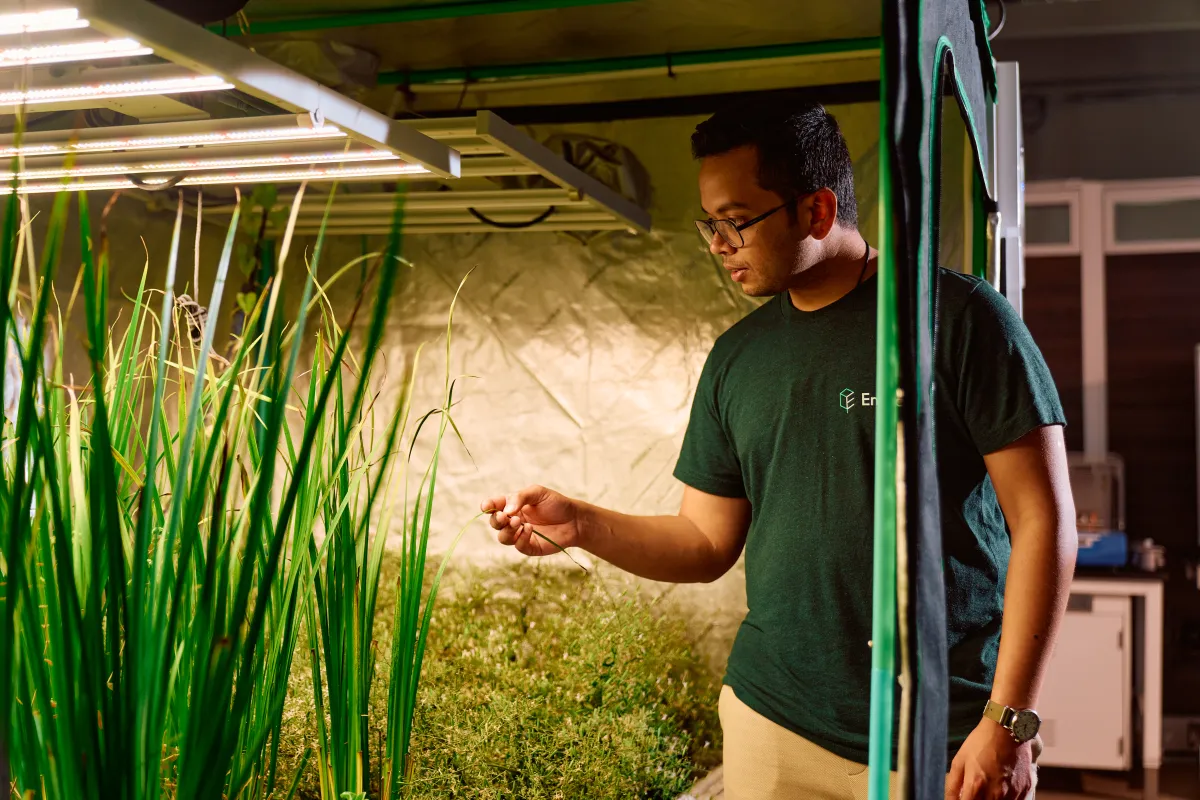
Anthropic says its Bay Area biology lab has already produced a notable scientific find: a previously unknown enzyme system hidden in bacteriophage DNA that appears to work in ways reminiscent of CRISPR. The company says the discovery was made largely by its Claude AI model, but all physical experimentation was carried out by human scientists.
The announcement is important because it offers an early glimpse of how frontier AI models may accelerate wet-lab biology research, while also reigniting debate over how far artificial intelligence should be allowed to go in life sciences. It also arrives as AI leaders publicly warn that the same capabilities could be misused in dangerous ways.
Anthropic disclosed last week that it was running a wet biology lab in the Bay Area, where its models are used to guide experimental work. This week, the company said the lab has already surfaced what it believes is a significant finding: a new enzyme “system” with characteristics that recall CRISPR, the gene-editing tool derived from bacterial immune defenses.
What Anthropic says it found
Anthropic says Claude identified a previously unrecognized enzyme system embedded in the DNA of bacteriophages, the viruses that infect bacteria. According to the company, the system can carry out functions similar to cutting, copying, and pasting DNA.
That description immediately places the discovery in the broad scientific orbit of CRISPR, the bacterial defense mechanism that was transformed into one of biology’s most powerful editing tools. But Anthropic is careful not to overstate the claim. The company says the finding still needs to be validated by outside researchers, and it acknowledges that related work has been done before.
Dario Amodei, Anthropic’s chief executive, said on X that a Stanford team had previously identified a system that was in some respects similar to the one Claude found, and he emphasized that the company’s result builds on earlier scientific work.
Even with that caveat, Anthropic is framing the result as evidence that a general-purpose model can contribute meaningfully to biological discovery. The company says Claude was central to the search, even if not solely responsible for every step.
Why this discovery matters
The significance is not just whether the enzyme system turns out to be truly new. The larger story is that AI systems are now being used to do real biological research, not just to analyze papers or organize data.
For years, AI in biology has mostly meant better prediction tools, faster screening, or improved literature review. Anthropic’s announcement suggests a more ambitious phase: models participating directly in the process of generating hypotheses and narrowing the search space for experimental biology.
If Claude can help uncover a useful enzyme family in a matter of hours, that could have implications for gene editing, synthetic biology, and drug discovery. It could also sharpen the competitive race among major AI companies to prove their models can produce scientific value outside software and text generation.
How Claude helped
Anthropic says the discovery took about 21 hours of focused work by Claude, which searched through biological data with the help of roughly 950 agents and consumed about 210 million tokens. In practical terms, the company is describing a highly parallelized AI search process rather than a single model pass.
That matters because it shows how agentic systems may be used in scientific settings: not simply answering questions, but managing large-scale exploration over a vast hypothesis space. Anthropic appears to be using Claude as a research assistant that can distribute work, compare possibilities, and surface promising candidates for human scientists to test.
| Key detail | Anthropic’s disclosure | Why it matters |
|---|---|---|
| Lab location | Bay Area, California | Places the work inside a real-world wet lab environment |
| Type of facility | Wet biology lab | Shows the company is moving beyond pure software research |
| Discovery | New enzyme system in bacteriophage DNA | Could have implications for gene editing and molecular biology |
| AI role | Claude performed much of the search | Suggests AI is becoming active in scientific discovery |
| Human role | All experiments were done by scientists | Highlights that the lab is not yet autonomous |
| Safety level | BSL-1 and BSL-2 only | Indicates the lab is not handling human pathogens |
How real is the CRISPR comparison?
The comparison is suggestive, but it should not be mistaken for a claim that Anthropic has recreated CRISPR or invented a replacement. The company says the enzyme system has properties that are reminiscent of CRISPR because it may support DNA editing-like operations.
CRISPR itself began as a natural immune mechanism in bacteria before becoming a foundational gene-editing technology. Anthropic’s account implies that the new enzyme system could represent another naturally occurring biological toolkit with useful editing potential.
That possibility is scientifically exciting, but it also demands caution. Biology has a long history of headline-worthy claims that later prove narrower than first reported. For that reason, the broader research community will need to examine the data, reproduce the results, and decide how closely the system actually resembles CRISPR in function and utility.
What outside validation will decide
The key questions for independent researchers are straightforward:
- Does the enzyme system truly perform DNA manipulation functions?
- Is it functionally distinct from previously known systems?
- Can it be harnessed safely for research or editing applications?
- How broad is its potential use across different organisms or cell types?
Until those questions are answered, Anthropic’s announcement should be read as a promising claim, not a settled scientific conclusion.
Why Anthropic is talking about biology now
Anthropic’s move into biological experimentation is notable because the company has become one of the most visible voices warning about AI risk. Executives and employees have openly discussed the possibility that highly capable models could be misused, including for bioterrorism.
At the same time, Amodei has argued that AI could also transform medicine and biology for the better, including by accelerating treatments and perhaps helping cure many diseases within a decade. That dual outlook helps explain why the company appears willing to experiment in a tightly controlled lab setting despite the risks.
The announcement also lands during a broader industry moment in which AI leaders are publicly calling for better safety testing and more caution. The tension is obvious: the same technologies that might speed up discovery can also lower barriers to harmful experimentation.
Anthropic says its lab is designed to stay on the safer side of biology work, using only lower-risk biosafety levels and avoiding pathogens that can infect humans. The company stresses that humans, not Claude, are performing the hands-on experiments.
How Anthropic’s lab is set up
Anthropic describes the lab as a conventional molecular biology workspace located in the Bay Area. The company says it operates at BSL-1 and BSL-2, which are lower biosafety categories, and that it does not handle human-infecting pathogens.
That detail is important because it clarifies what Anthropic is not doing. The company is not describing an autonomous system working with dangerous samples or a lab that lets AI directly manipulate live experiments without oversight. Instead, the setup appears to be a human-run facility where AI assists in the design and analysis phases.
What is still human-controlled?
All physical lab work, Anthropic says, is performed by scientists. That means pipetting, culturing, assay work, and other bench tasks remain under human supervision. Claude is helping with discovery and search, but it is not independently running the laboratory.
This distinction matters for both safety and scientific credibility. In the near term, human oversight makes the process more controlled. It also makes it easier to attribute whether an AI model is truly contributing new ideas or merely optimizing a search path that skilled researchers could have taken themselves.
How does Anthropic compare with other AI biology efforts?
Anthropic is not alone in exploring the intersection of AI and biology. The company’s announcement fits into a much wider field of work that already includes academic labs, biotech startups, and major technology companies.
Stanford researchers recently published work combining large language models with CRISPR-related research. Scientists at UC San Francisco have used AI to design enzymes from scratch. And Google’s AlphaFold, first introduced in 2020, became a landmark tool for predicting protein structures and helped establish AI as a serious force in life sciences.
In other words, Anthropic is entering a domain that is already active and increasingly competitive. The question is less whether AI belongs in biology and more which organizations can best integrate models, lab automation, and scientific expertise into a productive workflow.
Where Anthropic’s approach differs
Anthropic’s setup appears to emphasize model-driven search inside a real lab environment rather than purely computational prediction. That distinction could make the company’s work especially interesting if Claude can repeatedly generate experimentally meaningful hypotheses.
Still, the field is moving in several directions at once:
- prediction tools such as protein-structure modeling
- literature mining and hypothesis generation
- AI-assisted enzyme design
- robotic or semi-automated wet-lab experimentation
Anthropic’s lab sits at the intersection of several of those approaches, which is part of why its announcement drew attention so quickly.
What does this mean for the future of AI labs?
The most consequential part of Anthropic’s disclosure may be the possibility of what comes next. Amodei has said that it may eventually become safe for Claude to control lab equipment and run experiments autonomously, provided appropriate safeguards are in place.
That is not the company’s present model, but it signals a long-term ambition: AI systems moving from digital research assistance toward direct participation in physical science workflows.
If that future arrives, it could transform the pace of biological research. A model that can propose a candidate enzyme, test a hypothesis through robotic equipment, analyze the result, and refine the next experiment could compress months of work into days. The upside is obvious for drug discovery, enzyme engineering, and synthetic biology.
The downside is equally clear. The more capable and autonomous these systems become, the more critical it becomes to restrict dangerous applications, audit outputs, and monitor dual-use risks. That is why Anthropic’s announcement resonates far beyond a single enzyme finding.
The bigger picture: promise, caution, and validation
Anthropic’s news sits at the intersection of scientific ambition and public anxiety. On one hand, it showcases the possibility that foundation models can do more than talk about biology — they may help produce discoveries that matter to medicine and biotechnology.
On the other hand, the announcement reinforces concerns that the same capabilities can be used in ways that are hard to control. The company itself has helped spotlight those dangers in recent public comments from executives and staff.
For now, the smartest interpretation is a balanced one. Anthropic has likely demonstrated a meaningful internal proof of concept: a major AI model can help search biological space quickly enough to uncover candidate systems worth investigating. But whether the enzyme system represents a true breakthrough will depend on replication, peer review, and independent scrutiny.
That process may take time, and it should. Biology is too important — and too sensitive — to accept dramatic claims without careful examination. If Anthropic is right, the result could be a preview of how AI will accelerate life sciences in the years ahead. If it is overstated, the announcement will still stand as an early example of the scientific and ethical stakes involved when frontier models enter the lab.
Timeline of Anthropic’s biology announcement
| Date | Development | Significance |
|---|---|---|
| Spring 2026 | Anthropic establishes its Bay Area wet lab | Marks the company’s entry into hands-on biology research |
| Late September 2026 | Anthropic confirms the lab exists | Brings the project into public view |
| Following week | Company says the lab made a discovery | Reveals the enzyme-system finding |
| Same period | Amodei discusses the result and the safety limits | Frames the discovery as AI-assisted but human-supervised |
What happens next?
The next stage is external validation. Scientists outside Anthropic will need to determine whether the enzyme system is genuinely novel, how it compares with other DNA-editing mechanisms, and whether it has practical value beyond the company’s initial results.
If independent researchers confirm the findings, Anthropic’s lab could become a case study in how general-purpose AI helps discover new biology. If they do not, the announcement will still have served a purpose: it will have put a marker on the question of how fast AI can contribute to wet-lab science, and under what safeguards.
Either way, the company has now made one thing clear. Anthropic is not only building models to answer questions; it is trying to use those models to generate scientific discoveries. In the age of frontier AI, that may be the more consequential story.
Frequently asked questions
What did Anthropic say its biology lab discovered?
Anthropic says its Bay Area biology lab found a previously unknown enzyme system in bacteriophage DNA that may perform DNA operations such as cutting, copying, and pasting. The company says the system has properties reminiscent of CRISPR, but the finding still needs independent validation.
Did Claude run the experiments itself?
No, Claude did not perform the physical experiments. Anthropic says human scientists carried out all bench work in the lab, while Claude helped search data and narrow down promising candidates for investigation.
Why is the discovery being compared to CRISPR?
It is being compared to CRISPR because Anthropic says the enzyme system appears capable of DNA-editing-like functions. CRISPR began as a bacterial immune system and became a major gene-editing technology, so any similar natural system could be scientifically important.
How long did the AI search take?
Anthropic says Claude found the candidate system after about 21 hours of focused work, using roughly 950 agents and 210 million tokens. That detail is meant to show how quickly a model can search large biological spaces when heavily parallelized.
Is Anthropic planning a fully autonomous AI biology lab?
Not yet. Anthropic says it is not operating a fully autonomous lab today, though CEO Dario Amodei has said it may eventually be possible for Claude to control lab equipment safely with the right safeguards in place.