In short
Ron Johnson, the former Apple retail chief, says AI shopping agents will improve online buying but are unlikely to replace physical stores. He argues shoppers still want to see, touch and compare expensive products in person.
- Ron Johnson says AI shopping will enhance research, not replace stores.
- He believes expensive purchases like laptops still require in-person evaluation.
- Johnson credits Apple’s retail success to its people, not just store design.
- He says AI agents may make shoppers better informed before visiting stores.
- His view contrasts with Google and OpenAI’s push into agentic commerce.
Ron Johnson, the executive who helped turn Apple’s retail stores into a model for modern consumer tech, says Silicon Valley is overestimating how far AI shopping agents will go. The former Apple retail chief believes artificial intelligence will make online shopping easier, but not replace the physical store experience that many buyers still want when they are spending serious money.
Johnson’s comments land at a moment when major technology companies are racing to insert AI into the checkout process. Google is promoting a new commerce protocol for agent-driven shopping, while OpenAI is increasingly positioning ChatGPT as a place where people can research, compare and sometimes buy products without leaving the chatbot. Johnson, however, argues that when it comes to important purchases, most people will still want to touch, test and judge the product themselves.
“AI is a new technology that will improve the online shopping experience,” Johnson said in an interview, “but I don’t know that it’s going to change which way we shop.”
Why Ron Johnson is pushing back on AI shopping hype
Johnson’s skepticism is especially notable because he is not a retail outsider. He joined Apple in 2000, before online shopping had fully transformed consumer behavior, and was tasked with building a store network that would support the company’s products, service model and brand identity. The Apple Stores that emerged became a blueprint for premium retail far beyond Cupertino.
His argument is straightforward: AI can help shoppers sort through information, but it cannot replace the sensory and emotional parts of deciding whether to buy a product. That distinction matters most for high-value purchases, especially electronics.
When asked whether he could imagine someone allowing an AI agent to pick out and purchase a laptop worth $1,000 or $2,000 without visiting a website or store, Johnson gave a blunt response: “Honestly, nobody’s going to do that.”
In his view, some shopping decisions are too personal to outsource completely. A laptop buyer may want to see the screen, compare sizes, feel the weight and decide whether the device actually suits their needs. AI may reduce the number of options, he said, but the final judgment will still belong to the person spending the money.
How Apple’s store strategy shaped Johnson’s view
Johnson’s position is rooted in Apple’s long-standing belief that retail is more than distribution. The company’s stores were designed to be places where people could learn how products work, get help after buying them and interact with knowledgeable staff in a carefully controlled environment.
That model, Johnson said, was never only about selling hardware. It was about building confidence.
For Apple, the store solved multiple problems at once: it gave consumers a chance to experience products before purchase, provided a place for support after the sale and reinforced the brand’s premium image. Johnson believes those goals are still relevant even as shopping tools become more automated.
He expects AI to improve the front end of the buying journey rather than eliminate the in-person destination. In his view, agents may help people arrive at the store better informed, but they will not remove the need for hands-on comparison.
“AI will never be able to have you physically experience a product,” Johnson said, adding that agents may simply make people more prepared before they walk into a store.
That idea points to a blended future, not a fully automated one: research online, decide in person.
What big tech is betting on with agentic commerce?
Big tech companies are trying to redefine shopping around AI assistants and autonomous agents. The theory behind this shift, often called agentic commerce, is that software can handle more of the shopping process on behalf of consumers, from product discovery to checkout.
Google has been among the most visible advocates of this model through its Universal Commerce Protocol, which is intended to create a standard way for AI agents to move shoppers from discovery to purchase. OpenAI, meanwhile, has been expanding ChatGPT’s utility as a shopping companion, allowing users to research products, compare options and in some cases complete purchases without leaving the conversation.
To the companies backing this approach, AI shopping represents a meaningful upgrade over traditional e-commerce. Instead of forcing shoppers to click through multiple websites, filter endless product lists and manually compare specifications, an agent could narrow the choices, complete transactions and manage repeat purchases more efficiently.
But Johnson is unconvinced that convenience alone will overturn entrenched consumer habits. He sees AI as an enhancement to online shopping, not a replacement for the experience of physically engaging with a product before buying it.
What makes agentic commerce appealing to platforms?
It promises less friction, more data and a larger role for the platform in the transaction. If an AI assistant can guide the consumer from curiosity to checkout, the company controlling that assistant also gains influence over discovery, brand visibility and conversion.
For technology companies, that influence could be enormously valuable. It could also create a new layer of competition over who owns the relationship with the buyer.
What Johnson says shoppers still want from retail
Johnson believes many consumers still want a physical frame of reference before buying expensive products. His laptop example is telling: a buyer may know the model number and technical specifications, but still want to judge comfort, portability and display quality in person.
That belief extends beyond electronics. For many categories, the store remains a place where people can compare options side by side, ask questions and reduce the risk of regret.
Johnson’s broader point is that shopping is not only a rational exercise. It is also tactile, social and often emotional.
He argues that AI can sharpen the decision-making process without erasing the need for human experience. In that sense, the future of retail may be less about replacing stores and more about changing what shoppers know before they arrive.
- AI can summarize product information quickly.
- AI can help shoppers compare features and prices.
- AI cannot let customers physically inspect a product.
- Higher-ticket purchases still benefit from in-person evaluation.
How Apple’s stores became a retail template
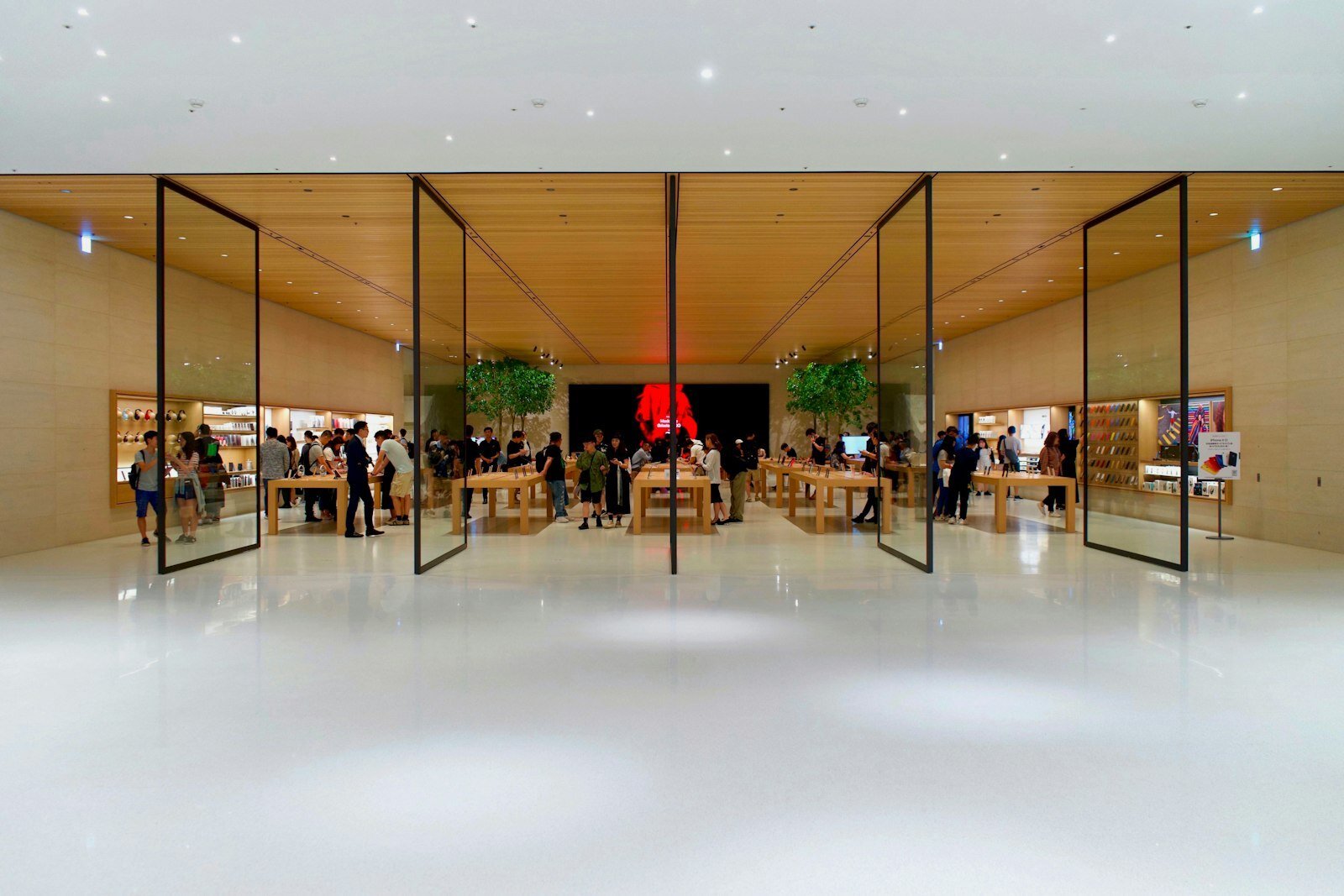
Apple’s stores influenced more than product displays. Johnson says rivals copied the wide-open layouts, glass-heavy facades and even elements of the Genius Bar concept, but too often ignored the human side of the model.
The employees, in his telling, were the real differentiator. Apple deliberately avoided a commission-based sales culture, which Johnson says allowed workers to focus on helping customers rather than pushing inventory.
That decision mattered because it changed the interaction inside the store. Instead of acting like aggressive salespeople, employees could concentrate on understanding a customer’s needs and recommending the right solution.
Johnson said the “secret sauce” of Apple retail was not only the architecture or the layout, but the people working there and the way they treated customers.
This emphasis on service rather than pressure helped Apple stores earn trust and loyalty. It also made them different from much of traditional retail, where incentive structures often push staff toward transactions over relationships.
| Company / Idea | Approach to Shopping | Johnson’s View |
|---|---|---|
| Apple Stores | Hands-on product demos and in-store support | Still highly relevant |
| AI shopping agents | Automated discovery, comparison and checkout | Helpful, but limited |
| Online-only retail | Convenient and information-rich | Improved by AI, not transformed completely |
| High-end purchases | Require more confidence and sensory evaluation | Best suited to in-person review |
How Johnson’s later career shaped his caution
Johnson’s thinking about retail was also influenced by a less successful chapter in his career. After leaving Apple, he became chief executive of J.C. Penney in 2011 and attempted a sweeping transformation of the struggling department-store chain. The effort failed, and he was forced out less than two years later after sales fell sharply.
Johnson now says that he moved too fast and underestimated how much support a turnaround needed from workers and customers. In his reflection, Apple had functioned more like a startup building an entirely new model, while J.C. Penney required a slower, more careful rescue.
He said he mistakenly brought “a startup mentality” to a business that actually needed a turnaround strategy.
That experience appears to have sharpened his appreciation for how retail changes in practice, not just in theory. It also helps explain why he is skeptical of grand predictions that AI will rapidly rewrite consumer behavior.
What was Enjoy Technology, and why does it matter here?
Johnson later returned to the startup world by founding Enjoy Technology, a company that delivered technology products and setup services directly to customers’ homes. The business tried to combine e-commerce convenience with the kind of high-touch help Johnson valued from physical retail.
The company ultimately filed for bankruptcy in 2022 and sold most of its assets to Asurion. That outcome does not invalidate Johnson’s belief in service-led retail, but it does show how difficult it can be to build a business around a hybrid shopping model.
Enjoy Technology is relevant to the current AI shopping debate because it reflects Johnson’s long-running interest in reducing friction for consumers without eliminating human guidance. The pattern is consistent: he is open to technology, but wary of assuming that convenience alone will remake shopping in every category.
Why Johnson remains an AI believer despite his doubts
Johnson is not dismissing AI itself. In fact, he describes himself as an enthusiast and says the technology has real value. What he rejects is the idea that AI’s usefulness in shopping automatically means customers will surrender their judgment.
He believes AI will help people make better-informed decisions, especially by organizing information that would otherwise take time to gather manually. But he does not see that as a substitute for intuition, taste or human experience.
Johnson said he remains “a real believer in AI” and an “AI optimist,” while also insisting that there is no replacement for human intuition.
He also suggested that Steve Jobs would have welcomed AI, but only on the condition that it strengthened, rather than replaced, human judgment. That view fits neatly with the philosophy Johnson says guided Apple’s retail rise: technology should empower people, not remove them from the process.
What the debate means for the future of retail
The clash between Johnson’s outlook and Silicon Valley’s current AI commerce push highlights a larger question facing retail: are shoppers looking for automation, or reassurance?
For low-stakes, repeat purchases, AI agents may well become standard. Reordering household goods, comparing commodity items or finding the lowest price may increasingly happen with minimal human involvement. But Johnson’s argument suggests a hard ceiling for automation when purchases become personal, expensive or experiential.
That distinction could shape how retailers invest in the next few years. Companies may need to support AI-assisted discovery while still maintaining physical spaces that let consumers test, feel and trust what they buy.
It may also force platforms to confront a simple reality: better recommendations do not always change behavior.
Shoppers may welcome AI as a smarter assistant, but that does not mean they are ready to let it make the final call.
Timeline: Ron Johnson’s retail journey
| Year | Event | Why it matters |
|---|---|---|
| 2000 | Johnson joins Apple to build its retail operation | Begins shaping the modern Apple Store model |
| 2000s | Apple stores expand and become a global retail benchmark | Proves that premium tech retail can be experiential |
| 2011 | Johnson becomes CEO of J.C. Penney | Attempts a major turnaround of a legacy retailer |
| 2013 | Johnson is ousted after sales decline | Highlights the difficulty of rapid retail transformation |
| 2022 | Enjoy Technology files for bankruptcy | Shows the challenges of hybrid retail-service models |
| 2026 | Johnson warns AI shopping won’t replace stores | Reframes the current AI commerce debate |
The bottom line
Johnson’s message is less a rejection of AI than a warning against overpromising what it can do in retail. He sees machine intelligence as a powerful tool for research and personalization, but not as a substitute for the human side of shopping.
In his view, physical stores still solve problems that software cannot: they let customers experience products, get reassurance and make decisions with confidence. As Silicon Valley pushes AI deeper into commerce, Johnson is betting that those needs will not disappear anytime soon.
For now, he believes the future is not agents replacing stores, but agents making store visits smarter.
Frequently asked questions
What did Ron Johnson say about AI shopping?
Ron Johnson said AI shopping will improve the online buying experience, but it will not fundamentally change how most people shop. He argued that shoppers still want to see, touch and judge products themselves, especially when buying expensive items like laptops.
Why does Ron Johnson think physical stores will survive?
Ron Johnson thinks physical stores will survive because AI cannot replicate the experience of handling a product in person. He believes stores remain important for high-value purchases, where customers want to compare quality, fit, and feel before spending serious money.
What is agentic commerce?
Agentic commerce is the idea that AI agents can help automate shopping from discovery to checkout. Companies like Google and OpenAI are pushing tools that let users research, compare and even buy products through AI instead of manually browsing websites.
How was Ron Johnson involved with Apple retail?
Ron Johnson joined Apple in 2000 to build its retail business and helped create the Apple Store model. That network became a key part of Apple’s brand, combining product demos, service and a premium in-store experience.