Updated September 10, 2026 8:54 pm
In short
Apple’s fall event added a two-color option for the iPhone Duo, more detailed camera controls and video features for the iPhone 18 Pro, and new battery and noise-cancellation specifics for AirPods 5.
- Apple’s first foldable phone, the iPhone Duo, starts at $1,999 and goes on sale October 23.
- The iPhone 18 Pro and Pro Max get major camera upgrades, including a variable aperture system.
- Apple Watch Series 12 and Ultra 4 add audio-based features like Live Rewind and Siri Recap.
- AirPods 5 bring stronger noise cancellation and broader Siri and Apple Intelligence support.
- A redesigned Health app will use Apple Intelligence to surface insights, readiness and longevity data.
Update — September 10, 2026 8:54 pm
Apple also said the iPhone Duo will come in two colors, a detail that was not included in our earlier story.
The company gave more specifics on the iPhone 18 Pro camera system too, saying the new Pro controls include white balance, shutter speed, aperture and a histogram. Apple also said the phone can shoot 4K video in Dolby HDR Vision and add cinematic effects after recording.
For AirPods 5, Apple said battery life reaches up to five hours with active noise cancellation on a single charge, and up to 22 hours total with the charging case. The company also said the earbuds cut background noise by 50% more than the previous generation.
Update — September 9, 2026 11:54 pm
Apple also gave its new Watches and earbuds more detail. The Apple Watch Series 12 and Ultra 4 are getting Audio Intelligence features that can help users revisit recent conversations, including a Live Rewind tool and a Siri Recap feature.
The company said Sound Recognition can flag noises such as sirens, alarms, doorbells and even a crying baby, while the redesigned Health app will add an Insights tab, a readiness score, a Health Age estimate and a new Longevity section.
AirPods 5 will include stronger noise cancellation, better Transparency mode, stem volume controls and longer battery life, with Apple offering a $129 base model and a $149 version with a wireless charging case.
Apple used its first fall event under new CEO John Ternus to debut its long-awaited foldable phone, the iPhone Duo, alongside the iPhone 18 Pro lineup, updated Apple Watches, new AirPods, and a redesigned Health app. The announcements matter because they show Apple pushing into new device categories while adding more AI-driven features across its core products.
At the company’s “Surprise and Sunshine” launch, Apple framed the iPhone Duo as its biggest hardware shift in years, while also sharpening the camera systems on its premium iPhones and broadening health and audio features on wearables and earbuds. The event signaled a clear message: Apple wants to defend its flagship businesses and answer rising competition in foldables, AI wearables, and on-device intelligence.
Apple’s biggest move: the iPhone Duo
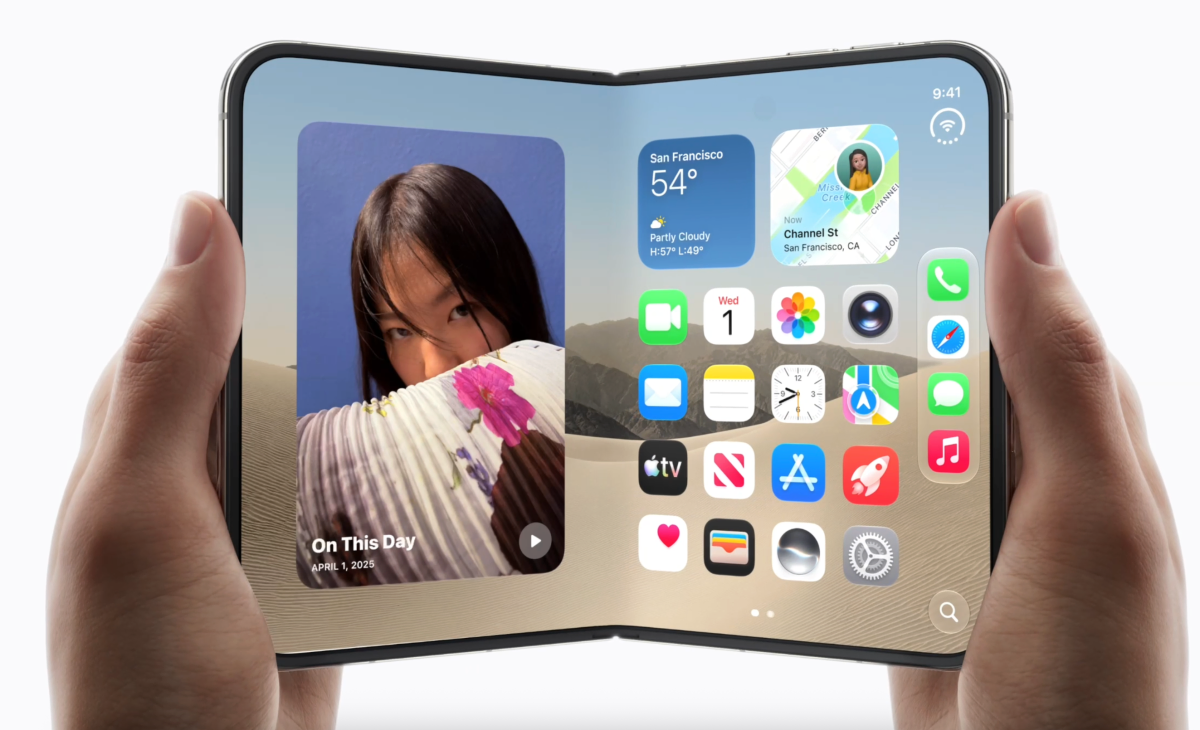
Apple’s first foldable phone, the iPhone Duo, is the product that will likely define this launch cycle. When unfolded, the device has a 7.6-inch Retina display, while the external screen measures 5.4 inches, giving it a book-style form factor that blends smartphone portability with tablet-style usability.
Apple said the design was inspired by iPad-like flexibility, and one of the more notable hardware details is the under-display front camera on the inner screen. That approach is meant to preserve a full-screen look when the device is open, reducing the visual interruption that has long challenged handset makers trying to build seamless foldables.
Battery life is another major selling point. Apple says the iPhone Duo can deliver up to 31 hours of video playback on the interior display and up to 44 hours on the outer display, figures that suggest the company is trying to position the phone not just as a premium curiosity, but as a practical everyday device.
What makes the Duo different?
Apple’s foldable is not only about the display. The company also highlighted its rear camera hardware and hinge engineering, both of which are critical on a device that must be slim, durable, and reliable through repeated opening and closing.
- 7.6-inch inner display and 5.4-inch outer display
- Under-display camera for a cleaner unfolded screen
- 48-megapixel main camera
- 48-megapixel ultrawide camera with 2x optical zoom
- Grade 5 aluminum hinge with more than 100 components
The camera setup includes a 48-megapixel fusion main sensor and a 48-megapixel ultrawide camera. Apple says the camera system supports 2x optical zoom and allows users to capture selfies with the rear cameras while checking framing on the outer display, a common foldable-phone trick that remains one of the format’s best features.
Perhaps equally important is the hinge. Apple says the mechanism is made from Grade 5 aluminum and relies on more than 100 engineered parts. That level of detail suggests the company is aware that foldable buyers will judge the Duo not only on features, but on the kind of structural reliability Apple has long used to distinguish its hardware.
How much does the iPhone Duo cost?
The iPhone Duo starts at $1,999 for the 256GB model, placing it firmly in ultra-premium territory. Apple will open pre-orders on October 16, and the device is scheduled to reach stores on October 23.
| Product | Starting price | Key feature | Pre-orders | Availability |
|---|---|---|---|---|
| iPhone Duo | $1,999 | 7.6-inch foldable display | October 16 | October 23 |
| iPhone 18 Pro | $1,199 | 48MP camera with variable aperture | Saturday | September 18 |
| iPhone 18 Pro Max | $1,299 | Advanced camera software and video tools | Saturday | September 18 |
| Apple Watch Series 12 | $399 | Audio Intelligence and Sound Recognition | Wednesday | September 18 |
| Apple Watch Ultra 4 | $499 | Audio Intelligence and Sound Recognition | Wednesday | September 18 |
| AirPods 5 | $129 | Improved ANC and Siri features | Wednesday | September 18 |
Why Apple is betting on a foldable now
Apple is entering the foldable market later than several rivals, but that delay appears deliberate. Rather than rushing out a first-generation device, the company is emphasizing polish, battery efficiency, and component engineering — areas where it has historically been willing to spend more time and money before launching a major product category.
The iPhone Duo also arrives at a moment when premium phones are increasingly expected to serve multiple roles. Consumers want a pocketable handset that can stretch into a larger screen for multitasking, media, and productivity. Apple appears to be answering that demand while still trying to make the device feel unmistakably like an iPhone.
Apple’s presentation framed the Duo as a device built around versatility, with the company positioning it as a phone that borrows the flexibility of a tablet without giving up the portability of a smartphone.
That positioning matters because the foldable category has often been treated as an engineering showcase rather than a mainstream product. Apple’s challenge will be to turn it into a status device that also has everyday utility — and to convince buyers that the premium price is worth paying for the new form factor.
iPhone 18 Pro and iPhone 18 Pro Max get major camera upgrades
Apple’s premium slab phones did not receive a dramatic redesign, but the iPhone 18 Pro and iPhone 18 Pro Max do get a meaningful upgrade where many buyers care most: the camera. Apple kept the overall look similar to the previous generation, but expanded the photographic controls and image quality tools available to users.
The main camera now uses a 48-megapixel sensor paired with a variable aperture controlled by six thin blades. In practical terms, that should help the phone adapt better to different lighting conditions, improving low-light shots while also enabling faster capture performance in some scenarios.
What’s new in the camera system?
Apple is giving photographers more manual control than before, with additional software options that make the Pro models feel more like compact creative tools.
- Variable aperture for better low-light and exposure control
- New Pro controls for white balance, shutter speed, aperture, and histogram
- Expanded Photographic Styles with texture and grain adjustments
- 4K Dolby HDR Vision video recording
- Cinematic effects that can be applied after recording
Those new Pro controls could make a meaningful difference for advanced users, especially creators and mobile journalists who want more predictable manual settings. The updated Photographic Styles also move the camera system closer to the kind of personalized look that photographers often want without carrying additional editing gear.
Apple is also leaning more heavily into video. The iPhone 18 Pro series can record 4K video in Dolby HDR Vision, and it supports cinematic effects that can be added after filming rather than locked in at capture time. That flexibility is likely intended to appeal to social creators, filmmakers, and anyone who wants a phone that can do more of the work once reserved for dedicated cameras.
How much do the new Pro phones cost?
The iPhone 18 Pro starts at $1,199, while the iPhone 18 Pro Max begins at $1,299. That puts both models $100 above last year’s equivalents, a sign that Apple is still comfortable asking more for its top-end hardware even as consumers become more price sensitive.
Pre-orders open Saturday, and both phones go on sale September 18.
Apple Watch Series 12 and Ultra 4 focus on listening, awareness, and memory
Apple’s new watch models are less about a physical redesign and more about smarter software. The Apple Watch Series 12 and Apple Watch Ultra 4 do not get a major hardware overhaul, but they introduce new tools that reflect Apple’s push toward AI-assisted wearables.
The most striking additions are aimed at conversations and sound awareness. Apple is rolling out features designed to help users review moments from recent speech, capture useful context, and recognize important noises in the environment. That makes the watches feel more like ambient assistants than simple fitness trackers.
How do the new watch features work?
The watches now include two major audio-focused capabilities: Live Rewind and Siri Recap. Live Rewind shows the previous 15 seconds of a conversation as text, while Siri Recap is intended to summarize important takeaways from everyday discussions.
- Live Rewind: shows the last 15 seconds of a conversation as a text snippet
- Siri Recap: helps users remember key points from meetings or conversations
- Sound Recognition: detects sirens, alarms, doorbells, and baby cries
- Audio Intelligence: Apple’s broader label for these memory and awareness tools
Apple is clearly trying to respond to the rise of AI wearables that promise to listen, remember, and assist in real time. By bringing these features to the wrist, the company is turning the Apple Watch into a more proactive device that can surface useful information with less user effort.
The Sound Recognition feature adds an accessibility dimension as well. By detecting common sounds such as alarms, doorbells, sirens, and babies crying, the watches can provide alerts to people who are hard of hearing, extending the device’s value beyond convenience and into practical everyday safety.
What do the Apple Watch Series 12 and Ultra 4 cost?
The Apple Watch Series 12 starts at $399, while the Apple Watch Ultra 4 is priced from $499. Pre-orders are available now, and both watches will arrive in stores on September 18.
AirPods 5 expand Apple Intelligence across audio
Apple’s AirPods 5 continue the company’s strategy of turning earbuds into more than just listening devices. The latest generation adds upgraded audio quality, stronger active noise cancellation, and a wider set of Siri and Apple Intelligence features.
Apple says the earbuds reduce background noise by 50% more than the previous generation, which would make them a significant step up for commuters, travelers, and people working in busy environments. The stems now support volume controls, a feature that had previously been reserved for more expensive AirPods Pro models.
What else is new in AirPods 5?
The transparency mode has also been improved so nearby voices and ambient sounds come through more naturally. That should make the earbuds easier to use in public settings where users need to stay aware of their surroundings without removing the buds.
Battery life remains competitive for the category. Apple says the AirPods 5 provide up to five hours of listening time with active noise cancellation enabled on a single charge, while the case extends total listening time to up to 22 hours.
| AirPods model | Noise cancellation | Listening time | Charging case total | Starting price |
|---|---|---|---|---|
| AirPods 5 | Improved, 50% stronger background reduction | Up to 5 hours | Up to 22 hours | $129 |
| AirPods 5 with Wireless Charging Case | Improved, 50% stronger background reduction | Up to 5 hours | Up to 22 hours | $149 |
The standard AirPods 5 start at $129, and the version with a Wireless Charging Case costs $149. Pre-orders are already open, with retail availability beginning September 18.
Apple Health gets a more intelligent redesign
Apple also used the event to preview a revamped Health app built around Apple Intelligence. The redesign is meant to help users make more sense of the health data gathered by their devices, especially when that information becomes overwhelming or hard to interpret on its own.
The app now includes an Insights tab that surfaces the most relevant health updates in a more readable format. Apple says the redesign will also bring personalized guidance, assessments, a Readiness score, and a Health Age calculation that aims to translate raw data into a simpler picture of overall wellness.
What is the new Longevity tab?
The Longevity tab is a new section that uses metrics from the Apple Watch and iPhone to evaluate health across sleep, movement, heart health, and related signals. Apple’s goal appears to be less about a single metric and more about making users think about how multiple daily behaviors shape long-term health.
The updated Health app will roll out later this year, beginning with U.S. English. That staged launch suggests Apple is taking a cautious approach as it expands the role of AI in one of its most sensitive consumer categories.
Apple’s health update reflects a broader effort to convert device-collected information into clearer, more actionable guidance rather than leaving users to interpret charts and numbers on their own.
What this launch says about Apple’s strategy
This event was about more than product refreshes. It revealed how Apple plans to compete in a market where hardware differentiation increasingly depends on software intelligence, design maturity, and ecosystem lock-in rather than simple spec gains.
The iPhone Duo gives Apple an entry into the foldable segment. The iPhone 18 Pro lineup preserves the company’s premium smartphone base while adding tools for photography and video. The Apple Watch updates make the wrist a more active AI companion. And AirPods 5 extend those intelligence features into one of Apple’s most ubiquitous accessories.
Seen together, the announcements show a company trying to do several things at once:
- Enter a new flagship category with the foldable iPhone Duo
- Keep the Pro iPhone line attractive to creators and power users
- Make Apple Watch more useful as an ambient listening device
- Bring Apple Intelligence into everyday audio products
- Repackage health tracking into something more understandable
There is also a notable pricing message running through the lineup. Apple is not softening its premium positioning. The foldable starts at $1,999, the Pro phones have each risen by $100, and the Watch and AirPods remain accessible by Apple standards, helping maintain a ladder of entry points into the ecosystem.
Timeline: when each product becomes available
Apple is staggering the rollout so buyers can choose between immediate launches and later-arriving marquee products.
| Date | Product | Milestone |
|---|---|---|
| Wednesday, September 9 | Apple event | Announcement of iPhone Duo, iPhone 18 Pro, Apple Watch Series 12, Ultra 4, AirPods 5, and Health app |
| Wednesday, September 9 | Apple Watch Series 12 / Ultra 4 / AirPods 5 | Pre-orders open |
| Saturday, September 12 | iPhone 18 Pro / Pro Max | Pre-orders open |
| September 18 | iPhone 18 Pro / Pro Max / Apple Watch Series 12 / Ultra 4 / AirPods 5 | In-store availability |
| October 16 | iPhone Duo | Pre-orders open |
| October 23 | iPhone Duo | First retail availability |
| Later this year | Apple Health app | Rollout begins in U.S. English |
What to watch next
The first big question is whether Apple’s foldable will feel like a true breakthrough or a luxury experiment. Pricing and durability will shape that debate, but so will the practical experience of using the Duo day to day.
The second question is whether Apple’s AI features feel useful enough to change habits. Wearable intelligence is becoming a crowded space, and Apple will need to prove that its memory and audio features are genuinely helpful rather than merely impressive on stage.
Finally, the company will need to show that these launches work as a system rather than as separate product reveals. Apple’s advantage has always been the ecosystem, and this year’s event underscores that the company is now trying to weave foldables, watches, earbuds, and health software into a more connected and more intelligent user experience.
If the launches resonate, Apple will have broadened its hardware lineup without sacrificing its premium identity. If they miss, the event could be remembered as a reminder that even Apple’s strongest product launches now have to compete in an era defined by fast-moving AI expectations and increasingly demanding hardware categories.
Frequently asked questions
What did Apple announce at its fall 2026 event?
Apple announced its first foldable phone, the iPhone Duo, along with the iPhone 18 Pro and iPhone 18 Pro Max, Apple Watch Series 12, Apple Watch Ultra 4, AirPods 5, and a redesigned Health app built around Apple Intelligence.
How much does the iPhone Duo cost?
The iPhone Duo starts at $1,999 for the 256GB model. Apple said pre-orders open on October 16, and the foldable phone will be available in stores on October 23.
What are the main new features of the iPhone 18 Pro?
The iPhone 18 Pro adds a 48-megapixel camera with variable aperture, new manual Pro controls, improved Photographic Styles, and 4K video recording in Dolby HDR Vision with post-shot cinematic effects.
What is new on the Apple Watch Series 12 and Ultra 4?
The Apple Watch Series 12 and Ultra 4 add Audio Intelligence features such as Live Rewind, which shows the last 15 seconds of a conversation as text, and Siri Recap, which summarizes key details from conversations and meetings.
When will the new Apple products be available?
Most of the new products, including the iPhone 18 Pro, Apple Watch Series 12, Apple Watch Ultra 4 and AirPods 5, arrive on September 18. The iPhone Duo follows later, with pre-orders opening October 16 and retail sales beginning October 23.