Updated September 10, 2026 8:54 pm
In short
Apple’s new Watch AI tools now include audible, user-triggered transcription and summary features, but they are also prompting fresh concerns that always-available listening is becoming normal.
- Apple unveiled Watch features that can transcribe speech and summarize conversations.
- The company says it does not store raw audio and uses encryption to protect outputs.
- The features could help with accessibility and note-taking, but they also raise consent concerns.
- Apple’s move signals that ambient AI listening is moving from startup niche to mainstream consumer tech.
Update — September 10, 2026 8:54 pm
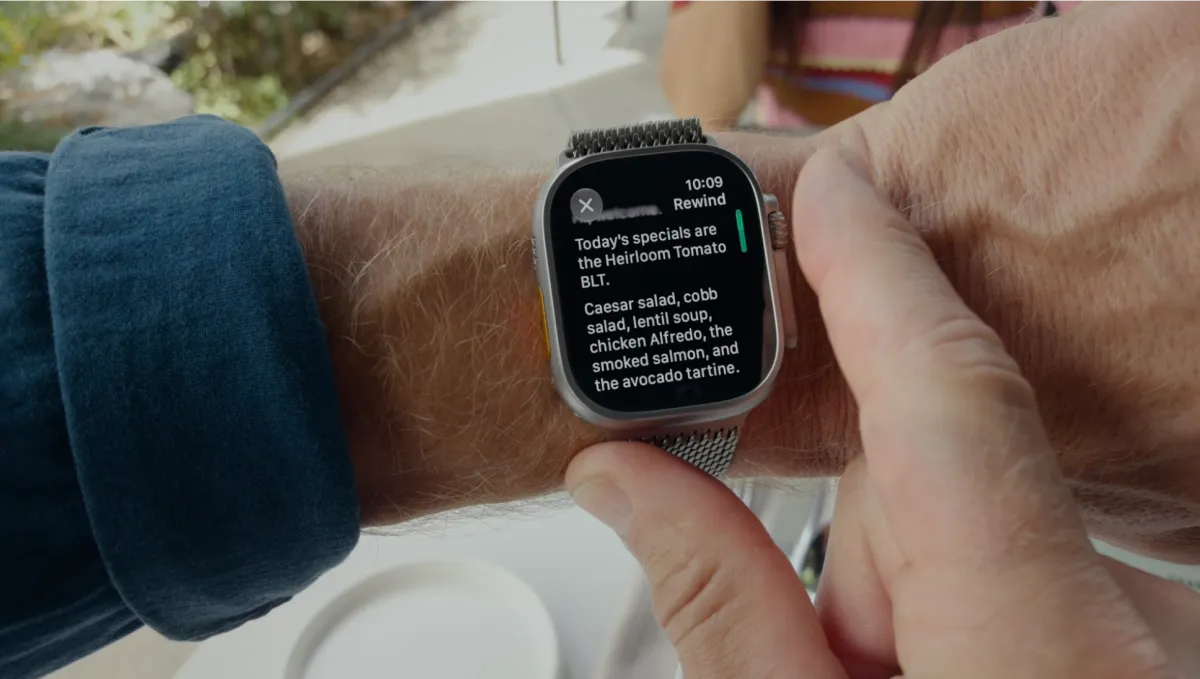
Apple’s new watch tools are also more explicit about how they work in practice: Live Rewind uses a double-press of the Digital Crown, adds an audible chime and on-screen microphone animation, and can save the result to Apple’s separate Siri app.
The updated source also says Siri Recap is meant to produce only high-level notes rather than exact transcripts, and that Apple may be bracing for a consumer backlash as these listening features move further into everyday use.
Apple is also positioning the features as a response to a wider market, where AI wearables and transcription devices are already pushing always-available listening into the mainstream.
Apple is moving the idea of ambient, always-available audio intelligence closer to the mainstream with new Apple Watch features that can capture speech, summarize conversations, and surface recent audio in useful ways. The change matters because it brings a privacy-sensitive company into the center of a debate over whether consumers are comfortable with devices that can listen, transcribe, and remember what was said around them.
At its Wednesday iPhone event, Apple introduced watch features including Audio Intelligence, Live Rewind, and Siri Recap. The company framed them as practical tools for accessibility, note-taking, and quick reference, but they also mark a significant shift in how wearable devices interact with everyday speech.
The most striking part of the announcement is not a new phone form factor or another incremental hardware upgrade. It is the way Apple is normalizing a class of AI behavior that many consumers still associate with surveillance: a device that can hear, process, and later reconstruct conversations.
What did Apple announce for the Watch?
Apple unveiled a set of AI-powered audio features for its newest watches that can detect sounds, transcribe short segments of speech, and generate summaries of conversations. The tools are meant to make the watch more useful in everyday life, but they also push the product into territory that raises questions about consent and privacy.
Apple’s presentation suggested that the company is trying to position these features as a bridge between convenience and assistive technology. That framing matters, because the same capability that can help someone catch a missed detail in a meeting can also make it easier to capture speech from someone who may not realize they are being recorded in any meaningful sense.
| Feature | What it does | Why it matters |
|---|---|---|
| Audio Intelligence | Detects sounds such as alarms, sirens, doorbells, and babies crying using on-device AI | Useful for accessibility and safety, especially when the iPhone is not nearby |
| Live Rewind | Lets users go back 15 seconds and transcribe recent speech after pressing the digital crown | Turns a fleeting conversation into text that can be saved and reviewed later |
| Siri Recap | Creates AI-generated notes with titles, summaries, and key points from ambient listening | Helps users review meetings or events without storing a full audio recording |
Why is Apple’s approach different from other AI wearables?
Apple is trying to avoid the “always on” feel that has made some competing AI devices controversial, while still offering the practical benefits of passive listening. Unlike some wearables that continuously record, Apple says its features are designed with user control and privacy protections built in.
That distinction matters because the wearable AI market is increasingly built around the promise that a device can act like an external memory. Startups have already moved aggressively into transcription and note-taking, particularly for meetings, lectures, interviews, and personal reminders. Some products go farther, marketing themselves as ambient companions that can store snippets of daily life.
Apple’s move suggests that it believes the category is not just a niche experiment. Instead, the company appears to be betting that consumers will eventually accept the idea that a personal device can listen selectively, remember context, and generate useful summaries — so long as the data handling seems trustworthy enough.
How Apple is trying to keep the features palatable
Apple says the features do not default to a permanently active mode. Users can switch them on when they want, such as during work hours or only in specific settings, and can disable them at any time through Control Center. The company also says that it does not store raw audio and does not make that audio accessible, even internally.
Apple further says the generated transcripts and recaps are protected with end-to-end encryption. It does not identify speakers or tag who said what, which may reduce some privacy concerns even as it creates new uncertainty about how useful or verifiable the resulting records will be.
Apple’s pitch is essentially that the watch can provide convenience without turning into a full-time recorder, because the raw audio is not preserved and the user remains in control of when the feature is active.
What exactly do Live Rewind and Siri Recap do?
Live Rewind gives Apple Watch users a way to recover the last 15 seconds of speech and convert it into text by double-pressing the digital crown. The resulting transcription can then be saved to Apple’s new standalone Siri app so it can be revisited later.
Apple says the feature is meant for things like catching a missed recommendation, remembering a colleague’s idea, or revisiting a detail that was lost in the moment. But the same design also makes it easy to capture a person’s words after the fact, which is why the feature is likely to draw attention from privacy advocates.
Siri Recap goes further by creating ambient notes from conversations. Rather than a verbatim transcript, it generates a title, summary, and key points based on the AI’s interpretation of what was heard. Apple says the feature could be especially helpful in settings such as meetings or parent-teacher conferences, where users may want a quick recap rather than a full record.
How does the audio get handled?
Apple says the watch does not retain the original audio recording, and that even Apple cannot access raw sound data. That design choice is central to its privacy argument, because it limits the system to text-based outputs rather than preserving a permanent audio archive.
Still, the absence of the source audio creates a new practical question: if the transcript is later used in a dispute, how easy will it be to authenticate? A written note can be useful, but without the original recording, its reliability may be harder to establish in court or in a workplace disagreement.
Could this create legal problems around consent?
Yes, and that is one of the biggest unresolved questions surrounding the new features. If a watch can convert nearby speech into text with minimal user action, the legal and ethical burden around consent becomes more complicated, especially in states with stricter recording laws.
Apple’s system may not be equivalent to a traditional voice recorder, but it could still produce material that people consider private or sensitive. That makes the distinction between “recording” and “transcribing” less reassuring than Apple may hope, particularly if consumers begin to use the feature in conversations where others do not realize how much is being captured.
Other AI device makers already warn customers about this issue. Some products tell users to obtain consent where required by law, and others place responsibility for compliance squarely on the customer. Apple’s emphasis on not storing audio may reduce the technical footprint, but it does not eliminate the social or legal concerns that come with ambient listening.
What happens if the transcripts are used as evidence?
That depends on jurisdiction, context, and how the transcript was produced. Because the watch is not saving a conventional audio file, the resulting text may be treated differently from a standard recording. It could still potentially be introduced in legal proceedings, but questions about reliability and verification would likely come up immediately.
In practical terms, the user may wind up with a note that captures the substance of a conversation without the technical baggage of a voice file. In legal terms, however, that note may invite disputes over whether it accurately reflects what was said, who said it, and whether the conversation was recorded in a way that complied with local law.
Why does this feel different from taking notes on a phone?
Because the action is more subtle, the social effect may be stronger. A phone recording or a visible camera introduces an obvious signal that someone is documenting the moment. A wrist gesture on an Apple Watch is easier to miss, even if Apple adds a microphone animation and an audible chime to indicate that something is happening.
That subtlety matters in real-life interactions. People behave differently when they think they are being observed, and technology has long changed the way users speak, joke, or disagree in public and private settings. A device that can quickly transform spoken words into text could encourage more cautious behavior, especially if people begin to assume that every conversation may later be replayed in summary form.
This is not a new problem for technology, but wearables make it more intimate. The more a device becomes part of the body, the less it feels like a separate tool and the more it feels like an extension of memory itself.
How does this fit into the broader AI wearable race?
It fits as a sign that major consumer tech companies are taking the ambient AI market seriously. Startups have spent the last few years arguing that transcription and note generation are among the most compelling everyday uses for AI, and Apple’s decision to add these features to the Watch suggests that argument has now reached the biggest hardware players.
Several newer devices have been built around the premise that AI should quietly collect, organize, and summarize the user’s life. Some focus on meetings and productivity, while others aim to act as always-available companions. In that sense, Apple is not inventing the category so much as legitimizing it.
That legitimacy could accelerate adoption. It could also raise the stakes. When a niche product uses ambient listening, consumers can dismiss it as experimental. When Apple does it, the behavior starts to feel like a future default.
Who is already pursuing similar ideas?
Several startups and device makers are already in the space, including firms focused on transcription wearables and passive note-taking tools. Some products are aimed at remembering meetings, lectures, or interviews, while others are designed more like AI companions that stay aware of your day and offer reminders later.
- Meeting transcription tools for professionals
- Wearables that capture lectures and interviews
- Ambient companions that summarize daily life
- Always-listening note devices for personal memory
What privacy promises did Apple make?
Apple made several privacy claims designed to distinguish its implementation from more aggressive always-listening products. The company says the system is user-controlled, does not store raw audio, and does not let Apple access the original sound. It also says the output is encrypted end to end and that the watch does not identify speakers.
Those safeguards are substantial on paper. They may reassure customers who trust Apple more than smaller hardware makers, and they align with the company’s long-running brand identity as a privacy-first technology provider. But consumer trust is not built only on technical architecture. It is also shaped by whether people feel a feature is socially acceptable in the first place.
That is where the story becomes complicated. A product can be secure and still make people uneasy. A device can be private in a narrow technical sense while still normalizing behavior that others view as intrusive.
Apple’s privacy message is that the feature is controlled, encrypted, and limited to text-based output rather than raw audio.
What are the cultural concerns beyond the technical ones?
The deeper concern is that people may begin to treat constant audio capture as ordinary. Once a feature like this becomes common on a wrist, the expectation of being overheard may shift from unusual to routine. That kind of normalization is what makes the debate bigger than one company’s product launch.
Recording technology already influences how people speak in public, in classrooms, in workplaces, and at social events. If the recording itself is less visible — or even not technically stored as audio at all — the behavioral impact may become harder to notice even as it spreads.
Apple appears to be betting that users will value convenience enough to overlook the discomfort. Whether that proves true may depend on where the line falls between helpful memory aid and unsettling surveillance.
How could consumers respond?
Consumers are likely to split into at least three groups. Some will see the features as genuinely helpful accessibility and productivity tools. Others will accept the trade-off only if Apple’s privacy guarantees are clear and easy to control. A third group may reject the entire idea on principle, seeing ambient speech capture as too invasive regardless of how the data is handled.
The reaction could also differ by use case. A parent may welcome a recap feature for school meetings. A commuter may appreciate alerts about sirens or alarms. A worker in a sensitive office, by contrast, may view the same tools as a liability.
- Accessibility use cases may draw the strongest support.
- Business and meeting users may value the time-saving element.
- Privacy-conscious consumers may remain skeptical.
- Legal and workplace norms will likely shape adoption.
What should users watch for next?
Users should watch how Apple explains the boundaries of the feature once the devices are in the hands of real customers. The biggest questions will not just be whether the tools work, but how clearly Apple communicates when listening starts, what gets saved, where the text lives, and how long it remains accessible.
They should also watch for whether the company expands the system beyond the Watch. If Apple proves that consumers will accept ambient transcription in a wrist-worn product, the same model could appear in more places across its ecosystem. That would push the industry further toward AI that is not just reactive, but continuously attentive.
For now, Apple is testing a delicate proposition: that always-listening technology can feel helpful rather than creepy if it is framed as private, limited, and useful. The answer from consumers may determine whether this becomes a niche accessibility feature or the beginning of a broader shift in how people expect their devices to behave.
Key details at a glance
| Topic | Apple’s position | Main concern |
|---|---|---|
| Listening behavior | User-controlled, not always on by default | Normalizing ambient capture |
| Audio storage | No raw audio stored or accessible to Apple | Difficulty verifying transcripts later |
| Use cases | Accessibility, reminders, meetings, conferences | Potentially recording people without meaningful consent |
| Privacy protection | End-to-end encryption and speaker anonymity | Consumer discomfort despite safeguards |
Apple’s bet is clear: if the company can make ambient audio intelligence feel safe, useful, and tightly controlled, it may help turn one of AI’s most controversial behaviors into an everyday convenience. The harder question is whether the public wants technology to become this good at listening in the first place.
Frequently asked questions
What are Apple Watch AI features?
Apple Watch AI features are new audio tools that can detect sounds, transcribe recent speech, and generate summaries of conversations. Apple says they are designed to help users capture useful information, improve accessibility, and review important moments without storing raw audio.
Does the Apple Watch record everything you say?
No, Apple says the Watch does not store raw audio or keep a permanent recording. The company says users can choose when the listening features are active, and the resulting text outputs are protected with end-to-end encryption.
Why are Apple Watch AI features controversial?
They are controversial because they make it easier to capture speech subtly, which raises consent, privacy, and legal concerns. Even if audio is not stored, people may still feel uncomfortable with a wrist device that can listen and turn speech into text.
Can Apple Watch transcripts be used in court?
Possibly, but it would depend on the circumstances and the state or country involved. Because Apple says it does not save raw audio, any transcript could be harder to authenticate than a conventional recording, which may affect how it is treated as evidence.