Updated September 5, 2026 11:54 am
In short
AI food images are unsettling because image models struggle with thin shapes, repeating textures, and real-world context, and the problem may be worsening as AI systems increasingly train on synthetic food imagery and poorly phrased prompts.
- AI food images often fail on strands, holes, and layered textures.
- Diffusion models build images in stages, which can lock in structural mistakes early.
- Training data, vague prompts, and upscaling can all make food look more grotesque.
- Humans are especially sensitive to food cues that suggest contamination or spoilage.
- The trend highlights broader limits in current image-generation systems.
Update — September 5, 2026 11:53 am
The updated source adds that some image models are now being trained on AI-made content, including food imagery, which can feed back into worse outputs over time.
It also says this loop may accelerate a kind of model collapse, where images become more degraded and increasingly alike as synthetic data piles up.
And it notes that prompt wording matters too: overly vague requests, like simply asking for a sandwich, or odd instructions such as “be precise,” can make food images even stranger.
Update — September 4, 2026 2:28 pm
The updated source adds that some AI image systems are now being trained on AI-generated material, including food-heavy content, which can worsen results.
It also notes that this kind of feedback loop may contribute to “model collapse,” leading to visual degeneration and images that look increasingly similar over time.
The new version further says prompts can make things worse when they are too vague or oddly phrased, such as asking only for a sandwich or using instructions like “be precise.”
AI-generated food images look unsettling because image models are still poor at rendering thin, repeating, and physically coherent details such as noodles, strands, holes, and layered textures. The result matters because restaurants, retailers, and brands are increasingly using these synthetic visuals in promotions, even when the pictures make the food look inedible.
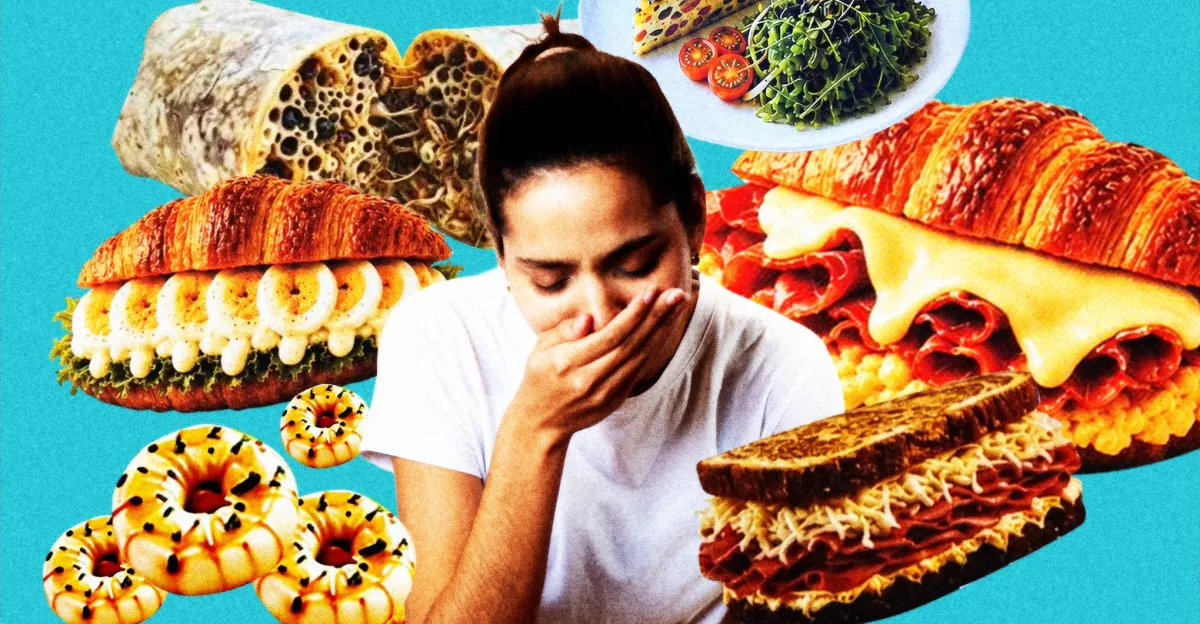
From shrimp-shaped donuts to burgers made of what appears to be stone and burritos riddled with holes, the latest wave of AI food imagery has become a case study in how image generators fail. The problem is not just bad taste in a stylistic sense; it reveals deeper technical limits in diffusion models, gaps in how models learn from internet data, and the way human brains react when something edible appears wrong.
Food photography has always been polished and exaggerated. AI is now copying that surface gloss without understanding the substance underneath. That mismatch is what creates the strange, nauseating effect that has made AI food images one of the most widely mocked outputs of generative systems.
What makes AI food images look so wrong?
AI food images look wrong because the systems are optimized to imitate visual patterns, not to understand food as a real object in the physical world. They can reproduce the general idea of a burger, noodle bowl, or dessert, but they often fail at the details that make the object believable and appetizing.
Researchers who study computer vision and digital media say the most obvious failures tend to appear in two places: early structural layout and late-stage texture generation. When either stage goes off course, the model may end up creating something that only vaguely resembles food, while also layering on details that make it more disturbing.
Chris Russell, a professor of AI, government and policy at the University of Oxford, said diffusion models recover broad shapes first and fine details later, which means a model can lock in the wrong structure before adding texture on top of it. He compared the effect to the classic image-generation failure where a person ends up with too many fingers.
That kind of structural error helps explain why some AI burgers look like stacks of rocks, why a pastry can resemble a bundle of worms, and why shrimp can somehow become donut-like objects.
How do diffusion models produce these food failures?
Diffusion models produce these food failures because they build images from noise, gradually removing randomness until a picture emerges. In theory, that process is excellent for generating detailed visuals. In practice, it can struggle with objects that depend on clean edges, repeated textures, and terminating lines.
The model typically starts with a coarse overall shape. Only later does it add smaller features such as texture, shading, ridges, and strands. If the early stage is inaccurate, the final image may become a hybrid of the wrong object with highly detailed surface embellishments.
Why are noodles, strands, and tendrils such a problem?
Noodles, strands, and tendrils are such a problem because they require the model to understand when a thin shape begins, how it bends, and where it ends. Diffusion systems are notoriously weak at this kind of geometry, so the output often turns into tangled spaghetti-like forms that spill across the image.
Giovanbattista Califano, a behavioral scientist at the University of Naples Federico II, said repeating textures such as bubbles, seeds, and clustered holes are especially difficult to keep within sensible boundaries. When the system loses control of these patterns, the result can look like contamination, infestation, or a medical oddity rather than lunch.
Califano said the visual geometry that causes trouble for image models is the same geometry that often appears in food: thin strands, narrow ends, repeating pockets, and clustered surfaces. In his view, that is why AI meals so often end up looking strangely biological.
Why does AI keep turning food into architecture?
AI keeps turning food into architecture because it learns surface appearance without grasping context. A texture that looks normal on a building facade or cracked pavement can seem deeply wrong when placed on a dessert or sandwich.
Michael Cook, a senior lecturer in computer science at King’s College London, said AI systems do not understand why food should not resemble stone, concrete, metal, or other non-edible materials. They can reproduce the look of a crunchy surface or a glossy sheen, but not the meaning behind those visual cues.
Cook explained that the same texture can feel ordinary in an architectural setting and unsettling in a culinary one. Once the image is interpreted as food, the brain expects softness, freshness, and internal consistency—expectations the model often fails to meet.
This is why AI-generated ice cream can resemble cracked cement, why burgers can look like masonry, and why certain desserts appear more like industrial materials than something from a kitchen.
How training data makes the problem worse
Training data makes the problem worse because image generators learn from huge, messy collections of online images, many of which are stylized, misleading, duplicated, or removed from their original context. The model may learn the appearance of food photography without understanding how food is normally photographed.
That distinction matters. Real food photography is often highly controlled: bright lighting, saturated color, sharp contrast, glossy highlights, and careful arrangement designed to make the dish look fresh and desirable. AI can imitate those signals, but it does not know why they work.
Roland Meyer, a professor of digital cultures and arts at the University of Zurich, argued that this is one reason the results are so uncanny. The image may mimic professional food photography at the level of style, while missing the aesthetic logic that gives the genre its persuasive power.
Meyer said AI image systems can reproduce the look of photography without understanding the professional strategies that make food photography effective. That imitation without comprehension is a major reason the results feel off.
What happens when the web is full of strange food references?
What happens is that the model can absorb bizarre associations instead of ordinary ones. Simon Colton, a professor of computational creativity, games and AI at Queen Mary University of London, noted that the internet may contain surprisingly few images of mundane items such as plain apples, while odd or meme-worthy food images can spread widely and disproportionately shape the training signal.
That means the system is not learning from a balanced archive of everyday meals. It is learning from a skewed, highly amplified visual culture in which the weird often travels farther than the normal.
Once memes, absurdist posts, and “brain rot” style content enter the mix, the model can develop associations that make food look stranger than it should. In that sense, the output is not just a failure of rendering. It is also a reflection of what the internet rewards.
Why does training on AI content create even stranger food?
Training on AI content creates even stranger food because models can begin to learn from their own synthetic output, not just from human-made images. That feedback loop can reduce variety and increase visual sameness, a phenomenon researchers often describe as model collapse.
When one generation of AI images is used to train the next, the result can be a progressive flattening of detail and a drift toward repetitive, degenerate patterns. If the original synthetic material already contained odd food imagery, the new model may amplify those distortions rather than correct them.
Cook said this matters because a significant amount of popular AI content already features food. He pointed to a broader trend of AI-generated videos and images built around people interacting with oversized or surreal food piles, which then become part of the data ecosystem that future models may absorb.
How prompts and image sizing add more problems
Prompts and image sizing add more problems because generative systems are highly sensitive to wording, framing, and resolution. A vague instruction such as “make a sandwich” may not provide enough information for the system to construct a coherent result.
System-level instructions can also be mismatched to the task. Language that sounds useful in a text context, such as “be precise,” may not translate cleanly into an image generator, which must make visual decisions rather than semantic ones.
Low-resolution output is another source of trouble. When an image is enlarged far beyond its native size, imperfections become more visible, and blank or ambiguous areas can be filled in with strange guesses. That can turn a merely mediocre food image into a monstrosity.
Why do humans find AI food especially disgusting?
Humans find AI food especially disgusting because our disgust response evolved as a defense against contamination, parasites, toxins, and other threats. When a food image looks slimy, worm-like, hole-ridden, or rotten, the brain does not treat it as a neutral design failure. It treats it as a possible warning sign.
That makes the uncanny valley for food more visceral than the version people experience with almost-human faces or bodies. A face that is slightly wrong can be unsettling. A meal that looks contaminated can provoke a much stronger bodily reaction.
Califano argued that AI-generated food can trigger multiple disgust cues at once. The images often combine wriggling strands, clustered holes, off-putting colors, and textures associated with spoilage or infestation. The brain reads these signals quickly, often before a viewer consciously understands why the picture feels repulsive.
Researchers interviewed for the story emphasized that the discomfort is not purely aesthetic. It is grounded in ancient threat detection systems that help humans identify food that may be unsafe to consume.
What disgust cues appear most often?
What disgust cues appear most often are the ones that resemble worms, parasites, rot, and contamination. AI food can look like it contains tendrils, cavities, bubbles, mold-like surfaces, or skin-like textures. Those cues are powerful because they overlap with the visual language of illness and decay.
- Thin strands that resemble worms or hair
- Clusters of holes that suggest infestation or rot
- Concrete-like or rocky surfaces
- Glossy coatings that feel synthetic rather than fresh
- Uneven shapes that seem physically impossible to eat
Why brands still use AI food images anyway
Brands still use AI food images anyway because the technology is fast, cheap, and easy to deploy, especially when companies need large amounts of promotional imagery. In theory, a model can create endless variations of a dish without a photographer, food stylist, studio, or shipping delays.
But the business logic collides with the visual reality. Food is one of the most emotionally charged categories in advertising, and appetite depends on trust. If an image looks synthetic or repellent, it can damage the very product it is meant to promote.
That tension is increasingly visible in online promotions from restaurants, cafes, and consumer brands. Some of these images are so extreme that they generate more mockery than marketing value. Instead of making viewers hungry, they make them share screenshots and joke about the output.
Timeline: how the problem develops inside the image pipeline
AI food images often become disturbing through a predictable sequence of errors. The table below summarizes the chain of failure described by researchers and observers of the field.
| Stage | What the model does | Where it goes wrong | Visible result |
|---|---|---|---|
| Noise removal | Builds an image from static-like randomness | Locks in a weak or incorrect shape early | Food has the wrong overall form |
| Detail synthesis | Adds texture, edges, and highlights | Overlays fine detail on a bad structure | Objects look fake or anatomically impossible |
| Pattern expansion | Repeats strands, bubbles, and spots | Cannot contain repetitive textures cleanly | Noodles, holes, and seeds spill everywhere |
| Prompt interpretation | Follows vague or generic instructions | Missing guidance leads to unstable guesses | Food becomes abstract or surreal |
| Upscaling | Enlarges the image for publication | Magnifies flaws and fills empty regions awkwardly | Distortions become more obvious |
What the food-image trend says about AI more broadly
The food-image trend says a great deal about the current limits of generative AI. These systems are impressive at style transfer, synthesis, and visual mimicry, but they still struggle with grounded understanding, especially when the task requires physical plausibility and cultural context.
Food is an unusually revealing test case. People can instantly spot when a sandwich is wrong or a pastry is impossible. The category also combines form, texture, freshness, and emotional expectation in ways that expose weak points in image generation faster than many other subjects.
That is why AI food has become a kind of public demo for the technology’s shortcomings. A bad landscape may be shrugged off as abstract. A bad lunch is harder to ignore.
Who is studying this and why does it matter?
Who is studying this includes researchers in computer vision, digital culture, behavioral science, and creative computing. Their interest goes beyond viral oddities. The strange look of AI food reveals how models learn, how they fail, and how people interpret the output.
It also matters because the same mechanisms that distort food images can distort other classes of visual content. If a system can mishandle strands, holes, textures, and context, it may also struggle with product images, medical imagery, or other domains where visual fidelity matters.
That makes the phenomenon more than an internet joke. It is a window into the limits of current image generation, the risks of synthetic data loops, and the social consequences of deploying AI visuals in consumer-facing settings.
Bottom line: why AI food looks like that
AI food looks like that because the technology is good at imitating the surface of images and bad at understanding the substance of what it depicts. Diffusion models can produce convincing gloss, shape, and color, but they still trip over thin geometry, repetitive patterns, physical coherence, and the contextual logic that tells humans whether something is edible.
When those failures are combined with skewed training data, meme culture, synthetic feedback loops, vague prompts, and the human disgust response, the result is a genre of pictures that feels almost designed to repel. The images may be generated for marketing, but the brain sees warning signs. That is why so much AI food ends up looking less like dinner and more like a dare.
And for now, that is the central paradox: the better AI gets at making food images look like photographs, the more obvious its blind spots become when the subject is something people know intimately from the real world.
Frequently asked questions
Why do AI food images look so weird?
AI food images look so weird because image generators imitate patterns without understanding food as a physical object. They often struggle with thin strands, repeating holes, and realistic textures, which makes meals appear fake, contaminated, or even biological rather than edible.
What kind of AI model creates these food pictures?
Most of these food pictures come from diffusion models. These systems start with noise and gradually build an image, but they can mis-handle early structure and later add textures on top of a flawed base, leading to bizarre results such as noodle tangles and rocky burgers.
Why do AI burgers and desserts often look like concrete or rocks?
AI burgers and desserts often look like concrete or rocks because the models learn visual style without context. A texture that seems normal on a wall or pavement can look deeply wrong on food, especially when the system does not know what edible surfaces should be.
Can AI food images improve with better training?
AI food images can improve somewhat with better training data, clearer prompts, and stronger image-control tools. However, the deeper limitation is that current systems still do not truly understand the world, so they remain vulnerable to errors in structure, context, and physical realism.
Why do people find AI food so disgusting?
People find AI food so disgusting because the images trigger evolved disgust responses linked to contamination, parasites, and spoilage. When food looks worm-like, hole-ridden, slimy, or unnatural, the brain treats it as a potential health threat rather than a simple design mistake.