Updated August 27, 2026 3:23 pm
In short
Hugging Face’s Pollen Robotics has launched the $399 open-source Microduck robot, with TechCrunch adding that it supports reinforcement-learning-based training, can handle up to 800 grams, and includes simulation and GitHub-hosted developer tools.
- Pollen Robotics has launched the Microduck, a tiny bipedal robot from Hugging Face’s robotics division.
- The robot costs $399 to preorder and is expected to ship before Christmas 2026.
- Microduck software is open-source, and users can retrain it to perform new tricks.
- Each unit generates its own unique voice the first time it powers on.
- The device includes a camera, motion sensors, LiDAR and a Rockchip RK3566 processor.
Update — August 27, 2026 3:23 pm
TechCrunch adds that Hugging Face CEO Clem Delangue frames the Microduck as an open-source robot that can be taught new tricks through reinforcement learning, underscoring the company’s push to make physical AI more accessible.
The publication also says the 25-centimeter robot can pick up objects weighing up to 800 grams, right itself after a fall and crouch, while its sensing package includes a camera, LiDAR and two IMUs.
TechCrunch further reports that developers can train behaviors in simulation and deploy them directly to the robot, with the SDK, simulation tools and full reinforcement-learning stack available on GitHub.
Hugging Face’s robotics arm, Pollen Robotics, has introduced the Microduck, a small open-source robot that can roll on tiny skates, sing in a distinctive voice, and be preordered for $399 ahead of a planned holiday shipping window. The launch signals another step in the company’s effort to make consumer-friendly robots more affordable, customizable and playful.
Unveiled on August 27, 2026, the Microduck is positioned as a compact bipedal robot designed less like a sterile assistant and more like a personality-rich companion. Pollen Robotics says it expects to begin shipping units before Christmas 2026, giving early buyers a chance to receive the robot in time for the holidays.
What is the Microduck?
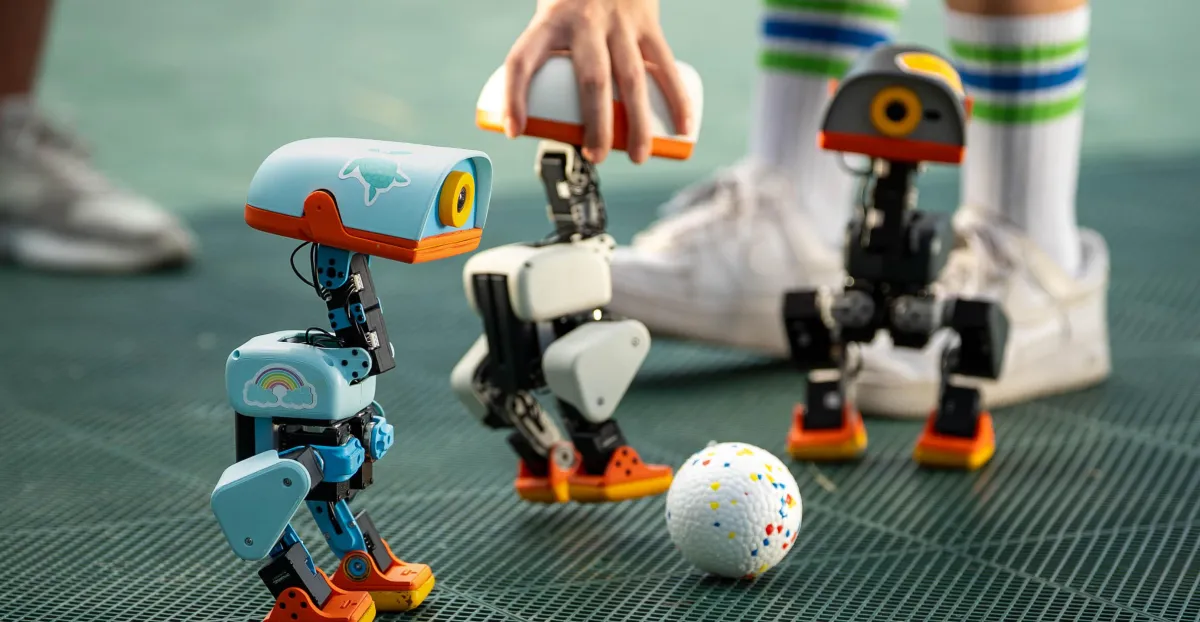
The Microduck is a one-eyed, bipedal robot that stands just under 10 inches tall and comes in four color options: cream, graphite, lavender and sky blue. It is the second cute, consumer-facing robot from Pollen Robotics, following the company’s earlier Reachy Mini release.
Unlike industrial robots built for factories or labs, the Microduck is being marketed as a small interactive machine that can move around a home, respond to prompts and be modified by users. Its compact size and lower price point place it in a rapidly growing category of tabletop and desktop robots aimed at enthusiasts, developers and curious consumers.
Why the Microduck matters
The Microduck matters because it reflects a broader shift in robotics: openness, personality and affordability are becoming part of the product pitch. In an industry where many robots remain expensive, closed and highly specialized, Hugging Face is betting that approachable design and open-source software can attract a wider audience.
The robot also arrives at a moment when AI companies are racing to pair language models with physical devices. For Hugging Face, which has built its reputation around open-source machine learning tools and model hosting, the Microduck expands its brand into a tangible product that can be bought, customized and experimented with at home.
Pollen Robotics says the Microduck is meant to feel more like a small creature than a traditional assistant, with a personal audio identity generated when it first powers on and tied to that unit for life.
How does the Microduck move and behave?
The Microduck is designed to do more than sit on a shelf. Video demonstrations show it picking up objects such as socks and markers, nudging a ball and gliding around on small rollerskates. Pollen Robotics says it can also react to nearby activity and follow a laser pointer.
Users can control the robot with a game controller, suggesting that the company wants the device to be both expressive and playful. The skating footage gives the robot a toy-like appeal, while the bipedal design and sensor suite hint at a more capable platform underneath the surface.
What hardware does it use?
The Microduck runs on a Rockchip RK3566 processor and includes a camera, motion sensors, LiDAR, articulated legs, a movable head and a flexible neck. That combination allows the robot to perceive its surroundings, balance as it moves and interact with its environment in a more dynamic way than a simple remote-controlled toy.
LiDAR and motion sensing are especially notable at this price level, since they help the robot map and respond to its surroundings. While the Microduck is clearly designed for fun, its hardware points to a product that could also be used for experimentation, demos and educational projects.
How does open-source software change the product?
Open-source software is central to the Microduck’s appeal. Pollen Robotics says the robot’s software is open-source, which means owners and developers can inspect the code, adapt it and train the robot to perform new behaviors.
That approach sets the Microduck apart from many consumer gadgets that are locked into a manufacturer’s own ecosystem. For programmers, hobbyists and researchers, the ability to retrain the robot adds long-term value beyond the initial novelty.
It also fits Hugging Face’s broader identity. The company has long promoted open access in AI, and applying that philosophy to hardware makes the Microduck part product, part platform. In practical terms, that could mean custom motions, new voice behaviors or entirely fresh use cases developed by the community.
What can owners customize?
Owners can reportedly retrain the robot to learn new tricks, which is one of the most important features in the product’s launch story. Rather than limiting behavior to a fixed set of preprogrammed actions, the Microduck is built to evolve through software updates and user experimentation.
- Open-source robot software
- Retrainable behaviors
- Game controller support
- Individualized voice identity
- Multi-sensor navigation and perception
Why does each Microduck sound different?
Each Microduck is designed to generate its own voice, and Pollen Robotics says that voice becomes part of the robot’s identity. According to the company, the first time the robot wakes up it creates a unique audio personality that is linked to that specific unit for life.
This is a notable design choice because it gives the robot a sense of individuality that goes beyond appearance. Instead of sounding like every other device in a product line, each unit develops a distinct vocal signature, which may make interactions feel more personal and memorable.
The company has described the sounds as more creature-like than assistant-like, reinforcing the idea that the Microduck is meant to be emotionally engaging rather than strictly utilitarian. That approach could help the product stand out in a crowded AI hardware market increasingly focused on companionship and character.
How much does the Microduck cost?
The Microduck is available to preorder for $399, placing it in the range of premium consumer toys and entry-level developer hardware. At that price, it is far more accessible than many humanoid robots, which often cost thousands or even tens of thousands of dollars.
The pricing strategy suggests that Hugging Face and Pollen Robotics are aiming for broad experimentation rather than enterprise deployment. A sub-$500 robot with sensors, open software and personality-driven features could appeal to developers, students, makers and robotics fans who want an approachable platform.
| Microduck Feature | Details | Why It Matters |
|---|---|---|
| Price | $399 preorder | Makes the robot comparatively accessible |
| Height | Just under 10 inches | Small enough for desks and shelves |
| Movement | Bipedal, rollerskates, controller support | Combines mobility with playful interaction |
| Software | Open-source | Allows modification and retraining |
| Shipping target | Before Christmas 2026 | Places the product in the holiday market |
How does the Microduck fit into Hugging Face’s strategy?
The Microduck extends Hugging Face’s robotics ambitions by pairing the company’s open-source software culture with a consumer-friendly physical device. The company’s earlier Reachy Mini robot helped establish that direction, but the Microduck pushes the concept further into novelty, affordability and charm.
That strategy is important because robotics often struggles with adoption outside specialist environments. By making a robot that is visually memorable, relatively affordable and easy to modify, Hugging Face may be trying to create a gateway product for the next generation of developers and hobbyists.
There is also a branding advantage. Hugging Face has become one of the most recognizable names in the open AI ecosystem, and a small robot that can skate and sing is likely to generate more attention than a traditional hardware announcement. In a market where personality can be as important as capability, the Microduck may be designed to spread awareness as much as revenue.
What does this say about the consumer robot market?
The Microduck highlights how consumer robotics is moving away from purely functional devices and toward products that blend utility, entertainment and emotional design. Recent robot launches have increasingly emphasized character, voice and openness, reflecting a belief that people will engage more deeply with machines that feel expressive.
At the same time, the robot shows how AI companies are trying to make hardware more approachable. Rather than asking buyers to accept a large, expensive humanoid, companies are experimenting with smaller machines that can sit comfortably in a home or office and do simple but delightful things.
That trend does not eliminate the technical challenges of robotics. Battery life, balance, safety, software stability and real-world reliability remain difficult problems. But a product like the Microduck suggests that the first wave of consumer adoption may come through charm, not perfection.
Timeline: from open-source software to a tiny robot
Hugging Face’s path into hardware reflects a gradual expansion from software tools into physical devices. The Microduck is the latest marker in that shift.
| Date | Event | Significance |
|---|---|---|
| Prior launch | Reachy Mini introduced | First cute robot from Pollen Robotics |
| August 27, 2026 | Microduck announced | Second consumer-oriented robot from the company |
| Preorder period | $399 preorders open | Begins the commercialization push |
| Before Christmas 2026 | Planned shipping window | Targets the holiday buying season |
Who is the Microduck for?
The Microduck appears to be aimed at a mix of robotics enthusiasts, AI developers, students and buyers looking for a quirky interactive device. Its open software and retrainable design make it especially attractive to people who want to tinker, while its small size and animated personality broaden its appeal to casual consumers.
It is less likely to replace a home assistant or serve as a serious labor-saving machine. Instead, it is positioned as a creative platform and conversation piece — a robot that invites users to explore what open-source hardware can look like in a compact, approachable form.
What comes next?
The immediate next step is shipping, with Pollen Robotics aiming to deliver the Microduck before the end of the year. If the company meets that timeline, the robot could become one of the more visible examples of low-cost, personality-driven AI hardware entering the market.
The larger question is whether open-source robotics can move beyond novelty and build lasting communities of users and developers. If the Microduck succeeds, it could help prove that a small, affordable robot with a distinctive voice and modifiable software can do more than entertain — it can also inspire the next phase of personal robotics.
For now, the Microduck stands as a playful, unusually charming attempt to make robots feel less intimidating and more alive. In a field often dominated by big promises and industrial prototypes, that alone makes it worth watching.
Frequently asked questions
What is Hugging Face’s Microduck robot?
The Microduck is a small open-source biped robot from Pollen Robotics, Hugging Face’s robotics arm. It stands under 10 inches tall, has a camera and sensors, can roll on tiny skates and is designed to be playful, customizable and developer-friendly.
How much does the Microduck cost?
The Microduck costs $399 to preorder. That price makes it much more accessible than many humanoid or research robots, and it positions the device as an affordable entry point for hobbyists, students and developers who want a modifiable robot platform.
Can the Microduck be customized?
Yes, the Microduck can be customized because its software is open-source. Pollen Robotics says users can retrain it to do new tricks, which means owners can experiment with different behaviors instead of being limited to factory settings.
When will the Microduck ship?
Pollen Robotics says the Microduck is expected to ship before Christmas 2026. The company opened preorders on August 27, 2026, making the holiday period the target for early deliveries.