In short
China’s World Humanoid Robot Games highlighted major gains in robot speed, balance and object handling. They also exposed how far the field still has to go before humanoids can work independently in messy real-world settings.
- The Beijing event drew more than 600 teams and over 2,000 robots from 16 countries.
- Tiangong Ultra won the 100-meter dash in 8.86 seconds and also took the long jump.
- Dexterity events such as cable plugging and tweezers tasks were meant to test practical usefulness.
- Some robots appeared to be remotely operated, showing autonomy is still incomplete.
- The games reflect China’s push to turn humanoid robotics into a real industrial tool.
The 2026 World Humanoid Robot Games in Beijing became a showcase for fast-running bots, awkward falls and surprisingly nimble hands. The event matters because it revealed how far humanoid robotics has advanced on speed and balance while also exposing how much work remains before these machines can operate independently in real-world jobs.
Held from August 22 through August 26 at Beijing’s National Speed Skating Oval, the competition drew hundreds of teams, more than 2,000 robots and participants from China and 15 other countries. What looked at times like a novelty sports festival also functioned as a live stress test for the humanoid industry’s hardware, software and commercial ambitions.
What happened at the World Humanoid Robot Games?
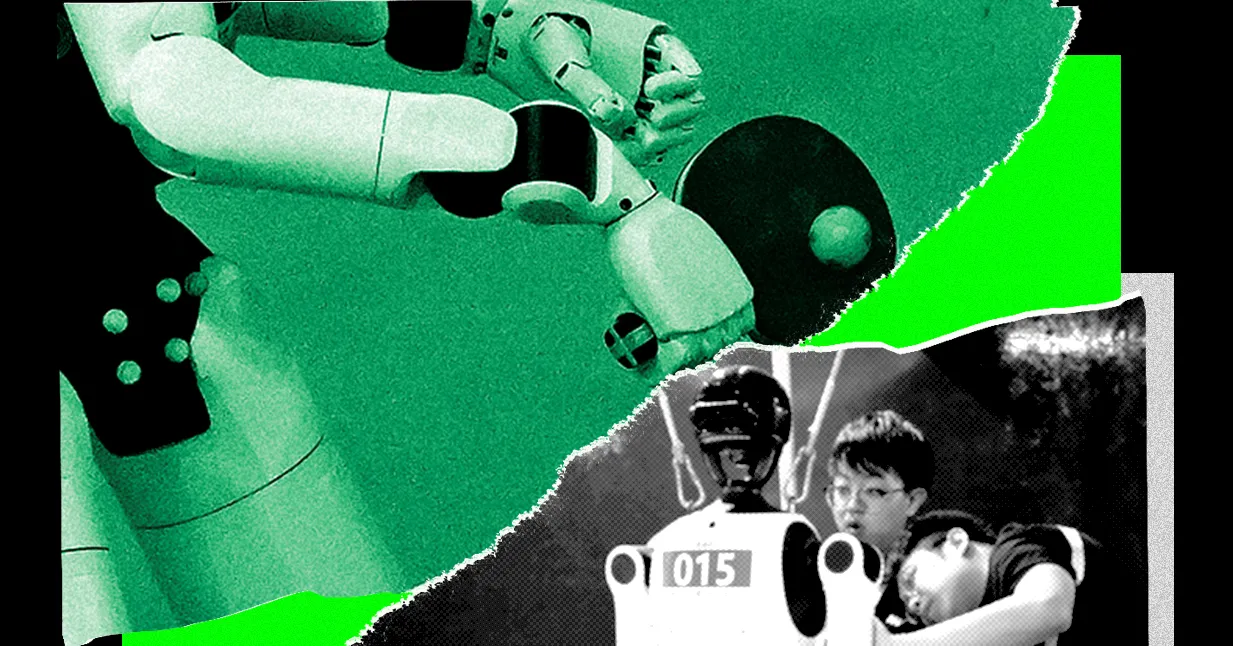
The World Humanoid Robot Games mixed athletic contests, dexterity trials and mock service tasks into one sprawling event. Some robots sprinted, jumped, played table tennis and even attempted combat sports, while others were challenged with jobs closer to everyday work, including object handling and basic cleaning.
The result was part engineering expo, part slapstick spectacle. The competition produced viral moments, but it also offered a useful snapshot of a field that is moving quickly from laboratory demos toward practical deployment.
Which robots stood out?
Several machines drew attention for standout performances. Tiangong Ultra, built by the Beijing Humanoid Robot Innovation Center, completed the 100-meter dash in 8.86 seconds, making it the fastest humanoid robot reported at the event. Another robot, Lightning from smartphone maker Honor, also posted a sprint time under the human world record previously set by Usain Bolt.
Tiangong Ultra also claimed the long jump with a distance of 7.97 meters, underscoring how much progress has been made in dynamic movement. Elsewhere, a robot challenged an Olympic-level table tennis player, while others attempted soccer, boxing and weightlifting.
| Robot | Company / Developer | Event | Result |
|---|---|---|---|
| Tiangong Ultra | Beijing Humanoid Robot Innovation Center | 100-meter dash | 8.86 seconds |
| Lightning | Honor | 100-meter dash | 9.47 seconds in one run; earlier test time reported at 9.32 seconds |
| Tiangong Ultra | Beijing Humanoid Robot Innovation Center | Long jump | 7.97 meters |
| Galbot robot | Galbot | Tennis / service tasks | Showed advanced perception and autonomy in limited scenarios |
How fast are humanoid robots getting?
Humanoid robots are now fast enough to compete in events that, only a few years ago, would have been unthinkable for walking machines. That progress has come from a combination of better motors, improved balancing systems and simulation-trained software that lets robots recover from instability at high speed.
China has become especially strong in this area. Roboticists say the country has excelled at building the hardware needed to support compact, high-power movement, and companies such as Unitree have helped make that progress visible to the public.
Why are running and jumping easier than grasping?
Running and jumping can actually be less difficult for robots than delicately handling objects. The reason is that locomotion can often be optimized in simulation, where algorithms explore many motion patterns and settle on a balance strategy that works, even if it looks awkward to human eyes.
Fine manipulation is another matter entirely. Picking up a cable, sorting blocks or moving a bean with tweezers requires precise control of friction, pressure and touch. Robots still struggle with those unpredictable details, which is why seemingly simple household tasks can be more difficult than a backflip.
Roboticists say this contrast reflects a classic idea in the field: the things humans find physically impressive are not always the hardest problems for a machine, while small-hand coordination can be far more demanding than acrobatics.
Why did the games focus so much on dexterity?
The event’s newer challenges suggested a clear industrial objective: move humanoids closer to tasks that matter in factories, warehouses and service environments. Events such as plugging cables into sockets, block building, trash disposal and “tweezer bean picking” were not designed for spectacle alone; they were meant to probe whether humanoids can perform useful labor in cluttered spaces.
That focus aligns with China’s broader push to automate manufacturing and logistics. Tasks like wiring a vehicle chassis or assembling electronics demand the kind of hand-eye coordination that remains one of robotics’ biggest hurdles.
What did the service-style contests test?
Several scenarios were modeled on real workplaces. Robots were asked to stock shelves in a supermarket setting, clean in a hotel-like environment and complete other tasks that resemble commercial service work. These environments are valuable because they combine predictable goals with unpredictable physical conditions.
Unlike a track race, a retail aisle or hotel room introduces obstacles, changing object positions and human proximity. That is where many humanoid systems still break down, especially when they must act without direct human control.
How autonomous were the robots?
Not fully autonomous, at least not across the board. Video and photos from the competition suggested that some robots were being remotely operated by humans for part of their routines, which is a reminder that the field’s most impressive demonstrations still blend machine capability with human assistance.
Even so, that does not make the results trivial. In several cases, human operators were still guiding machines that could execute delicate movements, including lifting tiny items with tools. That level of precision matters because it shows the hardware has advanced enough to support increasingly complex control systems.
What did Galbot demonstrate?
Galbot used the games to highlight capabilities it believes can translate into commercial deployment. The company participated in multiple competitions, including the supermarket stocking scenario, and also showed a robot that could play tennis against a human opponent.
According to the company, the goal is to move from structured settings toward open, less predictable environments where robots have to understand their surroundings, adapt to change and work alongside people. That progression is central to whether humanoids become useful products rather than just viral attractions.
Galbot said the games help its team push humanoid systems toward harder real-world scenarios, especially in environments where robots must collaborate with humans and handle uncertainty.
Why does China invest so heavily in robot competitions?
China appears to view robot competitions as both an industrial showcase and a public-relations opportunity. The games celebrate engineering progress, but they also help normalize the idea of humanoid robots as part of the country’s technological future.
That matters at a time when artificial intelligence is often discussed in terms of job loss and disruption. By turning robots into a source of national excitement, the event reframes automation as something aspirational rather than purely threatening.
How does this compare with the U.S. robotics scene?
The comparison is stark in tone, if not in technical ambition. Some researchers see China’s willingness to stage a huge public robot event as an advantage because it creates enthusiasm around science and engineering while also pressuring companies to move faster.
American robotics labs and startups continue to make important advances, particularly in manipulation, but the public-facing spectacle is less common. That difference may influence how quickly audiences, investors and policymakers understand the state of the field.
Chris Atkeson, a Carnegie Mellon roboticist, praised the enthusiasm surrounding the event and suggested that the U.S. could learn from the way China presents engineering as something worth celebrating.
What do the results say about the state of humanoid robotics?
The games showed that humanoid robots are getting faster, stronger and more stable. They also showed that the industry has not solved the hard problem of general-purpose dexterity, especially in chaotic environments where perception, touch and judgment must work together.
That divide is important for businesses tracking the sector. Speed records are impressive, but the commercial future of humanoids depends on whether they can reliably do useful tasks for long stretches, under variable conditions and with minimal supervision.
What are the biggest technical hurdles now?
The biggest hurdles are fine manipulation, autonomous decision-making and robust operation in uncontrolled spaces. Robots need better tactile sensing, better coordination between perception and movement, and software that can recover from errors without falling apart or burning out motors.
In many ways, the games underscored a central truth of robotics: hardware progress can arrive quickly, but practical autonomy is harder to achieve because the real world is messy, crowded and unpredictable.
Timeline of the 2026 World Humanoid Robot Games
The event unfolded over five days and escalated from showcase to competition to proof-of-concept demonstrations. Here is a simple timeline of the key moments.
| Date | Event | Significance |
|---|---|---|
| August 22 | Games begin in Beijing | Opening ceremonies highlight scale and international participation |
| August 23-25 | Race, sports and manipulation events | Robots compete in sprinting, jumping, table tennis, boxing and service tasks |
| August 26 | Games conclude | Results reinforce both progress in locomotion and gaps in autonomy |
What should readers take away from the robot spectacle?
The most important lesson is that humanoid robotics has entered a new phase. The machines are no longer merely curiosities that can stand upright for a few seconds; they are now capable of running, leaping and manipulating objects with enough skill to attract public attention on a global scale.
But the event also made clear that the leap from demo to deployment remains substantial. A robot that can race quickly is still not necessarily ready to stock shelves, wire a chassis or navigate a crowded room without help.
That is why the World Humanoid Robot Games matter. Beneath the comic tumbles and headline-making sprint times, they reveal the real competition in robotics: not who can make the most entertaining machine, but who can build one that is finally useful.
Key facts from the Beijing robot games
- More than 600 teams and over 2,000 robots took part, according to organizers.
- Participants came from China and 15 other countries.
- Tiangong Ultra won the 100-meter dash in 8.86 seconds and the long jump at 7.97 meters.
- Some events were designed to test practical dexterity, including cable plugging, block building and trash disposal.
- Remote operation appeared to play a role in some demonstrations, limiting full autonomy claims.
Why the event resonates beyond robotics fans
The robot games resonate because they translate a technical field into a form the public can immediately understand. A sprint is easy to compare. A fall is easy to laugh at. A careful cable insertion is easy to appreciate once you realize how hard it is for a machine.
That accessibility helps explain the event’s broad appeal. It also makes the games useful for industry: they create a vivid way to communicate progress, attract talent and set a benchmark for what humanoid systems should do next.
For now, the strongest robots in Beijing can outrun people, jump farther than many athletes and impress observers with their hands. The next milestone will be far less glamorous but much more important: robots that can do ordinary work reliably, safely and on their own.
Frequently asked questions
What are the World Humanoid Robot Games?
The World Humanoid Robot Games are a multi-event robotics competition in China that pits humanoid machines against each other in races, sports and practical tasks. They are designed to showcase progress in hardware, control systems and real-world robotic capabilities.
Which robot was the fastest at the 2026 games?
Tiangong Ultra was the standout sprint performer at the 2026 games, running the 100-meter dash in 8.86 seconds. That made it the fastest humanoid robot reported at the event and faster than several other notable competitors.
Were the robots fully autonomous?
No, not across the board. Some of the most impressive demonstrations appeared to involve human teleoperation, which means operators were remotely controlling parts of the robots’ actions. That shows the systems are advancing, but still not fully independent.
Why were there tasks like cable plugging and tweezers picking?
Those tasks were included to test fine motor control and practical manipulation, which are much harder for robots than running or jumping. They reflect the real industrial goal of building machines that can handle warehouse, factory and service work.