Updated August 27, 2026 11:55 am
In short
Runable has raised $21 million to expand its AI agent from building websites and apps into helping small businesses find customers and run growth tasks, while revealing heavy usage, negative margins, and an early ad-buying workaround for ChatGPT campaigns.
- Runable raised a $21 million Series A led by Susquehanna Venture Capital and Nexus Venture Partners.
- The Bengaluru startup is shifting from AI-powered creation tools to customer acquisition and business growth.
- Runable says it has about 1.7 million registered users and processed more than 1 trillion tokens in 90 days.
- The company reports negative gross margins for now as it subsidizes AI usage.
- Its main competition includes general-purpose agents and coding tools, but Runable is focused on small business outcomes.
Update — August 27, 2026 11:55 am
Runable also disclosed more detail on the economics behind its rapid growth: Kumar said more than 60% to 70% of the company’s token usage over the past 90 days came from paying customers, but the startup is still running at negative gross margins because it is subsidizing AI usage.
Kumar said the company is working with a mix of models, including some it is developing itself, and expects lower inference costs over time to improve margins.
On product limits, Runable said it can already run ads without a customer connecting an external ad account for campaigns on ChatGPT, backed by undisclosed partnerships it described as a “soft wedge.” In tests, the company could build and deploy a site and prepare an ad campaign, but still needed an ad account before actually spending a budget.
Indian startup Runable has raised $21 million in Series A funding to push its AI agent beyond building websites and apps and into helping small businesses win customers, run ads, and manage growth. The Bengaluru company says the round values it at $65 million after investment and signals a broader shift in the AI market from creation tools to outcome-driven automation.
For Runable, the bet is simple: many founders now use AI to launch a business, but the harder problem is what happens after launch — attracting traffic, converting visitors, and keeping marketing costs manageable. The startup wants its agent to handle that next stage as a single system rather than a stack of separate tools.
What Runable is building now
Runable is building an AI agent aimed at nontechnical entrepreneurs and small business owners who want to move from an idea to a functioning business without assembling dozens of software products. The platform already generates websites, apps, presentations, and other content from natural-language instructions while also managing some deployment and analytics tasks.
The company is now extending that system into what it calls the “grow” phase, which includes ad campaigns, social media management, search optimization, and improving how a business appears in AI chatbot results. In practical terms, Runable wants users to ask for customers, not just code or content.
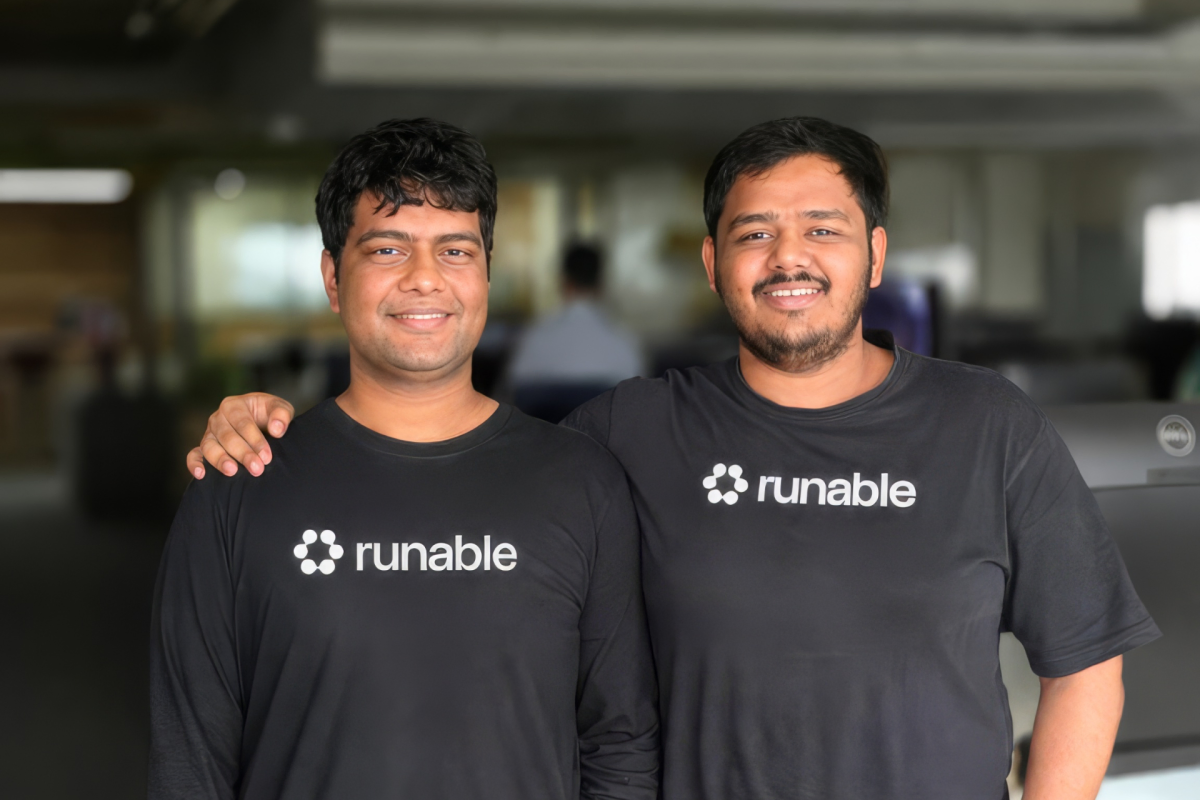
Co-founder and chief executive Umesh Kumar said the startup’s thesis is that business owners care less about whether an AI system can write code and more about whether it can deliver measurable results. He framed the opportunity as replacing expensive agencies and fragmented software workflows with a single AI layer that can do the operational work more cheaply and faster.
“In the end, a business doesn’t require Codex or Claude Code or anything. They require real outcomes,” Kumar said, arguing that a company spending heavily on Google Ads may want a lower-cost automated alternative.
How did Runable get here?
Runable did not begin as a marketing automation company. It was founded in 2025 by Kumar and co-founder Saksham Sarda as an AI infrastructure startup focused on browser technology that could scrape data at scale. Over time, however, the founders noticed a change in how customers were using the product.
Instead of only pulling data, users increasingly asked the browser-based agent to generate slide decks, websites, and other finished assets. That pattern convinced the team to pivot toward a more general-purpose AI agent capable of producing real business outputs rather than just underlying infrastructure.
The shift appears to have paid off quickly. Kumar said Runable reached a $2 million annualized revenue run rate within three weeks of turning on payments in March, underscoring how quickly demand can emerge when AI tools are tied to practical business functions.
From infrastructure to outcomes
The pivot from browser automation to business growth tools reflects a wider trend in AI. The market is no longer only rewarding products that generate code or text; investors increasingly want systems that can carry out a full workflow and create measurable business value.
That helps explain why Runable is framing itself around outcomes. A small business owner may not want to know how to deploy a website, connect analytics, configure ad accounts, or optimize search performance. Runable’s pitch is that the platform can connect those steps and execute them in one place.
Why investors backed the expansion
Runable’s Series A was co-led by Susquehanna Venture Capital and Nexus Venture Partners, with participation from existing backers Together Fund and Array VC. The financing was structured as an all-equity primary round, according to Kumar, and marks a meaningful step up for the startup as it races to define a new category in the AI stack.
The size of the raise suggests investors are willing to support a company that sits at the intersection of AI agents, marketing automation, and small-business software. It also reflects the belief that there may be room for product differentiation even in a market crowded by foundational model companies and fast-moving AI application startups.
Runable is only 15 people strong, but it already serves a large user base. Kumar said the platform has around 1.7 million registered users, with its biggest markets currently in the U.S., the UK, and Japan. The company also has users in Brazil, though its near-term commercial focus is on the first three markets.
Japan, Kumar said, is becoming especially important and could soon rank alongside the U.S. as one of Runable’s strongest markets.
| Key metric | Details |
|---|---|
| Funding raised | $21 million Series A |
| Post-money valuation | $65 million |
| Founded | 2025 |
| Team size | 15 employees |
| Registered users | About 1.7 million |
| Annualized revenue run rate | $2 million shortly after payments launch |
| Recent usage | More than 1 trillion tokens in 90 days |
What makes Runable different from coding agents?
Runable is not positioning itself as a direct rival to AI coding tools for developers. Kumar said products such as OpenAI’s Codex or Anthropic’s Claude Code make more sense for people already working with local files and writing software. Runable, by contrast, is aimed at owners who may not have the technical expertise or patience to orchestrate multiple tools on their own.
That distinction matters because AI coding agents and general-purpose business agents may sound similar but solve different problems. Coding tools help a user create software. Runable wants to help a business operate, market itself, and acquire customers.
The company sees its most relevant competitors as general-purpose agents such as Manus and Genspark, which are also targeting broad consumer and business use cases. But Runable argues that its value lies in combining creation, infrastructure, and distribution into one platform.
How is Runable trying to win customers?
Runable is trying to win customers by reducing the number of steps required to launch and grow a business. The company says its system can handle website creation, analytics, ad execution, social promotion, SEO, and chatbot visibility in a single flow instead of forcing users to stitch together separate services.
That approach is especially relevant for small businesses that often rely on freelancers, agencies, and multiple software subscriptions to reach customers. If Runable can automate enough of that workflow, it could appeal to founders who care more about affordability and simplicity than technical control.
Still, the company faces an important challenge: proving that an AI agent can reliably execute business-critical work without making costly mistakes. Running a website or drafting an ad campaign is one thing; managing paid marketing spend and customer acquisition at scale is another.
How Runable tested in the real world
A test of Runable by TechCrunch found that the platform could build and deploy a website for a fictional coffee subscription company, set up analytics, and prepare an advertising campaign aimed at bringing in the first 100 visitors on a $25 budget. But the agent did not fully launch the ad, because it first needed a connected advertising account.
The result points to both the promise and the current limits of AI business agents. The system did more of the work inside its own platform than some comparable tools, but it still depended on external accounts before it could spend money on advertising.
That limitation was not unique to Runable. A similar test on Cursor produced some of the same friction, including the need for a Meta Ads account, payment method, and an external service to permanently deploy the website. The difference, according to Runable, is that its platform handles more of the core infrastructure itself rather than pushing users out to separate services for every step.
What is the “soft wedge” Runable mentions?
The company says it can already run certain ads without customers connecting their own ad accounts in some cases, specifically for ads on ChatGPT. Runable describes those capabilities as being enabled through partnerships it would not identify publicly and calls them a “soft wedge” into a broader advertising workflow.
That phrasing suggests the startup is using selective integrations to prove the concept before expanding the system more broadly. In a market where access to ad platforms and AI distribution channels can be a competitive advantage, those relationships may matter as much as the underlying model quality.
The economics: big usage, limited margins
Runable’s growth comes with a cost. Kumar said the company has negative gross margins at present, in part because it subsidizes the AI usage customers consume on the platform. That means the company is spending more to serve users than it is currently bringing in from them.
Even so, Kumar sounded confident that the economics will improve over time as inference costs fall and the company optimizes its model stack. Runable says it is working with multiple models, including some it is building itself, as it looks for a lower-cost path to similar output quality.
Kumar said the company sees a future in which the same level of AI inference could cost roughly one-tenth of current prices, making it easier to support business workflows profitably.
The scale of usage helps explain why the business remains expensive to run. Kumar said customers used more than 1 trillion tokens across the last 90 days, and about 60% to 70% of that activity came from paying users. That level of consumption suggests genuine engagement, but it also highlights the infrastructure bill behind an ambitious agentic platform.
| Timeline | Milestone |
|---|---|
| 2025 | Runable is founded in Bengaluru |
| Early stage | Company focuses on browser-based AI infrastructure and data scraping |
| Product discovery | Users begin asking the agent to create slides and websites |
| March 2026 | Payments launch, leading to rapid revenue growth |
| Three weeks after payments launch | Annualized revenue run rate reaches $2 million |
| August 2026 | Company raises $21 million Series A |
What does this say about the AI market?
Runable’s raise illustrates a larger shift in the AI industry. A few years ago, the most obvious opportunities were in chatbots, model access, and developer tools. Now, startups are increasingly competing to turn AI into a full operating layer for business tasks such as selling, marketing, support, and analytics.
That move up the value chain matters because it changes the question customers ask. Instead of buying access to a model, they are buying an outcome. For small businesses, the outcome might be more leads, better search visibility, or a website that actually converts.
It also puts startups like Runable into a more complicated competitive field. They are not just competing with fellow application startups. They are also competing with the model companies themselves, many of which are building agent products and feature layers that could absorb some of the same use cases.
Why competition may intensify
Competition could intensify because the same companies powering AI generation are increasingly building the interfaces that sit on top of their models. If those model providers make their own agents more capable, smaller startups may struggle unless they own a distinct workflow or customer segment.
Runable’s answer is focus. It is aiming at a specific class of user — small businesses and nontechnical founders — and a specific job: turning AI-generated output into customers. That specialization may help it survive where broader tools get diluted.
At the same time, the company must prove that it can maintain product quality while reducing costs. If margins remain negative for too long, it could be forced to raise prices, narrow usage, or slow growth.
Where the startup goes next
Runable’s immediate goal is to deepen its “grow” functionality and make the path from business creation to customer acquisition feel seamless. That means more automation around search, social, ads, and AI discovery, as well as stronger infrastructure for users who do not want to manage back-end systems themselves.
For now, the startup appears to be balancing two realities: strong early demand and an expensive operating model. Investors are backing the belief that the company can turn usage into a sustainable platform, and that the economics of AI will improve enough to support that outcome.
If Runable succeeds, it could become a case study in how AI agents evolve from assistants that make things to systems that help businesses sell them. That is a more ambitious promise than simply generating code or content, but it may also be where the next wave of AI value is created.
Key facts at a glance
- Company: Runable
- Headquarters: Bengaluru, India
- Founded: 2025
- Funding: $21 million Series A
- Post-money valuation: $65 million
- Primary focus: AI agents for building and growing small businesses
- Reported users: About 1.7 million registered users
- Recent scale: More than 1 trillion tokens used in 90 days
For the startup market, the significance of Runable’s raise goes beyond one company’s valuation. It is another sign that investors increasingly want AI products that can tie directly to revenue, not just novelty, productivity, or experimentation.
Frequently asked questions
What did Runable raise and why does it matter?
Runable raised $21 million in Series A funding to expand an AI agent aimed at helping small businesses grow, not just build websites and apps. The raise matters because it shows investors are backing AI products that promise direct business outcomes such as leads, ads, and customer acquisition.
How is Runable different from AI coding tools like Codex or Claude Code?
Runable is different because it targets business owners who want outcomes rather than code. While tools like Codex or Claude Code are better suited to developers writing software, Runable is designed to handle infrastructure, analytics, ads, SEO, and customer growth in one workflow.
Who invested in Runable’s Series A?
Runable’s Series A was co-led by Susquehanna Venture Capital and Nexus Venture Partners. Existing investors Together Fund and Array VC also joined the round, which the company says was an all-equity primary financing.
Is Runable already generating revenue?
Yes, Runable says it has already reached a $2 million annualized revenue run rate after launching payments in March. The company also said users consumed more than 1 trillion tokens over the past 90 days, with most of that usage coming from paying customers.
What are Runable’s biggest challenges?
Runable’s biggest challenges are profitability and competition. The company says it currently has negative gross margins because it subsidizes AI usage, and it competes with both model makers building their own agents and startups offering general-purpose AI workflows.