Updated August 21, 2026 6:53 pm
In short
Linkdaze’s household smart calendar syncs major platforms, adds chores and meal planning tools, and now has confirmed pricing and a no-subscription pitch that undercuts Skylight on upfront cost.
- Linkdaze is pitching a household-focused smart calendar, not a personal scheduling gadget.
- The device syncs with Google, iCloud, Outlook, Yahoo and Cozi calendars.
- A Snap-to-Sync AI feature turns photographed recipes or lunch menus into meal plans and shopping lists.
- Core features do not require a monthly subscription, unlike some competing products.
- The 10.1-inch model costs $119.99, undercutting a comparable Skylight device.
Update — August 21, 2026 6:53 pm
Linkdaze says its 10.1-inch smart calendar costs $119.99, making it cheaper upfront than Skylight’s comparable 10-inch device.
The company also says its core features do not require a monthly subscription, while Skylight charges $79 a year for extra functionality.
Update — August 20, 2026 9:54 pm
Linkdaze has also confirmed pricing and says the 10.1-inch model costs $119.99, undercutting Skylight’s comparable 10-inch device at $159.99.
The company is still leaning on its no-subscription pitch for core features, a contrast with rivals that charge monthly fees for extras.
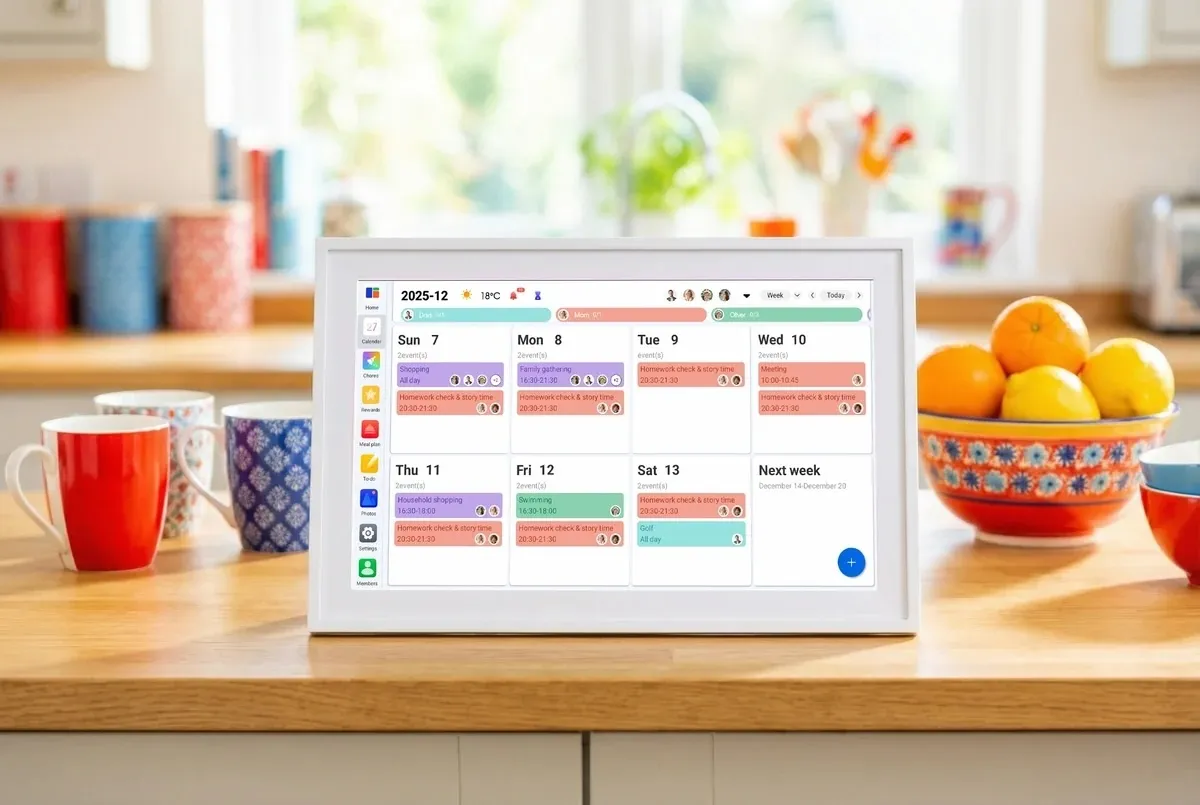
Linkdaze has launched a smart digital calendar designed to manage an entire household, not just one person’s schedule, as families head into the busy back-to-school season. The wall-mounted tablet pulls together multiple calendars, meal plans, chores, shopping lists and photos in one place, positioning itself as a cheaper, subscription-free alternative in a growing smart-home category.
The pitch is simple: when school pickups, work meetings, sports practices, doctor visits and grocery runs all collide, a traditional paper calendar — or even a standard calendar app — can quickly become inadequate. Linkdaze’s new device tries to solve that problem by acting as a shared family hub that sits visibly in the home and keeps everyone aligned.
What makes the product notable is not just the hardware, but the way it combines familiar household organization tasks with a few AI-driven conveniences. It also enters a market where some rivals increasingly rely on monthly fees, giving Linkdaze an opportunity to appeal to buyers who want a one-time purchase instead of another recurring subscription.
What is Linkdaze trying to solve?
Linkdaze is trying to reduce the friction of coordinating multiple people, multiple calendars and multiple responsibilities inside one home. For parents, roommates and caregivers, the challenge is not simply remembering one appointment — it is seeing every commitment in context and making sure nothing slips through the cracks.
That need becomes especially obvious during periods like the start of the school year, when households are flooded with new schedules, activity sign-ups, transportation responsibilities and recurring events. Linkdaze’s idea is to replace scattered planning across paper notes, phone apps and text messages with a shared display that everyone can check at a glance.
Why a household calendar matters now
Household coordination has become more complicated as modern families use different calendars and different devices. One child may be on Google Calendar, another parent may use iCloud, a caregiver may rely on Outlook, and a family organizer like Cozi may already be in the mix. The result is often fragmented planning that lives in silos.
Linkdaze’s promise is not that it invents a new category of task management, but that it packages those tasks into a visible, central display designed for the home. In that sense, it behaves more like a household bulletin board with software intelligence than a conventional calendar app.
How does Linkdaze work?
Linkdaze works by syncing with the services a household already uses and then presenting that information on a touchscreen tablet. The company says it supports calendars from Google, Apple’s iCloud, Microsoft Outlook, Yahoo and Cozi, giving families the flexibility to keep existing workflows rather than forcing everyone onto a single platform.
Once connected, the system color-codes entries so different family members are easy to identify. That visual layer is important because households do not just need a list of events; they need an immediate way to see who is doing what, when and where.
Supported calendar services
The strongest selling point is cross-platform compatibility. Instead of asking one parent to abandon their preferred calendar or forcing everyone to adopt the same app, Linkdaze brings multiple schedules into one shared interface.
- Google Calendar
- iCloud Calendar
- Microsoft Outlook
- Yahoo Calendar
- Cozi family organizer
That broad support gives Linkdaze a practical advantage in mixed-platform households, where calendar compatibility can otherwise be the biggest barrier to adoption.
What features does the device include?
Linkdaze is being sold in two screen sizes, a 15.6-inch model and a smaller 10.1-inch version, so buyers can choose based on available wall space and household needs. The larger display may better suit a busy kitchen or family room, while the smaller one could fit apartments, dorm-style shared living spaces or tighter entryway walls.
Beyond schedule management, the device is built to cover a range of household planning tasks. Users can assign chores, track rewards, build meal plans, maintain shopping lists and display family photos. That combination is meant to make the screen feel less like a niche gadget and more like a shared household dashboard.
It can also double as a digital photo frame, which may help the product blend into the home environment when it is not actively showing schedules or to-do lists. In the increasingly crowded smart-display market, that sort of dual-purpose design can be a meaningful differentiator.
Core feature set at a glance
| Feature | What it does | Why it matters |
|---|---|---|
| Calendar sync | Connects Google, iCloud, Outlook, Yahoo and Cozi | Keeps all household schedules in one place |
| Color coding | Assigns different colors to family members | Makes events easier to scan quickly |
| Chores and rewards | Tracks household tasks and incentives | Supports routine and accountability |
| Meal planning | Organizes meals for the week | Helps with shopping and food prep |
| Shopping lists | Builds and maintains grocery lists | Reduces forgotten items and duplicate purchases |
| Photo display | Shows family photos when idle | Makes the device feel more home-friendly |
How does the AI meal planner work?
Linkdaze’s most distinctive feature is an AI-assisted meal planning tool called Snap-to-Sync, which turns physical information into digital planning data. The idea is straightforward: instead of retyping a recipe or school lunch menu, the user takes a photo and the system converts that image into a meal plan and shopping list.
In practice, this could save time for parents who are juggling weekly meal prep, school lunches and grocery runs. It also lowers the barrier for households that still rely on paper materials, handwritten notes or printed menus. Rather than asking users to change their habits, Linkdaze tries to digitize them.
The feature is not entirely unprecedented. Other apps and devices have experimented with document capture and AI-powered organization tools. What Linkdaze appears to be doing differently is integrating that capability directly into a household calendar that already aims to be the center of family planning.
The company’s pitch suggests the value is not in novelty for its own sake, but in simplifying the everyday work of turning paper-based family logistics into something a household can act on immediately.
Who is the product for?
Linkdaze is aimed primarily at busy families, but its use cases extend beyond parents with school-age children. The company’s pitch also makes sense for roommates, college apartments, multi-generational homes and even freelance workers or remote employees who want a visible shared scheduling hub.
For parents, the value lies in coordinating kids’ school pickups, activities, meal planning and chores. For roommates, it could help divide cleaning duties, track shared meals and keep study schedules aligned. For workers with hectic calendars, it could serve as a central reminder board that sits in a common space rather than buried in a phone.
Likely household use cases
- Managing school calendars and after-school activities
- Coordinating work meetings and family appointments
- Assigning chores and rewards to children
- Planning meals and grocery trips
- Sharing schedules in apartments and shared homes
Because the screen is always visible, Linkdaze may be especially helpful in homes where family members are constantly asking the same question: “What’s happening today?”
How much does Linkdaze cost?
Linkdaze is priced below one of its better-known competitors, which could help it attract budget-conscious households. The 10.1-inch model starts at $119.99, while a comparable 10-inch Skylight device costs $159.99.
The pricing gap may not look dramatic at first glance, but in consumer hardware every dollar matters, especially for a product that could be perceived as a luxury rather than a necessity. If households are deciding whether to buy a smart family calendar at all, the lower entry price may be enough to win some of those purchases.
Price comparison
| Product | Screen size | Upfront price | Subscription model |
|---|---|---|---|
| Linkdaze | 10.1 inches | $119.99 | No monthly fee for main features |
| Skylight | 10 inches | $159.99 | Extra features available through $79/month plan |
The larger 15.6-inch Linkdaze model was announced as part of the lineup, though the source material did not list its pricing. Even without that number, the positioning is clear: Linkdaze wants to be seen as the more affordable option for families who want core smart-calendar features without an ongoing bill.
Why is the no-subscription model important?
The absence of a mandatory monthly subscription is one of Linkdaze’s biggest commercial selling points. In smart-home hardware, it has become increasingly common for devices to depend on subscription revenue for advanced features, cloud services or premium tools. That can make the initial purchase price look appealing while the true cost rises over time.
Linkdaze is taking a different approach by keeping its main functions available without recurring fees. For consumers, that can be a relief. For the company, it is a strategic gamble: it may help hardware sales, but it also limits a revenue stream that many competitors have embraced.
That tension is at the heart of the product’s business model. If Linkdaze can win enough households on value and simplicity, the no-subscription pitch could become a strong differentiator. If not, it may find itself squeezed between lower-priced tablets and more feature-rich subscription ecosystems.
In a market where many products push users toward recurring payments, Linkdaze is betting that a one-time purchase and straightforward household utility will be enough to stand out.
How does Linkdaze compare with competing smart calendars?
Linkdaze appears to be aiming directly at devices such as Skylight, which already has name recognition in the family-calendar space. The competitive angle is not about inventing the smart calendar category, but about refining the value proposition around price, flexibility and subscription-free basics.
Some competitors lean heavily on cloud-connected services, premium software features and recurring fees. Linkdaze is instead emphasizing compatibility with widely used calendar platforms, visible household organization and a lower upfront cost. That could be especially attractive to practical buyers who want utility over a long list of add-ons.
The challenge for Linkdaze will be execution. In consumer electronics, products often sound compelling on paper but win or lose on screen responsiveness, software reliability, setup simplicity and whether the device genuinely becomes part of daily family routines.
What are the strengths and risks?
Linkdaze has several clear strengths. It addresses a real household problem, integrates with the tools families already use, offers a useful mix of planning features and avoids the frustration of monthly fees. It also arrives at a time when households are actively trying to regain control of increasingly complicated schedules.
But the product also faces risks. The smart-display category is crowded and consumers are selective about which devices deserve wall space in the home. If Linkdaze is too limited, too cluttered or too dependent on gimmicks, it may struggle to stand out. And if the company cannot support the product well over time, buyers may hesitate to trust it as a central household tool.
Main advantages
- Works with several major calendar platforms
- Aims at real household scheduling pain points
- Includes meal planning, chores and shopping tools
- Offers a lower-cost entry point than some rivals
- Does not require a subscription for core functionality
Main challenges
- Competing in a crowded smart-home display market
- Convincing buyers to dedicate wall space to a gadget
- Proving the AI tools save meaningful time
- Maintaining software quality without subscription revenue
Why the back-to-school timing matters
Launching a household calendar product as school routines ramp up is no accident. Back-to-school season is one of the most schedule-heavy periods of the year for families, with new pickup times, sports seasons, after-school programs, homework expectations and lunch planning all arriving at once.
That timing helps Linkdaze frame itself as a practical solution rather than a novelty. The device is not being marketed as a futuristic smart-home toy. It is being positioned as an everyday coordination tool for a time of year when families feel the strain of organization most acutely.
In that sense, the product’s timing also serves as a marketing message: if a household calendar can survive September, it can probably justify its place in the home the rest of the year.
What does Linkdaze signal about the smart-home market?
Linkdaze reflects a broader shift in consumer technology toward devices that do one thing extremely well for a very specific household need. Rather than trying to be a universal assistant, it focuses on a familiar pain point: the logistics of running a home.
That focus is important because many consumers are now more cautious about buying connected hardware. They want clear value, minimal setup and a product that solves a daily problem. A calendar that organizes the home, not just an individual user, fits that trend neatly.
It also shows how AI is being used in increasingly ordinary settings. Instead of headline-grabbing generative features, the Snap-to-Sync tool represents a more practical application: taking a photographed paper menu or recipe and turning it into something usable with less manual effort. For many households, that kind of utility may matter more than flashy technology.
Bottom line
Linkdaze is entering the smart-calendar market with a clear pitch: help households manage schedules, chores and meals in one visible place, and do it without charging a monthly fee for the basics. The combination of calendar syncing, household planning tools, AI meal capture and lower upfront pricing gives the device a coherent identity in a crowded category.
Whether that is enough to turn it into a mainstream home staple will depend on execution and consumer trust. But as families head into one of the busiest planning seasons of the year, Linkdaze is making a case that the future of the family calendar may be less about personal productivity and more about running the entire household.
| Timeline | Development | Why it matters |
|---|---|---|
| Back-to-school season | Households face a surge in scheduling demands | Creates demand for shared planning tools |
| Product launch | Linkdaze introduces its smart calendar | Positions the device as a household organizer |
| Feature rollout | AI meal planning and Snap-to-Sync are highlighted | Adds differentiation beyond calendar syncing |
| Market comparison | Competitors like Skylight rely more on subscriptions | Strengthens Linkdaze’s no-fee pitch |
Frequently asked questions
What is Linkdaze’s smart calendar?
It is a touchscreen household calendar designed to organize an entire home, not just one user. The device combines shared schedule syncing, chore tracking, meal planning, shopping lists and photo display in a wall-mounted format.
Does Linkdaze work with Google Calendar and iCloud?
Yes. Linkdaze supports Google Calendar, Apple iCloud, Microsoft Outlook, Yahoo and Cozi, which makes it easier for families to keep different calendars connected without forcing everyone onto one platform.
How much does Linkdaze cost?
The 10.1-inch Linkdaze model is priced at $119.99. That puts it below a comparable 10-inch Skylight device, which starts at $159.99, making Linkdaze the lower-cost option at launch.
What is Snap-to-Sync on Linkdaze?
Snap-to-Sync is Linkdaze’s AI meal-planning feature. It lets users photograph a paper recipe or a school lunch menu and converts that image into a digital meal plan and shopping list.
Does Linkdaze require a subscription?
No, not for its main features. Linkdaze is positioning itself as a subscription-free alternative in a market where some competing smart calendars charge monthly fees for additional tools.