Updated August 18, 2026 1:24 pm
In short
Wispr has raised $280 million at a $2 billion valuation and is using the money to expand into meetings, hardware partnerships and new interface experiments while also trying to improve dictation quality.
- Wispr raised a $280 million Series B led by Menlo Ventures at a $2 billion valuation.
- The company plans to expand from AI dictation into meetings, hardware partnerships and new interfaces.
- Wispr says its new Canto model will cut dictation errors from around 30% to below 10%.
- The startup faces growing competition from both established and low-cost dictation apps.
- Wispr has now raised $361 million in total funding.
Update — August 18, 2026 1:24 pm
Wispr also said it is extending its reach beyond software by working with hardware makers, including the Oasis ring, so users can dictate more quietly on their devices.
The company additionally said its go-to-market teams have expanded in markets such as India and the U.K. since last November, signaling a broader international push alongside its product expansion.
Wispr last month announced Wispr Interface Labs, led by Ariya Rastrow, to explore new human-computer interaction interfaces beyond dictation and meetings.
Update — August 17, 2026 4:24 pm
Wispr has also launched a new interface-focused effort called Wispr Interface Labs, led by Ariya Rastrow, who previously worked on Amazon Alexa.
The company says the lab will be used to explore new ways people can interact with computers, adding another layer to its push beyond dictation and meeting tools.
Wispr has raised $280 million in Series B funding at a $2 billion valuation, giving the AI dictation startup fresh firepower to expand beyond voice-to-text into meetings, hardware integrations and new human-computer interfaces. The round, announced on Monday, underscores both the growth of the company’s business and the intensifying competition in speech and productivity software.
The funding comes less than 10 months after Wispr’s previous round and lifts the company’s total financing to $361 million. Menlo Ventures led the latest investment, with both existing backers and a wave of new firms joining in, as Wispr tries to defend its position in a crowded market where consumers and professionals have more alternatives than ever.
At the same time, Wispr is promising a technical reset. The company says its new speech model, Canto, is designed to sharply reduce dictation errors after some users complained of a recent drop in output quality. The startup says the model can bring error rates down from about 30% to below 10%, a meaningful improvement if it holds up in real-world use.
The new funding, product expansion and model update together suggest Wispr is no longer positioning itself as just another dictation app. It is trying to become a broader voice-first productivity platform with ambitions that overlap with note-taking, meeting capture, device control and, ultimately, new ways for people to interact with computers.
What Wispr announced and why it matters
Wispr’s latest financing round is notable for both its size and timing. A $280 million Series B is unusually large for a startup still best known for a single consumer-facing product, and the $2 billion valuation signals that investors see more than a niche transcription business.
The company is operating in a category that has become crowded quickly. AI dictation once looked like a relatively open lane, but apps such as Willow, Monologue, Aqua and Superwhisper have helped turn speech input into a competitive product segment. Some newer entrants are also offering free or lower-priced versions aimed at prosumers, putting additional pressure on pricing and retention.
That competition matters because dictation products tend to face a difficult balance: they must be accurate enough for professional use, fast enough to feel native and useful enough to justify ongoing subscription fees. If a user loses trust in the output, the product becomes harder to keep in daily workflows.
Wispr’s fundraising therefore does more than add cash. It buys time to improve accuracy, broaden the product line and build a larger distribution footprint before the market settles around a few leaders.
How is Wispr using the new money?
Wispr says the capital will support expansion into new product areas, especially meetings. That move is important because meeting software sits at the intersection of several lucrative categories: transcription, summarization, task extraction and workspace automation.
The company recently introduced a note-taker tool that can capture meeting content and generate summaries and action items. That brings it into closer competition with products such as Granola, Fireflies and Read AI, which have become familiar names in the AI meeting-assistant space.
Unlike a pure transcription tool, a meeting assistant can be designed to move beyond recording and summarizing. Wispr says there is room for its note-taker to connect with other tools, create documents or draft emails, and generally act as a bridge between conversations and follow-up work.
That broader workflow vision helps explain the size of the round. Investors are not just funding dictation; they are backing a potential productivity layer that could sit inside a user’s daily communication habits.
Product expansion at a glance
Wispr’s near-term strategy appears to center on four fronts:
- improving speech recognition quality in its core dictation product;
- adding meeting capture and summarization features;
- integrating with hardware and third-party tools;
- building a new interface layer for voice-driven computing.
Who backed the Series B?
The round was led by Menlo Ventures, and several of Wispr’s earlier supporters returned for another financing. Existing investors that participated again include Notable Capital, NEA, Neo Ventures, 8VC and MVP Ventures.
New backers in the round include Acrew, Forerunner, Goodwater, Peak XV, Together Fund and PLUS Capital. The mix of returning and first-time investors suggests that the company’s story is resonating both with firms that already know the product and with those newly convinced by its broader potential.
For a startup in a fast-moving market, that kind of cap table support can matter as much as the headline valuation. It gives the company room to spend on product development, sales, international expansion and strategic partnerships without immediately worrying about another raise.
Wispr said the new capital will help it widen its reach while it builds beyond dictation and into adjacent workflows such as meetings and device-based voice input.
Why users complained about dictation quality
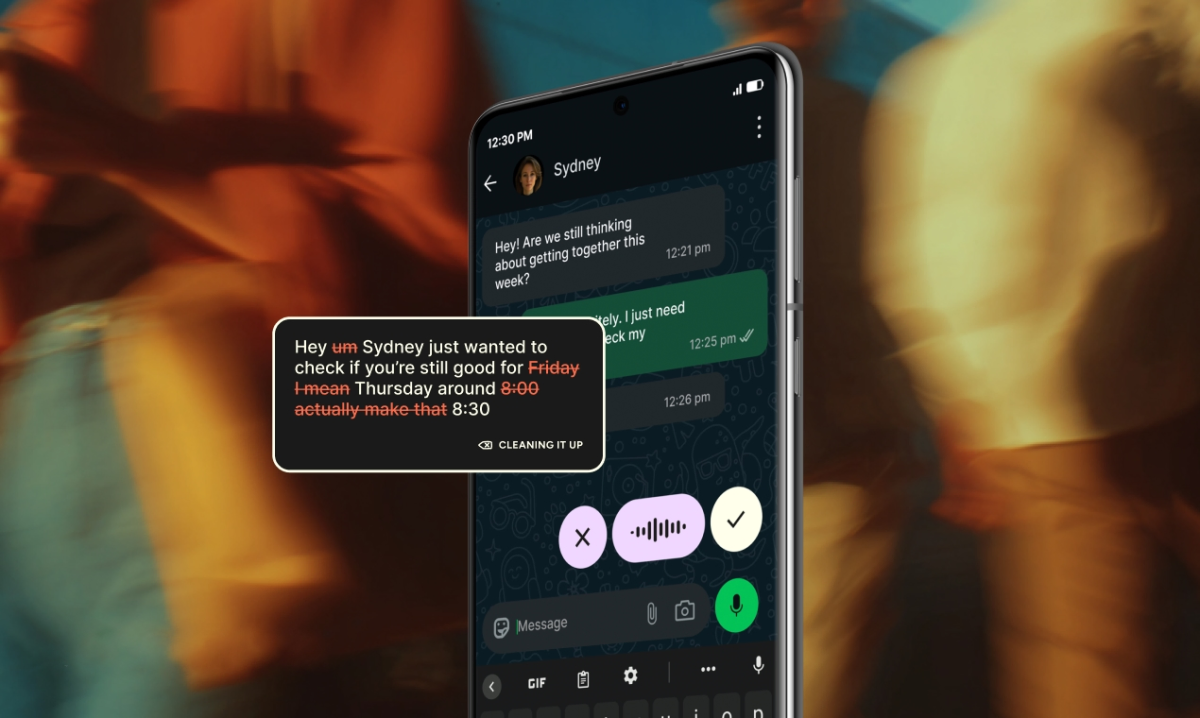
The funding announcement arrived alongside a product update that looks aimed at repairing trust. Over recent weeks, some users said Wispr Flow, the company’s dictation app, had become less reliable and produced worse output than before. In speech products, even a modest decline in quality can feel dramatic because users depend on the software in real time and often notice errors instantly.
Wispr says its new model, Canto, is intended to address that issue. The company claims the model can cut error rates from roughly 30% to under 10%, which, if accurate across a broad range of accents, environments and speaking styles, would be a substantial improvement.
Speech systems are notoriously difficult to perfect. Background noise, interruptions, microphone quality, accents, domain-specific vocabulary and even speaking pace can all influence results. That means a model’s performance in marketing materials may differ from its real-world reliability once thousands of users begin testing it across offices, homes, cars and mobile devices.
Still, the promise of better accuracy is central to Wispr’s pitch. Dictation software is only as strong as its trustworthiness, and the company appears aware that product quality will be just as important as funding in determining whether it can stay ahead of competitors.
How Wispr is broadening beyond dictation
Wispr has spent the past year moving out from its original niche. The company released its dictation app on Android last November, a significant step in reaching a wider audience beyond any one platform. It also expanded go-to-market operations in regions including India and the U.K., indicating a push toward international growth rather than a purely U.S.-focused strategy.
In parallel, Wispr has been experimenting with hardware partnerships. One example is its work with the Oasis ring, which is designed to let users issue dictation commands more discreetly, without having to speak loudly into a phone or computer. That kind of integration hints at a larger ambition: making voice input feel natural across different devices and contexts, not just on desktop software.
The startup also recently established Wispr Interface Labs, a research-oriented effort led by Ariya Rastrow, who previously worked on Amazon Alexa in its early years. The lab’s mission is to explore new forms of human-computer interaction, which suggests Wispr wants to be part of the next wave of interface design rather than remaining a single-purpose transcription company.
That is a significant strategic shift. Dictation products can be useful, but they are also vulnerable to commoditization. Interface innovation, by contrast, can create a wider moat if a company becomes associated with the way people interact with devices rather than only with one app category.
What interface research could mean
Wispr’s new lab may sound abstract, but the business logic is straightforward. If voice input becomes a default way to write, search, summarize and execute tasks, then the company that owns that experience could become more valuable than a standalone note-taking app.
Possible directions include:
- voice-first command systems for laptops and phones;
- ambient input methods that rely less on explicit tapping and typing;
- device integrations that make speech a control layer for apps and workflows;
- multimodal tools that combine voice, text and context awareness.
Each of those directions carries technical and product challenges, but they also open the door to much larger markets than dictation alone.
How crowded is the AI dictation market?
The market is crowded enough that differentiation now matters more than novelty. A few years ago, simply offering AI-powered transcription could attract attention. Today, users can choose from an expanding menu of apps that compete on speed, accuracy, interface design, price and workflow integrations.
Some products are marketed primarily to individuals who want quick note capture. Others aim at knowledge workers who need polished meeting records, shared summaries and action-item generation. The result is a market with overlapping use cases but different pricing and feature philosophies.
Wispr appears to be trying to straddle both worlds. It still needs to serve users who want a fast dictation app, but its meeting note-taker and interface research suggest a plan to move up the stack into more integrated productivity software.
| Company | Main focus | Competitive angle |
|---|---|---|
| Wispr | Dictation, meetings, voice interfaces | Accuracy, hardware partnerships, workflow expansion |
| Willow | AI dictation | Speech input for everyday productivity |
| Monologue | AI dictation | Lightweight voice-to-text workflow |
| Aqua | AI dictation | Prosumer-friendly transcription tools |
| Superwhisper | AI dictation | Lower-cost voice capture and transcription |
| Granola | Meeting notes | AI meeting summaries and follow-up support |
| Fireflies | Meeting assistant | Conversation capture and searchable notes |
| Read AI | Meeting assistant | Summaries, insights and collaboration features |
Why the valuation is drawing attention
A $2 billion valuation for a company still in the early stages of category expansion will inevitably attract scrutiny. Valuations at this scale typically imply a belief that the business can grow well beyond its current product line and become a platform rather than a feature.
For Wispr, that means investors are likely underwriting several things at once: better model performance, stronger retention, successful international growth, new use cases like meetings and a future in which voice becomes a major interface for work.
Those assumptions are ambitious, but not unreasonable in a market where AI software can scale quickly if users find genuine day-to-day value. The counterargument is equally clear: if dictation quality slips, or if competitors offer similar features at lower prices, growth could slow quickly.
That tension between promise and execution is part of what makes the company’s latest announcement significant. Wispr has raised enough capital to pursue a larger vision, but it now has to prove that its product can keep pace with the expectations that come with such a valuation.
What happens next for Wispr?
The immediate priorities are likely to be product stabilization and feature expansion. The company needs Canto to restore confidence in dictation quality while also shipping meeting tools that feel distinct enough to justify attention in a crowded category.
Beyond that, Wispr will have to decide how aggressively to pursue partnerships and platform integrations. Hardware collaborations could make its software feel more embedded in daily life, but they also introduce complexity around design, distribution and support.
International expansion may also remain a key part of the plan. The company’s work in India and the U.K. suggests it sees opportunity outside the U.S., especially in markets where mobile-first work habits and growing AI adoption could help voice tools spread quickly.
There is also a larger strategic question: can Wispr become the default voice layer for productivity? If its answer is yes, the startup’s new funding could mark the point at which it began evolving from a dictation app into a broader AI interface company.
Key milestones in Wispr’s latest chapter
The company’s trajectory over the past year shows a startup moving quickly from one use case to several. Here is a concise timeline of the developments highlighted by the company’s announcement.
| When | Milestone | Why it matters |
|---|---|---|
| Last November | Released dictation app on Android | Expanded reach beyond its earlier platform focus |
| Over the past months | Scaled go-to-market teams in India and the U.K. | Built international sales and distribution capacity |
| Last month | Launched Wispr Interface Labs | Signaled a push into new human-computer interaction research |
| Recent weeks | Users reported a drop in dictation quality | Created urgency around product improvements |
| Monday | Announced $280 million Series B at $2 billion valuation | Provided capital to scale and diversify the product line |
| Monday | Introduced Canto speech model | Aimed to reduce transcription errors and restore performance |
The bigger picture for AI productivity software
Wispr’s raise fits a broader pattern in AI software: investors are still willing to fund companies that show a clear path from one useful feature to a larger platform. The best-funded startups are no longer just selling a single AI function. They are trying to become part of how people work every day.
That shift is especially visible in productivity tools, where transcription, summarization, drafting and automation can be bundled together. A user may start by wanting notes, then move to meeting summaries, then rely on the same product to generate follow-up messages or documents. Each step creates a stronger relationship with the tool and a larger business opportunity for the company behind it.
Wispr’s challenge is to execute on that ladder of use cases without losing the simplicity that made its dictation product appealing in the first place. If the experience becomes too complex, users may migrate to smaller, cheaper alternatives. If it stays simple but improves materially, Wispr could become one of the few breakout names in voice-based productivity.
For now, the company has both a warning and a vote of confidence. User complaints show how quickly trust can erode in speech software. The new funding shows that investors still believe the opportunity is big enough to chase. What comes next will determine whether Wispr remains a promising dictation app or grows into a broader interface company with staying power.
Either way, the latest round marks an inflection point. In a market where voice tools are multiplying and expectations are rising, Wispr is betting that better accuracy, broader use cases and new interaction models will be enough to separate it from the pack.
Frequently asked questions
How much did Wispr raise in its latest funding round?
Wispr raised $280 million in a Series B round. The financing was announced on Monday and values the AI dictation startup at $2 billion, giving it substantial capital to expand beyond its original transcription product.
Who led Wispr’s Series B?
Menlo Ventures led the Series B round. Several existing investors also participated again, while new backers included Acrew, Forerunner, Goodwater, Peak XV, Together Fund and PLUS Capital.
What is Wispr using the new funding for?
Wispr says the money will help it expand into meetings, improve its core dictation product and explore new voice-based interfaces. The company is also investing in partnerships, international growth and product development around its note-taker tool.
What is Canto and why does it matter?
Canto is Wispr’s new speech model, and it matters because the company says it will improve dictation accuracy. Wispr says the model should reduce error rates from about 30% to less than 10%, addressing complaints from users about recent quality declines.
What other products does Wispr compete with?
Wispr competes with a growing list of AI dictation and meeting-assistant apps. In dictation, rivals include Willow, Monologue, Aqua and Superwhisper, while in meeting notes and summaries it faces Granola, Fireflies and Read AI.