Updated August 16, 2026 8:54 pm
In short
Your AI Slop Bores Me is a two-tab browser game that lets people pose as a chatbot for one another, and the latest update adds the option to skip prompts plus renewed complaints about intrusive ads.
- Your AI Slop Bores Me lets users pretend to be a chatbot in a timed online game.
- The site satirizes the repetitive, low-quality output many people associate with generative AI.
- Players can earn credits, earn a place in a Hall of Fame and join a Discord community.
- The project highlights how chatbot interactions often feel more like performance than intelligence.
Update — August 16, 2026 8:54 pm
The newest version adds that players can now skip prompts they don’t want to take on, instead of being forced to answer every request.
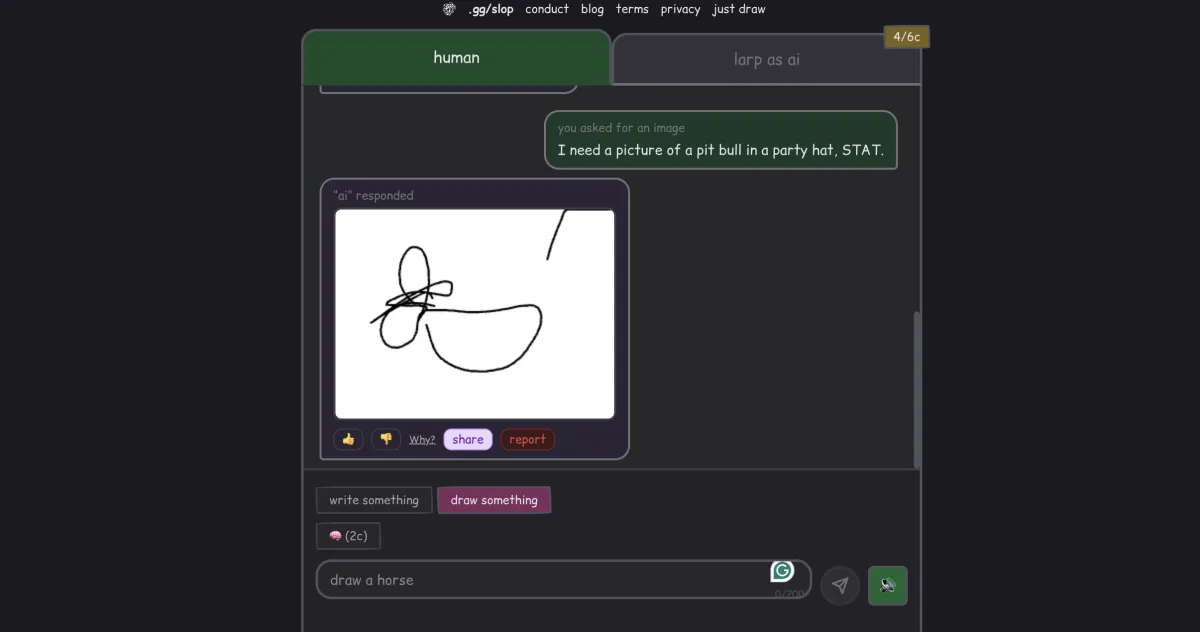
It also makes the layout clearer: the game is organized into two tabs, one for submitting a request and one for roleplaying as the AI. The source also again notes that the ads are especially heavy-handed.
Update — August 16, 2026 12:24 am
The updated source adds a new wrinkle: the site now lets players skip prompts they do not want to answer, rather than forcing them to take every request.
It also more clearly describes the interface as a two-tab setup, with one side for making a request and the other for roleplaying as the AI. The article’s note about the ad load being intrusive is also reinforced in the newer version.
A new web game called Your AI Slop Bores Me is turning the tables on artificial intelligence by asking people to play the part of a chatbot. Launched as a lighthearted response to AI fatigue, the site matters because it satirizes the same speed, polish and output quotas that define today’s generative AI systems.
The concept is simple: one person submits a prompt, another logs in as the “AI” and has a short window to respond, often with crude drawings or deliberately robotic text. The result is part parody, part improv exercise, and part commentary on how much modern AI output has come to resemble a game of speed, tone and performance.
What is Your AI Slop Bores Me?
Your AI Slop Bores Me is an interactive site that lets users request text or images from a human pretending to be a chatbot. Instead of a model generating the response, a person on the other side has to improvise an answer under strict time pressure, mimicking the quirks and limitations of an AI system.
The joke lands because the site borrows the logic of real chatbot tools while exposing how mechanical many of them can feel. Users can enter prompts, wait for a response, and then decide whether to jump into the “AI” role themselves and answer prompts for someone else.
How the game works
Participants can either make a request or act as the fake AI. A response can be text-based or visual, and the person playing the chatbot gets just 150 seconds to complete the task.
That time limit is central to the experience. It creates the same kind of rushed, incomplete output that sometimes frustrates AI users, but in this case it comes from a human juggling the challenge in real time. The result is less about accuracy and more about performance under constraint.
- Request side: Users submit a prompt or image request.
- AI side: Another person answers as if they were a chatbot.
- Time limit: The “AI” has 150 seconds to respond.
- Credits: Requests cost credits, which can be earned by answering prompts.
- Free access: One free request is available every two minutes.
Why does the site feel like a satire of real AI tools?
The site works as satire because it imitates the mechanics of generative AI while making the human labor visible. Real chatbots often appear effortless, but they are built on hidden layers of computation, product design and prompt engineering. This game flips that setup and makes the effort obvious.
By forcing players to respond quickly, the project highlights the tension between expectation and output. Many users ask for absurdly specific requests, including drawings of niche anime characters, and the challenge is to produce something that looks vaguely machine-made within the short deadline. That awkward mismatch is part of the comedy.
How the humor is built
The humor comes from limitation rather than sophistication. The site does not try to outdo commercial AI products with more realism or smarter answers. Instead, it leans into obvious roughness, wooden jokes and deliberately off-kilter results.
In that sense, the experience is a critique of the current AI content boom, especially the flood of low-quality, mass-produced output that many online users now dismiss as “slop.” The title itself signals that the joke is aimed at overproduction and automation fatigue.
The core gag is that the user thinks they are testing an AI, but the person on the other end is the one improvising the answer, turning the whole interaction into a live parody of chatbot culture.
Who is behind the experience?
The source material does not identify a corporate AI lab or a major platform. Instead, it points to a playful, community-driven internet project that appears designed more for entertainment than for product adoption. That matters because the project is not trying to sell a breakthrough model; it is poking fun at the social habits built around them.
The presence of a Discord server suggests an active community element, with players sharing their best responses and comparing attempts. A Hall of Fame further reinforces the idea that the site rewards creativity, timing and absurdity rather than technical accuracy.
What the Hall of Fame reveals
The Hall of Fame showcases standout submissions and underscores the game’s appeal as a performance space. One highlighted entry, a surprisingly strong interpretation of Van Gogh’s Starry Night, shows that some players can deliver impressive results even under a short deadline and minimal tooling.
That combination of constraint and surprise is a big part of why the site works. It turns low-stakes participation into a showcase for human improvisation, revealing how people can mimic the style and cadence of AI with nothing more than speed and judgment.
Why people are drawn to AI parody now
People are gravitating toward AI parody because many online users are tired of seeing the same generic outputs across apps, feeds and search results. As generative tools become more common, so does the sense that much of the content they produce is predictable, repetitive or impersonal.
Your AI Slop Bores Me taps into that mood by turning annoyance into a game. It lets people laugh at the formulaic side of chatbot culture while also participating in the same prompt-response dynamic that defines it.
What the site says about online culture
The project also reflects a broader internet trend: users increasingly enjoy media that reveals the machinery behind digital systems. By showing a person “pretending” to be an AI, the site exposes how much chatbot culture depends on the illusion of intelligence, responsiveness and confidence.
That illusion is easier to notice when the performance is intentionally clumsy. A human can imitate the style of a bot, but not without revealing how strange the format already is. The joke is not that AI is useless; it is that many of its habits are easy enough to parody in real time.
What users can expect when they play
Anyone opening the site should expect a chaotic, fast-moving experience. Some prompts may inspire clever responses, while others will be so obscure or visually demanding that the fake AI has little choice but to improvise. The pressure to maintain the illusion adds a layer of urgency that is both funny and mildly stressful.
The interface also includes ads that can feel intrusive, according to the source material, which slightly undercuts the playful tone. Even so, the site’s basic idea remains easy to grasp and quick to test.
| Feature | How it works | Why it matters |
|---|---|---|
| Two-sided play | Users can request an answer or act as the fake AI | Creates a human-to-human parody of chatbot interaction |
| 150-second timer | The “AI” must respond quickly | Forces improvisation and limits polish |
| Credit system | Requests cost credits, earned by answering prompts | Encourages participation on both sides |
| Free requests | One free request every two minutes | Makes the game accessible without immediate payment |
| Community features | Discord server and Hall of Fame | Turns a joke into a shared social experience |
How does this compare with actual AI chatbots?
It differs from actual AI chatbots in nearly every meaningful technical sense, yet it mimics their public-facing behavior closely enough to make the comparison funny. Real chatbot systems rely on training data, model inference and platform infrastructure. Here, the response is simply a person making a fast decision.
That contrast is what gives the game its edge. It suggests that some of the magic users associate with AI is really a matter of presentation, pacing and confidence. Remove those layers and the interaction can start to feel like a party game.
What the comparison reveals
The comparison reveals that chatbot design is as much about theater as it is about computation. When a response arrives quickly, with the right tone and formatting, many users interpret it as intelligence, even if the underlying output is shallow.
By recreating that format with a human in the loop, the project shows how little distance there sometimes is between automation and performance art. The line between machine-like and human-like becomes blurrier the moment the response is expected to be fast, polished and vaguely helpful.
A playful critique of “AI slop”
The phrase “AI slop” has become shorthand for the flood of generic, repetitive or low-effort content associated with generative tools. This site uses that language as both a joke and a critique, encouraging users to laugh at the aesthetic while also participating in it.
There is a deeper point underneath the humor. If a human can imitate a chatbot by giving bare-minimum responses in a tiny window of time, then some of the internet’s AI output may be less mysterious than it appears. The game turns that insight into entertainment.
What makes it different from anti-AI activism
This is not a protest site in the traditional sense. It does not call for bans, regulations or corporate accountability. Instead, it uses mockery, improvisation and community play to make the same point more lightly: a lot of AI content is funny because it is so easy to parody.
That makes the project accessible to people who may not follow AI policy or industry developments closely. Anyone who has ever seen a bland chatbot answer or an overproduced AI image can understand the joke immediately.
Timeline of the experience
The site’s appeal is built around a short, repeatable loop. Here is how a typical session unfolds.
| Step | Action | Result |
|---|---|---|
| 1 | User enters a prompt or image request | The system queues up a task |
| 2 | Another participant takes the AI role | A human begins improvising as a bot |
| 3 | The timer starts | There are 150 seconds to produce an answer |
| 4 | The response is submitted | The requester sees the fake AI’s output |
| 5 | Credits are earned or spent | Players rotate between requesting and answering |
What this says about the state of AI culture
The popularity of a project like this suggests that AI culture is no longer defined only by admiration or fear. It is also defined by exhaustion, irony and meme logic. People are increasingly comfortable treating AI as something to be mocked, not just celebrated or regulated.
That shift is important because it shows a more mature stage of public engagement. Early chatbot hype focused on novelty and capability. Now, as AI becomes ubiquitous, users are just as interested in its clichés, weaknesses and predictable formulas.
According to the source material, the best part of the experience is not the prompt itself but the chance to play the chatbot, work within absurd limitations and still try to keep the act believable.
Bottom line
Your AI Slop Bores Me is a small but pointed example of how internet users are processing the AI boom: through parody, participation and a little bit of organized nonsense. It does not replace serious analysis of generative AI, but it does capture the public mood around a technology that has become impossible to ignore.
By turning chatbot behavior into a human improv challenge, the site makes a simple argument in a funny way: sometimes the line between artificial intelligence and fast-talking performance is thinner than it looks.
Frequently asked questions
What is Your AI Slop Bores Me?
Your AI Slop Bores Me is a parody website that asks people to roleplay as an AI chatbot. Users submit prompts, while other participants answer as if they were a machine, usually under a short time limit.
How does the AI chatbot parody game work?
The AI chatbot parody game works by pairing a request side with a fake AI side. A human has 150 seconds to respond to a text or image prompt, and players can earn credits by taking turns answering other people’s requests.
Why are people interested in this kind of AI satire?
People are interested in this kind of AI satire because generative tools have become so common that their style is easy to recognize and mock. The game turns frustration with repetitive AI output into a social, humorous experience.
Is the site actually using artificial intelligence?
No, the site is not primarily using artificial intelligence for the response itself. The joke is that a human is impersonating the chatbot, which makes the interaction a live parody of AI behavior rather than a real model-generated exchange.
What makes the Hall of Fame important?
The Hall of Fame matters because it highlights the most impressive or entertaining human-made responses. It shows that the game rewards creativity and quick thinking, not just the ability to imitate a chatbot’s tone.